To plan a weekly date night, fix one recurring day and time, decide a spending cap, alternate who picks the plan, and draw each week from a rotating list of themes instead of deciding from scratch every time. The whole reset takes about twenty minutes and covers the next several weeks at once.
The reason this works where good intentions don’t is that most couples don’t fail at date night because they lack ideas. They fail because the decision never gets made, so the evening gets absorbed by chores, kids and work. A weekly rhythm takes the decision out of the week where it keeps getting lost.
Table of Contents→
- What You Need to Plan a Weekly Date Night
- Step-by-Step: How to Plan a Weekly Date Night
- Common Mistakes
- Frequently Asked Questions
- How often should couples plan a date night?
- What if we cannot afford a weekly date night?
- How do we keep weekly date nights from feeling repetitive?
- What should we do if one partner is more spontaneous than the other?
- Should weekly date nights include dinner, or can they be shorter?
- How do we choose a date night when we have different interests?
- Conclusion
What You Need to Plan a Weekly Date Night
Before you pick a single activity, gather five things. Without them, planning a weekly date night turns into a 45-minute negotiation every seven days, and that is exactly the friction that kills the habit.
- Two candidate time slots. One ideal, one backup. Couples who only ever have a preferred evening never plan anything in the week a work trip lands.
- A spending cap per date. A number, not a vibe. Decide it once and stop revisiting it each week.
- One shared calendar. A recurring event, not a reminder you dismiss. Relationship advice forums keep saying the same thing: if it isn’t a calendar block, it isn’t happening.
- A list with at least twelve ideas on it. Written down somewhere both of you can add to, so neither person has to be the idea engine.
- Your standing constraints. Transit and parking, mobility and accessibility needs, food allergies, shift schedules, and the hard limit on how late you can reasonably stay out.
Plan weekly, or biweekly if you’re both genuinely swamped. That framing matters because it takes the all-or-nothing pressure off before you start.
Step-by-Step: How to Plan a Weekly Date Night
This is a repeatable process. Run it once for the next four to six weeks, then rerun it as a fifteen-minute weekly reset. Each step ends with something you can check, so you know whether it worked instead of guessing.
Choose a recurring date night window
Pick the day and start time now and stop negotiating them later. Something like every other Friday from 7:30 to 9:30 works better than a vague “we should do something,” because a vague plan is the one most likely to be dropped.
Estimate the real total length, including transit and wind-down. A 20-minute drive each way turns a two-hour date into a three-and-a-half-hour commitment, and that mismatch is where weekly date nights quietly fail.
Name one backup option for genuinely busy weeks, and agree now that using it is not a failure. You will know the window is working if you are still doing it eight weeks from now without someone dreading the drive.
Set the budget and planning boundaries
Split your discretionary spending for the month into four date-sized portions, then cap each weekly date at one portion. If the month’s biggest outing is your one splurge, the weekly cap needs to sit clearly below it.
Separate the core cost from the optional upgrade. Dinner and getting there are core. A dessert stop, a nicer bottle, or an extra activity is the upgrade, and it is the first thing to drop when the week is tight.
Then decide which items need lead time. Reservations and event tickets may need weeks. A walk, a recipe, or a playlist needs nothing at all. Not knowing which is which is what makes planning feel heavier than it is.
Build a rotating weekly date night idea list
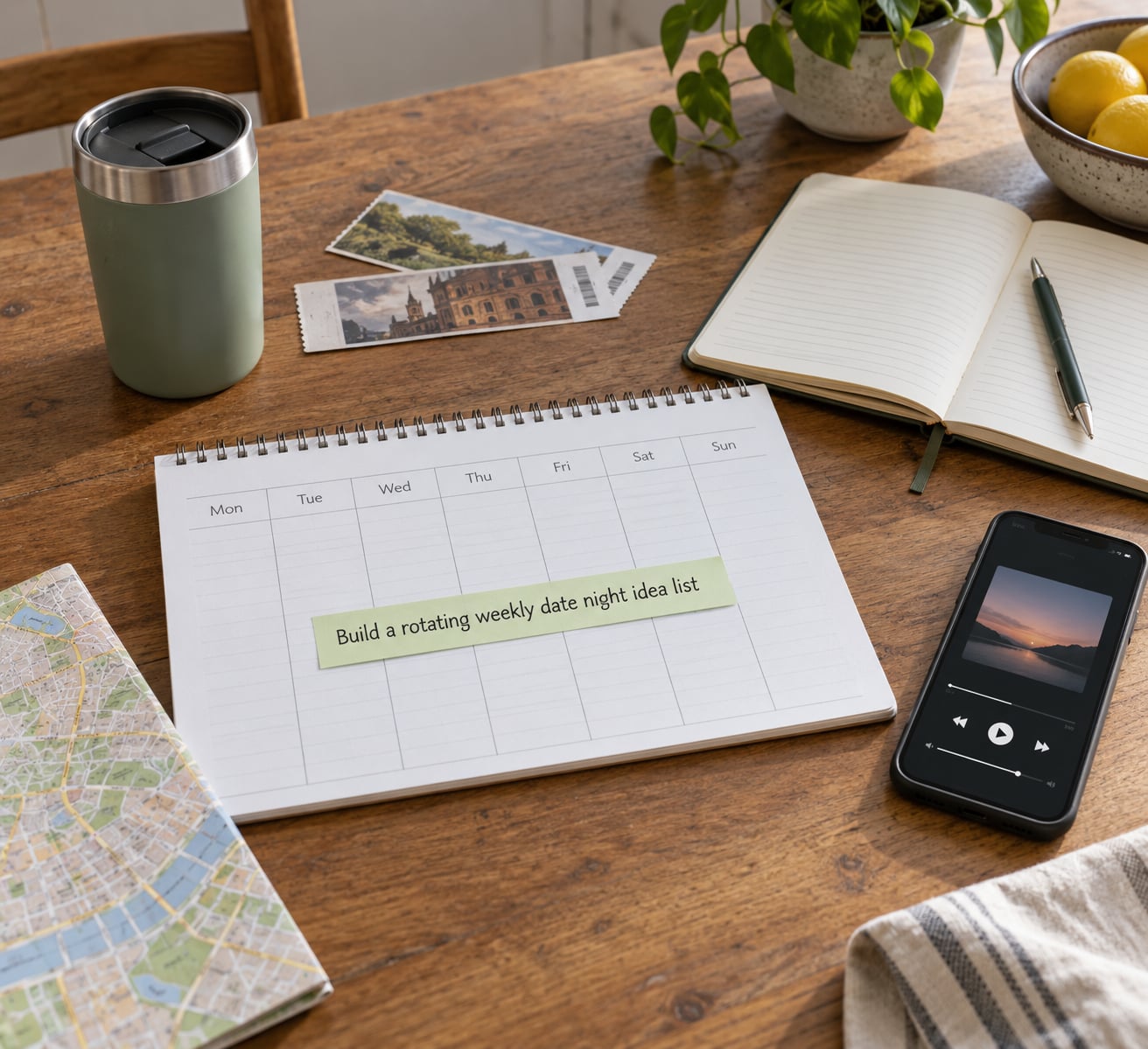
Write down at least twelve ideas and spread them across categories so the rotation never lands on the same type of night twice in a row: at-home, low-cost local, seasonal, active, creative, and relaxed.
For example: cook a new pasta recipe and eat it on the balcony, walk a part of your own town you have never walked, pick a date on the calendar and dress for whatever season it lands in, rent or borrow something neither of you has seen, visit a museum or a free gallery evening, or do absolutely nothing with the screens put in a drawer.
To keep the rotation from going stale, apply two rules. Each idea can appear once until the whole list is used, and a themed week counts as new even if you have done the activity before.
Give each week a simple theme
One theme does the coordinating for you. It sets the food, the music, the activity and the atmosphere, so the planning work is thirty seconds of decisions instead of a dozen separate ones.
A nostalgic movie night means a decade you met in, a playlist from that era, and snacks picked from memory rather than from an ingredient list. A neighborhood discovery night means one walk, three places you have never been inside, and one stop for something to eat. A dessert walk night means a two-mile route and three separate stops, nothing more.
The theme has to stay cheap in effort. If a theme needs a shopping list, a DIY project and a reservation, you built a project, not a date night.
Match activities to energy, interests, and the budget
Decide three things before choosing: how much energy each of you has, how far you are willing to travel, and how much of the cap is left after the core cost. That narrows the list fast.
Then use the shared-anchor-plus-add-on method when interests differ. Eat together, then each do your own thing for an hour, then meet back for dessert. One partner who wants a museum and one who wants to wander a market can both have a good evening, and neither one spends the whole night waiting.
Match the energy level to the day, not to the ideal. A Thursday after a long week wants the low-energy slot, and putting a five-hour plan there is how couples end up cancelling on purpose.
Make the necessary reservations and confirm the plan
Book anything with limited seating or a fixed start time, and do it when the window opens rather than the week of. Check the transit schedule both ways, not just outbound, since the return trip is what strands people.
Attach one weather alternative to any outdoor plan, and make it a real plan rather than a shrug. Tell the restaurant about allergies when you book. If either of you has mobility needs, confirm access before you commit.
Send one shared reminder, not three separate ones. Then ask the question out loud: does this work for both of us? A yes from one person and a shrug from the other is how dates get quietly abandoned mid-week.
Review the date and refresh the rotation
Give yourself two minutes afterward. Each of you names one thing that worked and one thing you would change, and you note which format goes back on the list.
Change exactly one variable next week. A different day, a different pace, or a different budget, but not all three, or the change becomes noise. That two-minute habit is the difference between a date night routine and a series of unrelated evenings.
Common Mistakes
Overplanning the evening. A three-item itinerary takes the spontaneity out and adds a half hour of logistics. Fix: one anchor, one add-on, done. Tip: write the plan on one line so you can see at a glance whether it is too much.
Planning only around one partner. If every date reflects one person’s taste, the other person stops feeling like a participant. Fix: the shared-anchor method, and alternating who chooses the anchor. Tip: if one person never suggests anything, ask them once a month for their own night rather than folding it into someone else’s.
Letting the budget float. Without a cap, the cost creeps and couples start feeling wasteful, which quietly kills the habit. Fix: split the month into four date-sized portions and cap each one. Tip: keep two of four weeks at zero spend on purpose.
Depending on good weather. Outdoor plans that collapse are the most common cancellation reason, and a cancelled date can read as rejection rather than bad luck. Fix: every outdoor plan gets a named indoor backup. Tip: pick indoor-first in the months where weather is unreliable.
Treating the date like an errand. Doing chores, emails or homework on the couch during the evening turns quality time into shared admin. Fix: devices in another room, and no household tasks. Tip: set one device-free rule and let the rest go.
Repeating one good idea. The same venue in a row is not a routine, it is a habit of convenience. Fix: the twelve-item rotation with one-use rules. Tip: mark a used idea rather than deleting it, so the list stays useful as a reference.
Frequently Asked Questions
How often should couples plan a date night?
Weekly is the sweet spot for most couples, and biweekly is a respectable fallback when schedules are genuinely full. What matters is that the slot is protected in advance instead of negotiated every week. A consistent block is what keeps date night from turning into a special occasion that only happens when something big comes up.
What if we cannot afford a weekly date night?
A weekly date night does not have to cost anything. Home-cooked dinner, a long walk, a board game or a playlist you made together are all real dates. If money is tight, decide up front that two of every four weeks are no-spend nights and put what you save toward one bigger outing that month.
How do we keep weekly date nights from feeling repetitive?
Rotate a list instead of repeating one strong idea. Keep twelve or more entries and mix at-home nights with local outings, seasonal and active options, and quiet low-energy evenings. One theme per week changes the feel of a familiar activity, and a five-minute check-in after each date tells you what to bring back and what to retire.
What should we do if one partner is more spontaneous than the other?
Use a two-layer structure. Fix the day, time and budget once, then leave the specific activity open inside the week’s theme. The spontaneous partner picks within that theme while the planner keeps the logistics. Alternating who chooses the activity each week keeps the planning load from landing on one person forever.
Should weekly date nights include dinner, or can they be shorter?
Shorter works better most weeks. A recurring block of one to two hours is easy to protect and hard to cancel, while a three-hour dinner reservation needs an entire evening free. If dining out matters to both of you, keep it for one longer date a month and let the other weekly dates run around a shared activity.
How do we choose a date night when we have different interests?
Do not pick one activity that tries to please both of you. Build the week from a shared anchor plus one personal add-on: eat together, each do your own thing for an hour, then meet back for dessert. Alternating who chooses the anchor balances preferences over time instead of one partner always deferring.
Conclusion
To plan a weekly date night that survives real life, keep the system small: a fixed window, a spending cap, an alternating planner, a twelve-item rotation, one theme a week, and a two-minute debrief. Every part of it exists to remove a decision from the week you are actually living.
Do three things before your next planning session. Pick the recurring day and time, agree the cap, and add three varied dates to a shared list so the first week is already solved. Couples who know how to plan a weekly date night stop treating it as an event and start treating it as part of the week, which is exactly where it belongs.