
The questions to ask before moving in together fall into a handful of areas: why you are doing it, money, chores, personal space, boundaries with other people, habits, and what happens if the relationship ends. Talk through all of them before you sign a lease, not the week of the move.
Couples who skip this step usually don’t skip it because they are careless. They skip it because nobody knows how to start, and the first conversation turns into a fight about commitment instead of about dishes. So below is a working list, plus a short section on how to actually ask.
Table of Contents→
- Questions to Ask Before Moving In Together at a Glance
- 1. Are We Moving In for the Right Reasons?
- 2. What Does Success Look Like in Our Shared Home?
- 3. How Will We Divide Rent, Utilities, and Other Costs?
- 4. Who Will Pay for Deposits, Furniture, and Moving Expenses?
- 5. How Will We Handle Chores and Household Responsibilities?
- 6. What Are Our Boundaries for Guests, Personal Space, and Privacy?
- 7. How Do We Resolve Disagreements at Home?
- 8. How Will We Handle Work, School, and Uneven Schedules?
- 9. What Are Our Rules About Alcohol, Smoking, and Other Habits?
- 10. What Will We Do If One of Us Loses a Job or Needs Financial Help?
- 11. What Are Our Expectations About Intimacy and Relationship Changes?
- 12. What Are Our Expectations About Family, Friends, and Visitors?
- 13. What Are Our Shared Expectations About Cleaning, Comfort, and Lifestyle?
- 14. What Happens if One of Us Wants to Leave or Needs Space?
- 15. Are We Still Committed to the Same Future?
- Frequently Asked Questions
- How soon is too soon to move in together?
- How long should you wait before moving in together?
- What are the common problems associated with moving in together?
- What percentage of relationships fail after moving in together?
- At what age do most couples move in together?
- How do you split bills when living together but not married?
- Conclusion
Questions to Ask Before Moving In Together at a Glance

Here is the short version. Use the table as a checklist to bring to the conversation, and treat the third column as the part people skip and regret skipping.
| The question | What it covers | Why settle it before signing |
|---|---|---|
| Why are we doing this? | Commitment vs convenience | You cannot undo a lease the way you can undo a bad date |
| What does a good week here look like? | Daily life, not romance | Romance hides the routine; routine is what you actually live in |
| How do we split rent and utilities? | Money | Resentment over money is the fastest way to a cold house |
| Who pays the deposit and the furniture? | One-time costs | Upfront bills are where income differences show up most |
| Who does what around here? | Chores and invisible labor | Unassigned chores are silently assigned to one person |
| How much alone time do we each need? | Space and privacy | Losing solitude is a top reason people feel lonely while living together |
| How do we argue and how do we fix it? | Conflict repair | You will argue. What matters is whether you come back from it |
| What do our schedules look like? | Work, school, commuting | Mismatched hours can feel like two people sharing one home badly |
| What are the house rules on habits? | Smoking, drinking, parties | It is much cheaper to negotiate now than to change a habit later |
| What happens if one income stops? | Support and limits | Financial emergencies should not be improvised during one |
| What do we expect physically and romantically? | Intimacy, privacy, consent | Expectations get clearer when they are said out loud |
| What is the deal with family and friends? | Visitors, input, loyalty | Boundary problems with relatives usually trace back to an unspoken rule |
| What kind of home do we want to live in? | Cleanliness, noise, pets, temperature | Tidiness is a values difference, not a personality flaw |
| What is our plan if this ends? | Exit logistics | The lease is joint even when the relationship is not |
| Are we still heading the same direction? | Marriage, children, location, careers | A shared address can outpace a shared plan |
1. Are We Moving In for the Right Reasons?
Ask this first, because the answer changes how you read every other answer. Two people can both want to live together and mean completely different things by it.
In one version, this is a step toward a longer future. In another, it is a way to save money, end an argument, or avoid a harder conversation. Neither is shameful, but a shared home built on the second version tends to collapse under the weight of the first version’s expectations.
Try asking it plainly: “Where do you see this going, and when?” If one of you is waiting for the other to name a timeline, say that out loud too. Couples on forums describe this exact mismatch as the single most common cause of pre-move arguments: one person reads the move as an implied proposal, the other reads it as a convenience upgrade.
A useful follow-up: would you still choose this if the money worked out evenly? If the answer is only yes when you are behind on rent, that is information worth having now.
2. What Does Success Look Like in Our Shared Home?
Get each of you to describe an ordinary Tuesday in six months. Not a holiday, not a hypothetical perfect weekend. A Tuesday.
Ask where you will be during the day, what the kitchen looks like at 6pm, whether you want dinner together most nights or separately, and what a lazy Sunday should feel like. The answers reveal far more than a conversation about goals does, because everyone has a picture of daily life and nobody says it out loud until they are living in it.
Two people can want the same home and still want different homes. One wants a quiet place to read after dinner. The other wants the couch, the speakers and a friend over. Neither is wrong. They just cannot both be true in a one-bedroom apartment.
Write down the answers in your own words and swap them. Disagreement here is useful information, not a failure.
3. How Will We Divide Rent, Utilities, and Other Costs?
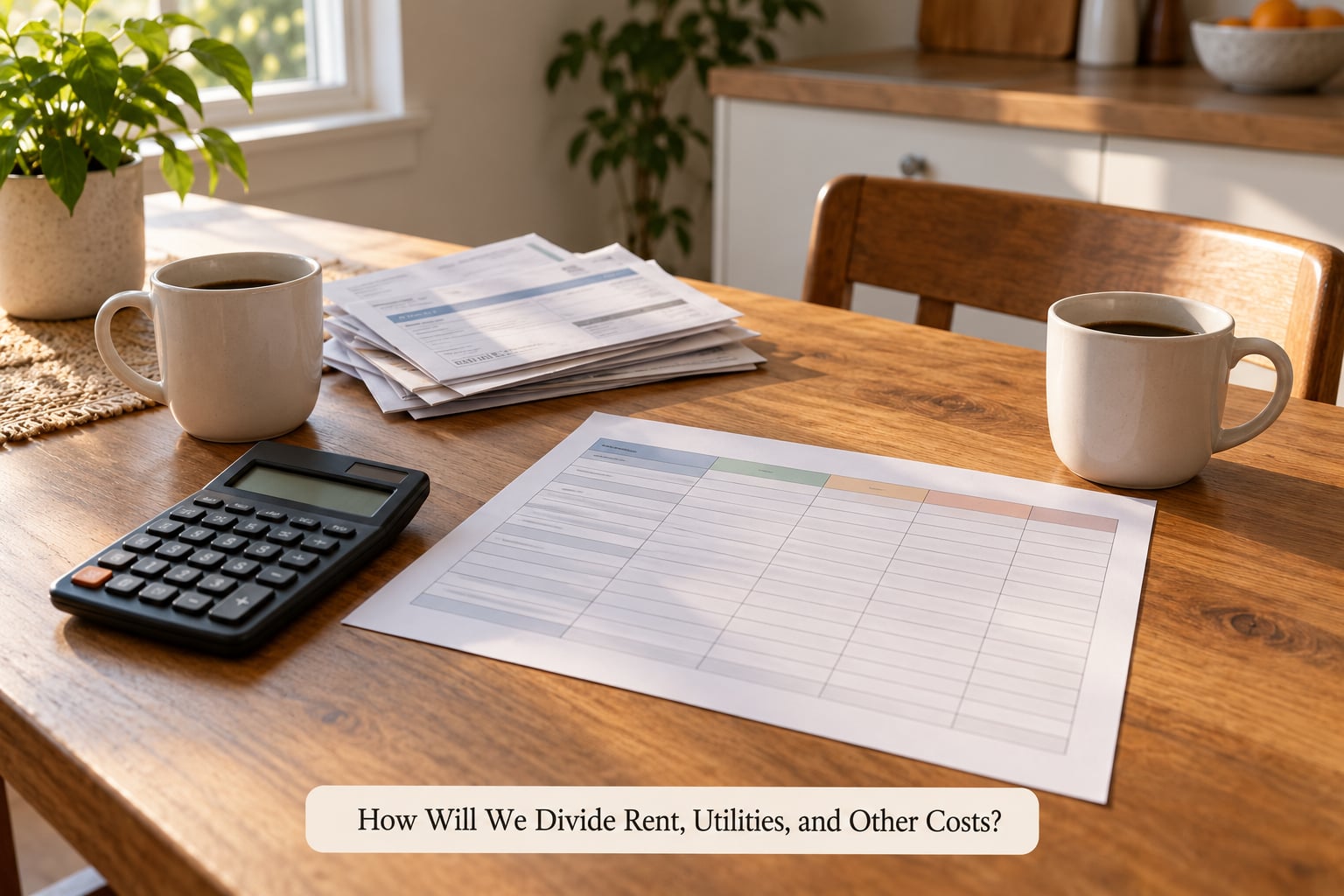
Settle the split on a number you can both say out loud without flinching. Three approaches come up most often, and each suits a different couple.
- Split by income. Each of you pays a percentage of their take-home pay to a fixed total, often 50/50 when incomes are close and a larger ratio when they are not. This is the fairest method for long stretches and the one most couples land on eventually.
- Split evenly. Simpler, and easier to track. It only feels fair when incomes are genuinely close.
- Keep separate accounts, share a joint one. Everyday spending stays personal; rent, utilities and shared subscriptions come out of the joint account. Couples on forums report that this structure reduces arguments in the first year more than any other single change.
Then list what counts as shared: rent, utilities, internet, streaming, groceries or not, the phone plan, renter’s insurance, pet costs, and the recurring subscriptions nobody remembers signing up for. A five-minute audit now beats a three-month argument about a charge you cannot find.
Decide who pays when a bill is late, and what happens to a shared expense one of you cannot afford this month. Specific beats generous here.
The money questions to ask before moving in together again
Watch for vagueness dressed up as flexibility. “We’ll figure out bills later” and “it doesn’t matter, do what feels right” sound generous in the moment and turn into resentment within weeks. A partner who cannot name a number is not being easygoing; they are avoiding a conversation they expect to lose.
4. Who Will Pay for Deposits, Furniture, and Moving Expenses?
The move-in has a pile of one-time costs that never show up in a monthly budget: security deposit, first month’s rent, a truck, a mover, cleaning supplies, curtains, a couch, tools, internet installation.
Agree on the split and on whether anyone is buying furniture for the household rather than for themselves. If one of you pays for the bed, the table and the rug, you are now living in an apartment that partly belongs to them, and you should name that out loud before the boxes arrive.
A practical piece of timing advice: start this conversation three to four months before the current lease ends, not the week before. Landlords price the gap, movers book up, and a couple that has to rush usually takes the first apartment they see.
Also decide whose name goes on the lease, and whether you are starting month-to-month with an overlap so either of you can back out without losing housing. Overlapping leases cost extra for a month and buy you an exit you will be glad to have.
5. How Will We Handle Chores and Household Responsibilities?
Assign chores before you move, then adjust monthly. The reason to assign is simple: unassigned chores get done by whoever is home, which is almost never a fifty-fifty split.
Cover the boring ones people skip: dishes, laundry, taking out trash, vacuuming, bathrooms, groceries, cooking, and maintenance tasks like changing filters or dealing with the smoke detector. Then cover the invisible ones, which cause the most arguments because they are never named: noticing the dishwasher is full, remembering someone’s birthday, keeping track of shared appointments.
Decide how the split works. By preference is simplest when you genuinely differ. By time works if one of you has a longer commute. By fairness works when you both want equal load even if the chores are not equally pleasant.
Some couples use a chore chart or a rotating list on the fridge. Others use an app. Either works better than the arrangement where one person “handles the kitchen” and never says what handling it means.
6. What Are Our Boundaries for Guests, Personal Space, and Privacy?
Ask how many nights a week you want the place to yourself, and how much notice you need before a friend comes over. Then ask the harder version: what does alone time look like when you live together?
Say out loud that alone time is not a comment on the relationship. A partner who needs three evenings a week to be alone and a partner who wants to be together every evening can both be sincere, but they cannot both be satisfied in a small space.
Cover overnight visitors, family stays, and how long guests can stay. Cover which rooms are shared and which are off-limits, and what a closed door means in practice. Also worth asking: is it okay to have a friend or family member on the phone in the bedroom, and is it okay to take a call in the other room when the other person is trying to sleep.
One more: how do you ask for a room to yourself without it sounding like a rejection? Agreeing on a phrase or a signal in advance makes the request easier for both of you.
7. How Do We Resolve Disagreements at Home?
Every household disagrees. What matters is whether you have a process, because a shared home produces small frictions daily and none of them get resolved by hoping.
Agree on a few things: we do not raise this issue while someone is driving, working or half asleep; we say the thing once and then stop pushing; we come back to it within a set time, like the next morning or the next weekly check-in; and neither of us is allowed to bring up an unrelated old thing as ammunition.
It also helps to separate agreement from compromise. Chore splits can be a straight division of labor. Apartment layout, pets, money down on a purchase those are the ones that need a real agreement, where both of you are actually okay with the outcome.
Know the signs that a conversation has stopped working: the same argument three nights running, one of you stonewalling, or a topic that reliably turns insulting. Couples counseling is not a punishment or a last resort before the relationship ends. It is simply faster than three months of the same loop.
8. How Will We Handle Work, School, and Uneven Schedules?
Compare a normal week before you compare anything else. One of you may start at 6am while the other works from home until 6pm, and someone will be eating dinner alone most nights.
Ask about commuting, remote work setups, study hours if either of you is in school, travel that repeats weekly, and who handles the house on days one of you works late. Then talk about the asymmetry that causes the most friction: one partner doing more of the mental load because they notice more of it.
Also agree on the shared calendar. Two people managing separate calendars in one apartment is a scheduling mess that feels like unfairness even when the work is equal.
If one of you plans to relocate for work later, put that on the table now rather than in two years.
9. What Are Our Rules About Alcohol, Smoking, and Other Habits?
Ask plainly about cigarettes, vaping, alcohol, recreational drugs, medication, supplements, and how often you drink socially. People share these habits at different speeds, and finding out after you are unpacked is worse than finding out now.
Beyond the substance itself, talk about the behavior around it. Does one of you drink on weeknights? Do you want parties with alcohol, or alcohol-free gatherings? Do you smoke on the balcony, or is the apartment smoke-free including outside the door?
Ask about health habits that affect a shared space: sleep schedule, naps, working out at home, and how you handle a hangover when the other person needs the shower at 7am.
Also worth raising: anything you want help with. Quitting something is much easier when the person you live with knows it matters and is not waiting for you to fail quietly.
10. What Will We Do If One of Us Loses a Job or Needs Financial Help?
Agree in advance what support looks like, so a crisis does not turn into a test of loyalty.
Talk about how much help is comfortable, how long it would last, and where the boundary sits. Some couples are comfortable with a few months of covering expenses. Others cannot carry even one month. Both positions are fine; neither is negotiable after the first missed paycheck.
Decide together what you would do: cut spending to a bare minimum, pause savings contributions, take on temporary work, ask family for help, or sell something. A plan agreed in advance gets followed. A plan improvised during a layoff turns into blame.
Then talk about the other direction, because money support can go both ways and it changes a relationship. If one partner contributes more for a long stretch, does the other owe it back, or is it a gift? Saying that out loud protects the person who gave.
Ask what financial information you share: income, debt, credit score, spending, subscriptions. Full disclosure before cohabitation is not distrust. It is how you avoid finding out at the worst time.
11. What Are Our Expectations About Intimacy and Relationship Changes?
Ask about sex, affection, contraception, privacy and consent, including what has changed for each of you and what you are unsure about.
Physical closeness often changes with a shared home. There is less privacy, more spontaneous contact, and more exhaustion at the end of the day. None of that has to be a problem, but assuming it will go one way tends to go badly.
Two questions worth asking: what do you need to feel comfortable, and what happens if one of us is not in the mood and the other is? Agreeing on how to handle a no keeps it small.
Also discuss the practical: who locks the door, do you want a bedroom door that always closes, and what are the rules about being intimate when family or a roommate-adjacent guest is in the home.
Finally, ask what happens if your needs genuinely do not match. Some couples solve it through conversation, some through therapy, and some by deciding that a mismatch is manageable. All three are workable answers. Silence is not.
12. What Are Our Expectations About Family, Friends, and Visitors?
Ask who has a key, who can come over without advance notice, and how long a family member can stay.
Some couples want a very open door and a house that is always hosting. Others need advance notice for anything past takeout. Both are fine, but the surprise is the problem, and surprise visits are a leading source of relationship friction with in-laws.
Then handle the harder part: input. Does either family get a say in where you live, whether you buy, whether you have children, whether you marry? If one of you is not fully out to family, say so and talk about what you are each comfortable with and what legal exposure you are taking on. Couples in same-sex relationships often need a specific conversation here rather than a general one.
Ask how you will handle it when a friend’s position conflicts with your partner’s, and agree that the two of you settle disagreements about other people between yourselves rather than recruiting allies.
13. What Are Our Shared Expectations About Cleaning, Comfort, and Lifestyle?
Compare preferences on cleanliness, noise, temperature, light, decorating, storage, meals and pets. People are often surprised by how different their standards are, and neither side is the reasonable one.
Use examples rather than adjectives. “Clean” means nothing until you agree that dishes are done the night they are used, that counters get wiped, and that the shared bathroom is wiped on Sundays. Two people with genuinely different standards can make a shared home work, but only once the standard is written down rather than assumed.
Talk about noise and quiet directly. One partner may need silence for focus or rest; the other may want music, a game on, or conversation until late. In a small apartment these collide constantly, so decide where noise is fine and where it is not.
Decide about pets too: whether you are getting one, whose existing pets are moving in, and who handles daily care and costs. That last one is the question that reveals a lot about how you will handle shared responsibility.
Ask about decorating, too. Whose furniture stays, whose wins a disagreement about a wall color, and how you handle storage if one of you hoards and the other minimalizes. These are small fights that get old fast.
14. What Happens if One of Us Wants to Leave or Needs Space?
Agree on the practical unwind before you need it. Couples on relationship forums describe the lease, the deposit and the furniture as the worst part of an ending, and almost all of it is preventable with a conversation now.
Cover: who stays in the apartment, what notice is reasonable, how the deposit gets handled, who takes which furniture, how the remaining bills get split, and how you will talk to friends and family so nobody hears the news from a third party.
Also cover the emotional side. Is there a trial separation, and what does it look like? Do you want counseling during a rough patch, and would you go? How do you handle a relationship that needs space without the space turning into a slow ending?
Finally, ask what happens if you buy a home together rather than renting. Shared equity changes the stakes of a breakup a great deal, and it is worth knowing what each of you would want to happen to the property before anyone signs anything.
15. Are We Still Committed to the Same Future?
Recheck the big plans now that they have a cost. Moving in is often the first shared financial commitment, and it tends to accelerate every other conversation.
Ask about marriage and whether either of you is waiting for the move to signal something. Ask about children, and about timing. Ask about where you live long-term, including whether either of you might want to relocate for work or family. Ask about the careers, the countries, the kind of household you both see in five years.
Disagreement here is not fatal. Unspoken disagreement is. Plenty of couples have different answers and build a workable life anyway, because they said it out loud and chose deliberately. A few have the same answer and still fall apart, because one was quietly hoping the move would change the other’s mind.
If you want one honest question to end the first conversation with, use this: “If we do this and it works, where do we go from there?”
Frequently Asked Questions
How soon is too soon to move in together?
There is no number that makes it right or wrong. Six months of dating is thin if you have never seen each other handle a bad week, and two years is thin if the conversations keep turning into fights. Length of relationship matters less than whether you have seen each other sick, broke, tired and irritated. Couples who rush tend to treat the move as proof of commitment rather than as a practical decision.
How long should you wait before moving in together?
Wait until you have been together long enough to have seen each other at low energy, not only at your best. If your lease renews soon, you do not have to rush the move to match the renewal date. People who take the extra few months to test things usually report fewer surprises, and the practical cost of waiting is small compared with the cost of an unwanted split lease.
What are the common problems associated with moving in together?
The recurring issues are money disagreements, an uneven share of chores and invisible household labor, losing alone time, mismatched sleep and noise habits, and the shift from a relationship into a running household. Family visits and guest boundaries come up too. None of these are catastrophic on their own; they become corrosive when they are assumed rather than discussed before the move.
What percentage of relationships fail after moving in together?
There is no reliable single percentage, and anyone who gives you one is guessing or selling something. Breakups after cohabitation happen for ordinary reasons: incompatible money habits, resentful unpaid labor, different plans for the future, or simply a relationship that had already run its course. What the research does support is that conflicts about money and household labor are among the most common reasons couples break up.
At what age do most couples move in together?
Most couples who cohabitate do so in their twenties and early thirties, and the average age has drifted upward over the decades as marriage and home ownership happen later. The age itself matters less than the life stage: people moving in during a first career job or a first lease often have very different expectations from people who are combining households with children already.
How do you split bills when living together but not married?
Most couples start with a written list of what counts as shared, then split those costs by income percentage or evenly, depending on how close your earnings are. Everyday spending often stays in separate accounts, with rent, utilities and subscriptions coming from a joint account. Being unmarried does not change the need for a written agreement about deposits, utilities in your name and what happens to shared purchases if you separate.
Conclusion
Start with question one, question three and question fourteen. Those three decide whether the move is a choice you both made or a problem you are both managing, and they are the ones people most often skip.
Pick a calm evening, away from the week, and set aside a couple of hours. Take turns answering, write down what you agree on, and keep the answers somewhere you will both find again in six months. A questions list for moving in together is not a pass-fail test. It is the cheapest insurance available against the small resentments that quietly end more shared homes than big fights do.