There is no fixed number. Most healthy long distance couples have some form of contact most days, plus at least one real voice or video conversation each week. Consistency matters more than the count, and the rhythm that works is the one both of you can keep without feeling anxious or wiped out.
Both positions are legitimate. Some people feel loved through a daily call, and others need evenings to themselves after a twelve-hour shift, and neither preference is a character flaw.
Here is the short version:
- Think in touchpoints per day and real conversations per week, not hours on the phone.
- A 25-minute call where both people are actually present beats three hours of distracted texting.
- Asynchronous contact counts. A voice note sent at 6am on your break is contact, and a busy week is not a breakup.
- Never pick a number from the internet. Negotiate one with the person who has to live in it.
- Review the plan every few weeks. Rhythms need editing.
Written and reviewed by the Mapathy editorial team. This is general relationship information, not therapy, and not a substitute for it.
Table of Contents→
- How Often Should Long Distance Couples Talk?
- What Communication Rhythm Works for Most Couples?
- How Do You Build a Schedule That Both Partners Want?
- How Often Should Long Distance Couples Talk When Schedules Are Busy?
- How Often Should Long Distance Couples Talk After a Disagreement?
- How Often Should Long Distance Couples Talk If One Partner Wants More?
- How Do You Keep Regular Conversations From Feeling Forced?
- What Signs Suggest the Schedule Is Not Working?
- Frequently Asked Questions
- Is it normal for long distance couples to not talk every day?
- How often should I text my long-distance partner?
- How often should long distance couples video call?
- How do you handle a 12 hour time zone difference?
- What do I do when my partner keeps missing our call times?
- Are the 72 hour rule or the 7 7 7 rule real?
- Conclusion
How Often Should Long Distance Couples Talk?
The honest answer is that there is no universal number, and any article that gives you one is selling you something.
A touchpoint is any single instance of contact: a text, a voice note, a phone call, a video call. When people ask how often long distance couples should talk, they usually mean touchpoints per day, and the ranges real couples report cluster somewhere between three and ten a day, with one or two substantial conversations a week layered on top.
Forum threads on r/LongDistance and the Loving From A Distance boards are consistent on this. One long-running thread has couples describing anything from a 30-minute call most days to two-hour calls every other day, with texting filling the gaps. A Zhihu answer describes a couple who talked by phone once a week, or even once every two weeks, and made it work by meeting in person every month or two.
So the spread is enormous, which is the point. What the forum data does not show is a single number, because none exists. What it does show is that couples who report feeling close tend to have one thing in common: the contact happens on a predictable pattern rather than whenever someone gets around to it.
Why frequency on its own is not the variable
One Reddit user described calling every two days for about an hour and still feeling like their partner was hard to reach. Same frequency, same duration, wrong feeling. The gap was in warmth and responsiveness, not volume.
John Gottman writes that trust is built in very small moments, and that idea is the whole ballgame at distance. Twenty unanswered hours then a distracted five-minute call reads as withdrawal, even though the pair spoke yesterday. Sidney Jourard’s work on self-disclosure points the same way: intimacy grows when people share real material, not weather reports and calendar logistics.
There is some actual research here. Holtzman and colleagues (2021), published in PMC8669216, found that more frequent and responsive texting predicted significantly higher relationship quality among long-distance dating partners. Note the second word. Responsive, not just frequent.
Is it normal to not talk every day?
Yes. Plenty of healthy long distance relationships have quiet days, particularly when one partner is on a shift, in class, in a season of overwork, or recovering from illness. What does not work is a quiet day that neither person mentions.
The difference is signal. Silence with a heads up reads as a full life. Silence with no signal reads as loss of interest, and your partner will fill that blank with the worst available explanation.
What Communication Rhythm Works for Most Couples?
Most couples land on a mix of the four patterns below, with the mix weighted differently depending on time zone gap and how long the relationship has been running.
| Contact type | What it is for | Typical frequency | What it looks like when it works |
|---|---|---|---|
| Quick check-in by text | Day-to-day presence and logistics | 2 to 6 a day | A few lines about the actual day you just had |
| Voice note | Presence with tone and personality, on your own schedule | 1 to 3 a day | 30 to 90 seconds, unedited, sent from a work break |
| Voice call | Emotional intimacy and repair | 2 to 4 a week | 20 to 45 minutes, both actually on the sofa |
| Video call | Closeness, reassurance, seeing a face | 1 to 2 a week | One planned video date rather than three accidental ones |
| Shared online date | Doing something together, not just talking | Weekly | Same recipe, watch-together app, shared playlist in sync |
| Sleeping on the phone together | Quiet companionship | When it suits you both | Optional and never a requirement |
The best schedule is the one both partners can sustain without it feeling like an obligation or a test. If one person is dreading the 9pm call every night, the schedule is wrong even if they show up.
Duration beats frequency, most of the time
Twenty-five focused minutes will get you further than an hour of half-present scrolling. Depth is what makes a conversation memorable, and depth needs a floor under it. Below about fifteen minutes, calls tend to stay on the surface unless there is already high trust.
Business Insider guidance that circulates in these forums lands in a similar place: a call or video chat roughly weekly, with most of the day-to-day carried by text. That is a floor, not a goal.
How Do You Build a Schedule That Both Partners Want?
You do it in four steps, and step four is the one people skip.
Compare actual availability, not theoretical availability. Open both calendars for the next two weeks. Write down the real windows, including shift patterns, commute time and the hour after your kids go to sleep. Abstract promises do not survive contact with a real week.
Name what you actually need. One person needs to feel included in the other’s day. The other needs a long undemanding stretch most nights and one real conversation. Different needs, not different amounts of love.
Separate required contact from optional contact. Put the agreed minimums in writing: a nightly 20-minute call, two video dates a week, a morning text. Everything else is bonus, not debt.
Run a four-week trial and then review it. A rhythm you picked on a good day in month one can stop fitting by month three. A scheduled review makes the change normal rather than an accusation.
A worked example with a six-hour gap
Say one partner is in Denver and the other in Boston, with a partner in grad school and the other on early shifts.
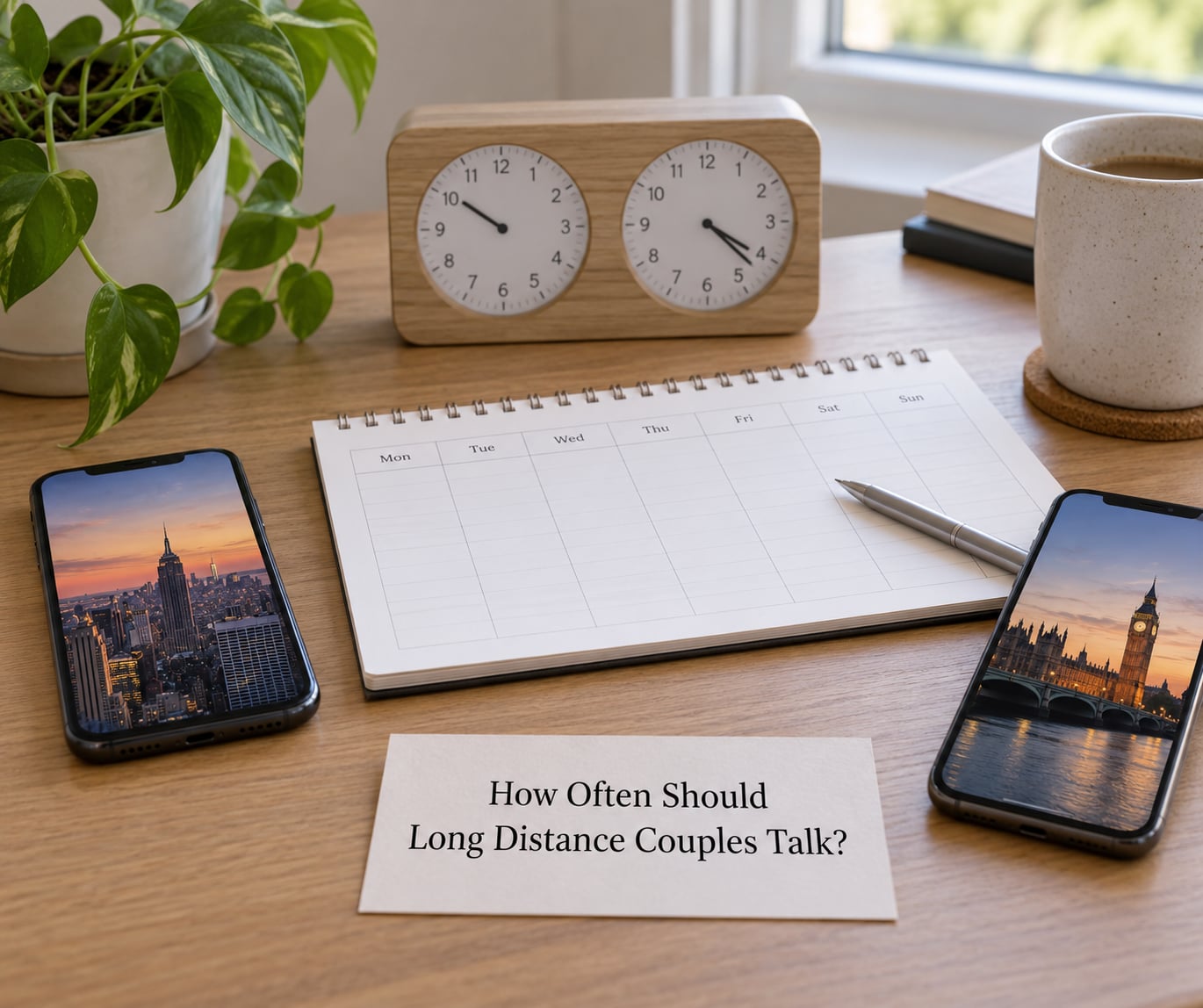
They anchor to a fixed daily window, 9pm Denver time, which is midnight in Boston, and they alternate. Nights that Boston sleeps early, Denver takes the shift and sends a 10pm voice note instead of expecting a reply. Weekends alternate which person absorbs the loss of sleep, so the sacrifice moves rather than sitting permanently on one person. Video dates land Saturday afternoons, when the time difference is least punishing. Everything else is texts and shared photos.
How Often Should Long Distance Couples Talk When Schedules Are Busy?
During busy weeks, shorten the contact and keep the promise. Three short dependable touchpoints beat one heroic Saturday call.
Work, grad school, caregiving, shift work and on-call rotations all compress the same way: something has to give, and contact is usually the thing that gets dropped silently. The fix is to protect the minimum and lower the ambition.
Async does a lot of the heavy lifting here. Voice notes, a shared photo album, and a running thread about the day let someone participate without being available. Two or three longer conversations a week, protected in advance, do more for closeness than daily contact that dissolves the first time someone is tired.
Say the duration out loud. A partner who knows you are aiming for fifteen minutes does not experience it as being cut off, and a partner who can do fifteen minutes does not have to decline.
How Often Should Long Distance Couples Talk After a Disagreement?
Talk more often after an argument, but only once both of you are calm enough to be useful.
Contact frequency going up right after a fight is not automatically good. Two people escalating at 11pm across six hundred miles will say things they cannot take back, and distance makes repair harder because you cannot reach across and touch a shoulder.
What works instead:
- Name the break out loud. Say you need a few hours or a night, and say when you will be back.
- Book the repair conversation before the fight cools, so it does not slide.
- Start with what you heard rather than what is wrong.
- End with something specific: a change, a question, a plan. Repair without a next step tends to reopen.
If someone needs longer than a night, that is information worth taking seriously rather than a negotiation to win.
How Often Should Long Distance Couples Talk If One Partner Wants More?
Work out which of three needs is driving the request, because each one needs a different response.
Reassurance. The worry is that you are being thought about less. This responds to predictability more than to volume. A fixed schedule you actually keep settles this faster than an extra twenty minutes.
Depth. The frequency is fine but the content is not. Ask for a call with no agenda and a rule against logistics for the first ten minutes.
Consistency. Not one big weekly call, but steady low-grade presence. Add two or three brief daily touchpoints rather than doubling the weekly call.
Try language that leaves the other person room. Something like, “I do better when I hear from you during the day, even briefly. Would mornings work for you?” is a question about logistics. “You never talk to me” is a verdict, and you will get a defence instead of a conversation.
One counter-intuitive tactic comes straight from the readers in the Boston Globe’s Love Letters column: stop initiating for two weeks and see what fills the gap. Silence is diagnostic. If nothing fills it, the imbalance is real and the conversation is no longer optional.
How Do You Keep Regular Conversations From Feeling Forced?
Scheduled contact should have something in it other than the two of you staring at each other on a screen.
Rotate the format so the same ritual does not go stale. A quiz-style call, a shared playlist, cooking the same recipe on opposite coasts, or a watch-together app turns contact into an activity, which is much easier to show up for than a blank conversation.
Share the ordinary parts. Traffic, a weird meeting, what the dog did. Sidney Jourard’s point about self-disclosure is that intimacy comes from the unedited material, and the unedited material is rarely the highlight reel.
Ask open questions rather than status questions. How was it today beats did you have a good day.
Let silence exist. If you are both tired after a long day, you do not owe each other an hour. Gottman’s small moments include reading together in silence on a call, and those calls count.
The mirror case deserves equal weight. If your partner wants less contact than you do, ask what is crowding it out, and try handing over a few decisions. Who calls, which nights, whether you video or just talk. Shared ownership of the rhythm kills most of the resentment.
What Signs Suggest the Schedule Is Not Working?
Watch for patterns, not single bad days.
Warning signs:
- Plans get missed repeatedly with no acknowledgement or reschedule.
- One person does all the initiating and the other never reciprocates.
- Conversation shrinks to logistics and scheduling.
- Contact drops sharply and nobody mentions it.
- Either person gets anxious when a message sits unanswered for a few hours.
- Priorities change and the relationship is never part of the conversation about them.
- Every call happens at one person’s convenience and the other has stopped saying so.
- You start rehearsing conversations instead of having them.
The distinction that matters most is temporary dip versus slow withdrawal. A dip has a reason attached: exams, a new baby, a night shift, illness. Slow withdrawal has no announcement, and it usually shows up first as shorter, shallower, less specific contact rather than fewer messages.
One Boston Globe reader put the frustration better than any advice column did: how can I miss you if you will not go away.
If the same mismatch survives three honest attempts to talk about it, that is not a scheduling problem. A licensed couples counselor can give you something a chat thread cannot, and that is exactly what they are for.
This guide is general information about communication frequency. It is not medical or mental health advice, and it does not replace therapy.
How Often Should Long Distance Couples Talk as a Starting Point?
Start at the floor rather than the ceiling: daily contact in some form, one voice or video call a week, one longer conversation, one shared activity.
Then watch it for two to four weeks. Both of you should be able to answer three questions honestly: do I feel included, do I feel expected, and am I looking forward to it or dreading it. If one answer is no, the number is wrong, not you.
Revisit whenever circumstances change. A new job, a new baby, a deployment, a closing-the-gap plan, a semester abroad. Nothing about your 2026 schedule should be treated as permanent when your life is not. And do not measure the relationship by screen time, message counts or who texted first. Measure whether you would drop everything for a weekend with this person. Frequency is supposed to serve that answer, not compete with it.
Frequently Asked Questions
Is it normal for long distance couples to not talk every day?
Completely normal. Plenty of healthy long distance relationships have days with no call at all, usually because one person is working, studying, on shift or unwell. What matters is whether the quiet day gets acknowledged. A partner who says nothing today but tomorrow is fine is giving you useful information. A partner who goes quiet with no explanation for a week leaves you guessing, and guessing is what erodes trust. Agree on a minimum you can both sustain, then let the rest be flexible.
How often should I text my long-distance partner?
Most couples who report feeling close land somewhere between two and six brief check-ins across a day, with one longer message in the evening. That volume works because it carries presence rather than content. Texting is also the channel that tolerates mismatched schedules best, since a reply can happen hours later without it reading as indifference. Research by Holtzman and colleagues in 2021 found that frequent, responsive texting predicted higher relationship quality among long-distance partners.
How often should long distance couples video call?
Once or twice a week is a solid target, and one of those should be a planned video date rather than a quick check-in squeezed between other tasks. Video carries more intimacy than text and more warmth than voice, so it is worth protecting time for. If your connection or schedule makes daily video unrealistic, alternate: two video calls and the rest on voice. Reviews of successful long distance relationships generally agree the channel matters less than the regularity.
How do you handle a 12 hour time zone difference?
Anchor to one fixed window where the gap matters least, usually a weekend afternoon, and protect it. Rotate who loses sleep so the sacrifice moves instead of landing permanently on one person. Members of the Loving From A Distance international forum describe exactly this negotiation for US and Asia splits. On off-days, asynchronous contact carries you: voice notes, shared playlists, photos of the same sunset. A 12-hour gap is a logistics problem with a known workaround, not a reason to communicate less.
What do I do when my partner keeps missing our call times?
Ask why before adjusting anything. Some people genuinely cannot predict shift changes, and some are avoiding a harder conversation. Name the pattern without scoring it: I notice we have missed four planned calls in a row and I do not know what is going on. Then agree on a fallback, such as picking the time earlier in the week or switching to voice notes when a call will not happen. If the misses continue with no acknowledgement, the issue is engagement, not scheduling.
Are the 72 hour rule or the 7 7 7 rule real?
They are popular rules with thin evidence behind them. The 72 hour rule treats a three-day silence as disqualifying in early dating, which was never designed for committed long distance relationships where people travel and work irregular hours. The 7 7 7 rule suggests seven calls, seven texts and seven dates a week, which sounds tidy and fits almost nobody’s actual week. Useful as a nudge to notice your own patterns, not useful as a standard to fail. Negotiated consistency beats any borrowed rule.
Conclusion
Pick one dependable minimum you can both hold for a month: contact most days in some form, one real voice or video call each week, one longer conversation, one thing you do together.
Then ask your partner what consistent connection looks like for them, in their own words, and write it down. Review it after a few weeks, edit it when life changes, and stop comparing your relationship to someone else’s message count. The rhythm that survives a bad Tuesday is the one worth keeping.