To give your partner space without creating distance, agree on a return time before anyone walks away, keep one warm check-in a day, and reconnect properly when the break ends. Space is a timed pause you both agreed to; distance is an open-ended exit nobody announced. The difference is entirely in the structure, not the amount of time apart.
That structure takes about fifteen minutes to set up, and it costs nothing but honesty. It also works for the person who needs the break and the person who is anxious to receive it, because those are two different jobs.
One note before you start: this is general relationship information, not therapy. If either of you is dealing with something heavier than conflict, a licensed couples counsellor is the right call rather than a self-guided plan.
Table of Contents→
- Step-by-Step: How to Give Your Partner Space Without Distance
- Common Mistakes
- Frequently Asked Questions
- How much space is healthy in a relationship?
- Can my partner need space while we are having an argument?
- How long should I give my partner before checking in?
- What if their need for space feels like avoidance?
- Is it normal to want more alone time in a relationship?
- Can a couples counselor help if giving space keeps causing conflict?
- Conclusion
Step-by-Step: How to Give Your Partner Space Without Distance
1. Define What Space Means to Both of You
Most space disputes are really definition disputes. One person hears “I need some space” and imagines a week of silence, and the other meant a walk around the block after a tense dinner.
So get concrete before anyone leaves. Name the actual thing: quiet evenings three nights a week, a two-hour training session, Saturday mornings with friends, an uninterrupted workday when you are heads down on something stressful.
Then separate the harmless from the concerning. A long shower to decompress is normal. Answering with one-word replies for three days while plans get quietly cancelled is not. Four things give the clearest read:
- Purpose: healthy space is for resetting, thinking and recovering. Distance is a slow exit nobody has named.
- Duration: healthy space has an end that was agreed out loud. Distance is open-ended and keeps getting extended.
- Communication: healthy space keeps one low-key check-in a day. Distance goes fully silent.
- How it ends: healthy space ends with both of you coming back. Distance ends with one person not coming back at all.
Write your definitions down where you both can see them. Sounds clinical, and it works anyway.
2. Choose a Clear Check-In Routine
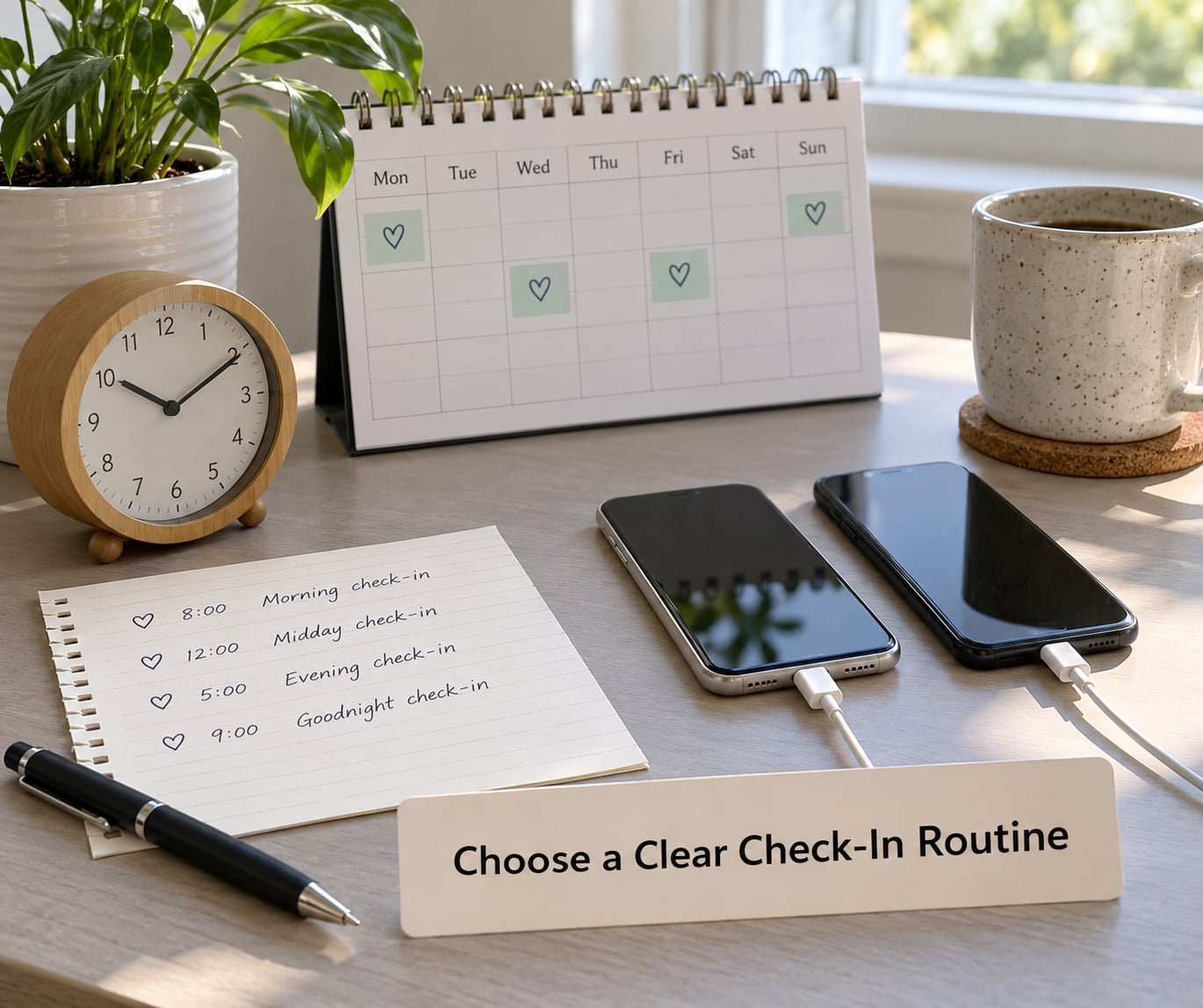
The routine is the part that keeps space from turning into distance. One message a day, at a predictable time, that carries no pressure to respond.
Options that work: a morning text before work, a scheduled evening call on set days, a shared playlist you both add to, or a next-day debrief where you each get fifteen uninterrupted minutes to say how it went.
Test a routine for two weeks before declaring it a failure. If it feels intrusive, the timing is wrong, not the habit.
A predictable beat is what makes the difference. Users on relationship forums describe the panic of space as physical, shaking and nauseous, and what tends to help is not more contact but contact they can count on.
3. Say What You Need Without Blaming
Neutral language works because it leaves room for the other person to hear a request instead of a verdict. Four parts: what you observed, how you felt, what you need, and what you are asking for.
For someone who needs quiet: “The last three evenings have felt compressed, and I want to be better company rather than worse. Could we try quiet time from 8 to 9 and a walk at nine?”
For someone who feels neglected: “I notice we have not had an evening that is just ours in two weeks. I am not asking you to stop seeing your friends. I am asking for one night a week where neither of us is checking work.”
Swap “you always” for a specific evening. Blame turns a reset into a defence, and you will not get your space.
4. Support Healthy Independence
Space only stays healthy if there is a life on the other side of it. Keep your own hobbies, friendships and routines going rather than pausing them for the sake of the relationship.
Cheering each other into that is doing more than any amount of reassurance text. When your partner takes a class, goes climbing, or rebuilds a friendship you had drifted from, say something specific about why it suits them.
Two situations make this harder than it sounds. Co-parents cannot simply take a walk, because the children still need both adults present and coordinating. Agree the logistics first, then the personal space. Long-distance couples should be even more deliberate, since absence is the default and a return time is the only thing holding the schedule together.
Encouragement builds security. Temptation builds resentment, and resentment is usually what people are actually trying to escape.
5. Stay Consistently Present While Giving Space Without Distance
Presence during a break is not volume. It is reliability: keeping the promises you made, asking about the thing they cared about, and putting a future date on the calendar.
Keep promises small and exact. “Text you at seven” beats “I’ll be around”. People relax when the world does what it said it would.
When the break ends, use a warm reconnection instead of a resumed argument. Name what went well, name your own part, then ask for one thing to change. Fifteen minutes of debrief beats an hour of replaying the worst sentence.
6. Notice When the Balance Needs to Change
More space is probably right when either of you is flooded, depleted, or handling something outside the relationship: a hard quarter at work, grief, a new baby, an illness.
Fewer red flags mean the space has become an exit: no return time was ever named, the routine you agreed on quietly stops, plans get cancelled one at a time, contact goes fully silent, and effort stops in both directions.
Forum readers say the difference between needing space and pulling away shows up in intent, and the clearest signal is low-key effort: is the person still making small moves, or has everything gone quiet at once?
Use the two-week check-in. If you are past two weeks of indefinite space with no return date and no conversation, say so plainly: “I am happy to keep giving you room, and I need to know we are still building this. Can we talk this week?”
When space keeps causing conflict rather than settling it, couples counselling is not a failure. It is the shortest route to a workable agreement, and it works whether you are in your first year or your twentieth.
Common Mistakes
Using space as punishment. Silence meant to make someone suffer is the silent treatment, and it erodes trust faster than the original argument. The correction is simple: if the aim is to be missed, it is not space, it is leverage.
Assuming motives. “You are pulling away because you do not love me” is a story you wrote about their inner life. Stay with behaviour you can observe and ask about it instead.
Demanding constant availability. If your partner must answer within an hour to prove they care, they cannot rest. Agree a response window and let the rest of the day be theirs.
Vanishing with no explanation. No return time, no check-in, no reassurance is the version readers describe as the moment the relationship effectively ended. Say when you will be back, and say it once.
Reading a hobby as rejection. A partner who swims three times a week is not choosing the pool over you. Cheer the interest, ask one real question about it, and watch whether they make time for you too.
Withholding attention on purpose. Advice that tells you to go cold so your partner will chase is not a relationship strategy. It is a tactic, and people can feel the difference even when they cannot name it.
Pick one step and do it this week. Write the definitions down. That single page solves most of what people try to fix with three months of guessing.
Frequently Asked Questions
How much space is healthy in a relationship?
Enough that you can return calmer, and predictable enough that nobody has to guess. A regular alone evening, a weekly solo activity, or a few hours after a hard day are all healthy. Space that has no agreed end time tends to feel like withdrawal rather than rest. Judge it by the effect: if you both come back steadier, the amount was about right.
Can my partner need space while we are having an argument?
Yes, and often that is exactly when it helps most. An overactivated nervous system cannot listen or reason well, so a timed break often prevents a sentence you would both regret. Name a return time before anyone walks away, and use the break to cool down rather than to build a case. Resuming the same conversation at the same temperature helps nobody.
How long should I give my partner before checking in?
Match the check-in to the timeframe they gave you, not to your anxiety. If they said a week, one warm text midweek and a real conversation at the end is plenty. If they gave no timeframe at all, reach out once after a couple of days to set one. Silence past two weeks with no date and no conversation is the point to stop waiting and ask directly.
What if their need for space feels like avoidance?
Look at behaviour rather than labels. Healthy space keeps a return time, keeps low-key contact alive, and ends with both people present. Avoidance drifts: no timeframe, plans cancelled one by one, no check-ins, and effort drying up in both directions. Give the benefit of the doubt once, then ask the direct question about whether you are still building the relationship.
Is it normal to want more alone time in a relationship?
Completely normal. Adults need time they do not account for, and a partner asking for it is usually reporting their limits rather than their interest in you. What matters is that both people keep separate interests and friendships alive, and that requests come with some shape to them. Wanting solitude is healthy; using it as a habit with no return point is not.
Can a couples counselor help if giving space keeps causing conflict?
Yes, and it is often the fastest option when every attempt to take a break turns into the next fight. A counsellor can help you build the agreement itself: how long a reset lasts, how often you check in, and what happens if the routine breaks. If space is repeatedly the problem, the missing piece is usually structure, which is exactly what that first session is built to create.
Conclusion
To give your partner space without distance, three ingredients do most of the work: a calm conversation before anyone leaves, an agreed check-in routine, and attention on how the balance feels over the following weeks.
Start with one step. Send the message that names what you need, how long it lasts, and when you are back. Structure is what separates a reset from an exit, and it works in both directions.