There is no single right answer to how much time should couples spend apart. A healthy relationship usually protects a few nights or half-days of genuine solo time each week, plus most of the workday, while keeping the shared hours predictable enough that neither person feels abandoned or suffocated.
That is the range, not a rule. Work patterns, kids, commutes, introversion and one partner’s shift schedule can change the workable number completely, which is why the honest answer to how much time should couples spend apart is always a range you agree on together rather than a target you try to hit.
Table of Contents→
- How Much Time Should Couples Spend Apart?
- What Counts as Time Apart?
- What Is a Healthy Amount of Time Apart for Most Couples?
- How Do Your Needs, Schedules, and Personalities Affect the Answer?
- How Can You Talk About Spending Time Apart Without Feeling Guilty?
- How Do You Tell If You Need More Time Apart?
- When Might Spending Less Time Apart Be Better?
- How Much Time Apart Is Normal in Long-Distance Relationships?
- Frequently Asked Questions
- Is it bad if my partner and I spend a lot of time apart?
- How much alone time should a new couple have?
- Does wanting time apart mean I do not love my partner?
- How often should long-distance couples see each other?
- How do I ask my partner for more time alone?
- Can couples spend every day together without it being unhealthy?
- Find Your Healthy Balance
How Much Time Should Couples Spend Apart?

Most couples who have a functioning rhythm land somewhere between five and fifteen hours of deliberate alone time in an average week, on top of the sleep, work and commute hours that already separate them.
What matters is less the total and more whether each person comes back to the relationship able to be present. Two nights apart during a heavy work week is healthy. Zero nights apart for two years is usually not. One couple needs a free evening four times a week, and the other needs a full Saturday alone before they can be around people again, and both arrangements are fine as long as they were named out loud.
Why the internet’s relationship rules keep coming up
Search results for this question are thick with rules like the 7-7-7 rule and the 30-60-90 rule. They are popular because a rule is easier to follow than a conversation, not because any of them were tested. Most originated as social media posts rather than published research, so treat them as a prompt to talk, not a target to hit.
What Counts as Time Apart?
Plenty of couples are already getting decent alone time without calling it that. Counting it accurately is the first step to knowing whether the balance needs work.
- Protected alone time. Time nobody else has a claim on, and that you are not spending scrolling. An evening alone at home reading counts. A night apart in separate beds counts.
- Work and commuting. A nine-to-five with a 40-minute commute removes roughly 12 hours a day from shared life. Most full cohabiting couples still protect a few more hours on purpose.
- Separate social plans. Different friend groups, sport leagues, classes or family dinners. Overlapping friend circles tend to shrink naturally over time, which is worth noticing.
- Uninterrupted evenings. One person out with friends while the other reads in the same room counts as separate time, even under one roof.
- Separate travel. Work trips, visiting family, holidays taken alone, and the commute to see a long-distance partner.
- Long-distance time. Any stretch where you are not physically together, including weeks between visits.
The number most people quote only counts the first item. That is why two couples with visibly identical schedules routinely argue about never having time apart.
What Is a Healthy Amount of Time Apart for Most Couples?
Here is a rough benchmark by stage, built from what clinicians and long-term couples describe as workable rather than from any single study. Treat every row as a conversation starter.
| Relationship situation | Typical healthy time apart | What to watch for |
|---|---|---|
| First dates and early dating | Most waking hours, plus the days between dates | Over-scheduling before the relationship can hold weight |
| Exclusive, dating separately | A couple of nights a week plus one longer block | Losing entirely separate friend groups |
| Newly living together | Overnight time apart 1 to 3 nights a week to start | Fusion in the first six months as routines merge |
| Established, no kids | 5 to 15 hours of real solo time weekly | Resentment building under the surface |
| With young children | Fragments rather than blocks, plus a weekly half-day each | One partner’s work-life balance eroding completely |
| Empty nest or retired | A full part-time routine outside the relationship | Work retiring and the structure disappearing with it |
| Long-distance | Days between visits, plus consistent daily contact | The working week turning into a countdown |
| Living apart together | 3 to 5 nights a week in separate homes, agreed in advance | The schedule being improvised week to week |
How much time should couples spend apart in each stage?
If you look down that table and think none of the rows describe you, that is usually because your needs sit at the edge of two rows at once, such as new cohabitation in a house with a long commute. Split the difference for a month and then adjust. Most mismatches get fixed by moving the arrangement 30 minutes, not by a fundamental change in how either person loves.
How Do Your Needs, Schedules, and Personalities Affect the Answer?
Introversion and extroversion
An extrovert recharges through contact and an introvert through quiet, so the same amount of time alone can feel restorative to one person and isolating to the other. Neither preference is a character flaw. One often needs a debrief conversation to process a hard day, the other needs an hour before they can speak to anyone at all.
Work patterns
Shift work, travel-heavy jobs, on-call rotations and long commutes eat into available time in ways that have nothing to do with the relationship. Couples who both work full-time outside the home often need less scheduled space than couples who are together all day, because they get separation for free.
Caregiving and load
When one person carries more of the housework, childcare or eldercare, the issue is usually framed as a space problem when it is really a fairness one. Space scheduled for the person doing less often masks a resentment that space for the person doing more would not touch.
Friendships and personal growth
Relationships tend to absorb the hobbies, sports and friendships of two people, and often both people stop. Staying in contact with friends and keeping one activity that has nothing to do with the relationship is what makes time apart restorative rather than empty.
Attachment styles
Most recurring arguments about time apart come down to two different operating systems. Someone with anxious attachment reads distance as the start of abandonment and wants more contact. Someone with avoidant attachment feels crowded under pressure and withdraws. When the anxious partner pulls closer, the avoidant partner needs more room, which tightens the spiral rather than loosening it.
Neither is a diagnosis and neither partner is at fault. Attachment style explains why your request makes sense to you and why the same request lands as rejection across the table, which is the part most couples find unexpectedly useful.
How Can You Talk About Spending Time Apart Without Feeling Guilty?
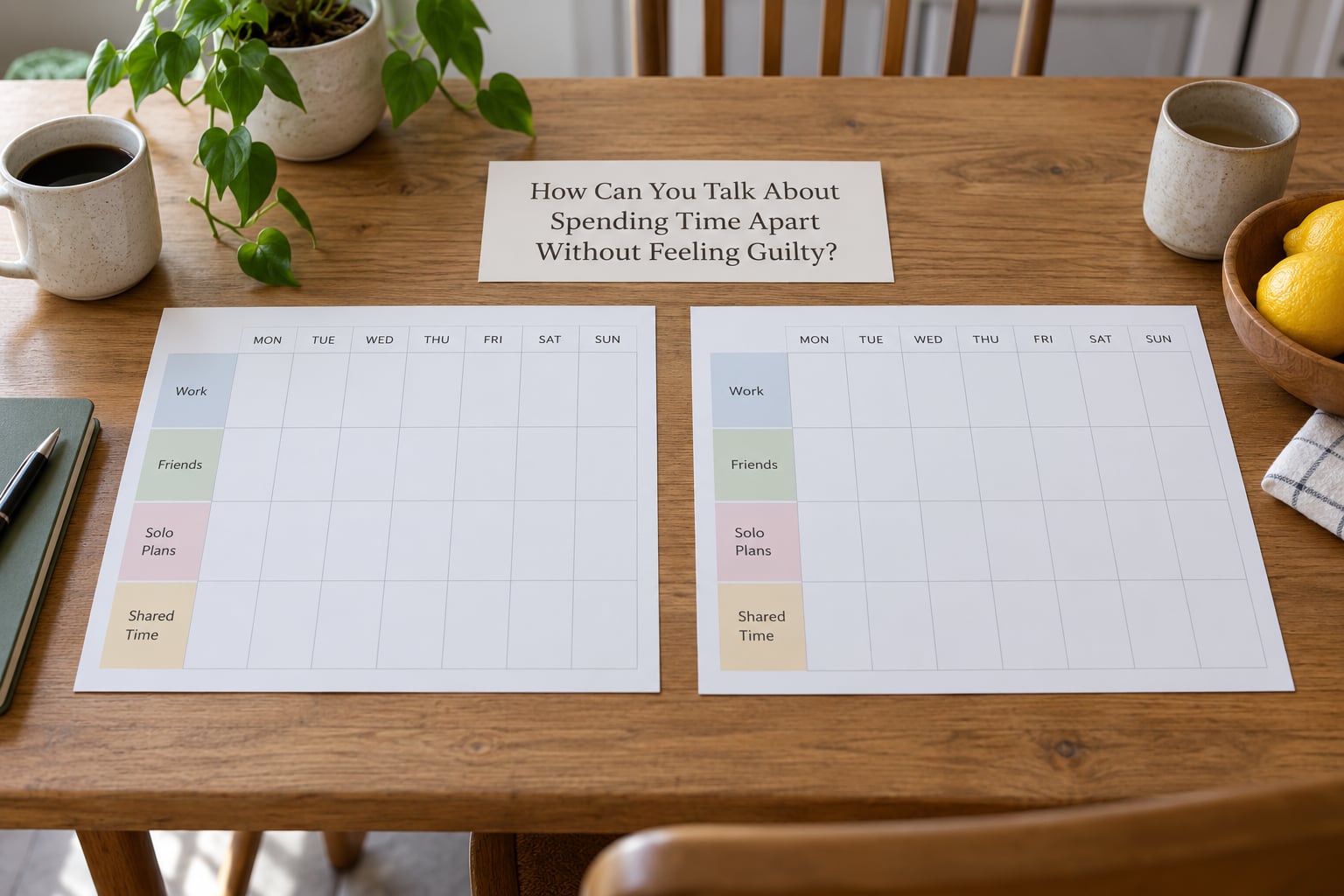
Most space conversations fail because they are framed as a verdict on love. The move is to describe your schedule instead of your partner, and to attach a duration to the ask.
What to say
“I need one evening a week where nothing is planned. It is not about you, it is about me.”
“After this week at work I am running empty. Can we protect Tuesday night this week with no chores?”
“I want to keep seeing Sam on Wednesdays. It matters to me that I keep people in my life.”
“I have noticed I get short with you by Sunday. Would a night apart on a Saturday help?”
Name the specific night, say what it restores, and say what stays the same. That last part is what keeps the request from sounding like a withdrawal.
What not to say
“I just need to get away from you.”
“You never give me any space.”
Both are statements about the other person, which guarantees a defensive answer. Time-together complaints work the same way: “I miss us” lands differently than “you never want to do anything.”
How to build the actual agreement
- Each person states their ideal week. Write it down rather than describing it. Ideal weeks differ from realistic ones, and the gap is where the useful conversation lives.
- Separate non-negotiables from preferences. Two protected nights and one full day a week is a floor. Which evening is the best one is a preference, and preferences are negotiable.
- Block the shared time first. Anchor the date night, the weekend morning, the evening you always talk, then fill the rest around it.
- Agree what happens when it breaks. A plan that survives a busy week needs a rule for the week it collapses.
- Review it in 20 minutes once a month. Ask how the space felt, what worked, what to change. Short and regular beats one long argument every few months.
Keep it light enough that you keep doing it. A written plan nobody opens for two years is worse than no plan.
How Do You Tell If You Need More Time Apart?
- You resent time you used to enjoy. An evening with your partner starts to feel like an obligation.
- Your interests quietly disappeared. The climbing gym membership lapsed, the language class stopped, the Sunday run did not happen.
- You are exhausted, not connected. Two free nights did not fix it, which usually means the time apart has not been real time apart.
- You are keeping score. Counting who left, who initiated, who got more. Scorekeeping almost always means the current arrangement feels unfair to you.
- You feel like a unit. Hard to explain to friends, harder to explain to yourself.
- Small things blow up. Constant low-grade conflict about dishes and plans is often depletion wearing a costume.
One bad fortnight means nothing. Work deadlines, sick kids and moving house all compress time temporarily. Look for the same imbalance across two or three ordinary months before treating it as a pattern.
One useful test is whether your alone time has an outcome. Time alone to read, see friends, exercise or sit in silence restores you. Time alone spent waiting for your partner to come back is avoidance dressed up as rest, and it usually leaves you more tired.
When Might Spending Less Time Apart Be Better?
Some periods genuinely call for more presence, and treating every hour apart as a failure would be its own mistake.
Early in a relationship
In the first months of dating, extra hours together tell you whether someone is easy to be around when nobody is trying. You cannot learn that from dinners. Just keep the rhythm you can sustain, because a pattern you built by over-extending rarely survives a busy month.
After a rough stretch
Newborns, illness, a death in the family, a job loss, a cross-country move. During upheaval, some couples want to be near each other constantly and others want to be left completely alone. Both are normal. The only mistake is assuming your partner should want what you want.
Transitioning to living together
Many couples who want to live together are not ready to live together. Plenty of people maintain two homes for years by agreement, and that arrangement is far healthier than cohabiting on schedule and then breaking up at month seven.
If the arrangement stops being restorative for either person after a fair trial, treat that as information rather than failure. Couples counseling is genuinely useful at this point, because the question is rarely whether space is too much or too little. It is usually what each person is using the time for.
How Much Time Apart Is Normal in Long-Distance Relationships?
Long distance is the easy case for time apart and the hard case for reassurance. The distance is a given, so the argument moves from hours to reliability.
What tends to work
Consistent daily contact beats marathon calls. A short call every couple of days and a longer weekend call gives the week a shape, where spontaneous contact leaves both people guessing.
Fix the calendar early. Couples who agree on visit dates, who travels and how costs are shared have far less conflict than couples who keep the visits open-ended. Alternating homes works well when both apartments are genuinely comfortable.
Keep separate daily routines. Sharing a morning and an evening in person is often enough, and trying to compress a whole relationship into a weekend tends to leave everyone exhausted by Monday.
What makes it hard
Uncertainty, not distance, is what wears couples down. Unannounced busyness, changing plans without a reason, and weeks where you are both too tired to talk all feed the same fear, and that fear shows up as either chasing or withdrawing.
If you are in this situation and cannot settle the schedule, it is worth naming the fear directly rather than negotiating logistics around it. “I am not worried about the three weeks, I am worried about the month where we did not talk” is a conversation that can go somewhere.
Frequently Asked Questions
Is it bad if my partner and I spend a lot of time apart?
Only if it is happening to you rather than with you. Many healthy couples keep separate homes, different friend groups and independent schedules, and none of it signals a problem by itself. The question worth asking is whether the arrangement was chosen by both of you and whether you each feel secure. Time apart that one person imposed through resentment, secrecy or drifting is a different situation entirely, and that one deserves attention.
How much alone time should a new couple have?
Most new couples should protect most of their non-date time for the first few months. Not playing together every evening is not a bad sign at the start; it is how you find out whether someone is comfortable when the energy is low. A steady rhythm of one or two nights apart a week, plus whatever your jobs already separate you by, tends to hold up better than a schedule built around spending every evening together.
Does wanting time apart mean I do not love my partner?
No. Wanting time apart is about how much contact you can handle right now, not how much you care. People who love their partners still need evenings alone, whole weekends off and friendships that have nothing to do with the relationship. What does matter is whether you are honest about it and whether you come back. Needing space while still turning toward your partner is ordinary; needing space to escape the relationship is not.
How often should long-distance couples see each other?
There is no required frequency, but a predictable schedule matters more than a large one. Couples who agree in advance on dates, who travels and roughly how long each visit lasts tend to have far less conflict than couples who leave it open. Two or three visits a month works well for many people, while others are steadier on a longer monthly rhythm. Whichever you pick, set the next two or three dates before you say goodbye.
How do I ask my partner for more time alone?
Name the time, not the feeling, and say what it is for. Try saying you need Thursday evening this week to yourself and you will be fully present for the weekend. Attach the reassurance your partner needs, such as naming a time you will talk, so the request reads as a plan and not a rejection. Then make the first move into that space yourself. People-pleasing and guilt about having needs both come from the same place.
Can couples spend every day together without it being unhealthy?
For a stretch, yes. Honeymoons, new jobs in a new city and weeks when a child is newborn are all reasons to be together constantly, and none of them make the relationship unhealthy on their own. Trouble shows up when together time starts to feel obligatory, when your own interests quietly drop away, or when a single evening apart reliably triggers a fight. Some couples genuinely prefer constant company and stay that way for decades without harm.
Find Your Healthy Balance
There is no answer to how much time should couples spend apart that you can look up and apply. The useful version is narrower and personal: how much alone time leaves you restored, how much time together actually feels meaningful rather than obligatory, and what schedule can you sustain on an ordinary Tuesday in February rather than on a good weekend.
Write down your ideal week, compare it with your real one, and adjust by about half an hour in the direction that feels better. Then book the time you share. That is the whole method, and it works better than any rule anyone has posted online.