
Most people don’t struggle to hear their partner’s words. They struggle to stay with the conversation long enough to understand what those words actually mean. Learning how to be a better listener for your partner is mostly a matter of attention, a few repeatable moves, and the willingness to sit with discomfort instead of fixing it.
Active listening means giving your partner your full, undivided attention with one goal: understanding what they mean and how they feel. It is not preparing your reply, judging what they’re saying, or waiting for your turn to talk.
It takes about ten minutes a day to practice, and almost no special equipment. The six steps below are the version I’d hand a couple in their first year, when the same argument keeps looping because neither person feels accurately understood.
This guide is updated for 2026, and none of it requires you to be a natural communicator. It’s a set of habits, and habits can be built.
What You Need
Nothing to buy. What you need is a state of mind, a slot in the day, and a way to remember what was said.
The mindset part matters more than people expect. Active listening is an attempt to understand, not a performance of understanding, so it will feel awkward for the first week. You’re used to talking your way through a conversation. Now you’re going to try staying in it.
For timing, pick a low-stakes window rather than waiting for the big talk. Ten minutes in the kitchen after dinner works better than a scheduled session on Saturday, because the pressure of a formal meeting makes people brace. Say something simple out loud, like “want to tell me about your day while I put this away?”
For place, choose somewhere you can both see each other’s faces. Sitting side by side while watching something is fine for casual chat, harder work for anything emotional.
For remembering, a plain notebook or your phone’s notes app is enough. If a conversation is complicated enough that you know you’ll lose track of it, jot down three words. Writing them down keeps you from rehearsing your rebuttal instead of listening.
One honest limit: you cannot control whether your partner listens back. These steps change your side of the exchange, and one changed side is often enough to move a conversation.
Step-by-Step: How to Be a Better Listener for Your Partner
Step 1: Set Aside Distractions and Create Space
Choose a time when neither of you is leaving soon, then silence the phone and put it out of reach, ideally in another room. A phone face up on the table is not out of reach, and people read the difference correctly even when they can’t prove it.
Face your partner, let your shoulders drop, and keep your hands still. Open posture reads as interest; crossed arms read as a verdict you’ve already reached.
Tell them you’re listening and how long you can give it. “I’ve got about fifteen minutes and I’m not rushing” removes the performance pressure that makes people talk too fast.
You’ll know this step worked when your partner slows down. People talk at their natural pace when they sense real attention, and that pace is where the useful detail lives.
Step 2: Listen for Feelings as Well as Facts
Most sentences carry two things: what happened and how it felt. Couples argue about the first and miss the second, which is why a conversation about who forgot the bins ends up about whether anyone feels appreciated.
Reflect the emotion tentatively, with a question at the end so you’re checking rather than declaring. “That sounds exhausting, is that right?” or “You sound disappointed, am I hearing that correctly?”
Separate what was observed from what you assumed. Your partner says “you were on your phone all dinner.” That’s an observation. “You don’t care about me” is your conclusion, and arguing with a conclusion you invented wastes the evening.
You’ll know this works when your partner says something like “yes, exactly.” That phrase is usually the signal you’ve landed on the real thing.
Step 3: Ask Clarifying Questions Instead of Guessing
Fill in a gap with a question rather than an assumption, because guessing means you solved a problem your partner didn’t have. Open-ended questions, like “what was that like?”, get you more than yes-or-no questions that close the door.
Keep the follow-ups brief. “How long has that been going on?” and “was it the meeting or the person?” are better than a rapid sequence that turns into an interview. Three questions in a conversation is usually plenty.
If you mishear something, say so plainly instead of nodding along. “I want to make sure I understood, did you mean the trip in June or July?” An honest question is far cheaper than agreeing to the wrong thing for a week.
You’ll know this step worked when you can repeat their reason back to them correctly. That’s the whole test of whether you’re listening to understand rather than listening to reply.
Step 4: Validate Before You Respond
Acknowledge their position out loud before you add anything. One sentence is enough: “That sounds genuinely unfair, I can see why it stings.” Validation is not agreement. It’s a statement that their experience makes sense given what happened to them.
The order matters. Advice, your own story, and disagreement all land much better after validation than before it, because once someone feels heard, the conversation stops being a fight to be believed.
Hold off on solutions until you’re asked. Most of the time your partner is describing a problem out loud to get it out of their body, not to hand you a task list.
You’ll know this step worked when the shoulders drop and the voice softens a little. That’s what it looks like when someone stops bracing for a counter-argument.
Step 5: Summarize What You Heard
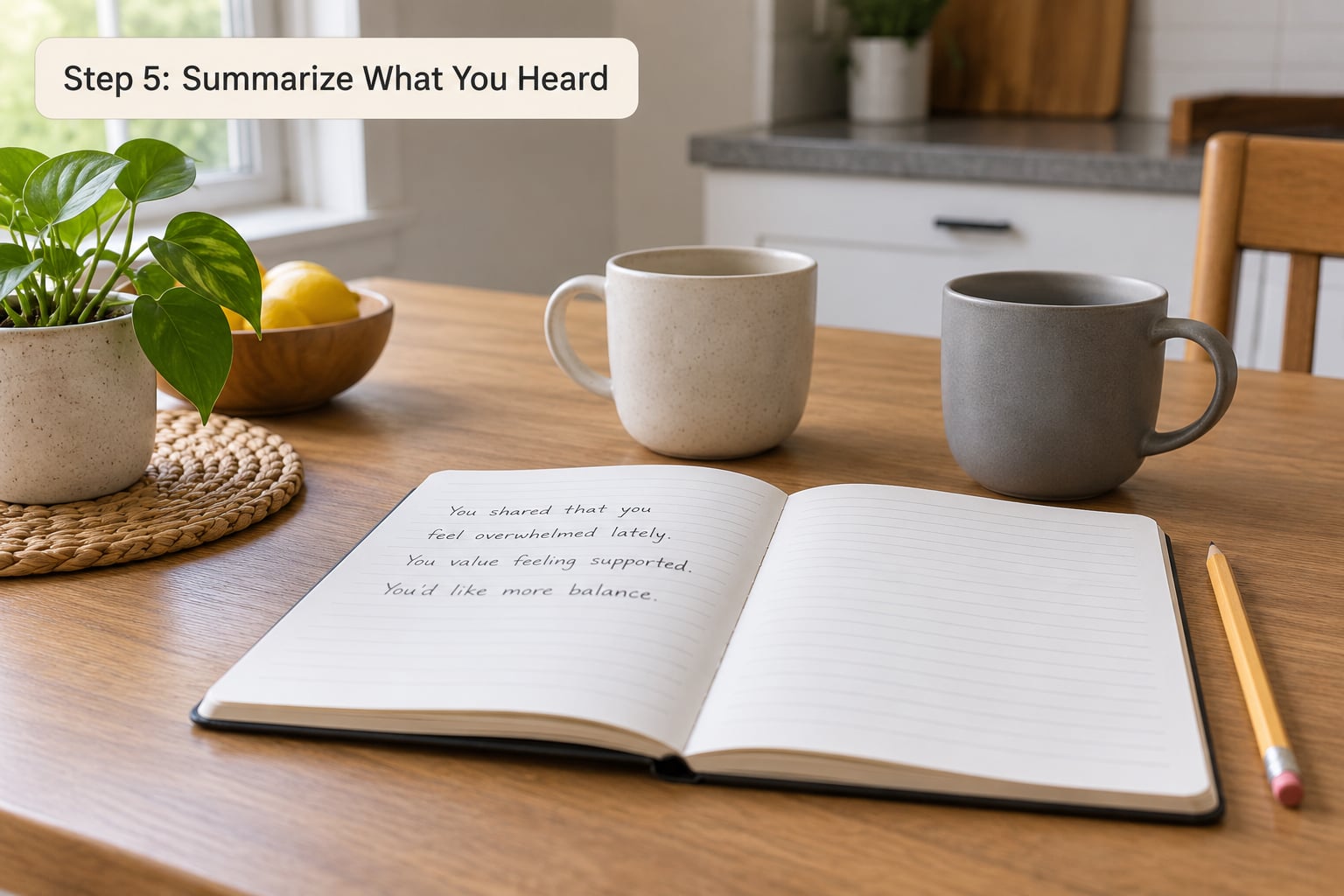
Before you respond, say the whole thing back in one or two sentences and ask for correction. This is the step that catches misunderstandings while they’re still cheap, and it’s the one most people skip.
Here is a concrete example. Your partner describes a week where three deadlines landed in the same week and nobody checked in. You summarize: “So the deadline was the worst part, and what really got you was having to carry it alone. Nobody asked how you were coping, and it felt like you were invisible.” They say yes, and add that it was the second week in a row, not the first.
Without the summary, you would have responded to the wrong problem, because you missed that this is a pattern rather than a bad week.
You’ll know this step worked when they correct you. Corrections mean they trust the summary enough to fix it, which is exactly what you want.
Step 6: Respond Slowly and Choose the Next Step Together
Pause before you reply. Two full seconds is enough to keep your first sentence from being the defensive one you’ll regret.
Then ask what they want from this moment. “Do you want me to listen, or would a suggestion help?” sounds clinical the first time you say it, and it’s the most useful question in the whole sequence.
Agree on one small next action instead of solving the problem in the same breath. One thing each, reviewable in a week, beats a plan you both forget by Tuesday.
You’ll know this step worked when the conversation ends with something specific rather than a vague promise to talk about it later.
Common Mistakes
Here are the errors that show up most often, each with the fix that replaces it.
Interrupting. You jump in with “but that’s not what I meant” before the sentence ends. The fix: stop yourself physically. Rest your hand flat on the table, take a breath, and hold your comment until they’ve finished and you’ve summarized. If you’ve already cut them off, say so plainly: “I interrupted you, I’m sorry. Go on.”
Rehearsing a rebuttal. You’re not listening, you’re drafting. The fix: aim at understanding rather than winning. If the argument is an assignment instead of a conversation, take a pause and restart later.
Unsolicited advice. “You should just tell your manager” lands as “your problem isn’t that bad.” The fix: ask permission. “Want options, or do you just want me to hear it?”
Assumptions. You fill the silence with your own story. The fix: ask one question instead of finishing their sentence for them.
Phone distraction. Half-listening while scrolling feels like company but registers as absence. The fix is unglamorous: put the phone in another room before the conversation starts, not during it.
Treating silence as agreement. A partner going quiet usually means they disengaged, not that you convinced them. The fix: check. “You’ve gone quiet. Have I said too much, or do you need a minute?”
Treating one interruption as proof you’re a bad listener. You apologize and try again. Trying to be perfect sets you up to fail at something you can’t actually control. Aim at repair over flawlessness, because a clean repair is stronger evidence of care than never stumbling at all.
One practical note on attention lapses: many people genuinely listen but cannot retain the details afterwards, and the other person reads that as not listening. If that’s you, say so. “I want to remember this properly, can I write down what you just said?” turns a memory gap into a visible act of care.
A few tips worth carrying: put the phone away before the conversation, not during it. Name the emotion, not just the facts. Summarize before you respond. Ask what kind of support is wanted before you give any. And let a silence sit for three seconds more than feels comfortable.
Frequently Asked Questions
How do I listen better when I disagree with my partner?
Disagreement and listening are not opposites. Listening is how you find out whether you disagree for a good reason or because you’re defending yourself. Reflect first, summarize their point accurately, and only then say where you see it differently. If you can state their argument better than they did, most of the heat leaves the room on its own.
What should I do if my partner says I never listen?
The accusation usually lands as a verdict on you rather than a request, which is why it triggers defensiveness. Try this instead: I’m sorry. I have noticed it too, and I want to do better. Can you tell me one recent moment when you felt that, and what I was doing? A specific example gives you something to work with, and thanking them for saying it keeps the conversation open.
How can I listen during a heated argument?
You often cannot, and that is normal. Physiologically, a high-conflict conversation pushes you into fight-or-flight within seconds. Name it out loud, name a return time, and leave. Something like I want to keep doing this well, and right now I can’t. Can we take twenty minutes and restart? Leaving with a stated return time is not abandoning the talk; it is the only way you can stay in it honestly.
Is it okay to give advice while my partner is talking?
Ask first, every time. There is a real difference between advice they asked for and advice they have not. Use a simple check: do you want ideas, or do you want me to listen? If they answer with listening, stop talking and reflect back what you heard. Advice given uninvited is heard as a verdict on the problem, and often as a verdict on them.
How do I show my partner that I am listening?
Non-verbal signals do most of the work: phone out of reach and out of the room, body turned toward them, open posture, nodding occasionally, and silence that lasts a beat longer than your impulse to fill it. Add one verbal check per conversation, such as restating what they said. People read attention within seconds, and the signals that work are the small boring ones, not the speeches.
How long does it take to become a better listener?
Expect a noticeable shift in two to three weeks and a durable habit in a couple of months. The change that shows up first is not performance, it is volume: you interrupt less and defend less. Treat lapses as data rather than failure. The practical target is simple: apologize and try again in the moment instead of chasing a flawless record.
Conclusion
The first thing to do is small: pick one conversation this week and run the four moves in order. Listen without preparing a reply, reflect the feeling back, summarize what you heard and ask if you got it right, then ask whether they want support or solutions.
That is the whole method. You don’t need to change everything about how you communicate at once, and you don’t need to become someone who never interrupts. Start with one short conversation, do it properly, and let that one go better than the last one be the practice.