
The way you split expenses in a relationship matters less than the fact that you decide it together, out loud, and then revisit it. Most couples who argue about money are not arguing about the amount. They are arguing about an arrangement that was never clearly stated. Pick a method — equal halves, percentages based on income, or a mix of both — write down what counts as a shared cost, and set a date to talk about it again.
That takes about an hour the first time and twenty minutes a month after that. The awkwardness people dread usually comes from putting it off, not from the conversation itself.
This is a general guide on how money arrangements work between partners. Rules and norms differ by country, culture and family, and nothing here is individual financial advice. What works for a couple in Manchester or Melbourne or Mumbai will not look identical to a couple in Ohio, and that is fine — the method matters more than the specific numbers.
Table of Contents→
- What You Need
- How to Split Expenses in a Relationship Step by Step
- Common Mistakes
- Frequently Asked Questions
- Should couples always split expenses 50/50?
- How do couples split expenses when they have different incomes?
- Who should pay for groceries if they live together?
- Should one partner pay for more if they earn more?
- How should we divide a large shared purchase?
- What should we do if one person is not paying their share?
- Conclusion
What You Need
Before you talk, you need one shared list. Not a spreadsheet with formulas — a plain list of what comes in and what goes out, written where both of you can see it.
That list has four parts:
- Income. What each of you actually receives after tax and deductions, not your gross salary. Take-home pay is the only honest number, because a 10 percent raise that gets eaten by tax does not help pay rent.
- Recurring bills. Rent or mortgage, utilities, internet, phone plans, subscriptions, insurance, transport, minimum debt payments.
- Future obligations. Anything already committed: a car loan, a course you are paying through, a family member you help, a deposit you have saved for.
- Spending categories. Which of those costs are shared and which are individual. This is the part most couples skip, and it causes most of the friction.
A spreadsheet, a shared note in a notes app, or a budgeting app that supports two people are all fine tools. None of them do the hard part. You also do not need a perfect 50/50 split, and honestly chasing one causes more harm than good when your incomes differ. What you need is honest figures and a willingness to say them out loud.
One more thing to have ready: a rough sense of what you each want the money to do. A partner paying a larger share may be saving, may be planning to move, may be studying. The arrangement feels very different once both people know which goal the number is serving.
How to Split Expenses in a Relationship Step by Step
1. List Your Income and Fixed Expenses
Start with the two numbers that never move: take-home income and total monthly obligations. If one partner earns 3,200 and the other earns 2,800, household income is 6,000. Subtract rent of 1,500, utilities averaging 180, internet at 60, phone plans at 90, a car payment at 350, subscriptions at 45, and minimum debt payments at 310. That leaves roughly 3,465 of genuinely flexible money each month.
Decide what each of you shares and what stays private. Income, debts, and the big fixed commitments are fair game. Nobody needs a running commentary on every purchase, and asking for one signals distrust rather than planning. If one of you has very different circumstances — serious debt, a disability benefit, no income at all while studying — say so early, because a split built on inaccurate numbers will not survive contact with reality.
Work from numbers, not feelings. Vague impressions like “I think I spend most of my money here” are how the same bill gets argued about three months running.
2. Separate Shared and Personal Costs

Now sort every line into shared or individual. A clean test: if either of you would still be paying it without the relationship, it is individual. If the cost exists because you share a home, meals or a life together, it is shared.
Usually shared: rent or mortgage, utilities, internet, household groceries, cleaning supplies, rent on a storage unit, a shared phone plan if you both use it, a shared pet, a streaming plan you genuinely both watch, travel you take together, and any goal fund you have agreed on.
Usually individual: dates out, gifts for each other, personal subscriptions, your own gym membership, your own car insurance if you drive different vehicles, clothes, hobbies, phone upgrades, and repayments on debt you took on before or outside the relationship.
The edge cases are where resentment hides. If one partner does all the cooking and the grocery shop, groceries are still shared — someone just happens to be fronting the cash. Agree in advance who pays the bill and how the other person reimburses, rather than deciding afterwards.
Dates and gifts are worth special care. A rule like “each of us spends our own money on dates until we can agree otherwise” removes a whole category of quiet resentment. So does writing gifts into the shared list as a monthly allowance, which many couples find simpler once the spending stops being a surprise.
3. Choose the Fairest Split Method
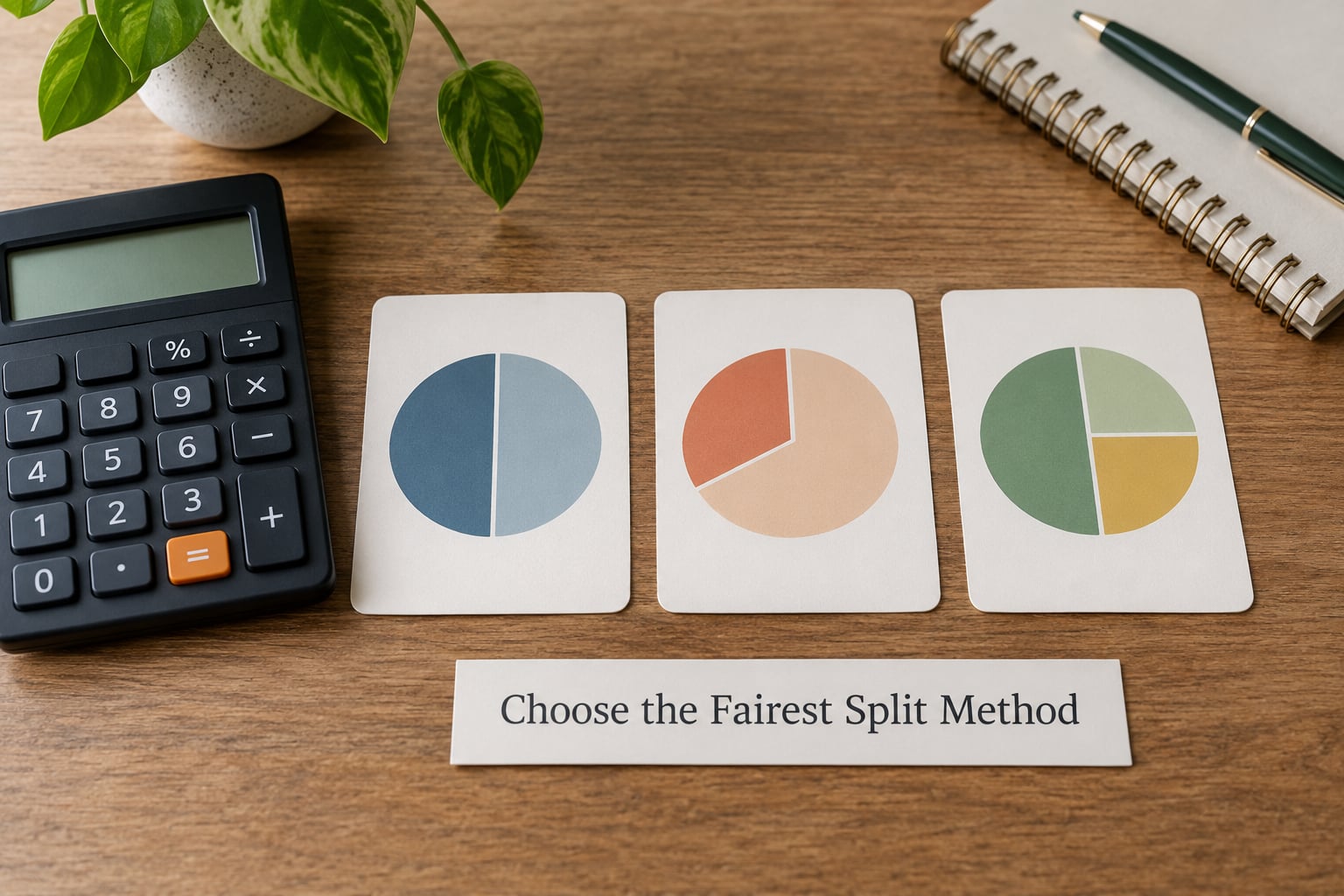
Three methods cover almost every situation. Most couples who argue about this are arguing for the wrong one.
1. Equal halves (50/50). Each person pays half of every shared cost. This works when incomes are close, when both partners are students, or when neither wants to owe the other anything. It fails when one income is much smaller, because a half share of rent can consume a third of that person’s pay while feeling completely ordinary to the other. It is also the simplest option to administer, and simplicity has real value.
2. Income-based percentages. Each person pays the same percentage of shared costs as their share of household take-home income. If one partner brings 60 percent of the income, they pay 60 percent of shared costs. The calculation is simple: divide your income by the household total and multiply by 100. With incomes of 3,600 and 2,400, that is 60 percent and 40 percent. Multiply each share by the total shared cost and round to the nearest currency unit.
Use net income, not gross. If one partner has student loans, a car payment or a large medical bill, gross income overstates their actual capacity to contribute. Some couples subtract debt payments first and then divide what is left — that method is fairer still when the debt load is very uneven.
3. Hybrid. Shared bills are split by percentage; personal spending stays individual. This is the model most couples in practice land on, and it is a good default. You can go further and put a fixed amount per month into a joint account to cover shared costs, while everything outside that account remains private.
On account structure, three setups work. A fully joint account gives the clearest picture and the most control, and some couples find it suffocating. Fully separate accounts with monthly transfers in each direction preserve independence but require more bookkeeping. A hybrid — one joint account for shared costs, one personal account each — balances both, and it is where most people end up.
Keep percentages out of the emotional territory. Saying “you pay 55 percent because that is your share” reads as arithmetic. Saying “you pay more because you earn more” reads as a verdict. The number is the same; the framing decides whether the conversation ends in relief or defensiveness. Sharing the calculation on paper, with both sets of figures visible, usually does more good than any particular phrasing.
4. Discuss What Each Partner Can Afford
Percentages only work if each person can actually carry them. Say what is genuinely possible before you agree to anything. A student with 1,100 a month in income cannot take on 40 percent of a shared budget, however fair that percentage looks on paper.
Three questions worth answering together:
- What is your realistic monthly contribution right now, not your best month?
- What are you already paying that you consider yours alone — student loan repayments, a car, family support?
- What happens if your income changes, and how quickly do we adjust?
Temporary inability and unwillingness look identical from the outside, which is why the conversation has to name the timeframe. “I cannot do 300 this month, my hours are cut until the end of the quarter” is a plan. “I will get to it” is not. Agree what happens in the first case — a smaller contribution this month, a fixed amount set aside next month, a short pause on shared extras — and what happens in the second, which is a different conversation entirely and better handled directly rather than through more accounting.
One partner carrying more carries it without resentment only if the extra is visible and acknowledged. Nobody minds being the larger contributor. People mind being the larger contributor silently.
5. Put the Arrangement in Writing
Write it down in plain language. This is not a contract and not an accountant’s document. It is a note in a shared file or a notes app that both of you can edit, containing:
- The list of expenses treated as shared, and the ones treated as individual.
- The split method and, for a percentage split, the exact percentage for each person.
- Payment dates and whose account pays first.
- Which accounts are joint and which stay personal.
- The date you will review it, and what triggers an earlier review.
A one-page note beats a long document because it can actually be updated. When income changes, you edit one line instead of rebuilding a spreadsheet.
For bigger commitments — buying a home, a shared investment, anything with a legal dimension — mention that couples who bring in a financial planner together tend to make better decisions, because a third party removes the argument from the room. A planner can also tell you plainly that something is not affordable, which is harder to hear from a partner.
6. Review and Adjust the Plan
Put a recurring check-in in the calendar. Monthly works for tight budgets or new arrangements; quarterly works once a system has settled. Thirty minutes is enough. Look at three things: what actually got paid, what surprised you, and what changed.
Adjust without drama when something shifts — a raise, a move, a new utility contract, a baby, a season of reduced hours. Set a trigger in advance: if income changes by more than 10 percent, the percentages are recalculated the following month. A rule decided calmly in advance is far easier to apply than a negotiation held under pressure.
When one partner consistently misses an agreed payment, deal with it in two stages. First, raise the actual amount with the plan rather than the character: “rent was due on the first and it is now the ninth, can we look at what happened this month?” If it repeats, the issue is probably not scheduling. It may be that the arrangement is unaffordable, or that something else has changed. Reworking the percentage is cheaper than letting resentment build and cheaper still than the relationship ending over a figure neither of you wants to be the villain about.
Couples who hold a scheduled money check-in tend to catch problems while they are still small. Problems that get left for a year stop being about money entirely.
Common Mistakes
Assuming equal income because you are equals. People are not their paycheques. If your incomes differ, use a percentage split or the pair will be renegotiating by accident every month. Fix it: write down both take-home figures and recalculate.
Mixing gifts with shared costs. When a birthday present comes out of the shared fund, the gift stops being a gift and becomes an expense with feelings attached. Fix it: a fixed monthly gift allowance each, taken from personal money.
Keeping a private tally. The spreadsheet your partner does not know about is a record of grievances, not a budget. Fix it: share the numbers. If the total is uncomfortable, that discomfort is the information you were avoiding.
Using one partner’s spending as permission for your own. If one of you takes a trip, the other reasons that a bigger dining budget is fair. Fix it: decide in advance whether extra spending in one area reduces the shared contribution in another.
Not saying anything about an overdue payment. Silence turns a scheduling problem into a trust problem. Fix it: mention missed payments within days, not months, and treat the cause as a budget question rather than a character question.
Making a fixed arrangement and never touching it again. A system built for two incomes with no debt, two empty rooms and no children will not survive a career change. Fix it: schedule the review date at the moment you agree, not when it feels stale.
Leaving categories vague. “Shared groceries” becomes a dispute the moment one person buys household supplies for a hobby. Fix it: define categories with a sentence each, including the awkward ones.
Overshooting the process. Some couples spend months designing a system instead of having the conversation. A working arrangement agreed in half an hour beats a perfect one that never happens. Start small and revise once it has been used twice.
Frequently Asked Questions
Should couples always split expenses 50/50?
Not always. An equal split works well when both incomes are close or when neither partner wants to owe the other anything. It strains when one income is much smaller, because half of rent can consume a third of that partner’s pay. Fair is not the same as equal, and couples who switch to a percentage split usually report less tension than couples who force equal halves.
How do couples split expenses when they have different incomes?
Use an income-based percentage. Divide each partner’s take-home income by the household total, multiply by 100, and apply that percentage to every shared cost. Someone bringing 60 percent of household income pays 60 percent of shared costs. Use net income rather than gross, and subtract debt payments first if one partner’s loan payments are much larger. Recalculate when income changes by more than about 10 percent.
Who should pay for groceries if they live together?
Decide together whether groceries are a shared cost or an individual one, and write it down. Most cohabiting couples treat groceries as shared because they feed the household, even when one person does all the cooking. Agree in advance who fronts the cash at the shop and how the other person reimburses, rather than settling it up each week. Shared groceries and personal snacks are different categories and should be listed separately.
Should one partner pay for more if they earn more?
Usually yes, when the gap is wide. Paying a larger percentage of shared costs is fair, and it lets the lower earner keep real money for their own goals. What matters is that the extra is acknowledged rather than silent, and that the lower earner’s contribution is never framed as a favour owed. A hybrid arrangement works well: shared bills split by percentage, personal spending covered individually.
How should we divide a large shared purchase?
Treat it like any other shared cost and apply your agreed method to the total, not the monthly payment. With a 60/40 split on a 12,000 purchase, the larger contributor pays 7,200 and the other 4,800. If paying your share in full would strain either budget, say so before committing and agree a schedule in writing instead. Large purchases are worth a slower conversation than small bills, because the stakes are higher and the payment lasts longer.
What should we do if one person is not paying their share?
Raise it within days, while the amount is still small, and ask about the cause rather than the attitude. Usually there is a real reason: a shortfall at work, an unexpected bill, or a share that was set too high to start with. Reworking the percentage is usually cheaper and easier than letting resentment build. Repeated non-payment after an honest conversation is a different problem, and one worth naming directly rather than tracking in a private spreadsheet.
Conclusion
Start with the smallest possible version of this: tonight, write down every expense you share, add up the monthly total, and book a thirty-minute conversation to pick a method. Equal halves, income percentages, or a hybrid — whichever you choose, it only works if both of you say it out loud and agree to look at it again.