The best questions to ask on a first date are open-ended prompts that pull a story rather than a fact. Ask one, listen properly, then ask a genuine follow-up about what they just said. That single habit matters far more than having fifty questions memorised, because people open up when they feel heard, not quizzed.
Most first dates don’t fail for lack of topics. They fail because both people are running through the same shallow checklist: job, hometown, weather. What works instead is a handful of adaptable questions you pick from based on the moment, plus the judgement to drop one when it stops being interesting.
What follows is ten prompts, each with what it reveals and the moment it tends to work best. Treat them as a menu, not a script.
Table of Contents→
- Questions to Ask on a First Date at a Glance
- 1. What has been one of your favorite memories from this year?
- 2. What are you most looking forward to right now?
- 3. What is something you have tried recently that you enjoyed?
- 4. If you had a completely free weekend, how would you spend it?
- 5. What is something most people do not know about you?
- 6. What are you passionate about, and how did that start?
- 7. What is something you would love to learn?
- 8. What is something you value in a close relationship?
- 9. How do you usually make your free time feel restorative?
- 10. What is something on your list that you hope to do soon?
- Frequently Asked Questions
- How many questions should you ask on a first date?
- How do you keep the conversation going without it feeling like an interview?
- What are good flirty questions to ask on a first date?
- How do you recover when someone gives you a one-word answer?
- How deep should first date questions go?
- Should you ask about kids, religion or other dealbreakers on a first date?
Questions to Ask on a First Date at a Glance
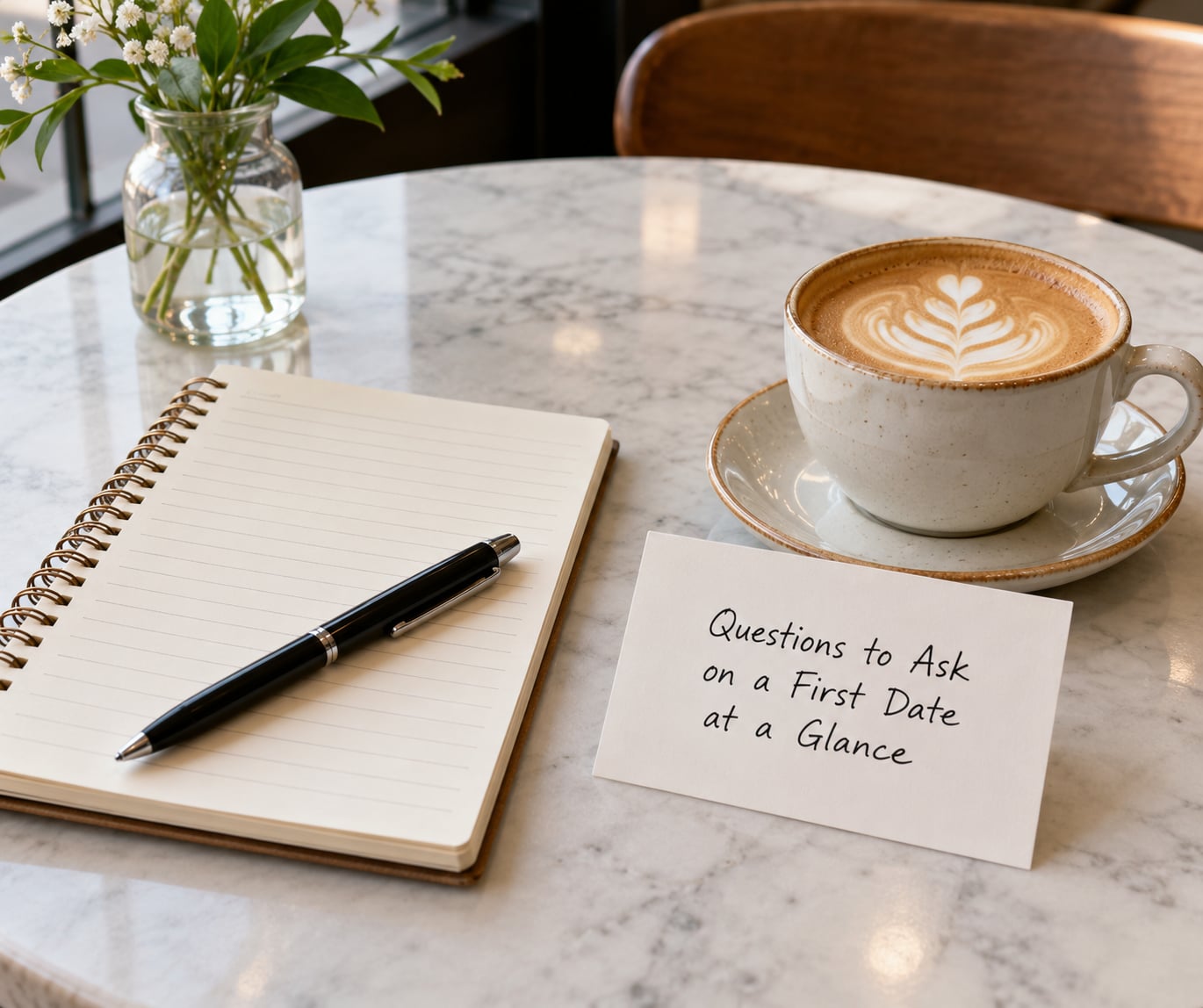
Each prompt below is listed with what it reveals and when it lands best, so you can pick two or three that suit the setting you’re actually in.
- One of your favorite memories from this year? Reveals storytelling style, family ties, what they light up about. Best in the opening minutes, once coffee arrives.
- What are you most looking forward to right now? Reveals current focus and where their attention is going. Best early, after one story lands.
- Something you have tried recently that you enjoyed? Reveals willingness to try things and current hobbies. Best in the middle of the date, especially on a walk.
- Free weekend with nothing scheduled, so how would you spend it? Reveals how they rest, spend and prioritise. Best any time the energy is relaxed.
- Something most people do not know about you? Reveals depth below the profile facts. Best midway, once both people have relaxed.
- What are you passionate about, and how did that start? Reveals origins, influences and long-running interests. Best mid-to-late, when stories are flowing.
- Something you would love to learn? Reveals curiosity and future plans. Best when the conversation turns light.
- Something you value in a close relationship? Reveals what they actually want from connection. Best later, if mutual interest is clear.
- How do you make your free time feel restorative? Reveals stress habits and self-treatment. Best in the evening, if the date has gone well.
- Something on your list you hope to do soon? Reveals future plans and a natural reason to talk again. Best in the last fifteen minutes, as the date winds down.
Questions to ask on a first date: how many is too many
Roughly six to eight real questions in a 90-minute date. More than that and you are working down a list, which both people can feel. Fewer than four and you might be chatting about the weather for an hour without ever landing on anything real.
The other half of pacing is listening. Talk roughly 30 percent and listen roughly 70 percent, and after each answer ask one follow-up drawn from what they actually said. Reddit’s dating communities call this the ping-pong rule, and it is the single most repeated piece of advice in those threads: relate briefly, then follow up, rather than firing the next scripted prompt.
1. What has been one of your favorite memories from this year?
This is a strong opener because “favorite” forces a choice and “memory” forces a scene. People answer with a trip, a parent’s kitchen, a small party that went sideways. Whatever they pick gives you three or four threads to pull without inventing anything.
It also sidesteps the tired opener. Nobody’s profile tells you what they did since the last time they updated it, so the answer is guaranteed to be new information to you.
What to listen for: whether they describe people or places rather than achievements. That tells you something about what they narrate their life through.
2. What are you most looking forward to right now?
“Right now” is doing the work in this one. It pulls a current answer rather than a rehearsed life plan, so you learn what is actually occupying them this month instead of where they think they should be headed.
People tend to answer honestly here because there is nothing to prove. A trip they’re saving for, a launch at work, a parent’s health scare, a course they signed up to. Follow up on the specifics and you get real texture.
What to listen for: whether the answer includes other people. Someone whose excitement is entirely solo is telling you something about how they build their life.
3. What is something you have tried recently that you enjoyed?
Recent and enjoyed are both load-bearing words. “Recent” keeps it current, and “enjoyed” means they have already done it, so the answer comes with a story attached rather than a list of things they meant to try.
This is the question that quietly reveals your date. Someone who tried a pottery class, a trail run, or a language app will tell you more about their energy in ten seconds than any job title will.
What to listen for: the gap between what they tried and whether they stuck with it. Novice enthusiasm with no follow-through is worth noticing, though rarely worth challenging on date one.
4. If you had a completely free weekend, how would you spend it?
Hypothetical framing takes the pressure off. Nobody is being graded on a real plan, so they can be as specific or as silly as they like, and both make for good material.
The answer shows how they decompress. Some people need silence and no plans. Some describe a Saturday that involves eleven other people. Neither is wrong, but the difference matters when you are trying to work out whether you would want a free weekend with this person.
Ask it when the energy is relaxed rather than formal. It works well on a walk or over a second drink, where a slightly imaginative question fits the mood.
5. What is something most people do not know about you?
This question is an invitation and a test at the same time. How they handle it says plenty: some people light up with a genuinely odd detail, others deflect, and a few hand you a rehearsed vulnerability they have clearly used before.
The move that makes this work is slowing down. If someone offers you something small and strange, meet it with the same smallness. Answering with your own odd detail first, and then staying with their answer, gets you a real exchange instead of a rapid-fire interview.
What to listen for: does the answer have a story in it, or is it a one-line flex? And does it come with any attempt to know you back?
6. What are you passionate about, and how did that start?
Almost every good interest has an origin story, and the origin is where the values show up. Someone who got into baking from a grandmother, and someone who got into it from a competitive cooking show, give you two very different people.
The how-did-that-start half is what sets this apart from a hobbies interview. You end up talking about who shaped them rather than collecting facts about their free time.
What to listen for: how old they were when it started. Passion picked up in childhood usually has a longer runway than something adopted two years ago, and long-run interests tend to survive a bad week.
7. What is something you would love to learn?
Good at any point the mood turns playful. It assumes nobody has mastered everything, which is true, and it gives you both an easy place to admit ignorance without it feeling like a weakness.
The best answers are specific. Someone who wants to sail, repair a watch, or speak Italian has an actual destination, and that destination turns into something you could do together later if the date goes well.
What to listen for: whether the thing is aspirational or evasive. “I want to learn a language” with no detail is a placeholder answer. “I want to learn enough Spanish to order food in Oaxaca” is a real one.
8. What is something you value in a close relationship?
This is the question that moves past small talk, and it needs handling with some care. Ask it later rather than early, and phrase it as a value rather than a demand. If mutual interest is clear by the time it comes up, most people answer it with real relief rather than defensiveness.
Listen for how they talk about other people in general, since that predicts how they will talk about you. Someone whose close relationships are all long friendships with a bit of space in them is describing a pattern, not one relationship.
What to listen for: consistency between what they say they value and what you have already seen. Watch for answers that are entirely about what other people do wrong.
9. How do you usually make your free time feel restorative?
This is a question about habits rather than opinions, and habits are harder to fake. It also opens the door to the ordinary stuff people rarely get asked about, which tends to be where the comfortable silence stops being awkward.
Answers range from exercise and cooking to doing absolutely nothing on a Sunday. Follow up on the boring details, because that is exactly where a person’s real life shows through.
What to listen for: whether they treat rest as something they have earned or something they have to justify. It is a small question with a decent read on how they treat their own needs.
10. What is something on your list that you hope to do soon?
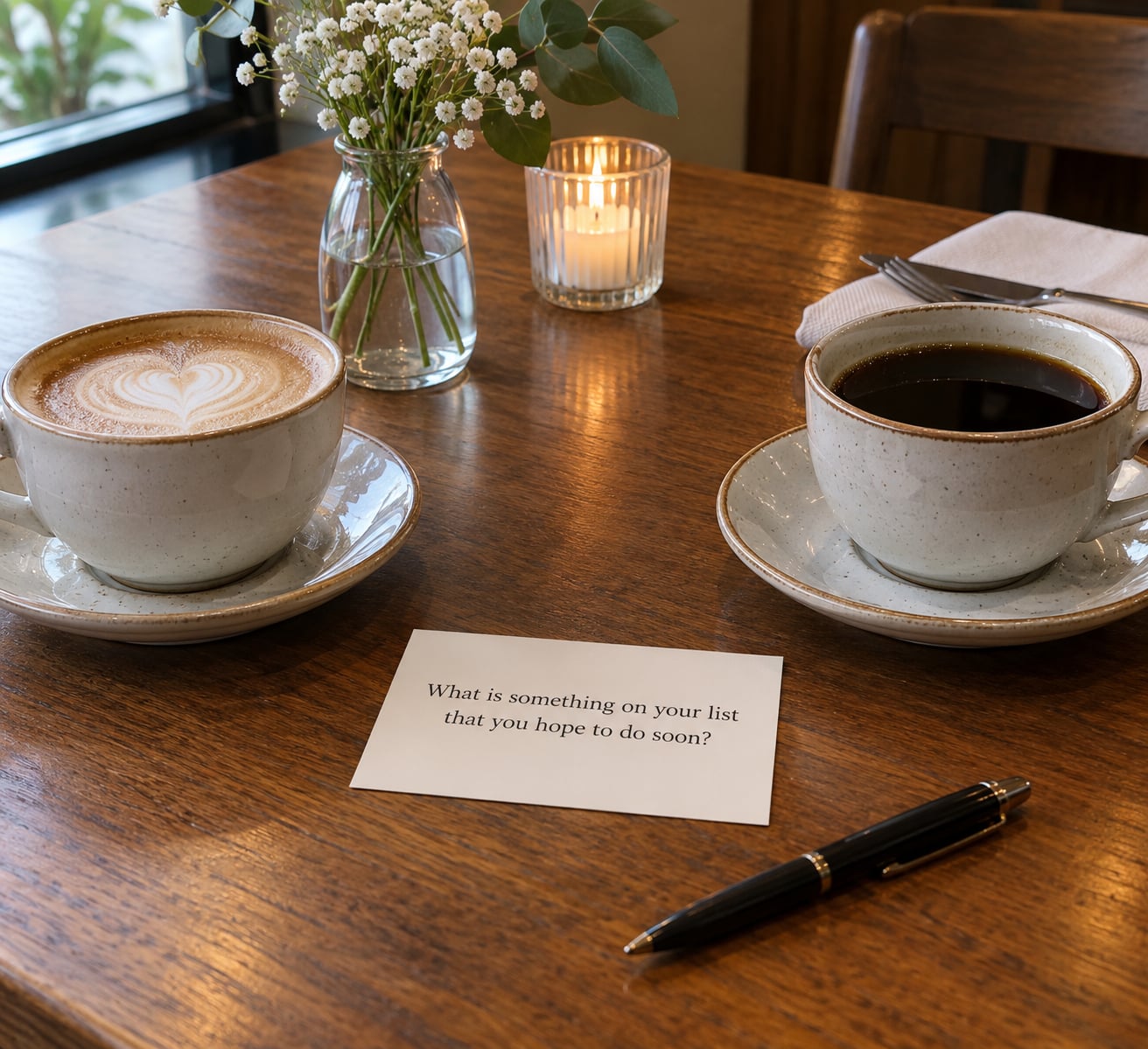
A forward-looking question is a natural way to close, because it hands the conversation somewhere to go next. Even if you never see each other again, you both leave with a plan that is not about a second date.
If the answer is a place, a show, an event or an activity you could both do, you have just been given an easy reason to suggest seeing each other again without making it sound like a verdict on the evening.
Ask it in the last fifteen minutes, not earlier. Early on, a bucket-list question can feel like you are already angling for date number two.
Frequently Asked Questions
How many questions should you ask on a first date?
Aim for six to eight real questions in a 90-minute date. That leaves room for follow-ups, which matter more than the questions themselves. If you are asking more than one question without the other person having properly answered the last one, you have turned a conversation into an interview. Follow the ping-pong rule instead: one question, a full answer, one follow-up, then whatever comes naturally.
How do you keep the conversation going without it feeling like an interview?
Stop moving through prompts and start responding to answers. When they mention a hobby, relate to it briefly and ask one thing about it, then let the thread develop naturally. Talk roughly 30 percent and listen roughly 70 percent. Interview feeling comes from speed, not from the subject matter, so slowing your delivery fixes most of it.
What are good flirty questions to ask on a first date?
Keep flirty questions playful and low-stakes rather than intense. Good ones ask what they are terrible at, whether they are a morning person, whether they would rather have a long drive or a short trip, or what their ideal first date looks like. Ask them with a smile and let your date set the temperature. If they answer seriously or with discomfort, switch back to something light.
How do you recover when someone gives you a one-word answer?
Do not fire the next question at them. One-word answers usually mean nervous, uninterested, or thinking, so rephrase and make it easier to answer: if they say they like cooking, ask which dish they cook most often. If you still get a short answer twice, accept it, share something about yourself, and give them room to re-engage. Sometimes the quiet stretch passes on its own.
How deep should first date questions go?
Depth should rise gradually, not jump. Start with memories and current interests, move into values once both people are relaxed, and leave anything genuinely heavy for a later date. Trauma, detailed medical history, and detailed accounts of why an ex behaved badly are the things most people agree belong much later. The test is whether the question invites a story or asks someone to perform a wound.
Should you ask about kids, religion or other dealbreakers on a first date?
You do not have to, and many people save genuine dealbreakers for a second or third date. If you do raise them, frame it as a preference rather than a demand, and make it two-way: tell them what matters to you and ask the same back. Whether someone wants children is close to unavoidable eventually, so hearing an honest answer early can save both people real time.
Pick two questions from this list, one for the opening and one for the middle, and let the rest go. Ask them slowly, follow up on whatever comes back, and spend more of the evening listening than talking. That is the whole job, and nobody on a first date expects more than that.