
A situationship is a romantic or sexual connection that has never been defined. There is no agreed label, no exclusivity, no talk of a future, and often no honest conversation about any of it, even though the two of you have real intimacy and real feelings. Recognizing one is less about a single behaviour and more about noticing a pattern that has stopped moving.
The honest version of this article’s question is usually not “what is a situationship.” It is “is this a situationship, or am I just anxious and reading into something normal?” Those feel identical from the inside, which is why so many people end up on relationship forums at two in the morning asking strangers to read their text history back to them. The people answering almost always land on the same conclusion: the label matters far less than whether you and the other person want the same thing.
So here is the honest version. There are six behavioural signs that separate an undefined connection from an ordinary early-stage relationship, one question that resolves most of the ambiguity in about a minute, and a set of next steps that work whether you want it to become something or you have quietly decided it should not.
Table of Contents→
- How to Recognize a Situationship
- What Is a Situationship?
- Clear Signs You Are in a Situationship
- How to Tell the Difference Between a Situationship and a Relationship
- Why Do Situationships Happen?
- What to Do If You Think You Are in a Situationship
- 1. Assess the pattern, not the moment
- 2. Decide what you actually want
- 3. Pick the moment and say the specific thing
- 4. Read the response rather than the words
- 5. Set your own deadline
- 6. If you caught feelings, say so plainly
- 7. If they will not define it, decide what you can live with
- 8. Know when you are the one who is stuck
- 9. If you are leaving, leave properly
- Frequently Asked Questions
- Conclusion
How to Recognize a Situationship
You have a situationship when the connection is real but the agreement is missing. The central distinction is not intimacy, because plenty of situationships involve more physical and emotional intimacy than some marriages. It is that nobody has said out loud what you are to each other, and both of you have quietly accepted that the question will not be raised.
Three things give it away fastest. First, you cannot plan anything more than a few days out. Second, you have no idea whether the other person is seeing anyone else, and asking is unthinkable. Third, when the topic comes up, the conversation slides sideways into something else.
There is a test question that works on almost everyone: if this ended tomorrow, how would each of you feel, and would you both feel the same thing? Sit with it for a day before you answer. People who have named what they are usually have a fairly clear reaction. People in a situationship often cannot get past the first half of the sentence.
Self-diagnosis is hard for three reasons, and none of them are that you are bad at relationships. The first is that most signs are absences, and absences are easy to overlook when you are hoping. The second is asymmetry: when one person has fallen further than the other, the invested person usually interprets every inconsistency as a sign the feeling is mutual. The third is that the question is socially embarrassing. Plenty of people have told no one, which removes the one set of eyes that would say anything useful.
That embarrassment has its own fingerprint online. There are entire communities built around this one question, including subreddits devoted to situationships and to situationship advice specifically, and large relationship forums where “am I in a situationship?” is one of the most repeated post titles. When a question gets its own subreddit, it is not a fringe worry.
What Is a Situationship?
A situationship is any romantic or sexual connection that exists without a mutual agreement about its nature, its exclusivity, or its future. That is the whole definition. Everything else people attach to the word is interpretation.
The term itself is recent. It entered common dating discourse around 2017, largely online and among dating-app users, as a shorthand for something that existed long before anyone had a word for it. Surveys of young adults have found that roughly half of American Gen Z have been in one at some point, which is why the label feels more mainstream now than it did a decade ago.
It helps to separate it from the arrangements people often confuse it with.
Casual dating usually has an understood rule that neither person is looking for something serious, and that rule is discussed, even if briefly. In a situationship, the ambiguity is rarely out loud.
Friends with benefits is usually a deliberate arrangement between friends, often with a prior friendship and often with an agreement not to develop feelings. A situationship lacks the deliberate part, which is why it catches people off guard.
A friendship stays friendship-shaped because neither party is feeding it romantic expectation. The moment one person starts hoping, it is no longer the same category.
An exclusive relationship involves two things you can actually point to: a shared label and a stated position on other people. One of those is usually enough to make it a relationship, even if you never said the word.
None of these labels are as important as whether four things are clear: what you expect, how available each of you is, what you each want, and where the boundaries sit. Where those are clear, the label is mostly decoration. Where all four are unclear, you are in a situationship no matter what either of you calls it.
Clear Signs You Are in a Situationship
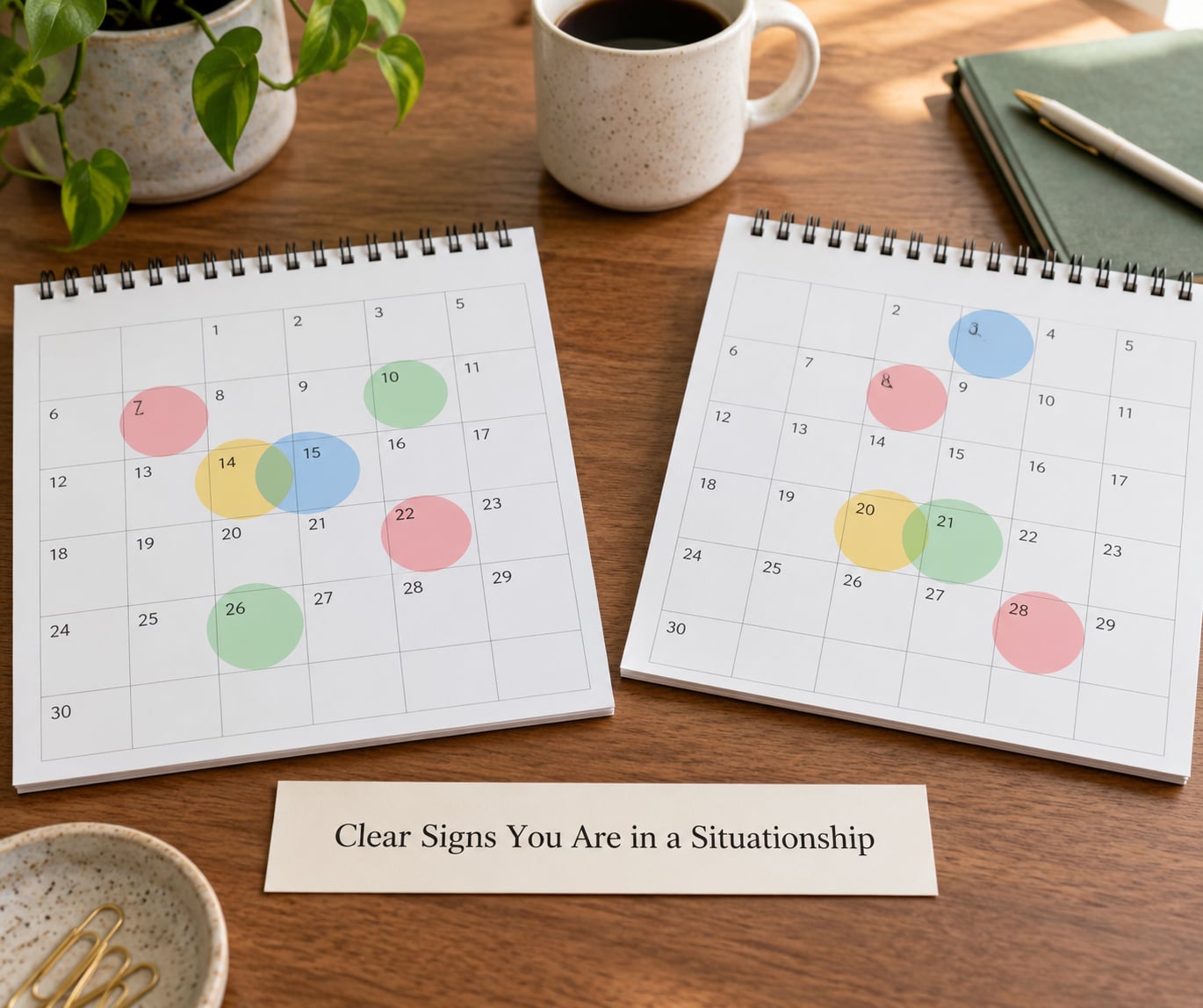
These are patterns, not moments. One weird week proves nothing; three of the following, repeated over months, describe a situation rather than a bad run of luck.
Intimity with no conversation about what you are
You have slept together, or nearly, and told each other things you have not told anyone else. And yet nobody has ever said “we are dating” or “I don’t see myself doing this with anyone else.” The absence is usually disguised as reassurance. They will tell you they really like you. They just will not attach a category to it.
Watch for the sentence that sounds like a definition and is actually a dodge. “I don’t really do labels,” “I don’t want things to get complicated,” and “let’s just see how it goes” all feel like honesty in the moment, and all three leave you exactly where you started a month ago.
Plans that never stretch past this week
Thursday you might do something. Saturday is maybe open. There is no month where both of your calendars are visible to the other person, because nobody has asked. If a holiday, a trip, or a work deadline came up, you would have no idea whether you are meant to be part of it.
This one is often mistaken for a busy person rather than a sign. Sometimes it is genuinely a busy person. Test it by asking for something three weeks out and watching what happens: a firm no is fine and honest, a vague maybe followed by silence is not.
You live outside their frame
You have never met their friends. You do not know what they told their family about you, because they have not said. Their social media shows a life that does not include you, and when you appear in a photo it is cropped, dimmed, or a distant table.
The inverse is worth noticing too. If you are the one hiding, or explaining them away to your own friends, you may be keeping this undefined rather than discovering that they are.
The availability question has no answer
You do not know whether you are exclusive. Neither do they, as far as you can tell. They have not said they are seeing others, and they have not said they are not, and the subject has never come up in a way that required honesty.
Google searches for their name turning up a dating profile is the common version of this, and it is worth naming plainly: checking someone’s profile after they have not told you is a reasonable way to learn something you should have been told. Snooping is not a strategy, but it is a diagnostic.
The connection stopped growing
Early on it built quickly. Now the range of what you talk about has narrowed to a fixed set: the last show, a work complaint, an inside joke from month one. You have not met anyone new in each other’s lives. The relationship is not failing, it is simply parked.
Psychologists who write about this call it a relationship that does not grow or end, and it is one of the cleanest signs, because growth at the start is nearly automatic. Stalling is the unusual part.
You are doing all the managing
You remember the thing they mentioned once in week two. You suggest plans, follow up, and keep the conversation going. When you stop initiating, it goes quiet, and the quiet does not get repaired.
This is the sign people argue about most, because it sounds like an accusation. It is not about blame. It is about effort that is one-sided, which tells you something real about where this sits for them.
How to Tell the Difference Between a Situationship and a Relationship
Compare the structures, not the individual behaviours. One inconsistency is a bad week. A consistent gap across every row below is a situationship.
| Dimension | Situationship | Friends with benefits | Talking stage | Exclusive relationship |
|---|---|---|---|---|
| Label discussed | Never | Yes, the arrangement is named | Not yet, but moving toward it | Yes |
| Exclusivity | Unknown or denied | Explicitly not exclusive | Unstated but assumed | Stated by both people |
| Physical intimacy | Often yes | Yes, that is the point | Varies | Yes, when both want it |
| Emotional depth | High, and one-sided more often than not | Usually kept shallow on purpose | Building | High on both sides |
| Future plans | Never discussed | Explicitly excluded | Discussed in general terms | Discussed with specifics |
| Typical end | Drifts, or one person asks and the other avoids | Agreed in advance, often with a check-in | Either defines it or ends | Discussed when it is tested |
| Best for | Nobody in particular, which is the problem | People who genuinely want no romance | People still getting to know each other | People who want a partner |
Time is the other axis, and it is the one nobody gives readers a number for.
Weeks one and two. Nothing is unusual yet. Very few people define anything in the first two weeks, and wanting to is a sign of skipping steps rather than of healthy pace. If you are already anxious here, that is anxiety, not a situationship.
Month one. You are still in the talking stage. The normal pattern is increasing frequency, longer conversations, meeting a friend or two, and an emerging sense of whether this is heading somewhere. A month in, you should be able to name something that is growing. If everything is exactly where it started, that is worth watching.
Months two and three. This is where the label usually happens, or at least where both people admit what the label would be. Someone who genuinely wants a relationship has usually said something by now, even if it is only “I like seeing you.” “Let’s not make it weird” at this stage is information.
Month four and beyond. If there is still no conversation, no exclusivity, and no growth, this is not caution. It is the arrangement.
One honest note on timing: nobody can tell you a universal number of weeks, because people move at genuinely different speeds. Use the shape of the change rather than the calendar. Direction matters more than duration.
Why Do Situationships Happen?
Most of these reasons are reasonable. That is what makes them hard to argue with.
Fear of commitment. Some people have been hurt by a relationship and would rather keep the reward than risk the loss. Nothing about this makes them bad people; it does mean the situation will not resolve itself without someone being willing to go first.
A relationship that just ended. Many situationships are rebounds that never got named as such. Someone is on a break they are still recovering from, and neither wants to be the person who admits they are not over it.
Different definitions of dating. One of you may treat a connection as a relationship the moment feelings appear, while the other treats the same behaviour as getting to know someone. Both are sincere, and the gap between them is invisible until someone says which definition they are using.
Emotional convenience. A situationship offers closeness with none of the administrative parts: no expectations to remember, no disagreements about money or family, no end date. For someone whose last relationship involved moving in, this is genuinely restful. It also means nobody is doing the work.
Loneliness. A lot of them are scaffolding. Someone is far from home, between jobs, or fresh out of a breakup, and a warm recurring connection fills a gap that a friendship cannot quite reach.
Avoiding one difficult conversation. Often this is the whole cause. Both people can see the same mismatch, and both prefer to keep a good thing rather than risk a conversation that might end it.
Two structural forces are worth naming too. Attachment style explains a lot of the pattern: people with avoidant attachment often pull back precisely when closeness increases, while people with anxious attachment read that pullback as a verdict and chase, which produces exactly the hot-and-cold rhythm both styles recognise. And dating apps make undefined easy to find. When options are abundant and switching costs nothing, holding something loosely costs the chooser very little, and the person waiting for clarity carries all of the risk.
One more possibility, and it is the one people skip. Sometimes the person keeping things undefined is you. Not deliberately, and not out of manipulation, but because you are enjoying the attention, or because naming it would turn something easy into something you would have to be responsible for. Take that possibility seriously before you decide they are the problem.
What to Do If You Think You Are in a Situationship
Here is the sequence that works, in order. Skipping to the last step is why people stay stuck for a year.
1. Assess the pattern, not the moment
Go back through the last eight weeks and count the signs above, not your feelings. Feelings are unreliable evidence, because hope and anxiety produce identical symptoms. Behaviour over time is more honest, and it is also easier to talk about without sounding emotional.
2. Decide what you actually want
Before you ask anyone anything, answer this for yourself. A real relationship? Something casual that stays casual? No romantic involvement at all? These are all legitimate answers. What does not work is asking for clarity while hoping for a specific answer, because you will hear what you wanted rather than what was said.
3. Pick the moment and say the specific thing
Not over text, not at 1 a.m., not as an accusation. Somewhere calm and unhurried, ideally in person or on a call where you can both hear tone.
Then be concrete. Vague openings get vague answers, because they leave room to dodge. Try: “I want to keep seeing you. I also want to know what this is to you, and I’d rather hear the real answer than keep guessing.” Or: “I’ve been enjoying this, and I’m starting to want something more. Are you in the same place?” Or, if exclusivity is your actual question: “I care about this, and the not-knowing is what’s wearing me down. Are we seeing other people?”
4. Read the response rather than the words
This is the part nobody teaches. What they say matters less than what they do with the question.
If they answer directly, even uncomfortably, that is a good sign. Difficulty is not the same as avoidance; a person who says “I don’t think I want a relationship right now” has respected you.
If they change the subject, make a joke, or reply with “why do we have to define everything,” you now have your answer. Deflection is a position, even when it is delivered cheerfully.
If you get a clear yes, ask what it means in practice: exclusive, and seeing where this goes. Agreement on a label with no change in behaviour is not agreement.
Give it a beat before you react to a delay. A few days to think is healthy. Two weeks of silence after a direct question is a complete answer.
5. Set your own deadline
Pick a date, roughly two weeks out, by which you will revisit this with yourself regardless of what happens. Deadlines are what turn an open-ended arrangement into a decision, and they also protect you from the arrangement simply continuing because nobody wants to be the one to end it.
6. If you caught feelings, say so plainly
This is the most common version by a wide margin, and the one people handle worst. “I’ve caught feelings and I want more than this” is a complete sentence. It does not need to be dressed up, and it does not need to be softened with a joke afterwards.
You are not requesting permission to have feelings. You are giving information and asking for a decision, which is information they get to act on. If they already know and have been hoping you would not mention it, saying it is the first honest move available to you.
7. If they will not define it, decide what you can live with
Some people genuinely cannot do what you are asking, and repeating the request will not change that. At that point you have two real options: accept the arrangement as it is, in full knowledge of what it costs you, or leave. What does not work is staying in the hope zone while pretending you have accepted it.
If you stay, say out loud what you are agreeing to. “I know we’re not exclusive and I know this has no future, and I’m choosing this anyway” is a legitimate position. It stops the anxiety, because the anxiety is mostly about hope.
8. Know when you are the one who is stuck
You can be right about every sign and still be the reason it continues. If you are the one who keeps initiating, keeps replying at 2 a.m., keeps making plans that only require one evening, you may be the one who has not actually accepted that it is undefined. Being honest with yourself about that is not blame. It is the fastest way out.
9. If you are leaving, leave properly
Say it in a sentence rather than gradually disappearing, which is ghosting with extra steps and leaves you doing the rumination later. Something like: “This isn’t working for me and I’ve decided to step back. I wish you well” is enough. Do not ask for a discussion you have already had.
Then expect the reappearance, because undefined connections rarely end cleanly. There will be a text a few weeks later, at a low moment, that is warm and interested and contains no change. Do not confuse movement with change. Judge the next six weeks by what they do, not by how the message felt.
Finally: tell someone. The shame that keeps people quietly stuck is the single most useless thing in this situation, and it disappears the second you say the sentence out loud to a friend who is not invested in the outcome.
Frequently Asked Questions
Can a situationship turn into a real relationship?
Yes, it can, but it does not happen on its own. Situationships that become relationships share a pattern: both people eventually admit they want something more, and the shift tends to come from a specific moment rather than from slow drift. The longer a connection stays undefined, the less likely a definition is, because both people have quietly built separate expectations around what it is. If nothing changes in the next few weeks, it will not change on its own either. Ask, or decide it is not going to happen.
Does sleeping with someone in a situationship count as cheating?
It counts as cheating if there was an agreement about exclusivity, and it counts as something else entirely if there was not. That is the problem with situationships: without a stated position on other people, both people are drawing lines from different assumptions and neither can be accused of breaking a rule that was never said out loud. This is also why exclusivity is worth raising directly. Most hurt in this situation are not caused by what happened, but by finding out later that the other person had been seeing someone else the whole time.
How long should you wait before asking to define the relationship?
There is no universal number, but there is a useful shape. In the first two weeks, asking is usually premature. By month one, you should see something growing. Between months two and three, most people have named it or admitted they are not going to. Past month four with no conversation, no exclusivity and no growth, waiting longer will not produce a definition. Judge by direction rather than dates: if things are getting closer over time, patience is reasonable. If the shape of it has been identical for weeks, the answer is not coming by itself.
Is a situationship healthy?
Sometimes, genuinely, and there is nothing inherently wrong with one. It is healthy when both people want the same thing, both say so out loud, and neither is quietly hoping for something different. It is unhealthy when one person is invested, the other is not, and nobody is willing to name that gap. The label is not the problem. Asymmetry is the problem, and so is dishonesty, whether deliberate or just convenient. One honest conversation resolves most situationships that were quietly hurting someone.
What do I do if they refuse to define the relationship?
Accept that you have your answer, even if the answer is unsatisfying. Deflecting a direct question is a position, not a delay, and repeating the request will not change a pattern that has already repeated for months. Your options are to accept the arrangement as it is in full knowledge of what it means, or to step away. What does not work is staying in the hope zone while acting as though you have accepted it, because that is what keeps people stuck for years. You are allowed to want something and still leave.
Conclusion
Stop trying to identify the single moment that proved it. Review the last two months of behaviour and count the signs, because a situationship is a pattern that stopped moving, not an incident you can point to. Then pick one of three honest options and act on it: say the specific thing out loud and see what comes back, agree in advance on what this arrangement is and stop hoping for more, or leave without fading out.
Whichever you choose, the useful thing you have after the conversation is information. You already know the two things you cannot live without. They do not.