
Ghosting is when someone abruptly stops replying to your messages and cuts off contact with no explanation and no warning. To get over being ghosted, you stop chasing for a reason, stop checking for a message, let the disappointment land instead of swallowing it, and rebuild your routine without them. That takes weeks for some people and months for others, and most of the delay comes from the rumination, not from the relationship itself.
The reason ghosting lands harder than a normal breakup is that a breakup at least has a sentence attached to it. When the messages just stop, your brain gets handed an open question instead of a closed one, and an open question gets picked at. That pattern has a clinical name: ambiguous loss. You know the relationship ended, but you have no ending to hold, so your mind keeps re-running the search for a reason.
Here is the short version of what to do in the next 24 hours.
- Stop chasing and accept the silence. No double text, no follow-up on your last message, no mutual-friend probe asking whether they mentioned you.
- Mute or remove the source. Archive the conversation, leave read receipts off, and take their posts out of your feed so you are not checking their life daily.
- Process the disappointment instead of arguing with it. Name what you lost, tell one trusted person, and let the feeling be proportional to what you actually invested, not to how official the relationship was.
- Protect your routine. Sleep, food, movement, daylight, one commitment that has nothing to do with dating. You will feel worse before you feel better, and the basics are what carry you through that stretch.
One more thing worth saying early: their silence is information about their capacity to be a decent partner. It is not a verdict on your worth, and the people who would have said something kind are not the ones leaving you guessing.
What You Need Before You Start
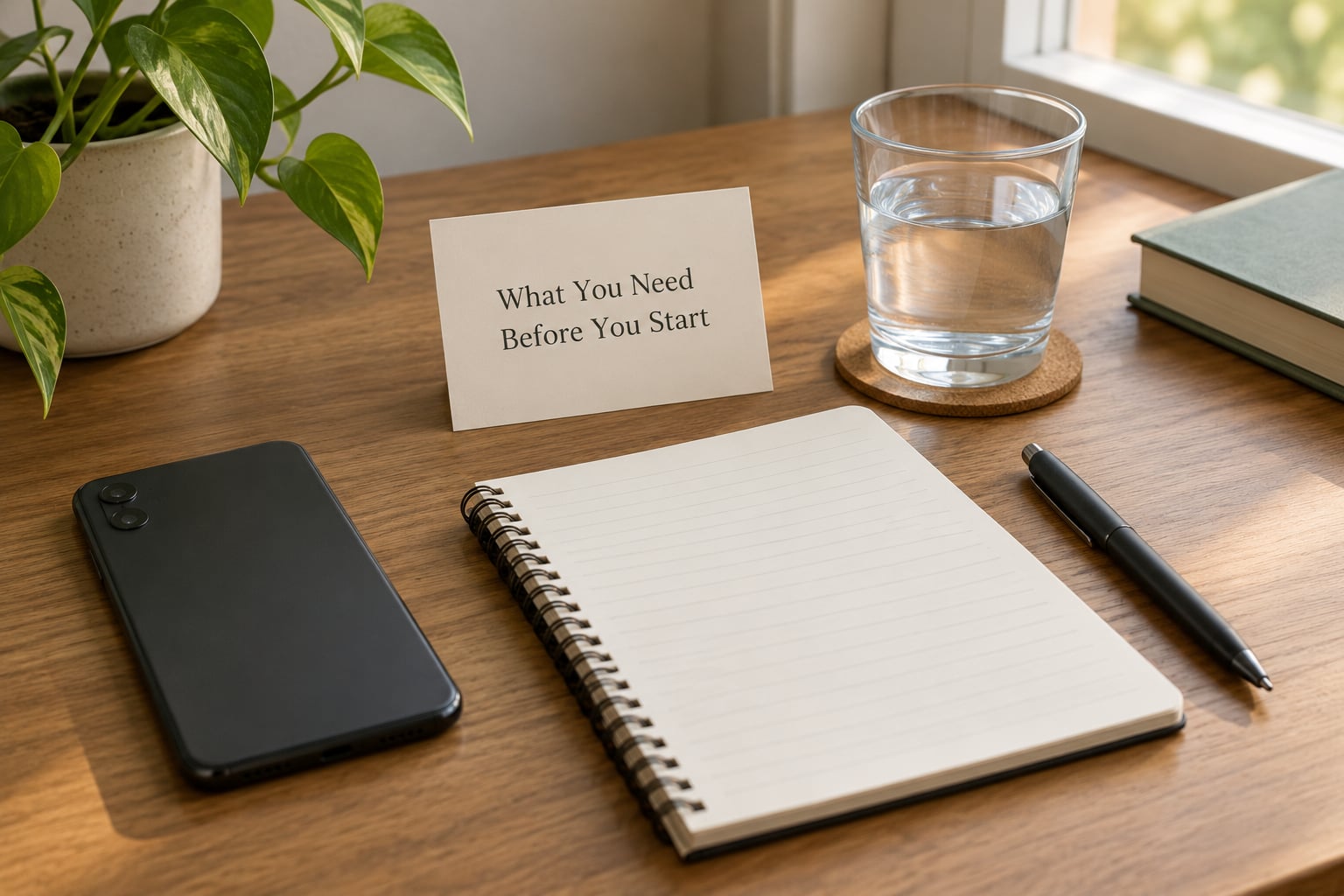
Four things. None of them are expensive or complicated, and you can set them up in an evening before you start working through this.
One grounding tool. This is whatever reliably brings you back into your body: five slow breaths, a cold glass of water, a 20-minute walk, a playlist you have worn out. The point is not the technique. The point is that you need one thing you can reach for in 90 seconds when the phone-checking urge spikes, and it has to already be in your hands.
One person, told in advance. Not a group chat and not a mutual friend of the ghoster. One friend or sibling who will not start solving the problem for you or start drafting your reply at 11pm. Tell them what happened in plain terms, tell them what you want from them (listening, mostly), and agree that they will check in on Thursday.
A way to limit the checking. This is the piece most people skip and most people need. Depending on the app, that means turning off read receipts, unmatching or hiding profile views, muting the account, or simply moving the conversation out of the home screen so it stops appearing every time you unlock the phone.
A private record of what happened. A note in your phone, not something you will post anywhere. Write what actually happened, in order, in plain facts: the date of the last real conversation, the date of the last message, anything that was left unresolved. This matters more than it sounds, because the alternative is that your memory fills the gaps with the worst available guess, and you will be reacting to that guess for weeks.
How to Get Over Being Ghosted, Step by Step
Pause the search for an explanation

Start by sorting three separate piles, because this is where most people get stuck. Pile one is known facts. Pile two is your assumptions. Pile three is the part you currently cannot verify at all.
A worked example. Known facts: the last conversation was on a Tuesday and it ran about forty minutes. You made plans for the weekend and they never confirmed. Your messages have sat unread for nine days. Assumptions: they saw your weekend message and decided not to come, they lost interest, they are deactivating their account, they thought you were pushy. Unverifiable: whether they are going through something serious, whether another person is in the picture, whether anything you said mattered.
Pile two and pile three are where all the pain lives, and neither one is going to resolve by opening the thread again. Rereading the conversation does not produce new information. It only produces new interpretations, which is why it feels productive for ten minutes and then leaves you worse off.
Try tolerating the gap on purpose rather than filling it. Set a date, ten days after the last message, for deciding it is over regardless of what you learn. Until then, no investigation, no rereading, no mutual-friend intelligence. Researchers who study this area have a useful label for the whole phenomenon: people ghost using a one-sided dissolution strategy, which is a clinical way of saying they got all the benefits of ending it and none of the discomfort.
Let yourself feel the disappointment
Here is the part most advice gets wrong. Being ghosted after three weeks can hurt more than being dumped after three years, and that is not a sign that you are being silly or dramatic. Pain tracks the depth of what you felt, not the length of the paperwork. People describe sitting in a genuine crisis after a single date that went unusually well, and nobody is silly for that.
So name the feeling precisely rather than in general terms. Not “I’m sad” but “I was hoping to see him again on Saturday and now I don’t know whether that was ever real.” Vague feelings feel bottomless; specific ones have edges, and you can hold an edge.
Then tell your one person. Say the version you have been rehearsing too carefully and let it come out badly the first time. Forum threads on this topic run long for a reason, and the pattern in them is consistent: the thing that unsticks people is not insight, it is saying the unedited version out loud to someone who was not there when the messages stopped coming in.
The last piece is resisting the story that their silence says something about you. That story usually goes: they saw something clearly that you could not, and once you know what it was you can fix it. It is a very plausible-sounding story built on zero information. You did not get a performance review. You got a behaviour, and the behaviour reflects the person doing it.
Stop checking for a message
This is the single habit that keeps people stuck for months, because checking is a low-effort action that briefly takes your mind off the problem and then hands it right back. The fix is structural, not motivational.
- Archive or delete the conversation. Deleting is fine even if you would like an apology someday. Screenshot first if you need the evidence, then close it. Keeping the thread live on your home screen is the same as leaving a door open.
- Turn off read receipts and typing indicators. Depending on the platform, turn them off for yourself too, so the app stops telling you whether you have been read. Knowing you have been read without a reply is close to the worst available information.
- Mute, restrict or unmatch. You do not need an unfollow announcement. If seeing a new story is what derails your evening, hide it.
- Give the phone a schedule. Check your messages at two fixed points a day. Genuinely, two. The other thirteen hours you were not refreshing anything.
- Replace the check with something physical. Stand up, run water, go outside, do the dishes. The substitution has to be boring and immediate, because the alternative wins on ease every time.
One genuine exception: if there is money, a shared plan, or something of theirs you need back, that is a request, not a reconnection. Keep it to a single factual line, send it once, and do not follow up if the answer does not arrive.
Rebuild your routine and self-confidence
Now the part that sounds generic and is actually the mechanism that moves the needle. Your brain learns what to repeat from what you repeat, and after a few weeks of checking a phone, your days have restructured themselves around one open question.
Rebuild deliberately. Return to the one or two routines you dropped, because they were dropped for a reason and they are worth reclaiming. Get outside and move most days, not as wellness theatre but because it reliably lowers the physical restlessness that comes with an unfinished situation. Keep one commitment with no dating attached to it: a class, a project, a shift, a Sunday match, a language app.
Give it three to four weeks before you evaluate it. Routine does not feel like healing while you are inside it.
Then do an honest self-check, because healing and rumination can look identical from the outside. Both mean thinking about the person constantly.
- Healing: the memory surfaces, hurts for an hour, and then lets go without an action attached to it.
- Rumination: the memory surfaces and immediately produces a task: check the profile, write a message, ask a friend, work out what you did wrong.
If every appearance leads to an action, you are still running the search. Not because you are doing anything wrong, but because you have built the search into the only structure your days have right now. Put the energy somewhere else.
Decide whether to reconnect or move on for good
Most of the anxiety here comes from not knowing where the threshold is between “busy” and “the answer.” Here is how the evidence tends to run.
A delayed reply is not ghosting. People get sick, lose jobs, travel, deal with a dying relative, or simply exist badly for a while. If someone engages warmly and fully when they do reply, you have a busy person, not a ghoster.
A pattern of disappearing is ghosting. Some people decline every single invitation, vanish for days after any hint of closeness, and reappear on schedule with a meme or a “hey, you around?” every few weeks. That is not busyness. That is a person managing their own discomfort by keeping you on standby.
Second one of those is worth naming: partial contact is harder to get over than total silence, because every crumb resets the countdown.
So, do you send one final message? My read is that sending nothing is usually the stronger move, and it is close to the consensus in the online communities that write about this most often. Several posters describe sending a closing text and getting nothing back, then realising they had simply handed the ghoster a way to feel relieved rather than accountable.
There are reasonable exceptions. Send one message when there is something practical to settle, or when the silence followed an argument where you think you said something genuinely unfair and you would rather be the bigger person than be right. Keep it short, ask for nothing, and do not explain yourself twice:
Taking a step back. Wishing you well.
No hard feelings from my end. I would rather not keep checking.
No reply needed. I am moving on either way.
What to avoid is any message that asks for closure. “Why did you do this,” “give me one reason,” “was it something I did” all hand the other person a task, and people who withdrew generally did not withdraw because they wanted to have that conversation.
What if they come back? Give yourself one standard question: has anything actually changed? A birthday message six months later, an apology with no specifics, or a “hey, you around?” is not change. If the answer is no, you can reply politely and shut the door, or not reply at all, and both are fine.
One more situation deserves a specific answer: mutual friends. The general preference, both from therapists and from people living it, is to leave the friend group relationship alone and do not use friends as intelligence. Do not ask, do not hint, do not go looking for their new partner. If someone who genuinely cares about you volunteers information you did not ask for, accept it and change the subject.
And if this keeps happening, or if this one landed on top of an old wound, that is worth taking seriously. A therapist is the right call when the silence keeps pulling you back to the same question, when you cannot sleep or eat for it, or when you notice you are starting conversations hoping to avoid being dropped again. Support groups for breakup recovery and peer chat communities can be enough on their own. If you feel depressed for weeks with no relief, that is a clinical matter, not a character flaw.
Common mistakes and how to fix them
Rereading the last conversation looking for the mistake. You will find something every time, because there is always a slightly awkward sentence in any exchange, and that sentence is not why they stopped replying. Fix: read the record you wrote once, put it away, and do not reopen it.
Sending the follow-up, then the second follow-up. A double text after silence is a request for a reason, and the honest answer is usually no, which is why you will feel worse after sending it. Fix: the silence is already the answer; nothing you send improves it.
Blaming yourself for something you cannot see. “I came on too strong,” “I should have waited longer,” “I talked about the future too early.” You have no evidence for any of these, and each one gives the ghoster more power over your self-image than they have earned. Fix: the only thing you control here is what happens next.
Opening the app to numb it. Matching with three new people that night feels like relief and behaves like a delay tactic, because it stops you from doing anything about the thing that is actually hurting. Fix: wait a full week before you date again, however strong the itch.
Demanding closure from someone who has withdrawn. Closure is a thing you can mostly give yourself. Chasing it from a person who has gone quiet means handing your recovery to someone who has already shown you they will not do the work. Fix: write your own ending, out loud or on paper, even if they never hear it.
Generalising to everyone you might meet next. “Everyone on these apps ghosts,” “nobody can be trusted.” One person disappearing is a data point about that person’s character and about the reality that plenty of adults cannot handle rejection face to face. Fix: keep the lesson specific, and keep looking.
A few reminders worth keeping. Your healing is not linear and there is no schedule for it. You are allowed to be more upset about a three-week connection than a three-year one. And the goal is not to stop thinking about them. The goal is to stop needing an answer.
Frequently Asked Questions
How long does it take to get over being ghosted?
There is no fixed timeline, and anyone promising one is guessing. Most people describe the sharpest part lasting one to three weeks, with the checking urge fading somewhere in the first month. For longer relationships, expect a few months and expect it not to be straight. What matters more than the calendar is whether the pain is quietly shrinking or the same day is repeating. Healing is not linear, so a bad week does not mean you have gone backwards.
Should I send one final text after being ghosted?
Usually no. Sending a closing message rarely gets you an answer and often gives the other person relief, which is the opposite of what you want. Send one message only if something practical is unresolved, or if you said something genuinely unfair and you would rather own it than stay angry. Keep it short, ask for nothing, and say no reply is needed. Then send it once and stop.
What are the main reasons people ghost someone?
Common reasons include conflict avoidance, where ending a relationship feels worse than abandoning it; lack of emotional maturity or communication skills; an avoidant attachment style, where closeness triggers withdrawal; wanting attention or options without commitment; and avoiding money, housing or shared plans. Research on this behaviour points to a one-sided dissolution strategy, meaning the person who ghosts gets to end things while avoiding all of the discomfort. None of these reasons are a verdict on you.
How do I deal with being ghosted by a friend?
The mechanics are the same: stop checking, stop investigating through other people, and stop trying to extract a reason. What changes is that the loss is harder to label, because a friendship has no status and no obvious end date, so the open question sits there indefinitely. Say it once, plainly, in a message that asks for an honest answer rather than an apology. Silence in response to a direct message is still an answer, and you are allowed to treat it as one.
How do I know when it is time to stop waiting for a reply?
Ten days after your last message is a reasonable line for most situations, longer if you genuinely know the person runs a chaotic life. Before that line, silence is only silence. After it, silence has become a decision they made about you. Set the date when the conversation went quiet, put it in your calendar, and let it expire without you having to make the call in the moment. Waiting indefinitely is the one option that keeps the question open forever.
If you do one thing tonight, make it the quiet structural part: archive the conversation, turn off the read receipts, and put the phone somewhere out of reach for the rest of the evening. That is how to get over being ghosted faster than any conversation you could have with them. The rest of it, the feelings, arrives on its own schedule and does not need your permission or your attention to run its course.