
The honest answer to how to respond when someone ghosts you and comes back is that no reply is a legitimate answer, and often the strongest one. What you send depends on how long they were gone and how they returned: three words after a silent month deserves one clean closing line, while a specific apology after ten quiet days might deserve a slow, conditional second chance.
This guide takes about ten minutes to read and five to act on. Last updated October 2026.
One framing note first. When a person stops replying without explanation, that silence is usually about their own capacity to be honest, not about your appeal. Their return usually has less to do with you than with a quiet week, a failed distraction, or a new person not panning out. Knowing that keeps the whole decision less flattering and far more useful.
What You Need Before You Reply
No tool, app or template is required. What you need is four things, and three of them take five minutes to assemble.
- The original conversation.Scroll back far enough to see how consistent their attention actually was before the silence. One flirty week followed by nothing means something different than four months of steady contact.
- Any explanation they have already given.If they reached out once, vanished again, and are now back a second time, that history belongs in your decision. A repeat disappearance is the most useful piece of information you will get.
- A boundary you actually mean.Write it in one sentence before you write the message. A boundary you would abandon the moment it costs you something is not a boundary, it is an opening bid.
- Enough time to decide whether you want contact at all.Some people want the explanation more than the person. Deciding that first stops you from writing a reply that argues for something you do not want.
Step-by-Step: How to Respond When a Ghoster Comes Back
Work through these in order. The order matters, because most replies that go badly are written by someone who skipped step one and started at step four.
1. Pause before replying
An immediate response is not required, and replying in the first ten minutes is usually the version of the message you will regret. You are in a worse state than you think: relief and hurt are running at the same time, and relief flatters.
Give it a night. Most people who come back send one message and then wait, so there is no window you are losing by waiting until tomorrow. If you want a physical handle on it, put the phone face down and go to bed. The impulse to explain yourself usually passes by morning.
2. Check the context and your safety

Before you write anything, check where they resurfaced and how. A message on the same app months later is one situation. A new account after you blocked them is a different one entirely.
Look at whether the behaviour changed rather than whether the words did. Did they delete the account that hurt you and reappear clean? Did they come back only after you posted something? Did the message land late at night? Did anything about the profile, the photos or the details feel borrowed from someone else?
Treat any request for money, an urgent crisis, a link to click or a request to move to a private app as disqualifying, not as something to weigh carefully. Dating apps do have impersonation accounts, and nobody who genuinely cares about you needs your bank details or a hard-to-trace app in the first week of talking.
Also check your own data. If the person gave you a surname, a workplace or a photo that a quick reverse image search can confirm, take a minute. It is a small amount of effort against a large amount of downside.
3. Decide what you want before asking questions
Pick one of five goals before you write, because each one needs a different sentence and mixing them is how people end up apologising for ghosting someone who ghosted them.
- An explanation — you want to understand, and you will not continue regardless of the answer.
- An apology — you want them to name what they did and take responsibility for it.
- A second chance with conditions — you are open to continuing, but only with stated expectations about communication.
- A limited conversation — you are curious but not invested. You will reply once and not extend.
- Nothing — you have already closed this, and the correct message is silence.
Write the goal down. If you cannot write it in a sentence, you are not ready to send anything yet.
4. Reply clearly and set a boundary
Good replies share three qualities: they are short, they describe the behaviour rather than the person’s character, and they say what happens next. Adapt one of these rather than sending something you would not say out loud.
Unexplained disappearance, you want closure:
"Hey, I appreciated the time we spent together. Since you disappeared without a word, I am going to close this out here. Take care."
Sincere apology, you are open to a slow restart:
"Thank you for saying that, and I am sorry you went through that. The silence was confusing and I am not going back to how things were. If you want to try again, I need consistent contact, starting with once a week."
Ongoing connection you want to protect:
"Good to hear from you. To be straight with you, going silent was hard, and I need to know this is different this time before I invest in it again."
You do not want to reconnect:
"I am not going to restart this. Take care of yourself."
You want the explanation before anything else:
"Before I respond to this, can you tell me what happened? I am not looking to start over, I just want to understand."
Two rules. Send one message and then stop, because a second message from you turns a boundary into a negotiation. And never explain your whole history in the reply; the other person does not need your feelings spelled out to take responsibility for their own behaviour.
5. Watch the response, not just the words
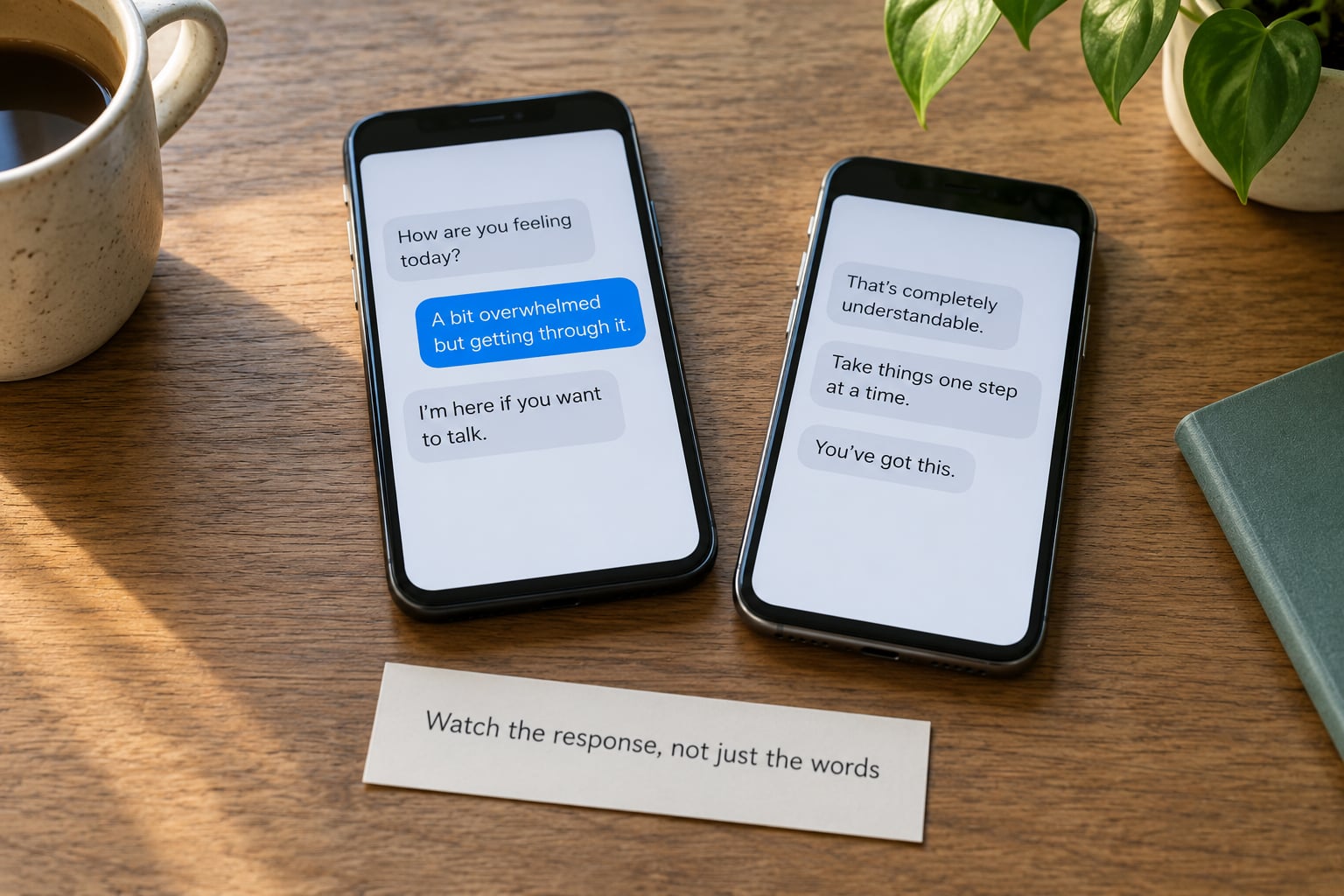
A good reply to your boundary is not measured by how warm it sounds. It is measured by four behaviours.
- Responsibility.They say what they did, not what you did to cause it. Blaming your reply speed, your tone or your expectations is a deflection, however politely it is wrapped.
- Specificity."I was going through a lot" is an atmosphere. "I was finishing a move and my phone was in a box for two weeks, and I should have told you" is an explanation you can evaluate.
- Acceptance of your timeline.If you asked for a week of space and they push to meet tomorrow night, that is an answer.
- Follow-through over weeks.This is the only one that really counts. People who mean it keep showing up at the pace they agreed to, including the weeks when nothing exciting is happening.
Forum readers describe this test the same way: the specificity of the explanation is the thing they scrutinise hardest, and the vague version — life happened, I was busy, my phone died — is the one that reliably does not survive contact with follow-up questions.
6. Decide whether to continue or end it
Three things decide it. Did they take responsibility without blaming you? Has their behaviour matched their words for long enough to be a pattern rather than a good week? And do you feel calmer after the contact, or more alert and more anxious?
That last one is not a small signal. If a person makes you track their mood, decode their messages and rehearse replies, you are managing their availability, not building something. Nobody sets out to date that, but it is where a lot of these end up.
Your options are a second date on your terms with the pace stated out loud, continued texting with no meeting for two weeks while you watch consistency, or a clean permanent block. If they ghost you a second time after promising not to, that is not bad luck. That is the answer.
Common Mistakes That Make the Response Worse
Replying while still angry.Anger makes people write longer, sharper and more revealing messages than they intend to send. Draft it, wait a night, cut it in half.
Accepting a vague promise."It will never happen again" is a promise with nothing behind it. Ask what changed and how they will handle the next time they want space.
Overexplaining.A long account of how hurt you were makes you the difficult one in the story you are both telling. One sentence about the behaviour is enough.
Ignoring safety signals.New accounts after a block, urgent money requests, refusal to meet anywhere public, pressure to move off the app. None of these are things to work through with better wording.
Chasing explanations repeatedly.Asking twice is patience. Asking four times over two weeks is a pattern of your own, and the answer will not improve.
Treating one good message as proof of change.A polished apology can be written in ninety seconds. Consistency is the only reliable signal, and it takes a month to read.
Sending several messages in a row.One message, then silence. It is the simplest rule in this article and the one most often broken.
Two habits help more than any wording: keep your reply shorter than theirs, and never meet within the first week of a reappearance. Let the pace be your decision rather than theirs.
Frequently Asked Questions
Should I respond when someone who ghosted me comes back?
Respond only if you want contact on your terms, not because they returned. A person who vanished owes you nothing by returning, and answering enthusiastically rewards the behaviour and makes a second disappearance more likely. If you do reply, keep it to one short message, state what you need going forward, and then stop. If you want nothing further, silence is a complete answer and usually the strongest one.
What if they apologize but do not explain why they disappeared?
An apology without an explanation is half a response, and it is usually the half that is easier to perform. Ask once, directly and without blame: what actually happened during that time. If the answer stays vague, you have your information. Most people who are genuinely taking responsibility can say what went on, however uncomfortable it sounds, while a vague answer usually means the disappearance still serves them.
Is it okay to change my boundaries after they come back?
Yes, and you are allowed to hold them. Coming back does not restore the access you had before, because that access was withdrawn by their behaviour, not by a rule you invented. You can also ask for something new now, such as a specific contact rhythm or meeting in a public place. Boundaries are not penalties handed out for good behaviour; they are the terms you require to keep talking.
How many chances should I give someone who ghosted me?
Treat one return as the chance, not as the first of several. If they vanish once more after promising not to, you have your answer about the pattern, and further chances tend to cost you time rather than teach them anything. People describe this loop as the most repeated complaint in ghosting forums: the apology, the improvement, and then the same silence a month later. There is no useful version of a third round.
Should I meet them again after they return?
Not straight away. Wait a week or two of consistent, low-effort contact first, and make sure it happens in a public place where you have your own way home. Do not move to a private app, a home address or a remote location during the first conversations after a reappearance. If you feel pushed, hurried or asked to keep the meeting secret, that pressure is itself the answer, and you are allowed to end it there.
Conclusion
Start by deciding whether you want clarity, reconciliation or closure, because that choice writes the message for you. Then send one calm reply that names the behaviour and sets a term, and judge what comes back by consistent action over the following month rather than by charm, guilt or an apology that sounds good. If you already know you want nothing, closing the app is a decision too, and the only message you owe anyone is the one you send yourself.