
Body language signs someone is into you show up as a cluster of small, mostly involuntary cues: leaning toward you, holding eye contact a beat longer than comfortable, finding reasons to touch your arm, and matching your movements. One cue on its own means almost nothing. Three or four that keep repeating across more than one interaction, that is a real pattern.
Most sign lists fail because they treat a single gesture as proof. Someone playing with their hair might be nervous about a job interview. Someone laughing too easily might just find you fun. The useful version of this guide tells you what each cue looks like, what it might mean, and how much weight it can actually carry.
What follows is written for adults trying to read early interest on dates, in first conversations, and across dating apps without turning themselves into amateur mind readers. Last checked for 2026.
Table of Contents→
- What Do Body Language Signs Someone Is Into You Actually Mean?
- Eye Contact, Face, and Attention Clues
- Posture, Movement, and Physical Comfort Clues
- Actions During and After a Date
- What Texting and Online Dating Behaviors Can Add to the Picture
- Body Language Signs That Are Often Misread
- How to Tell If the Interest Is Mutual
- Frequently Asked Questions
- Does strong eye contact mean someone likes you?
- Can someone be interested even if they seem nervous?
- What does it mean when someone keeps touching their hair?
- Is mirroring another person’s body language a sign of attraction?
- Do fast text replies prove that someone is into you?
- How should I ask if I think someone likes me?
- Start With the Pattern, Not One Gesture
What Do Body Language Signs Someone Is Into You Actually Mean?
Body language is the non-verbal half of communication: gaze, posture, distance, movement, tone and timing. Most of it is managed by parts of the brain that handle threat and pleasure, so it leaks before anyone decides what to say out loud.
When attraction kicks in, dopamine and oxytocin rise, adrenaline lifts heart rate and skin temperature, and attention narrows onto one person. That narrowing is why you feel like they are tracking you in a crowded room, and why the small stuff becomes visible. The same arousal system fires when someone is nervous, which is exactly why the interpretation has to stay cautious.
Reliability is the part sign lists usually skip. A cue becomes meaningful when it is voluntary-independent, repeated, and exclusive to you. Gaze and orientation are harder to fake than a smile; a smile is easy. So is saying nice things.
| Signal | What it looks like | What it may mean | Reliability |
|---|---|---|---|
| Body oriented toward you | Torso, knees and feet angled your way | Attention is allocated to you | High |
| Gaze held a beat past politeness | Looks back after you look away | Interest plus willingness to be seen | High |
| Closing distance | Sits or stands nearer than baseline | Comfort and proxemics shift | High |
| Mirroring | Matches your gestures, posture, pace | Rapport, possibly interest | Medium |
| Invented reasons to touch | Arm brush, hand on shoulder, hand-holding | Testing physical contact | Medium |
| Remembering small details | Repeats things you said weeks ago | Attention, not just politeness | Medium |
| Extending or initiating plans | Suggests one more drink, asks you out again | Wants time with you | Medium |
| Hair touching, nervous laughter, fidgeting | Touching hair, laughing at weak jokes, playing with a glass | Arousal of any kind, including nerves | Low |
Read that last row carefully. The cues readers ask about most, hair touching and nervous laughter, sit at the bottom of the reliability scale because anxiety, cold rooms and bad dates all produce the same thing.
Friendly behavior looks similar for about five minutes. The difference is who gets it. A friendly person is warm toward the waiter, your friend and the group. Someone who is into you tends to keep the warmth pointed, and starts spending time only they could have spent elsewhere.
Eye Contact, Face, and Attention Clues
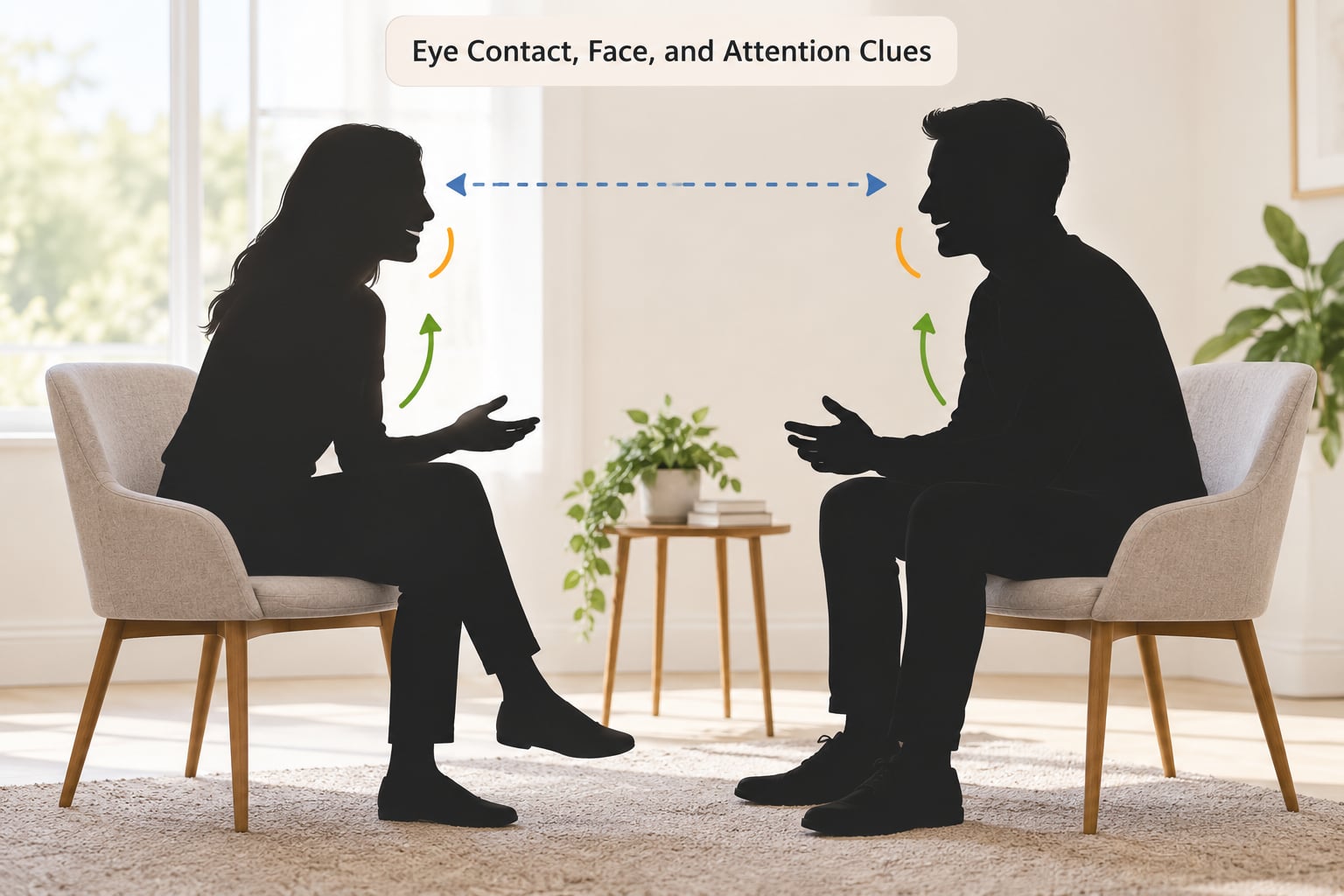
Eye contact that lingers slightly past comfortable
You glance away, and a second later you feel them looking back, so you check and catch them. That return gaze is harder to fake than holding a look, because it involves choosing to be seen doing it.
Watch the pattern rather than the duration. Someone who is genuinely engaged with what you are saying holds eye contact in long stretches and breaks it naturally when they think or talk. Someone sizing you up keeps it short, fixed and watchful, like a security camera.
Smiles that reach the eyes
A polite smile lifts the mouth and stops there. A genuine one crinkles the corners of the eyes and changes the whole lower face, and it tends to arrive slightly late and stay slightly too long.
Frequency matters more than width. Interest usually shows up as smiling at you more than at the rest of the room, including at moments when nothing funny has happened.
Attention that tracks you across the room
You look up from your drink and they are already looking, then they turn to whoever just spoke. That pause-and-return is a reliable indicator of interest because it costs them something socially.
In a group setting, watch who they orient toward when they laugh. Interest usually wins over the person talking, which is the same reason body language gets so loud in crowded bars.
Inviting cues: the eyebrow flash, the blush, the larger pupil
Three quick signals arrive before conscious effort kicks in. The eyebrow flash is a brief raise and release of both eyebrows when you appear, lasting under a second. Blushing and flushing show up as warmth across the cheeks, neck or chest. Pupils widen slightly in low light, which is easier to notice in a dim bar than a bright cafe.
None of these means much alone. All three at once, aimed at you, is a different conversation.
Posture, Movement, and Physical Comfort Clues
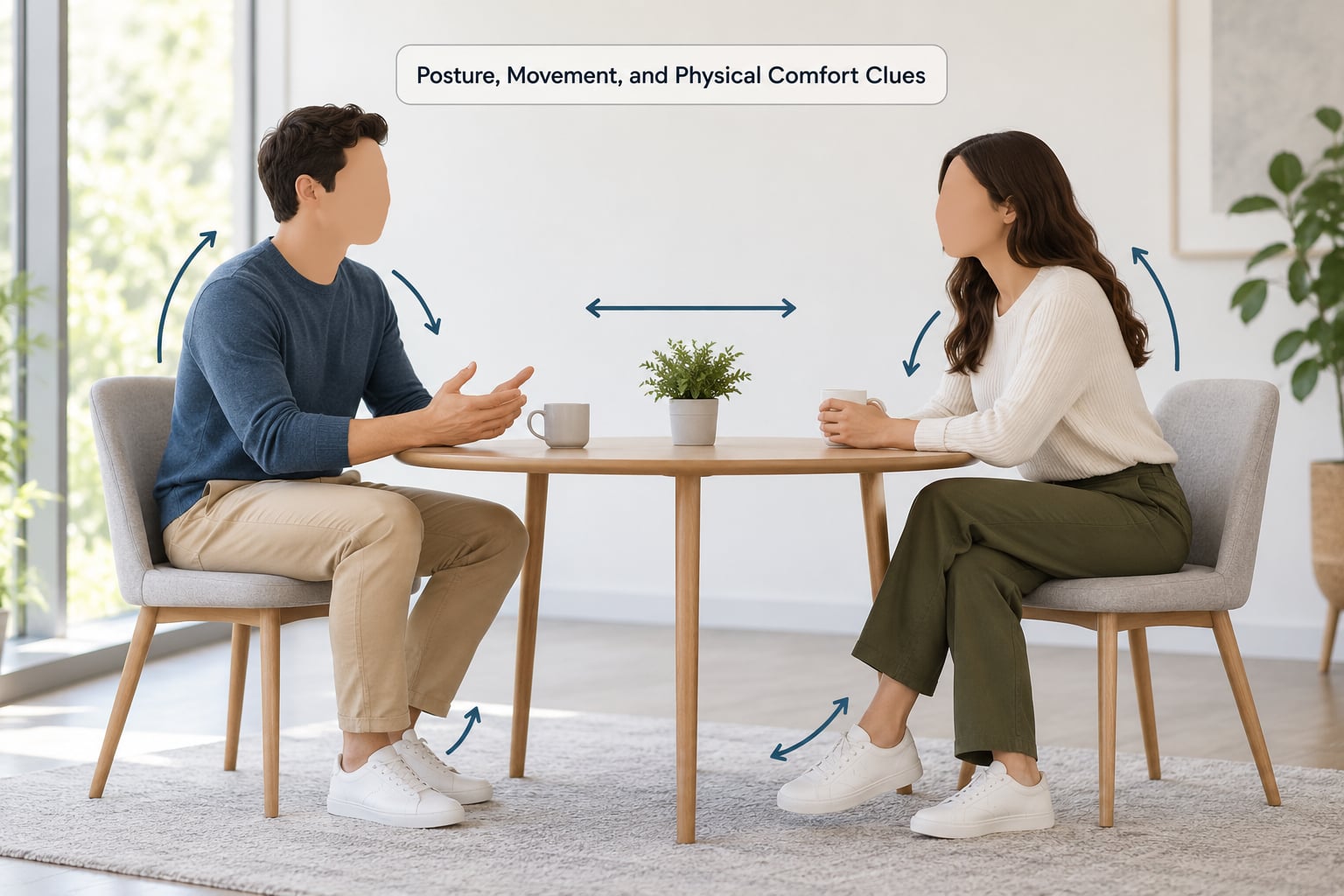
Leaning in to close the distance
You can call this proxemics, the study of how people use space. Anthropologist Edward T. Hall described intimate, personal, social and public distance zones, and attraction compresses the distance between the first two.
Watch the whole body, not the torso alone. Torso lean can be politeness or leaning over a loud table. When the lean comes with the feet turning your way and the arms opening, it is harder to explain away.
Open posture instead of crossed arms
Folded arms, a phone held in both hands and a bag placed on the chair between you all reduce available space. When those barriers drop and hands become visible, the conversation usually gets easier too.
Open posture is about availability, not romance. A good host is open with everyone. The signal only counts when you notice the change in how they are sitting with you versus with your friend.
Mirroring your movements
You take a sip, they take a sip. You lean forward, they lean forward. You laugh, they laugh a beat later. Behavioral mirroring suggests rapport and a willingness to sync with someone, which is why it keeps showing up in real accounts of how interest was spotted.
It also happens between colleagues and old friends who already share a rhythm. Mirroring that appears suddenly, and only with you, is the version worth noticing.
Comfortable closeness and low-stakes touch
Interesting people tend to run an escalation ladder: standing beside someone, a brush of the arm, a hand on a shoulder, then hands held. Each rung is a small question about whether the next one is welcome.
Watch what they do after touching you. Someone comfortable stays close or leans in again. Someone testing the water often pulls back and watches your reaction, which means the touch is a question, not a statement.
Some of this is personal and some is cultural. Touch norms vary a lot by background, family and region, and plenty of people express interest entirely through proximity and eye contact. Read the pattern against their normal behavior with other people rather than against your own.
Actions During and After a Date
Finding excuses to extend the time together
Somebody who wants to leave will not invent a second coffee, a walk around the block or an argument about which restaurant to try next. Suggesting one more thing is one of the clearest signs of interest, because it costs time and money to say.
Asking the second question
Small talk has a natural end. Interest shows up when someone keeps pulling the thread anyway, asking about your brother, your job, the thing you mentioned once in passing, and following up on the answer.
The depth of the questions is the tell. Broad and surface questions are conversation habits. Specific ones, asked slowly, are attention being spent on you.
Remembering small details and coming back to them
Someone who repeats the name of your dog, the trip you took last year or the restaurant you disliked is showing you what their attention did while you were not talking. That is a behavior, not a vibe.
It also gets tested by time. Details recalled weeks later are stronger evidence than details recalled the next morning.
Being the one who initiates the next meetup
Who texts first after a good date is more informative than how long the first date ran. If you never hear from them, you have your answer. If they propose something specific within a day or two, they are thinking about you outside the date.
Specificity is the giveaway. A vague later is politeness. A named place, a day and a time is intent.
What Texting and Online Dating Behaviors Can Add to the Picture
Online, the body disappears and the leftovers behave oddly. Typing dots, response time and message length get read as if they were posture, and they are worth much less. Texting is where signal lists do the most damage, because a slow reply can mean a busy shift, a bad mental health day or disinterest, and you cannot tell which from the screen.
| In person | Text equivalent | How much it counts |
|---|---|---|
| Leaning in | Messages get longer and more specific | Medium |
| Attention tracking | Remembers detail from three conversations ago | Medium-high |
| Touch | Willingness to be vulnerable or personal | Medium |
| Extending the date | Proposes the next meet without being asked | High |
| Open posture | Fast replies | Low |
| Mirroring | Matching your texting rhythm and emoji use | Low |
Fast, specific replies that keep momentum
Reply speed on its own tells you very little. Phones get ignored, people work shifts, and some people simply hate typing. What carries weight is a reply that comes back fast, stays on topic and asks something back.
Personalized messages instead of openers
Someone interested sends references to things you actually said. They build a running joke with you, send a link about something you mentioned once, and remember that your flight lands at six.
Plans instead of maybes, and plans that actually happen
Interest converts into logistics. Vague openers that never resolve into a time are the clearest digital sign of someone who is not into you, and it is a far better indicator than response speed.
Voice notes and video calls are a useful middle ground. They bring tone, pacing and pause back into the picture, which gives you more to read than a text does.
Body Language Signs That Are Often Misread
Touching their hair
This is the single most over-read cue. People touch their hair when they are nervous about anything at all, when their hair is in the way, or out of habit. It means something only as part of a cluster that also includes proximity and gaze.
Nervous laughter
Laughing at a joke that was not funny, or talking faster than usual, is an arousal signal with no direction attached. It shows up when someone likes you and when someone wants the conversation to end. Check whether the laughter comes with leaning toward you or away.
Mirroring
Mirroring is a rapport signal, not a romantic one. Shared habits of posture and pacing usually come from a common background or a long friendship, so treat a sudden mirror as a warm sign and not a declaration.
Long eye contact
Prolonged eye contact can be interest, a power move, or someone simply reading your face because they are unsure how the conversation is going. Context beats duration: hold the gaze and speak warmly is different from staring without speaking.
Delayed replies
Response time is a log of someone’s actual life. It says almost nothing about interest, and treating it as a signal produces a lot of unnecessary stress for people who are just bad at texting.
There are also factors worth naming before you read anything. Anxiety disorders produce constant nervous cues. Autism and ADHD change how some people handle eye contact, touch and fidgeting without any attraction involved. Introverts look engaged while appearing closed off. Someone who flirts loudly will read very differently from someone who flirts quietly. Give the person a baseline before you compare.
How to Tell If the Interest Is Mutual
Reading is passive and slow. Reciprocating turns it into an experiment, and it is the fastest route out of guessing. Pick one small cue and mirror it back: match their pace of walking, hold eye contact one beat longer, laugh a second late. Then watch what they do with it.
Interest responds. Someone into you will close a little more distance, keep the eye contact going, or escalate the joke. Someone being polite will stay exactly where they were, because nothing about your behavior created any pressure to respond.
The cleanest test is an invitation with an easy out. Say you are grabbing another drink or walking the long way back, and make it specific enough that they can say no without awkwardness. Interest shows itself in how readily they agree and whether they extend the plan.
One note for the practical side of this: body language is not consent. Reading interest is a guess about how someone feels, and a guess is not permission for anything physical. Ask, in words, and take the answer at face value.
Frequently Asked Questions
Does strong eye contact mean someone likes you?
Not on its own. Strong eye contact shows attention, and attention can come from interest, from awkwardness, or from someone trying to work out whether they like you. The stronger signal is a return gaze: you look away, you sense them looking, and they do not turn it into a stare when you check. Judge eye contact alongside body orientation and how the person treats everyone else in the room.
Can someone be interested even if they seem nervous?
Yes, and nervousness is where most sign lists go wrong. Anxiety, a first date and genuine attraction all raise heart rate and speed up speech, so the signs look identical from the outside. The difference shows up in direction. An interested nervous person stays close, keeps finding reasons to talk and holds your gaze. An anxious person tends to pull away, shorten answers and avoid sustained eye contact.
What does it mean when someone keeps touching their hair?
Very little on its own. People touch their hair when it is in the way, out of habit, or when they are anxious about something unrelated. It becomes useful only as part of a cluster, for example hair touching combined with leaning toward you, lingering eye contact and finding excuses to stand close. On its own, it is noise, and it is the most over-read cue on every sign list online.
Is mirroring another person’s body language a sign of attraction?
It is a sign of rapport, which is not the same thing. People mirror people they already know well, colleagues with a shared rhythm, and anyone they feel comfortable with. Mirroring counts more when it starts suddenly, happens only with you, and includes small details like matching pace or repeating your posture. If they mirror your friend the same way, you have learned about their manner, not their feelings.
Do fast text replies prove that someone is into you?
No. Reply speed mostly reflects whether a phone is in a hand, and people ignore texts on shifts, on trains and on busy weekends. The digital cues that carry weight are different: longer and more specific replies, remembering details from earlier conversations, and turning vague openers into actual plans. Someone who consistently fails to make a time is telling you something. Someone who replies fast is telling you they have a phone.
How should I ask if I think someone likes me?
Ask directly and lightly, ideally in person and with a specific next step attached. Saying you have enjoyed talking and asking to do it again over a coffee puts the ball in their court without forcing a confession. Skip the speech about the signals you noticed, because it turns a simple yes or no into a debate about evidence. Either answer is useful, and no answer takes a week is a clear one.
Start With the Pattern, Not One Gesture
Attraction is visible, but it is never printed on someone’s face. It shows up as a repeatable cluster: their body points at you, the distance closes, the gaze comes back, they ask about the small things, and they are the one who proposes the next time. Any single item on that list can be explained away. The whole pattern is much harder to fake, because faking it means holding it for an hour.
So give it a fair run before you decide. Watch two or three interactions, reciprocate one small cue, and then make a move with an easy exit attached, such as another drink or a walk the long way. Interest turns into a yes quickly when it is there, and a slow reply is its own kind of answer.