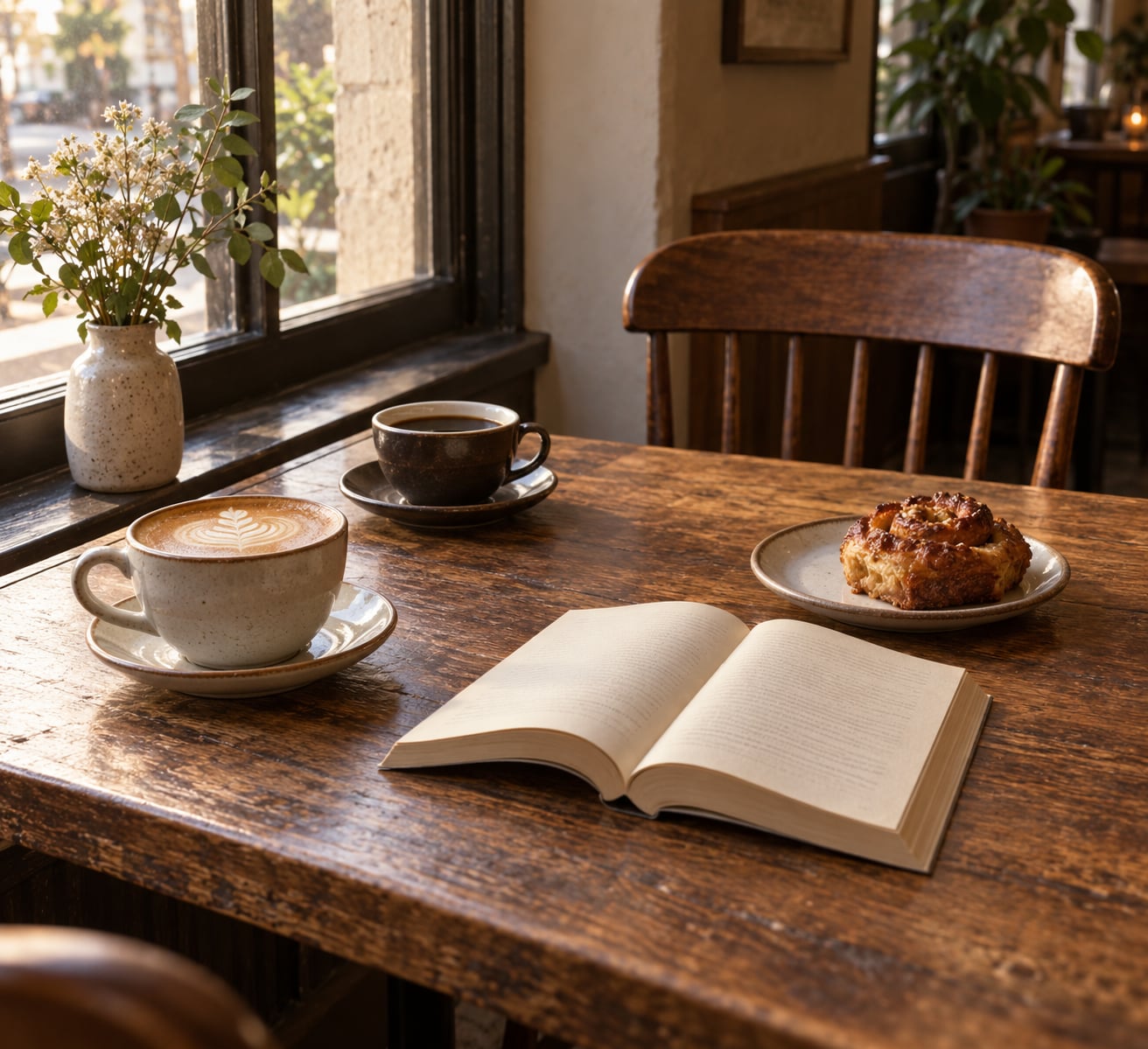
Most people approach a stranger in a coffee shop by rehearsing three sentences on the walk in, then abandoning all of them at the counter. It doesn’t have to work like that. How to approach someone at a coffee shop comes down to four things: check that the moment is open, say something about what is actually happening in front of you, follow their energy rather than your own, and give everyone an easy exit. No routine required.
The anxiety is normal. Forum threads on r/datingadviceformen and r/dating_advice are full of people who say the same thing in different words: not knowing what to say is the hard part, not the approach itself. A 70-plus comment debate on r/datingoverthirty argues whether any of it is appropriate, which tells you the question is genuinely unsettled for adults who have been out of the dating game a while.
So here is the whole thing on one screen before we go into detail.
- Check they are open: no headphones, no call, no deep work, not visibly upset.
- Walk over with open body language and a relaxed tone.
- Open with a comment about what they are doing, not how they look.
- Ask one question, then answer it yourself too.
- Watch reciprocity, not your own nerves.
- Invite them for coffee or exit warmly. Either answer is fine.
That last point matters more than the other five combined. Someone who says no and feels respected about it costs you about fifteen seconds. Someone who feels cornered in a coffee shop is an experience you will hear about from other people for a long time.
What You Need
You need very little, and none of it costs money. What you need is a setting that lets both people leave without making a scene, an honest read on whether the moment is open, and one sentence prepared for the end.
Pick a shop where conversation is normal
A place with communal tables, a counter you can stand at, and low ambient noise works far better than a silent library-style cafe. Noise is not just atmospheric, it is functional: if nobody nearby can hear the exchange, the whole interaction feels private, and that is exactly the feeling that makes people tense. A quiet shop makes the same words land heavier.
Go somewhere you would actually enjoy sitting for ninety minutes if nothing happens. That framing does more for your composure than any amount of preparation, because you are no longer gambling on an outcome.
Give yourself a visible approach route
Order your drink first, or stand at a spot near their table with a reason to exist. Walking straight at a stranger from across the room with nothing in your hands is the version that reads as threatening. Holding a cup, waiting for a name on a screen, or standing at the condiment counter nearby gives your approach a shape that makes sense to anyone watching.
Open posture, easy tone, real smile
Shoulders down, hands visible, a smile that reaches your eyes. Voice a little quieter than the room rather than louder, so the other person controls the volume and the distance. If your own voice sounds strange in your ears, that is a volume problem, not a personality problem.
Prepare one exit line
Something like “Nice to meet you, I’ll let you get back to it” does the whole job. Having it ready stops you from inventing reasons to stay when the conversation has already ended. It also signals from the start that you are not planning to occupy their afternoon.
Give yourself permission to walk away
The most useful thing to bring with you is a decision: you will not approach anyone on the list below. That decision carries more relief than any opener script, because the fear is really about approaching the wrong person and living with it. Leaving alone is a complete result, not a failed one.
How to Approach Someone at a Coffee Shop
The process below takes about five minutes. Most of the work happens in the first fifteen seconds, before you say anything at all.
1. Check Whether the Moment Is Appropriate
A coffee shop is semi-public, which means the person you approach cannot fully opt out without standing up in front of everyone. That asymmetry is the reason to be selective rather than enthusiastic. Approach when they are physically open: facing the room, hands free, occasionally glancing up, no barrier between you and them.
Leave people alone who have headphones in, are on a call, are typing with purpose at a laptop, are wearing AirPods, are visibly upset, are deep in conversation with friends, or are working there. Every one of those signals means the same thing: not now. People on r/dating_advice ask about headphones constantly and the consensus is unmoving. Earphones are a door that has been closed.
One exception worth knowing: a person who is simply reading alone with a book is usually fine to approach. Reading is quiet and open. Headphones are quiet and closed. The difference is worth holding onto, because people frequently confuse the two.
2. Create a Natural Opening
The best openers come from the room, not from a list. They reference what is actually in front of both of you, they are short, and they do not ask anyone to feel flattered on demand.
- Something about the drink: “Is that a cold brew? I’ve been trying to find one worth going back for.”
- Something about the work in front of them: “That book looks brutal. What’s it about?”
- Something about the shop itself: “This place has been packed every morning this week. Do you know when it got so busy?”
- A genuine question about a visible thing: “Have you tried the cardamom bun? I’ve been thinking about it for three days.”
- A shared observation with a small smile: “Saturday morning crowd is a different species.”
- Direct and warm, if you prefer: “Hi, I’ve been working up the nerve to say hi. I’m Sam.”
All six share the same structure: a comment or question about the present moment, said warmly, with nothing riding on the answer. That structure is why readers on r/CasualConversation keep reporting the same result, that openers about what the other person was already doing are the ones that turn into conversations.
What to leave alone are openers built on appearance. “You should be a model” asks someone to compliment you back and puts them in the position of declining a gift. Comments about someone’s body, age, or ethnicity land as a verdict regardless of how friendly the tone is.
3. Keep the Conversation Light and Reciprocal
One question in, one answer from you. That is the whole engine. Ask what they do, then tell them something real about your own week. Ask where the good coffee is in this neighbourhood, then tell them about the place that ruined you for it. Reciprocity is what separates a conversation from an interview, and it is the part most people skip because they are busy planning their next line.
Short exchanges are normal. Two or three minutes of small talk at a cafe counter is a complete, successful interaction. You are not auditioning for a role. If the other person is giving short answers with flat posture, that is information, and it arrives faster than you think.
Stay out of the deep end early. Job hunting, exes, health problems and salary are all things a stranger does not need from you. Funny, light and situational is the register a coffee shop conversation is supposed to have.
4. Read the Person’s Interest Cues
Interest looks like effort directed at you. They turn their body toward you rather than away. They ask you a question back, or offer a detail you did not ask for. They keep the conversation going when a natural pause appears, and they do not glance at their screen while you are talking.
Politeness looks like efficiency. Short answers, laughing at things that are not funny, eyes drifting to a laptop or a friend, body angled toward the exit. One delayed glance and a “sure, good luck” tells you the conversation is over. That is not a failure and it is not judgement on you.
Eye contact is the least reliable signal there is. Someone making eye contact with the person behind the counter is not signalling anything about you. Hold a conversation for two or three exchanges before you read anything into it, and weight what people do over what their face does while they are deciding what to do.
If you are not sure, treat uncertainty as a no. Nobody has ever regretted leaving a conversation alone. People regret pushing.
5. Suggest a Low-Pressure Next Step
When the conversation has felt mutual, ask for something small and specific. “I’m grabbing a coffee around this time most days, you’re welcome to join me” is a real invitation with no obligation attached. “I don’t have anything going on, we should hang out sometime” is vague enough that nothing happens.
Asking to exchange contact details works too, and it puts the scheduling on later ground where both people have options. Have your own phone out and open so you are not fumbling with it in front of them.
Say it once. If the answer is a soft no, thank them and go. Repeating the ask after a no is the point where a friendly approach stops being friendly.
6. End the Interaction Respectfully
Wrap up before the other person has to. Two minutes is plenty, and most good coffee shop conversations end because somebody chose to end them, not because the other person fled.
When you are done: “This was nice, I’ve got to get going. Enjoy the rest of your day.” When there is no second meeting planned, add a short wave and turn away. Do not stand near their table hoping for a reprieve. The longer you stay after the conversation has ended, the more the ending becomes about you rather than them.
When Not to Approach: The Short List
This is the part most guides skip and the part readers ask for most. Headphones, AirPods, an active phone call, a laptop with a document or spreadsheet open, a person who is crying or visibly shaken, a group mid-sentence in a real conversation, and anyone wearing a staff apron or name badge.
That last one is worth expanding. Approaching a barista is a different situation entirely because they cannot walk away without losing their job. Ask about the coffee, tip well, be friendly, and let the relationship build over repeated visits if you want it to go somewhere. An invitation that arrives cold from behind a counter puts them in a genuinely awkward spot, and people on staff deal with more of that than anyone notices.
If someone is a regular in a cafe you use, the slow route often works better anyway. Readers on r/AskMen describe going back to the same shop repeatedly until a shared greeting becomes natural, and report far fewer rejections that way. It costs weeks and almost no risk, which makes it the sensible choice if you are not in a hurry.
Common Mistakes
Almost every awkward coffee shop approach fails on one of a handful of predictable mistakes.
- Interrupting real work. Someone with a laptop open is on a clock. Either wait for a natural pause or skip it. The fix is simply not approaching.
- Walking into a private conversation. A table of friends mid-sentence has already told you they want to be left alone. The fix is to route around them.
- Opening on appearance. Compliments about looks or body require a compliment back, and most people would rather not perform one. Use the room instead.
- Outlasting the welcome. The conversation ended, and now you are performing relaxation for a second person. Fix: end it in the first sentence after the last real exchange.
- Treating politeness as interest. A friendly stranger is being friendly. The fix is to wait for repeated, specific signals rather than one good moment.
- Disappearing after exchanging details. The number exchange is not the end of the interaction. Say something warm, confirm their name, and follow up within a day.
- Approaching staff the way you would approach a customer. Different power, different rules. Fix: build the relationship over visits instead.
One more, for anyone who reads pickup advice and thinks the language is useful: this works better when nobody is performing. The version of confidence that makes strangers comfortable is relaxed attention, not a technique being executed. If you can hear yourself narrating your own approach, you are probably overthinking it.
What to Talk About on a First Coffee Date
Hard to do well when you just met, easy the second time. Low-stakes subjects carry better than big ones: what you have been watching, books, food, the worst thing that happened to you this week, the best coffee in a five-mile radius.
Swap stories rather than asking questions, and let silence run for a few seconds. Interviews feel like interviews. Two people telling a friend about the same terrible landlord is a good thirty minutes.
Coffee is a strong first-date choice for a reason. It is public, it is short, and it has a natural end that neither person has to engineer. If it goes well, you can extend it. If it does not, nobody has to survive a three-hour meal together.
Frequently Asked Questions
Is it creepy to approach someone at a coffee shop?
It can be, but the deciding factor is context rather than the coffee shop. Someone with headphones in, on a call, visibly upset or deep in conversation has given a clear signal to be left alone. Someone sitting alone, facing the room with free hands has not. Short, warm, about the situation rather than about them, and you are in the normal range for a public place.
What do I say when I approach someone at a coffee shop?
Say something about the room. The drink, the book, the pastry case, how busy the shop is, or a genuine question about something in front of them. Keep it to one sentence and let them answer rather than filling the silence. Openers about appearance put the other person in the awkward position of returning a compliment they did not ask for.
How can I tell interest from politeness?
Look for effort rather than friendliness. Turning their body toward you, asking you something back, adding detail you did not ask for, and staying in the conversation past a natural pause all point to interest. Short answers, eye contact with the counter, body angled away or eyes on a laptop point to politeness. When you cannot tell, treat it as no.
How do I recover when an approach goes badly?
Thank them, smile, and leave immediately. Something as simple as thanks anyway, it was nice to meet you ends the interaction cleanly and costs you nothing. Most people who get a respectful no describe it as fine. The thing that lingers is being made to explain yourself twice to someone who has already asked to leave.
How do I ask them for coffee without pressuring them?
Be specific and offer a clear exit. Something like asking whether they are free for a coffee sometime this week, or saying you are here most mornings and they are welcome to join, leaves the answer entirely with them. Say it once. If the reply is soft, thank them and go. Repeating the ask after a no is the point where an approach stops being respectful.
Is it okay to ask a barista out?
Not as a cold approach. Staff cannot walk away from a customer without risking their job, which makes a first invitation awkward for them in a way it is not for a customer. Build the connection over repeated visits, be warm and consistent, tip well, and read whether they are engaging with you outside the transaction before asking anything personal.
Conclusion
Learning how to approach someone at a coffee shop is not about finding the perfect line. It is about being selective about the moment, saying one true and situational thing, and being the person who ends the conversation before the other person has to.
Start with one low-pressure interaction where you are genuinely happy to walk away. Watch what the other person does, not what you feel. If they give you effort, follow it; if they do not, thank them and enjoy your coffee.
Updated for October 2026.