Listening better on a date means giving the other person your full attention for a stretch, no phone and no rehearsed reply, and then responding with real curiosity: eye contact, open posture, short acknowledgements, and follow-up questions that go one layer deeper than what they just said. None of it is a technique you need special talent for. It is a handful of habits you can practise on your next date and feel the difference within about ten minutes.
Most first dates do not fall apart because someone said the wrong thing. They fall apart because two people talked at each other for ninety minutes and neither one felt genuinely heard. That is a fixable problem, and it starts with the loop almost everyone gets stuck in: planning what you will say while the other person is still speaking.
Worth saying early so it does not hang over you: the popular numeric dating rules you will hear about, the five C’s of dating and the 3-3-3 rule among them, are conventions about timing and texting frequency. None of them is a listening framework. What follows is about what to do with your attention in the two hours in front of you.
Table of Contents→
- How to Listen Better on a Date: Step-by-Step
- Common Mistakes That Make Good Listening Harder
- Frequently Asked Questions
- What if I am nervous and cannot focus on what my date is saying?
- How do I keep a conversation going without asking repetitive questions?
- What if my date tells me something difficult during the conversation?
- Should I share my own stories while my date is talking?
- How can I tell whether my date wants me to ask more questions or change the subject?
- Start With the One Thing You Keep Skipping
How to Listen Better on a Date: Step-by-Step
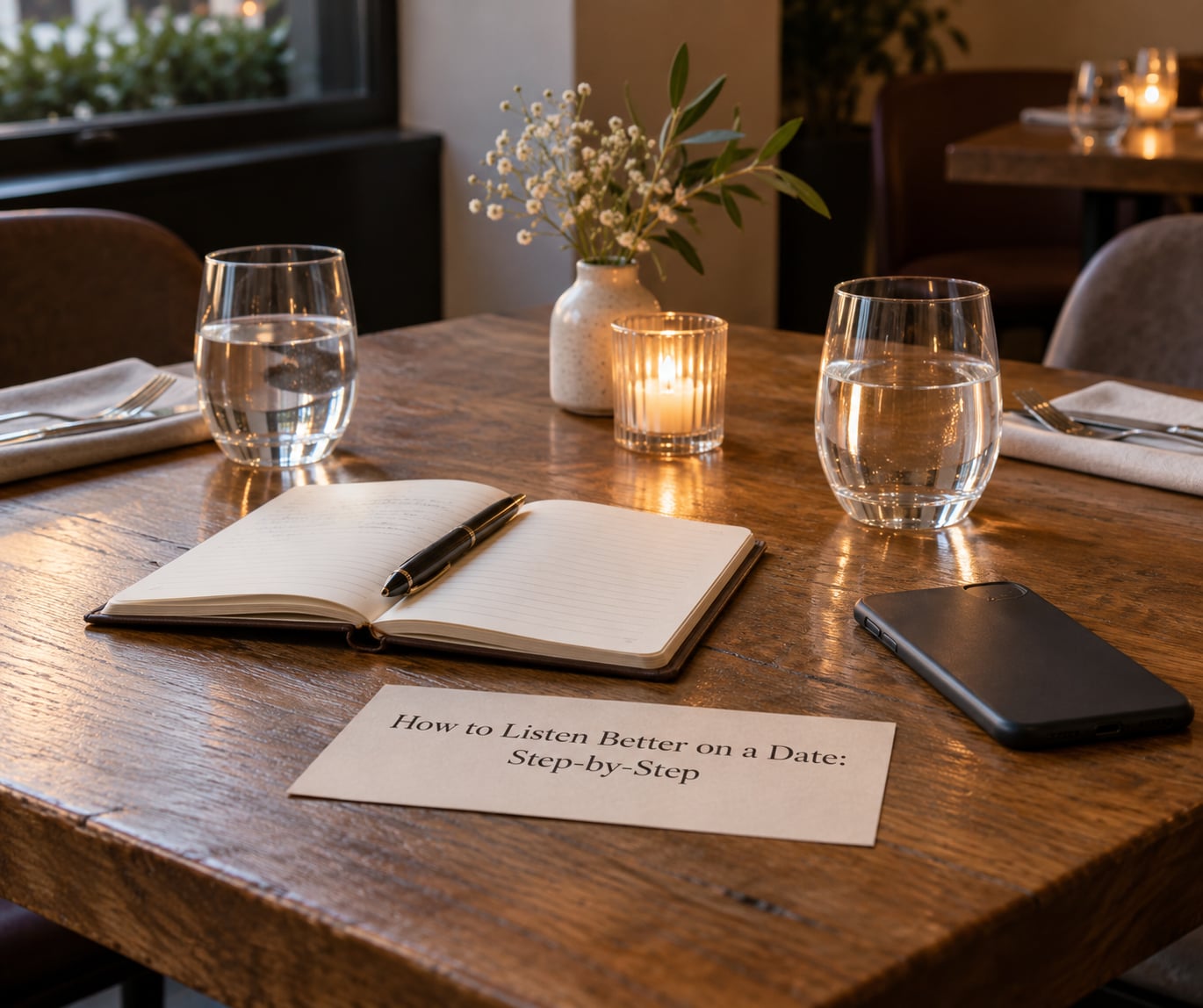
Six steps, in the order they happen. The first one happens before you meet.
1. Arrive Focused and Put Your Phone Away
Put the phone on silent, out of sight, screen down. Then choose your seat with listening in mind: somewhere without a television pointed at you, without a host walking past every ninety seconds, and not right under a speaker. You are deciding how easy it will be to stay present, and that is a decision, not a personality trait.
Arrive ten minutes early. A first date spent catching up with a phone under the table while trying to read someone across from you is a bad start, and the person across from you can always tell.
Then open well. Most people hand you a rehearsed answer about themselves the moment they sit down. Let the first thirty seconds be them getting comfortable, and ask something that is not about their job: where they have been recently, what they have been cooking, what their weekend actually looked like. The tell that this step worked is simple: you never glance at your phone in the pause after someone finishes a sentence.
2. Notice Cues Beyond the Words
The information you need is usually in the delivery, not the sentence. Watch pace, pause length, pitch, and volume, plus what their hands and shoulders do while they talk. Someone speeding through a story with a high laugh is usually managing nerves, not being carefree. Someone who goes quiet for four seconds before answering is deciding how much to trust you, not rejecting you.
Most people mirror pace without meaning to. If they talk fast, speed up slightly and let them pull you back. If they speak slowly, slow down and let the silence do some work.
Watch three specific things: do they hold eye contact a beat longer when they say something that matters to them, do their hands stay still or fidget, and does their tone flatten when they change subject. Those three cues tell you where to aim your next question, which is worth more than any opener you rehearsed on the walk over.
3. Use Reflective Follow-Up Questions to Learn How to Listen Better on a Date
A good follow-up question quotes a specific detail they already gave you. That is the whole trick. It signals you caught the thing that mattered to them, and it keeps the conversation from turning into an interview.
Here is a bank grouped by what it opens up:
- Childhood and background: What did a typical Saturday look like where you grew up? Who cooked, and what did they make?
- The current season of their life: What has been the biggest change in your life this year, good or bad? What is the part you are still adjusting to?
- Craft and work: What is the thing you do that colleagues ask you about most? What part of your job would you keep if you got a 40 percent raise?
- Taste: What is the last thing you watched that you actually loved? What music have you been playing on repeat?
- Dislikes: What is something everyone loves that you cannot stand? What is a restaurant you would never go back to, and why?
- Rituals: What does your Sunday actually look like? What is something small you do that makes a bad week better?
One question per turn. Then stop and let the answer land, because a follow-up question followed by silence and eye contact feels like genuine interest, while a follow-up question followed by three more questions feels like a quiz.
4. Reflect Back What You Heard
Paraphrasing is how you confirm you understood, and it buys you thinking time while you talk. Say it tentatively so it never sounds like a diagnosis. Try: “So what I am hearing is that the timing was the hard part, not the work itself?” or “That sounds like you miss the people more than the place.” If you get it slightly wrong, being corrected is a small, warm moment, not a failure.
There is a well-known four-part framework for this that most dating advice leaves out, and it is called RASA: Receive, Appreciate, Summarize, Ask. Take in the words without interrupting. Appreciate the pause, the effort and the feeling underneath. Summarize what you took it to mean. Ask one question to check. It works anywhere, but it earns its keep when someone tells you something they have not said out loud before.
One warning: reflecting their exact words back word for word sounds canned, like a customer service script. Reflect the meaning, not the wording. “You sound like you miss your dog” lands. “So your dog…” does not.
5. Share Your Own Story Without Taking Over
Listening well on a date is not silence for an hour. Early on, aim to talk roughly a third of the time and let them fill the rest, then match whatever pace they settle into. Answer a question in twenty to forty seconds and hand the floor back.
The fear of talking too much is common enough that whole threads on r/dating_advice are about it. If a date felt you were taking over, they usually interrupt, shorten answers and start wrapping up early. If you are unsure you are dominating, you are almost certainly not.
Connect before you share. When they mention a night-market habit, say you did the same thing growing up, tell it in two sentences, and return to them. One person on that same forum described doing well at listening and asking lots of questions, then wondering why it was not leading anywhere. The gap is usually not the listening. It is whether the other person ever got space to talk about themselves, or whether the questions came out as a checklist while their answer went past you.
6. Check In Before the Date Ends
You do not have to wait three days by text to signal interest. At some point before you part, say plainly that you had a good time and would like to do this again, and ask how they feel about it. Then name one specific thing they said, not a compliment about their looks. “That thing you said about your dad’s shop was a good story” does more work than “you’re really easy to talk to.”
A clear close makes the next date easier for both of you, and it saves you the exhausting week of guessing. If you are not feeling it, say that kindly and early rather than ghosting on date one.
Common Mistakes That Make Good Listening Harder
Each of these feels helpful in the moment and lands badly after. The fix for each is small enough to actually use.
Rehearsing your reply while they talk
This is the big one, and almost nobody realises they are doing it. Your attention splits: half listening, half drafting. The fix is to keep a two-word note in your head or on a napkin, nothing more. Writing a full sentence is another conversation in your head, and the moment you finish the sentence you have missed twenty seconds.
Answering every question with advice
The reflex is to fix. They mention a landlord who ignores repairs and out comes your three-step plan for filing a complaint. What they wanted was thirty seconds of being annoyed out loud. Try the shorter version first: “That’s frustrating.” Then wait. Advice offered after that is welcome; advice offered instead of that is an interruption with better manners.
Rapid-fire questions
Fifteen minutes of where do you work, what do you do, how long have you lived there, do you like it here, and the date becomes a screening call. Leave gaps of two or three seconds after each answer. A pause is where people add the part they actually wanted to say.
Treating silence as a problem to fix
Three seconds of quiet feels like thirty to you. It is comfortable to the other person, who is often just thinking. Let it sit, breathe, and smile slightly. Most of the time, someone fills it with something better than the joke you were about to make.
Performing attention instead of paying it
Nodding constantly, mirroring every gesture, and saying “totally” too often reads as technique. Be interested or do not. Genuine attention has a slightly uneven shape: it lingers on some details and lets others pass, which is exactly how real interest looks.
Going somewhere they cannot follow
Therapist voice, ex comparisons and “healthy boundaries” talk in the first hour all land badly. A date is not a place to be interpreted. Also skip the phone-check reflex, and skip turning their disclosure into a story about yourself, which is the most common way a good conversation quietly dies.
Before the next date, keep five things in mind: silence and face-down phone, one specific follow-up question per turn, about a third of the talking early on, no advice until they ask, and a clear close that names something real.
Frequently Asked Questions
What if I am nervous and cannot focus on what my date is saying?
Nerves are normal and almost everyone feels them. Instead of trying to listen harder, lower the bar: pick one detail from each answer and hold onto it, and that alone keeps you present. Slow your own breathing between their sentences. Nerves fade fastest when your attention is on someone else rather than on how you look, which is one more reason the phone goes away.
How do I keep a conversation going without asking repetitive questions?
Go one layer deeper on what they already said instead of moving on. A story about a trip becomes the part they still think about, or who they went with and why. Keep a two-word reminder of the detail worth returning to, and let silence do some of the work between questions. Repetitive questions usually come from jumping topics too early.
What if my date tells me something difficult during the conversation?
Do not solve it and do not steer away. Slow down, let a pause sit, and say something short like that sounds heavy or thank you for telling me. Ask whether they want to talk it through or just wanted to say it. Follow their lead, and if it comes up in a good moment you can check in again later rather than pressing in the middle of dinner.
Should I share my own stories while my date is talking?
When they ask you something, answer fully, in twenty to forty seconds, then hand it back. Connect your answer to what they just said so it reads as a response rather than a redirect. Early on aim to talk about a third of the time and let them take the rest, then match whatever pace they settle into.
How can I tell whether my date wants me to ask more questions or change the subject?
Look at what they volunteer. Detail, tangents and stories usually mean keep going, because they are enjoying the floor. Short answers with a fixed smile and topic changes usually mean they want lighter material. Short answers and a long pause can mean something real is coming, so stay quiet rather than filling it. Follow what they give you, not what you planned to ask.
Start With the One Thing You Keep Skipping
On your next date, do one thing: put the phone face down and silent when you sit, and leave it there. Everything else in this guide, the follow-up questions, the paraphrasing, the ratio, sitting with silence, builds on top of that. If you only change one habit, change that one, and see how the rest of the evening goes.