Standing out on crowded dating apps is a legibility problem, not an attractiveness problem. Feeds are scanned in a few seconds, photo one does most of the deciding, and anything generic disappears into the hundreds of profiles around it. When you replace vague claims with specific, checkable details, the people who are actually right for you recognise themselves in the profile instead of scrolling past it.
Most low reply counts trace back to one of three failures, and each has a different fix: you get no likes at all, you get plenty of likes but nobody starts a conversation, or conversations start and then die. Work out which one you have before you change anything, because editing a bio when your photos are the problem wastes a fortnight.
This guide is a sequence rather than a tip list. Positioning first, then photos, then prompts, then scannability, then the opener, then follow-up, then measurement. Skipping ahead to the opener when your first photo is a bathroom mirror selfie is the most common mistake people make.
Last updated October 2026.
What You Need to Stand Out on Crowded Dating Apps
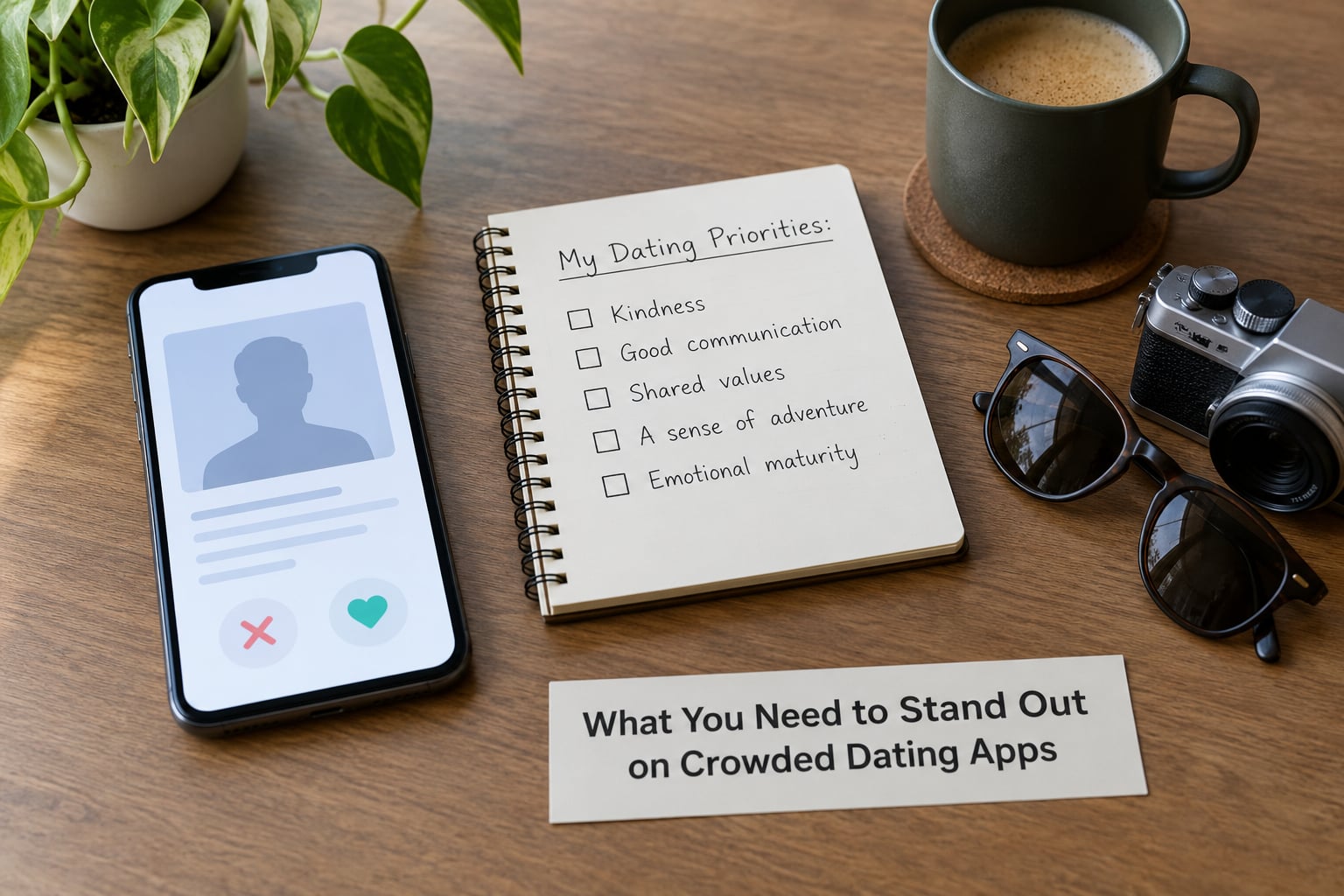
You need five things ready before you touch a single field on your profile. None of them take more than an evening, and skipping any one of them pushes the vagueness somewhere else in the profile.
- A clear dating goal. Not a mood, a direction: a long relationship, exploring, or dating with the intent to meet someone within weeks. Ambiguity here reads as low effort.
- A realistic list of priorities. Three non-negotiables and three preferences. More than that and you are filtering out people you would have been fine with.
- Recent, representative photos. Taken in the last year, in ordinary places, doing ordinary things. Not a holiday snap from a decade ago that no longer looks like your life.
- A personality description in your own handwriting. Full sentences you would actually say out loud, written without a thesaurus. If you would not say it on a date, cut it.
- Three examples of conversations you enjoy. The topics you can talk about for an hour without checking the time. This is your raw material for prompts and openers.
The last item is the one people skip and the one that does the most work. Ask yourself what you talked about for forty minutes at a family dinner recently. That answer is usually more distinctive than any adjective you could put next to your name.
Diagnose which failure you actually have
Three symptoms look like the same problem from the inside and have completely different causes. Check your numbers before you start editing.
| What you see | Likely cause | Where to fix it |
|---|---|---|
| Very few likes, almost no matches | Photo one is not doing the work, or your filters are too narrow for your location | Steps 1 and 2, then your age and distance settings |
| Lots of matches, hardly any conversations | Prompts and bio are generic, so nobody has a reason to write first | Steps 3 and 4 |
| Conversations start well, then stall | Openers are generic, or your replies are too short to continue | Steps 5 and 6 |
| Conversations go fine, dates do not happen | No plan to meet, or the goal is too vague to commit to | Step 6, and your positioning statement |
One caveat before you start. In one r/AskMen thread, a poster asked what everyone else sees too much of on apps, and the answers clustered around heavy filters, five-year-old photos and profiles with nothing in them but selfies. That tells you what looks like effort from outside, which is the standard you are actually competing against.
Step-by-Step: How to Stand Out on Crowded Dating Apps
1. Choose a Clear Positioning Statement
Decide on one angle and let the rest of the profile support it. The strongest positioning statements are narrow enough that some people immediately know it is not for them, and that rejection is the point: it raises match quality faster than match count.
Weak positioning reads as a label. Strong positioning reads as a sentence. “Adventurous” tells me nothing. “I will drive four hours to eat at a place I have never heard of, and I have already picked three” tells me exactly what a Saturday with you looks like.
Use the five-word exercise that matchmakers use: ask three friends to describe you in five words each without warning you. Their answers are almost always more accurate and more distinctive than your own list, because they describe behaviour rather than intention.
Then check the angle against the app you are actually on. The three big apps reward different things, and the same profile does not carry across all of them.
| Hinge | Bumble | Tinder | |
|---|---|---|---|
| Who moves first | Either side, but likes are deliberate and slower | The woman opens the chat | Either side, likes are quick and low-commitment |
| How people browse | People read the prompts before liking | Short browse, high volume, lots of profile filters | Fast swipe, photo decides almost everything |
| What gets rewarded | Specificity and a clear relationship intention | Energy, activity and a prompt that starts a chat | A strong first photo and one clean line |
| Asset worth using | Three prompts plus a photo prompt or voice prompt | Two strong prompts and an active-looking lineup | Two or three photos, minimal text |
| One tailored move | Answer a prompt on the other person’s photo | Put your best conversation hook in a prompt, since you send first | Keep the bio to two lines and let photos work |
2. Build a Photo Set That Feels Recognizable
Photo one is your cover photo and it decides the swipe. Shoot it in natural light, at eye level, in a solid colour, with a real expression rather than a posed one. Golden hour outdoors or a window facing a bright room both work; overhead bathroom light never does.
The rest of the set works as a lineup, not a collection. Each slot has a job, and a photo that duplicates another slot is wasting a slot.
| Slot | What it must accomplish | What it prevents |
|---|---|---|
| 1. Head and shoulders | Clear face, natural light, real expression, uncluttered background | The swipe happening before anyone sees your face |
| 2. Full body | Shows how you carry yourself and roughly what you look like head to toe | Surprises at the date |
| 3. Activity | You doing something you mention in a prompt or bio | A profile that lists interests with no evidence |
| 4. Everyday context | Home, work, a walk, a friend’s kitchen, a dog | Looking like a person with no actual life |
| 5. Social proof | Friends, family or a group setting where you are clearly identifiable | A profile with no evidence you have a social life |
| 6. Wildcard | Something specific to you: a trip, a cake you baked badly, a costume | Six interchangeable headshots of the same person |
Five or six photos is the working range. Three gives people nothing to work with, and nine turns the grid into homework.
What to leave out: group photos where nobody can tell which person you are, mirror and bathroom selfies, car photos taken at night, and anything with a filter heavy enough that a friend would not recognise you at a bar.
If you are not photogenic, treat it as a practice problem rather than a character flaw. A 23-year-old on r/selfimprovement asked how to make dating photos when you hate being photographed, and the useful thread running through that kind of discussion is that posed shots are why most people look uncomfortable. Ask a friend to take twenty candid pictures of you making a coffee, holding a dog, walking to a car. Use one where you are not aware of the camera.
Three practical things that help. Stand further from the camera than feels right, because phones flatten faces at close range. Ask the photographer to talk to you, not pose you, so your mouth and eyes are doing something real. And stop photographing yourself in the same five poses for two years running.
3. Write Prompts With Specific Details
A prompt is a slot someone else has to fill. Answer it with a detail only you could have written, not with a trait name. The difference between “I love to laugh” and “I laughed so hard at my own karaoke video that I pulled a muscle” is the whole game.
The most common complaint in forum threads about apps is repetition: the same Hinge prompt answered the same way, over and over, until nobody reads it. In the r/AskMen thread on what people see too much of, the recurring answer was that prompts either reveal nothing or say something everybody already knows.
Use this replacement table when a line feels interchangeable.
| Stop writing | Try instead | Why the second one works |
|---|---|---|
| “Ask me anything” | “Ask me how I ended up doing karaoke on a Tuesday” | It hands the other person a specific opening instead of homework |
| “The secret to getting to know me is just ask” | “Two questions that always get me talking: what’s your worst holiday habit, and what’s a hill you’d die on” | Shows the shape of your conversations rather than inviting them |
| “No time-wasters” | “Looking for someone who texts back the same day and does not treat a no as a challenge” | States a behaviour rather than a grievance, so it does not read as bitter |
| “Pineapple on pizza, dealbreaker” | “I will judge your pizza order silently but I will still eat your crusts” | Keeps the opinion, drops the hostility, and sounds like a person |
| “Worst idea” style prompts | Pick the prompt you can answer with a story, and ignore the one that gets you a paragraph nobody reads | Prompt choice is a filter you control |
| Any mention of an ex | Say what you want instead: “Looking for someone who does Sunday markets and the crossword” | Exes signal history; wants signal direction |
Write three prompts, not five. Extra prompts dilute the good ones, and on Hinge the three you answer become part of how you are filtered and shown.
4. Make Your Profile Easy to Scan
Profiles are read on a phone, in a queue, by someone half-listening to something else. Short sentences, sensible spacing and one clear hook beat a dense paragraph every time.
Keep the bio to three lines of ordinary speech. The first line is for recognition, the second for a detail, the third for what you want. Test it by reading it aloud; if you would not say it, rewrite it.
Leave one unanswered detail on purpose. A curiosity gap works because the only way to close it is to ask, and asking is exactly the behaviour you want.
Delete anything that reads as defensive. Sentences about apps you hate, exes, or how bad dating is all say the same thing: you are not enjoying this either.
5. Start Conversations That Do Not Sound Like Templates
The opener has one job: prove you read their profile. Commenting on something specific does two things at once, showing attention and giving them an easy reply.
Four patterns that adapt to almost anything.
- Comment on a detail. Reference something in their photo or prompt without complimenting it. “That dog has clearly won every argument in that house.”
- Ask something only they can answer. Tie it to their prompt rather than their appearance. “What made you pick that one?”
- Lead with something of your own. Share a small related fact and let them respond to it. Shorter than a question and often easier to answer.
- Light callback. Reference something that will only make sense if they open the chat, which gives them a reason to.
Aim for two or three sentences, roughly a quarter of the time it takes to read their whole profile. Match the reply length to the conversation, and stop asking questions in consecutive messages.
The same line copied across thirty conversations is obvious. It also performs worse, because a message you could send to anyone reveals you were not paying attention to this person. Personalise the middle of it: keep the shape, change the specific reference.
6. Follow Up Without Overexplaining
When a conversation stalls, do not send three paragraphs about how busy you have been. One message that adds new information and leaves a door open is enough, and if that gets silence, you have your answer.
Reply within a reasonable window rather than instantly, and put the conversation somewhere it can go. Suggest a specific plan instead of asking whether they would ever want to meet, which is a question most people dodge.
Something like “There’s a place in town that does Sunday markets and terrible coffee, if you want to judge both” is easier to say yes to than “so are we going to meet sometime”.
If two messages with real content get nothing back, stop. Chasing a conversation that has stopped is the fastest way to turn a decent match into someone who avoids you next time.
7. Improve the Signal Before Changing Everything
Test one change at a time over roughly four weeks, and count three things rather than feelings: likes relative to profile views, how many matches turn into conversations, and how many conversations reach a second exchange.
Put a number on it before you start. If you do not have analytics, open the app at the same time each week and note the counts. Guessing produces flip-flopping, and flip-flopping wastes months.
If profile views are healthy but likes are not, the cover photo is the problem. If likes are fine and conversations are not, work on prompts and bio. If conversations start and die, your opener or your follow-up is the weak link. Change only that and measure again.
Fresh content gets redistributed, so an update every few months beats a permanent profile you stopped looking at years ago. Update the lineup when your life changes enough to notice, not every fortnight.
Common Mistakes
Most profile problems are not exotic. They are the same handful of habits, repeated by most of the feed, which is exactly why they are worth avoiding.
| Instead of | Try |
|---|---|
| Six similar headshots | A lineup where each slot shows a different context |
| A list of interests with no proof | One photo that shows you doing the thing you claim to enjoy |
| Filters that change your face | No filter at all, which also sets the expectation for the date |
| “I’m not like the others” | Simply describing a specific thing you did last week |
| Filters set at the minimum range | A slightly wider age and distance setting, refreshed every few months |
| “Hey” as the opener | A two-sentence comment on something in their profile |
| Changing everything at once | One change per test cycle, measured before and after |
Over-filtering is its own mistake and the most expensive one. Most people set their age range to the smallest number that would not feel embarrassing, then wonder why the feed feels thin. Treat the three biggest items on your must-have list as fixed and widen everything else.
Consistency matters more than cleverness. A profile that reads as one person across the photos, the prompts and the first message is doing something no template can fake, and that consistency is exactly what forum users say they are tired of not finding.
On safety and boundaries, keep your standard the same one you would use offline: meet in public, tell someone where you are going, and keep your location sharing private until you know someone. Trust your own reaction to a mismatch between photos and person. Our dating safety guides cover the screening questions people ask most, including how to spot a catfish before you have wasted an evening.
Finally, expect a normal number. Plenty of matches and no conversations is a positioning problem you can fix. Very few matches in a crowded app is partly just volume, and the changes here improve your odds rather than guaranteeing a result.
Frequently Asked Questions
How do I fix a dating profile that gets no replies?
Work out which number is broken first. Lots of likes with no conversations means your prompts and bio are interchangeable, so replace traits with specific details and leave one unanswered question. Few likes at all points at your first photo, your filters, or both. Fix one thing, wait a few weeks, and count again before changing anything else.
What order should my dating profile photos go in?
Start with a clear head and shoulders shot in natural light at eye level, because the first photo decides most swipes. Follow it with a full body shot, then an activity photo, then an everyday context photo, then a social shot with friends, and finish with something specific to you. Each slot should do a different job rather than repeat the first one.
How many photos should I have on my dating profile?
Five or six is the useful range. Three gives people nothing to react to, and nine turns the grid into homework. Make sure the first three work on their own, because many people never scroll past the visible row. If a photo repeats what another one already says, delete it rather than filling the slot.
What not to put on your dating profile?
Skip mentions of exes, complaints about other apps and other daters, and lines like no time-wasters or ask me anything. Heavy filters, old photos, group shots where you cannot be picked out, and bathroom or car selfies all work against you too. Say what you want and show what your life looks like instead.
Is it bad to use the same opening line on every app?
Yes, if it could be sent to anyone. The message that works is the one that proves you read a particular profile, so keep the shape but change the specific reference each time. Templates also perform worse because the person receiving them has seen forty that week. Two or three sentences is plenty before you get a reply.
Should I use AI-generated photos on my dating profile?
Use them carefully, if at all. Some apps now flag generated or heavily edited images, and a face that does not match you in person is exactly the mismatch that ends a date badly. If you experiment, blend a generated headshot with several real candid photos of yourself so the grid still reads as one real person.
Conclusion
Standing out on crowded dating apps comes down to being legible rather than louder. Pick one positioning statement, build a photo lineup where every slot does a different job, replace interchangeable prompt answers with specific details, and open conversations by proving you read the profile in front of you.
Start today with the clearest change: write your positioning sentence, then fix one photo or one prompt, and test a personalised opening message on your next match. Measure it over four weeks before deciding whether it worked.