Why online dating feels exhausting comes down to a mismatch: the apps are engineered to keep you scrolling, while you are trying to evaluate one real person at a time. You get an endless deck of options, unpredictable rewards, unpaid emotional labour and near-constant rejection. The tiredness you feel is a normal response to a demanding system, not a sign that you are bad at this.
The numbers back that up. A 2024 Forbes Health survey conducted by OnePoll of 1,000 US dating app users found that 78% reported feeling emotionally, mentally or physically exhausted by dating apps. Forty percent of them named the inability to find a real connection as the biggest factor, ahead of disappointment and rejection.
Associated Press reporting from June 2024 made the same point from a clinical angle: one psychologist estimated that roughly three out of every four clients she works with use dating apps, and somewhere between 80% and 90% have expressed fatigue or burnout at some point. This is common enough that researchers gave it a name.
Dating app burnout, or dating app fatigue, is the emotional, mental and physical exhaustion that builds from the repeating loop of swiping, matching, messaging and then being ignored or unmatched. Below is what is actually draining, why it hits some people harder than others, and how to make the process feel manageable again.
Table of Contents→
- Why Online Dating Feels Exhausting at a Glance
- What Makes Online Dating So Mentally Draining?
- The 7 Biggest Reasons Online Dating Feels Exhausting
- 1. Constant swiping turns into a slot machine habit
- 2. Most matches never become conversations
- 3. Signals are unclear, so you interpret constantly
- 4. Rejection, ghosting and the grief of lost potential
- 5. Endless messaging with several people at once
- 6. Your profile is unpaid work with an audience
- 7. Social comparison runs on an infinite loop
- How Exhaustion Differs From Ordinary Dating Frustration
- Why Online Dating Can Feel Worse for Certain People
- Simple Ways to Make Online Dating Feel Less Exhausting
- A 20-Minute Online Dating Reset
- When to Take a Break From Dating Apps
- Frequently Asked Questions
- Conclusion
Why Online Dating Feels Exhausting at a Glance
Six things drive almost all of it. Each row below lists what happens, the mechanism behind it, how it tends to feel, and the quickest fix worth trying.
- The swipe loop — unpredictable rewards keep you scrolling long past the point of interest. It feels like restless, low-grade distraction. Fix: a hard daily time cap.
- Too much choice — an endless catalogue makes any single person feel replaceable. It feels like indecision followed by mild disappointment. Fix: narrower, non-negotiable criteria.
- Low-effort matches — many matches never become conversations. It feels like unpaid screening work. Fix: judge the first message, not the photo.
- Unclear signals — slow replies, read receipts, half-effort openers. It feels like constant interpretation. Fix: agree on pace early and keep moving.
- Rejection and ghosting — silent no-shows after a promising exchange. It feels like erosion rather than one big hurt. Fix: expect the pattern, not the person.
- Comparison — an endless feed of curated highlights to measure yourself against. It feels like inadequacy on a timer. Fix: close the app on a schedule, not on a whim.
Two figures explain the shape of that list. Average active users spend close to an hour a day inside dating apps, which is roughly the length of a workday spent on strangers. And 21% of surveyed users admitted lying about their age, 12% about their height, so the deck you are evaluating is partly fiction.
What Makes Online Dating So Mentally Draining?
Because it stacks several kinds of effort into one activity without giving you any of the relief that effort normally earns you. Real dating has a rhythm: you meet someone, you feel something, you find out. Online dating replaces that with volume, and volume has its own costs.
Cognitive load comes first. Judging thirty profiles is thirty small decisions, and decision quality drops as the stack grows. Add emotional labour on top, which researchers call unpaid emotional labor: writing an opener that does not sound like a robot, keeping a conversation warm, reading between the lines of a two-word reply, and managing five of those conversations at once while working a full-time job.
Then there is the part most articles skip. Exhaustion does not stop at the app. There is first-date fatigue, where a week of planning and cancelling leaves you more tired than the evening cost you. There is texting logistics fatigue, where scheduling a simple coffee becomes a two-day negotiation across time zones. There is commitment-decision fatigue, which is when meeting someone decent feels like another project to be assessed. Dating fatigue covers all three; app fatigue is only the entry point.
Forum threads describe the pattern more bluntly than any study: users call it unpaid emotional labor, scrolling, crafting replies and reading between the lines. What wears people out is rarely dating itself, but repeating low-value conversations at volume.
The 7 Biggest Reasons Online Dating Feels Exhausting
1. Constant swiping turns into a slot machine habit
Swiping works on variable-ratio reinforcement, the same schedule that keeps a slot machine spinning: reward arrives unpredictably, so you cannot stop. Your brain gets a small hit from the possibility of a match rather than from any real connection, and after weeks of that pattern the reward feels flat. You keep scrolling because stopping feels like giving up, not because you are enjoying it.
2. Most matches never become conversations
A match is not a person who is interested in you. It is a person who tapped an icon. That gap means you screen constantly and rarely get to the part you actually wanted. When a large share of your matches vanish within a day, the unpaid work of sorting them becomes its own drain. One r/OnlineDating user described the cumulative version of this: each match took a little something off, until three months in they felt exhausted.
3. Signals are unclear, so you interpret constantly
Did they read it? Why the pause? Is the slow reply about me, about their day, about the app? Dating apps give you thin data and expect you to build a conclusion from it. That interpretation runs in the background, and it is the mental equivalent of a tab you never close. It drains even when you are not looking at the app.
4. Rejection, ghosting and the grief of lost potential
Ghosting, breadcrumbing and orbiting all create the same specific ache: a person who seemed real and then vanished mid-sentence. The painful part is not only losing them, it is grieving the version of the future you had already started building. That is why online dating feels disappointing so often. You are not losing ten strangers; you are losing ten small imagined stories, and some of them were better than what you ended up with.
5. Endless messaging with several people at once
Five half-alive conversations at any moment is a job. You are performing a version of yourself five times, keeping track of where each one stalled, and holding attention across all of them. It is intimacy with the friction removed and none of the substance, and it leaves you tired in a way that a real conversation usually does not. One commenter put it as the performance of intimacy without the closeness.
6. Your profile is unpaid work with an audience
Crafting a profile means editing photos, rewriting prompts and trying to guess what will appeal to strangers. Then you perform that version in every conversation. Self-presentation is a form of emotional labour, and it never switches off. If your photos stop getting traction, the drop feels like a verdict on your face rather than on your photo selection.
7. Social comparison runs on an infinite loop
You are scrolling past hundreds of edited highlights, then evaluating yourself against them. The people swiping on you see the same kind of feed about themselves, which means the mismatch is built in. Roughly half the users in the Forbes Health survey said social comparison damaged their mood. Add quantified attractiveness, where being rated makes you feel like a metric, and you have a steady supply of small shame.
How Exhaustion Differs From Ordinary Dating Frustration
A bad week is one bad week. Fatigue is a pattern that changes how you behave outside the app: you dread opening it, you feel lonelier after a session than before it, or you avoid planning a date that looked promising. The distinction matters because the two need opposite responses. A bad week calls for persistence; fatigue calls for load reduction.
Why online dating feels exhausting even when the match is good
The most common complaint in forum threads is not that the matches are bad. It is that a genuinely good match arrives and nothing happens inside you. One user wrote that after three months of repeated letdowns they matched with someone who shared a lot in common and could hold a conversation, yet could not get excited, and were not sure whether that was a defense response or something broken.
That flatness has a name in psychology: protective detachment. After enough disappointment, feeling excited becomes risky, so you stop allowing it. It looks like indecision about someone you would have liked a year ago. Nothing is broken. Your nervous system is doing exactly what it learned to do, and it unwinds when the pattern changes rather than when the person does.
Three signs point toward burnout rather than ordinary frustration. You feel relief when a good prospect disappears. You have deleted and reinstalled your apps several times without feeling different. And the exhaustion has followed you into conversations with people you actually enjoy, which means the cost is coming from the process, not from the outcome.
There is also a boundary worth naming. Dating fatigue that lifts when you delete the apps is burnout. Fatigue that sits with you regardless of whether you date, that touches sleep, appetite, concentration and interest in things you used to enjoy, deserves a conversation with a doctor or therapist. The exhaustion alone is not a diagnosis, and no app is a treatment for one.
Why Online Dating Can Feel Worse for Certain People
Some readers arrive already carrying more cost, and the app does not discount for that. Recent breakups mean your baseline for rejection is lower, so each match lands softer and each letdown cuts deeper. Narrow preferences cut the pool, which means less choice rather than more, and less choice is not the same as better compatibility. Caregivers, shift workers and students get fewer usable hours, so every wasted message costs more than it would to someone with a free Tuesday.
Introverts and people with limited energy feel the surface-level interaction rate hardest, because apps substitute conversation for chemistry. Rejection sensitivity works the same way it does anywhere else: if past hurt taught you that most things end, each new match arrives already discounted. Disability and accessibility needs add real friction too, since some filters exclude you before anyone sees your profile, and some platforms handle accessibility unevenly.
The survey data shows a clear gender gap. Eighty percent of women reported some level of burnout compared with 74% of men. The mechanism is not abstract: women absorb the safety burden, which means vetting venues, sharing locations, reading tone for threat, and managing unsolicited explicit messages before any of the ordinary exhaustion starts. That is unpaid risk management, and it is on top of everything else in this list.
Age tells a similar story. Seventy-nine percent of Gen Z and Millennials reported burnout sometimes, often or always, compared with 77% of Gen X and 69% of Baby Boomers. Younger users have been inside these systems longest, and they entered them at an age where many first dates already happen through a screen. If you are reading this at 24 and feel worn down by dating, you are not unusually fragile. You are a typical case.
Simple Ways to Make Online Dating Feel Less Exhausting
Each of these works by reducing one of the six costs in the table above. Pick two, not seven.
Narrow your criteria until they hurt
Write the three things you actually cannot compromise on and stop swiping on everything else. Fewer matches feels worse on paper and better in practice, because every conversation you do have becomes a real option instead of another item to triage. Infinite choice lowers the value of every person in the deck; a short list does the opposite.
Set a time cap you cannot argue with
Choose a window, roughly fifteen to twenty minutes, and stop when it ends. Put the cap in the app’s own reminder settings so you are not relying on willpower. Most people who feel exhausted are scrolling far past the point of interest, then blaming themselves for the mood it leaves them in.
Improve the profile once instead of tuning it daily
One afternoon of clear photos, three honest prompts and a bio that sounds like you will carry weeks. Stop checking which photo performs best, because that loop converts dating into self-surveillance. After that, freeze it and let it work.
Use one app, not four
Every additional app multiplies matches, conversations and decisions without multiplying your actual chances of meeting someone. Consolidating usually feels like a loss at first and reads as relief within a week. If you need a niche platform for a specific interest or identity, let that be the one.
Judge people by their first message
You cannot screen a profile for how the conversation will go, but the opening message tells you quickly. Someone who asks a real question is worth fifteen minutes; someone sending a one-line compliment is not, no matter how good the photos look. This one habit removes most of the unpaid screening work.
Make one conversation your limit
Close or archive the rest instead of keeping five warm. Parallel conversations are the single biggest source of cognitive load, and the people you close are not gone. One live conversation at a time feels slower for about three days and then feels normal.
Build offline time into the same week
Apps fill evenings that are already full, which is how an hour of scrolling quietly displaces sleep, exercise and the people who actually know you. Put something recurring and physical on the calendar: a class, a club, a regular sports night, a weekly volunteering slot. The forum consensus is that burnout comes from repeating low-value conversations, and third places are the most reliable way to stop repeating them.
A 20-Minute Online Dating Reset
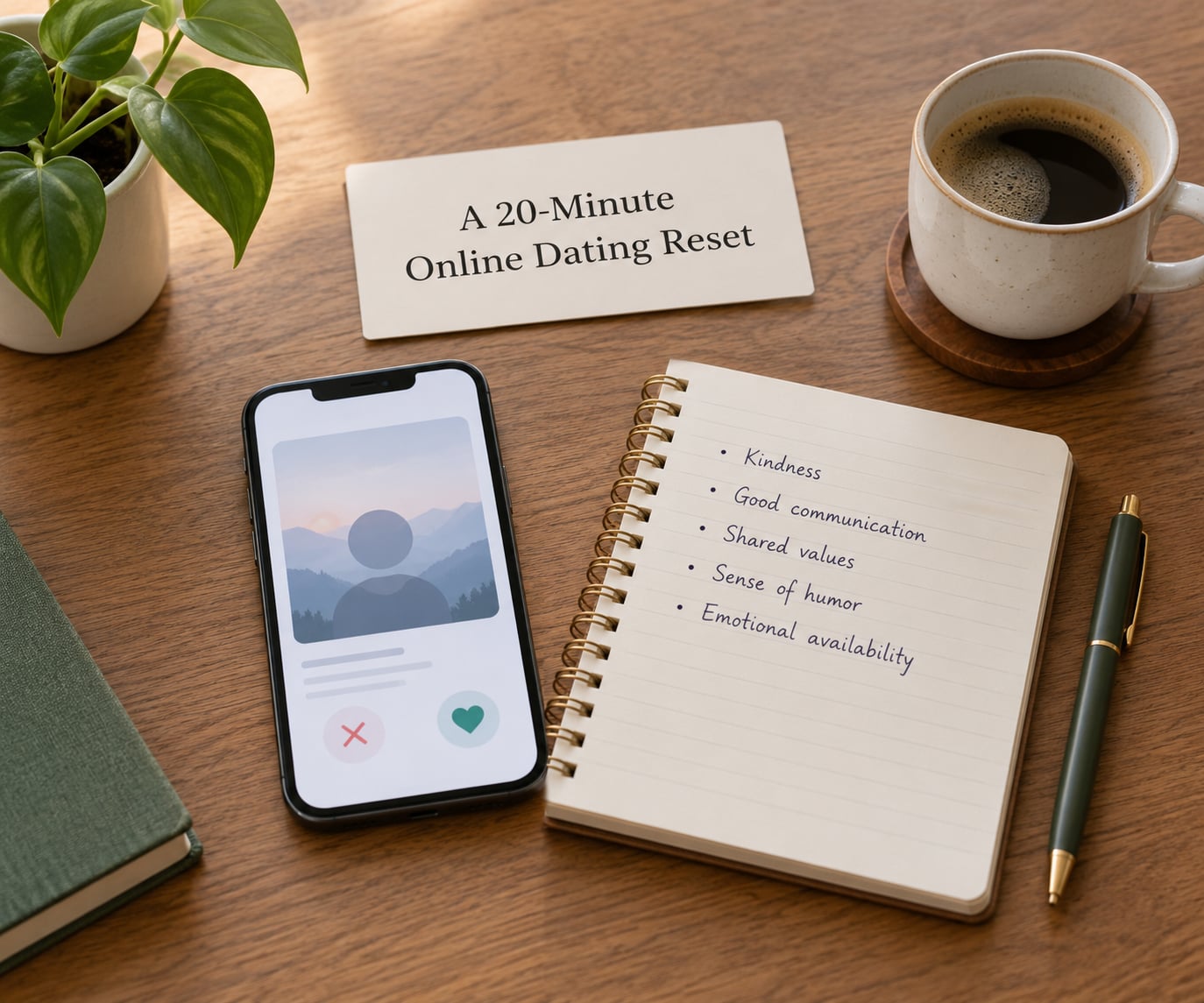
If you have about twenty minutes, work through this in order. It clears the backlog rather than adding another plan to it.
Minutes 1 to 5: audit what is actually happening
Open your recent matches and write down what happened to the last ten people who made you excited. Not what they looked like, what the moment was: they asked a real question, they had a dry sense of humour, they were available on a Sunday. You are looking for the pattern you keep reacting to, because right now you are guessing.
Minutes 5 to 10: clear the dead weight
Delete, archive or mute every conversation that has gone quiet, including the ones you keep meaning to answer. Nobody keeps track of your inbox. Leaving thirty stalled threads open is why the app feels heavy the second you open it.
Minutes 10 to 15: write the three non-negotiables
On paper, not in your head. Three traits you require and two you would genuinely trade for them. This is the step that turns swiping into filtering, and it is what stops a good person from reading as interchangeable with the next one.
Minutes 15 to 18: pick one app and set a cap
Delete the extras. Choose one window of twenty minutes, put the reminder in the app settings, and add one non-app evening block to your calendar this week. Two small commitments, written down, in the calendar.
Minutes 18 to 20: define the next step
Not a life goal. One concrete action: send the message you have been drafting, reply to the one person worth replying to, or schedule the date you have been avoiding. If nothing qualifies, then take the break in the next section instead of forcing another session.
When to Take a Break From Dating Apps
A break is the correct response when the cost has overtaken the purpose. Signs that you have hit that point: you open the app resentfully instead of hopefully, you feel lonelier after swiping than before, you have deleted and redownloaded several times, or you have started treating people like cards to get through.
Take the break without treating it as a defeat. Delete the apps instead of muting notifications, because a muted icon still pulls you in eight times a day. Tell one person in your real life what you are doing so nobody reads your silence as a story about them. And keep at least one part of your life pointed at connection, even if that part is a recurring class or a weekly dinner with friends.
Four weeks is usually long enough to notice whether anything changed, and short enough that returning does not feel like starting over. Before you go back, review three things: your criteria in writing, one conversation you actually enjoyed, and one you did not. Fix the profile only if a real pattern shows up in the conversation, not because a photo performed badly.
You are allowed to be tired of dating. That line shows up again and again in comment sections, and it is not a confession of failure. Some weeks dating is a source of energy and other weeks it is a tax, and how often that flips has very little to do with how likeable you are.
Frequently Asked Questions
Why are dating apps so exhausting?
Dating apps are exhausting because they combine an endless supply of options with unpredictable rewards. You spend real effort judging profiles, writing openers and holding several conversations at once, and most of it leads nowhere. That is high effort with low output, repeated daily, which is the exact recipe for the tired, flat feeling people call dating app burnout.
Is dating app burnout normal?
Very. A 2024 Forbes Health survey of 1,000 US dating app users found 78% reporting emotional, mental or physical exhaustion from dating apps, with 79% of Gen Z and Millennials affected. Fatigue is especially common among long-term users who have had their excitement dulled by repeated low-effort matches and ghosting. Normal does not mean harmless, but it does mean you are not doing something wrong.
How do I know if I am burned out rather than just unlucky?
A bad week has a bad match in it. Burnout is a pattern: you dread opening the app, you feel worse after scrolling than before, you feel relief when a promising person disappears, or you cannot get excited about someone you would genuinely like. If the exhaustion follows you into conversations with people you enjoy, or it shows up in your sleep and concentration, talk to a doctor or therapist about it.
How do I stop feeling drained by dating apps?
Cut volume before you try to feel better. Set a fifteen to twenty minute cap with an app reminder, run only one app, clear stalled conversations, and judge people by their first message rather than their photos. Add one recurring offline activity to the same week. Doing two of these for three weeks changes more than months of trying to be more patient with the app.
Should I delete my dating apps?
If the cost has overtaken the purpose, yes, and delete rather than mute them, since a silenced icon still pulls you back. Tell one friend what you are doing, keep one offline activity that points at connection, and plan to return in about four weeks. Before reinstalling, review your criteria in writing and one conversation you actually enjoyed.
How long should a dating app break last?
Four weeks is a useful default. Long enough for the habit to fade and for you to notice whether your mood lifts without the app, short enough that returning does not feel like starting from zero. What matters more than the length is that you spend the break building something real rather than simply deleting the icon and waiting for the urge to pass.
Conclusion
Why online dating feels exhausting has an answer that is not about you. Apps run on swiping loops and infinite choice, and then charge you for the privilege in emotional labor, comparison and silent no-shows. Seventy-eight percent of surveyed users feel it, which makes it a shared condition rather than a personal failing.
Start by reducing volume and clarifying what you want, not by trying harder. Write down three things you require, cap the scrolling, run one app, and let the next step be small. If none of that touches the exhaustion, take the break. You are allowed to be tired of dating, and the tiredness says more about the system you are using than about your prospects.