Here is the short version: a dating app matching algorithm is a ranking system that scores and orders the profiles shown to you. It combines what you typed into your profile with what you do after you open the app — swipes, how long you look, how fast you reply, whether you logged in this week — then predicts which people you are most likely to reciprocate with.
Understanding how dating app matching works behind the scenes matters because these systems are built to keep you tapping, not to help you find a partner. Once you know which levers actually move your results, you stop wasting evenings on tricks that do nothing.
Table of Contents→
- What Does a Dating App Match Actually Mean?
- What Information Does a Dating App Use?
- How Does a Dating App Matching Algorithm Work?
- Why Do Dating Apps Show More Attractive or Active Profiles?
- How Dating App Matching Differs Across Platforms
- What Are Compatibility Scores and How Are They Calculated?
- How Does Location and Distance Affect Your Matches?
- Can Dating Apps Match You Without Knowing Everything About You?
- How Can You Get Better Matches Without Gaming the Algorithm?
- What Doesn’t Matter as Much as You Think?
- Frequently Asked Questions
- What to Do First
What Does a Dating App Match Actually Mean?
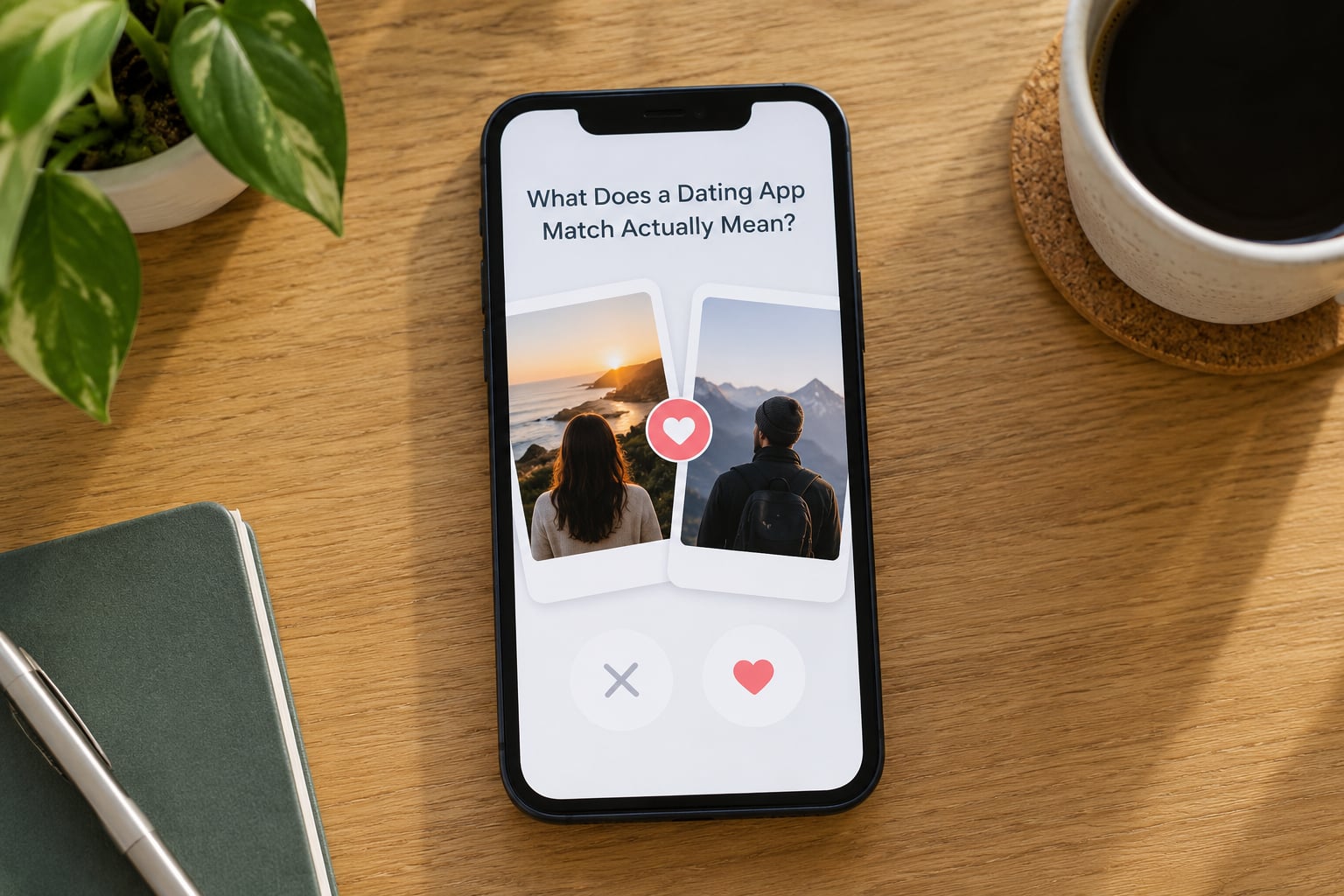
A match, in the strict sense, means two people have each selected the other. On Tinder, Hinge and Bumble, that mutual selection is what creates a chat window. Bumble adds a timer: once a match exists, one person has 24 hours to send the opening message or the connection disappears.
A suggested match is not the same thing. Some apps will show you profiles as “recommended” or “standouts” before any mutual selection happens, based on a predicted compatibility score. Those are ranked guesses, not connections, and plenty of them never become one.
One person can also sit in several of these queues at once. Your neighbor might be a mutual match on Bumble, a suggested match on Hinge, and a “someone you may know” on Facebook Dating, and the apps do not coordinate with each other. Different products run on different data, so a strong result on one tells you very little about the next.
What Information Does a Dating App Use?
It helps to separate two categories: what you told the app, and what the app inferred.
Declared data includes your photos, bio, prompts, age range, gender, orientation, stated preferences, job, school and the location you selected. Declared data is where the filters live, and it is the part you control most directly.
Inferred data is the rest. The app builds it from how you use the service: which profiles you swipe right on, how quickly you pass, how long you linger on a photo before deciding, whether you open a match’s chat and reply, your session length and how recently you were last active. Apps also collect device and identifier data so your activity can be linked across sessions.
What the algorithm cannot see is the part you would most want it to see. Nobody’s profile carries a field for honesty, current relationship status, whether someone is emotionally available, or whether they actually want a relationship. Public safety guides make the same point from the other direction — profile verification catches a fake face, not a fake situation — so treat verification badges as one signal among many rather than a green light.
On filtering by race and similar demographics: most apps deliberately removed hard preference filters after criticism that they reinforced skewed pools. What replaced them is subtler. Ranking models trained on past behavior reproduce the patterns of who liked whom, so a lopsided swiping history shows up in results without anyone setting a rule. The result feels like invisible demographic filtering because that is often exactly what it is.
How Does a Dating App Matching Algorithm Work?
Five stages run every time you open the app, and they run again with fresh data after every session.
1. Data collection
Your profile fields, your device and location signals, and every interaction are logged. This is the raw material for the rest of the pipeline.
2. Candidate filtering
Hard constraints cut the pool before anything clever happens: distance radius, age range, gender, orientation, and any setting you have locked down. Everything that survives this is genuinely eligible. Running out of profiles usually means this stage, not a punishment.
3. Compatibility scoring
Each surviving profile gets a predicted score. Some models use declared preferences; others use learned similarity; some combine both with a questionnaire.
4. Ranking
The scored pool is sorted and thinned into the cards you scroll. Popularity, activity recency and predicted response rate are folded in here, which is why the same pool of people can be ordered very differently for two users.
5. Presentation and feedback
You see a handful. Your reaction — swipe, linger, open a chat, reply or ghost — becomes new training data, and the loop closes. This feedback loop is why an account behaves differently after a few weeks of a particular habit.
That closed loop is the whole answer to the question of how dating app matching works. Ranking is not a static list. It is a prediction being corrected every time you tap.
Why Do Dating Apps Show More Attractive or Active Profiles?
Because the models are trained to predict reciprocity, and reciprocity is heavily influenced by how visible someone already is. Someone who appears to fifty people a day gets fifty chances to swipe back, and that measured response rate feeds straight back into their ranking. The system learns that showing them is efficient.
Activity recency matters for a blunter reason. An impression shown to a dormant account is wasted, so recent activity is one of the strongest controllable levers. People on dating forums consistently name regular recent activity as the thing that changes their results most, ahead of photo counts or clever bios.
Gender ratio and geography sit underneath all of this, and they are the most under-discussed variable in the whole system. The gap between men and women on any given app in any given city determines how much competition each side faces. Practitioners posting on Teamblind describe the effect as dramatic — the same profile producing very different volumes in different cities, with local gender ratio seen as the main cause rather than profile quality. That pattern shows up on Bumble and Hinge just as much as on Tinder.
The uncomfortable part: high visibility is not the same thing as a better romantic fit. A heavily boosted profile that ignores you costs you nothing in the algorithm’s eyes. Ranking optimizes for a click, not for a conversation worth having.
How Dating App Matching Differs Across Platforms
The broad approaches differ more than the marketing suggests. Nobody publishes exact formulas, so the table below describes the publicly documented approach and the widely reported behavior for each product, not a leaked scorecard.
| Platform | Primary matching approach | Strongest controllable lever | Distinctive quirk |
|---|---|---|---|
| Tinder | Behavioral ranking built on swipes and reciprocation | Recent activity | Pulled the public ELO label in 2019 while keeping the underlying desirability mechanism |
| Hinge | Behavioral model heavily weighted by prompt answers and photo likes | Answering prompts in a way that invites specific replies | New profiles reportedly get a heavy push for the first 24 to 48 hours, plus a standouts pool for high performers |
| Bumble | Ranking plus a women-first initiating mechanic | Keeping the connection alive before the 24-hour window closes | The match expires if nobody sends the opening message in time |
| OkCupid | Questionnaire compatibility producing a percentage score | Answering a high percentage of the questions, consistently | The most transparent model on the market and the one you can argue with, because you can see the answers behind the number |
| Facebook Dating | Separate pool using existing friend graph and activity data | Secret Crush entries and profile completeness | Kept deliberately walled off from the main news feed, and pairs entirely outside your friend list |
Hinge markets itself as built to be deleted, which is a retention joke as much as a product stance. Bumble’s women-first design is a matching rule, not a ranking rule — it changes who initiates, not who gets shown. Facebook Dating’s separate pool means the same person can be a complete stranger there in a way they never are on the main platform.
What Are Compatibility Scores and How Are They Calculated?
A compatibility percentage generally represents the share of comparable answers or attributes the two of you line up on, which is why it only exists on apps that ask structured questions. OkCupid’s classic model compares question responses across categories that matter to you, weighting importance, and shows the percentage alongside the specific answers that produced it.
The meaning changes from app to app, and sometimes the same label covers completely different mathematics. A number derived from declared answers measures agreement. A number derived from behavior measures predicted engagement. Only the first kind tells you anything about values, and even then it measures what you said on a multiple-choice question, not what you would do on a Thursday night.
So no, a high compatibility score is not proof of anything. It is a useful summary of one narrow input, and treating it as a verdict is how people end up on a date with someone who agreed about everything on paper and had nothing to say in person.
How Does Location and Distance Affect Your Matches?
Location changes more profiles than almost any other setting, and mostly through the filtering stage rather than the scoring stage. Widen your radius by ten miles and the eligible pool can grow faster than you expect in a dense city. A tight radius is the single most common reason a profile seems “broken.”
How precisely your position is used varies. Some apps work from the city or neighborhood you select, some from a rounded area, and some request precise background location. Location permission is worth reviewing in your phone settings and in the app itself, since a precise permission is not required for the service to function and it says more about you than the matching needs.
Travel creates a separate effect. When you open an app in a new city, you are not joining a new pool so much as borrowing one — and if your stated location is home while your device is elsewhere, the results can be noticeably inconsistent. A sudden change in geography can also reset how familiar your profile looks to the ranking model, which is why some people describe a trip as a visibility boost.
Can Dating Apps Match You Without Knowing Everything About You?
It can match you, but it will match you worse. A sparse profile produces a thin preference profile and a weaker similarity signal, so the model falls back on broad behavioral averages that describe an average user rather than you.
New accounts have the same problem in a more obvious form. There is no history for the model to learn from, so early results are pulled from generic pools and then corrected as you swipe. That correction period is why a new profile can feel wildly accurate for two days and useless by the end of the first week.
The tradeoff is straightforward. Every signal that improves your recommendations is another piece of information the company holds about your movements, preferences and conversations. You can narrow that considerably — review connected apps and location permissions, use an alias where the app allows it, and skip photo verification if you would rather not have facial data processed. You will trade some match quality for that, and it is a reasonable trade for a lot of people.
How Can You Get Better Matches Without Gaming the Algorithm?
Work in this order. Each step feeds the next, and none of it requires pretending to be someone else.
- Finish the profile before you optimize anything. A half-complete profile collects interest it cannot convert. Prompts answered properly matter more than another photo.
- Write prompts that generate replies. Ranking models weight prompt engagement heavily, and a prompt answered generically gets skipped. Ask something specific enough that a stranger has an easy opening.
- Set honest, workable preferences. A tight age or distance range shrinks your pool more than any ranking factor can rebuild.
- Use the app often enough to register as active. Five minutes most days beats one long session a week, because recency is read as a constant.
- Open your matches and reply. Chat engagement is one of the strongest signals in the pipeline, and it is the one most people abandon after day two.
- Fix the obvious breaks. A hidden face in your best photo, a stale bio from three years ago, or a photo of a group where you are impossible to find — these suppress you for free.
- Write opening messages that answer the profile. It improves the conversation, and the reply that follows improves your ranking.
If you go back to the diagnostic question people actually ask — why did my matches stop — check these in order: a drop in your own activity, a profile edit that reset your signals, an accidentally tightened age or distance filter, and finally whether you have simply swiped through everyone in range. In practice the last one is the most common answer, and the fix is widening the range or waiting for the pool to refresh.
What Doesn’t Matter as Much as You Think?
Several folk theories circulate widely and none of them hold up well. Here is the honest version.
Elo. Tinder removed the public ELO label in 2019 and led with that, which convinced a lot of people the mechanism disappeared too. It did not. Desirability-style ranking, driven by who swipes back and how reliably that swipe converts into a chat, is standard behavior across the category. You do not need the number to exist for the effect to be real.
The 3-3-3 rule. The idea that you should like three profiles, comment on three, and send three messages each day has no published basis and no mechanism behind it. No app has confirmed it. Treat it as folklore, not a setting.
Right-swiping everything. There is no documented shadowban for indiscriminate likes. What actually happens is unremarkable: your selectivity rate gets low, you receive fewer likes back, and the model correctly learns that your right-swipe carries little information. That is a feedback effect, not a punishment.
Paying for ranking. Boost and premium products reliably increase visibility for a defined window. They change how often you are seen, not whether the people you see fit you. Our take on which paid features earn their cost is that buying reach on a profile with no conversation skills is renting an empty room.
Photo order tricks. Your first photo dominates because it decides whether anything else is seen. That is real. But moving an unusual photo to slot one buys a short bump, not a better match pool. Photo slot weighting comes from downstream response, not from image grading — the app learns which photo earns the right swipe.
Deleting and recreating your account. It reopens the new-user visibility window, and it costs you every existing match and conversation. People report it working; they also report the emptiness that follows. If your problem is a stale pool, widen your filters first.
Frequently Asked Questions
Why does a dating app keep showing me the same person?
It usually means your eligible pool is small and you have already seen the best-scoring profiles in it. A tight distance radius or narrow age range is the usual cause, and the app re-serves the top-ranked candidates until they are exhausted. Widening either setting by a meaningful amount is the fastest fix. A smaller share of repeat appearances comes from suppressed accounts that keep getting requeued until a swipe removes them for good.
Do dating apps secretly save profiles I do not want to see?
Not in a meaningful sense. When you pass on a profile, that decision feeds your preference model so it can rank similar profiles lower in future, but the card itself is normally gone from your queue. The persistence people notice is ranking behavior: if your filters are narrow, the same small pool keeps cycling. Turning on the option that hides already-liked or previously-passed profiles will stop it looking like the app is ignoring you.
Does a paid boost guarantee better matches?
No. A boost guarantees more impressions for a set window, not better ones. It moves your profile in front of more people from the pool you have already qualified for, so it helps most when your profile already converts reasonably well and you simply are not being seen enough. If your match-to-chat rate is low, buying reach puts more people in front of a profile that is not landing, and the boost runs out without changing anything.
Why did my compatibility score change after editing my profile?
Compatibility scores are recalculated from your current inputs every time they are viewed, so anything you changed is reflected immediately. Adding photos, answering more prompts, or rewriting a bio all shift the score because they add or change comparable answers. The same applies to the other person, which is why a figure can move when they update rather than when you do. Treat the number as a snapshot of two profiles, not a fixed rating.
Is a high compatibility score proof that someone will be a good partner?
Not remotely. It measures overlap on the inputs you both provided, usually structured answers or stated preferences. It cannot weigh kindness, reliability, emotional availability, honesty about intentions, or whether either of you is still dating someone. Those are exactly the things people most want to know, and the score says nothing about them. Read it as a useful summary of surface alignment, then judge the person in conversation like you would anywhere else.
What to Do First
Start by writing down the three traits you actually refuse to compromise on. Then check your age range and distance radius, because those two settings do more damage than any tactic people sell online.
Next, finish the prompts on your profile and make each answer specific enough that a stranger can reply to it. Show up for a few days so you register as active, and reply to the matches you get instead of letting them expire.
Finally, judge every match by the conversation rather than by its rank or its score. No ranking model on any app has access to the things that decide whether you want to see someone again.