Free vs paid dating apps differ in three concrete ways: how many people you can reach each day, how precisely you can filter who reaches you, and whether you can see interest before you spend time on it. A free account gives you a profile and a capped number of daily likes. A subscription removes the caps, adds advanced filters, and often adds visibility tools. None of that fixes a weak photo.
The most-repeated view over on r/SwipeHelper, in a thread about the truth about paying for dating apps, is that a subscription is an amplifier rather than a fix. Pay while doing badly and you simply get more of the same bad result. Pay while already converting and you get more of the good kind. That framing decides most of the advice below.
So the real question is not free versus paid. It is whether your free numbers say the app is limiting you, or whether your profile is. Read the table first, then the diagnostic near the end before you spend anything.
Table of Contents→
- Free vs Paid Dating Apps What You Actually Get at a Glance
- What Free Dating Apps Usually Include
- What Paid Dating Apps Usually Add
- How Matching and Profile Visibility Change
- Privacy and Control Features to Compare
- The Hidden Costs of Paid Dating Apps
- Which Should You Choose?
- Frequently Asked Questions
- Are free dating apps worth using?
- Is a paid dating app better for finding a serious relationship?
- What do paid dating apps actually provide that free apps do not?
- How much should I pay for a dating app subscription?
- Can I try a paid dating app without being auto-renewed?
- Should I pay for a dating app if I am not very active?
- What to Do First
Free vs Paid Dating Apps What You Actually Get at a Glance
| Feature | Free tier | Paid tier | Why it matters |
|---|---|---|---|
| Profile and photos | Full profile, several photos, bio and prompts | Same, sometimes with extra profile slots | Identical, so paying cannot fix a weak profile |
| Daily likes or swipes | Capped, and the counter refills every few hours | Unlimited on most apps | The cap decides whether you can act on a good profile while you see it |
| Who liked you | Usually hidden until you swipe right, if at all | Often shown as a separate list | Saves time when your ratio is high but your follow-through is low |
| Filters | Basic only: age, distance, sometimes gender | Height, education, interests, verified-only, intent, dealbreakers | Filters decide who reaches you, not just who you see |
| Rewind or undo | Often not available, or limited | Usually included at some tier | Matters most for deliberate swipers, not fast ones |
| Advertisements | Yes, between swipes | Removed at most tiers | Quality-of-life, not a match-rate change |
| Boosts and super likes | Available as one-off purchases | Sometimes included monthly | Cheap visibility for a few hours, not a lasting boost |
| Location changes | Usually locked to your current area | Travel mode or passport feature | The one paid feature people genuinely cannot replicate free |
| Verification and safety tools | Photo verification on some apps | Priority review, read receipts, extra reporting detail | Helps with moderation, not with honesty |
| What reaches you | Whatever the algorithm decides | Same pool, shown to you more often | Paying changes exposure, not the underlying user base |
Read the last row carefully, because it is where most marketing copy gets loose. Paying does not add users to the pool. It changes how often your profile is shown inside the pool that already exists.
Pricing in this space moves constantly and is set per platform store and per region, so check the upgrade screen in the app itself rather than trusting a number you read on a blog months ago. What does not move is the shape of the differences above.
What Free Dating Apps Usually Include
What every free account gets
More than most people expect. Free users on the big swipe apps can build a full profile, add several photos, answer prompts, match, and message matched people without paying a cent. The messaging is the part people get wrong: chatting is not a paid feature. It is the discovery layer that is throttled.
You also get the basics of safety tooling on most apps regardless of tier. Photo verification, block and report buttons, and the ability to hide or restrict your profile are normally available to everyone.
The caps you will actually hit
The free limit is a like cap, not a match cap. On Tinder, for example, free users get roughly a hundred likes at a time and the counter refills every several hours. Tinder has never published the exact figures, so treat any specific number you read as a snapshot rather than a promise.
Two other limits bite harder than the cap. First, you usually cannot see who liked you, so a free account can be accumulating interest it will never show you. Second, filters are minimal, which means your deck is full of people outside your stated preferences and you are doing the filtering by hand.
For a casual browser this is completely workable. For someone who swipes deliberately, reads profiles properly, and opens the app several times a day, the cap starts to feel like the app deciding how much of your attention is allowed.
Who the free tier tends to attract
Free tiers are the volume layer of a two-sided business, so they skew heavily toward men and toward casual intent. Widely repeated figures put Tinder’s user base at around three quarters men, though the company does not publish a current breakdown. Hinge has publicly described a more even split without publishing a precise ratio. Treat any specific ratio you find online as an estimate that ages badly.
The practical consequence: the free experience is usually more crowded on one side, so the same swipe gets less attention. That is a reason to pay, but it is also a reason to check whether the app you are on even has people in your age range and area.
What Paid Dating Apps Usually Add
The three features that change the experience
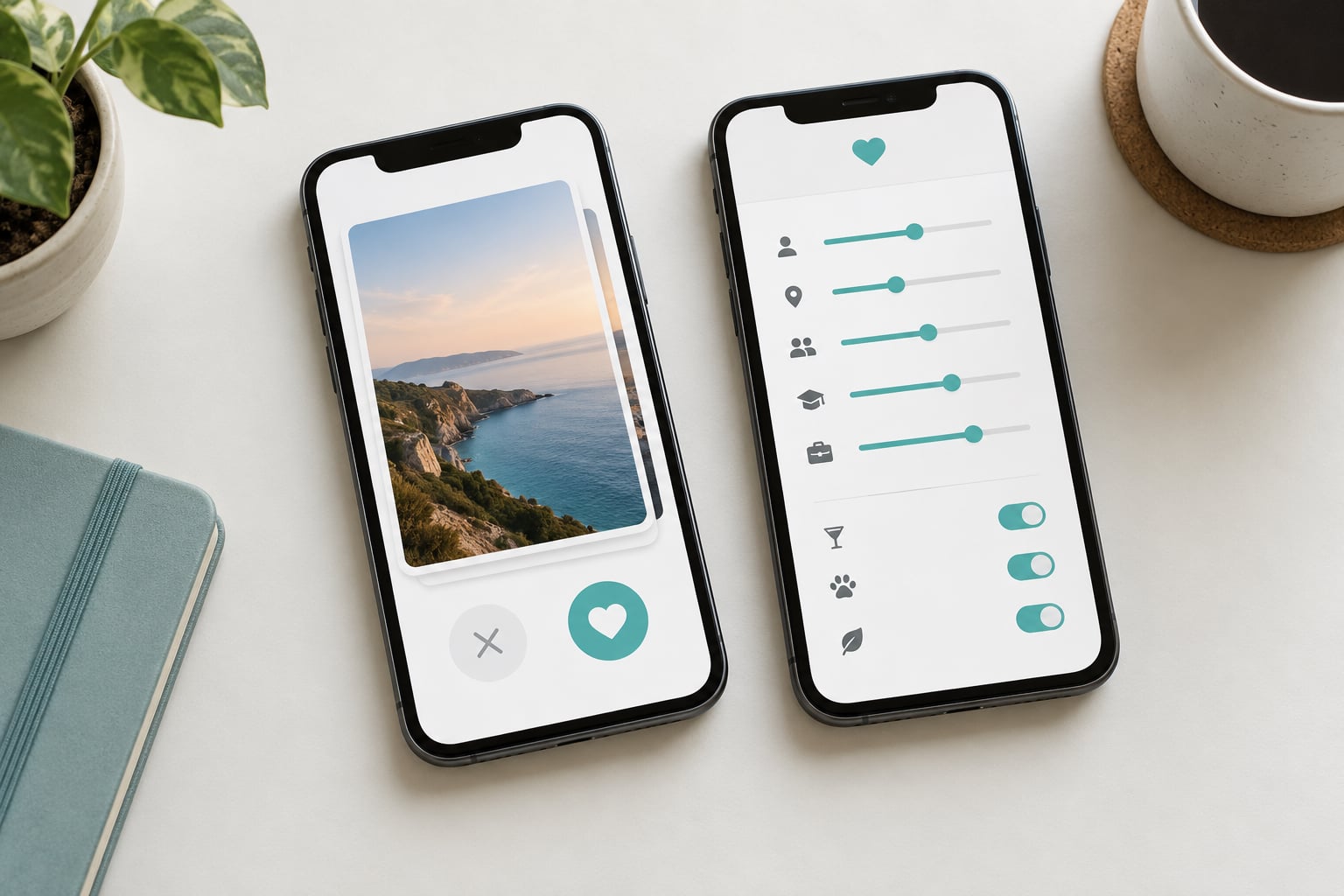
Unlimited likes, advanced filters, and visibility into who liked you are the only three upgrades that reliably change how a week feels. Everything else is decoration around those. If a subscription is not giving you those three, you are paying for a nicer interface.
Unlimited likes matter when you are active and interested. Advanced filters matter when your standards are specific, because filters change who is in your deck rather than how often you see the deck. Who liked you matters when you are popular but slow to follow through, since it converts a guess into a shortlist.
Nice-to-have extras that rarely justify a subscription
Rewind, read receipts, ad-free use, priority support, profile boosts, and the occasional extra profile slot all sit in this bucket. They are pleasant, and several of them are free during a trial period, which is a useful way to test whether you would actually use them.
Rewind gets the most praise and the least use. If you swipe with a plan instead of on impulse, you almost never need it. If you swipe on impulse, you are not going to notice the button exists.
A boost is not a subscription
Boosts and super likes are one-off purchases that push your profile in front of extra people for a short window. They are useful in one situation: a weekend where you know you have time to message everyone who appears. They are useless in a month where you plan to open the app twice.
Buying a handful of boosts is often a better use of money than a subscription when your profile already pulls a decent response rate. Single purchases also have no auto-renewal attached, which removes the single most common billing complaint.
How Matching and Profile Visibility Change
Discovery and who gets to see you
Every swipe app runs on a ranking system that decides which profiles you see, based on mutual filtering, activity, and how fast people right-swipe. A paid account is not matched to better people. It is shown to the same people, more often, and shown earlier.
That is a real gain when you are in a dense area with heavy competition, because position in the queue matters. It is close to meaningless in a small town where the deck is thin no matter what tier you are on. The algorithm is not the tier; the size of the pool is.
Does paying actually improve match quality?
Usually not on its own, and sometimes it appears to get worse. A 44-year-old man posting in r/Bumble reported that after subscribing he received matches from other continents, well outside the distance range he had set, and concluded he had been sold visibility rather than a better pool.
That complaint is worth taking seriously because it has a mundane explanation. Paid tiers widen the radius of who gets shown to you so that the increased volume has somewhere to come from. The fix is to set your filters again after upgrading and check the distance range yourself rather than trusting the default. Users who report a drop in quality after paying are usually seeing the widened radius, not a downgrade.
There is published survey research, frequently cited through Pew, that paying users report more positive overall experiences than non-paying users. That measures satisfaction with the service, not whether they ended up dating sooner. Treat it as a measure of the product, not of your outcome.
Why the paid experience differs for men and women
The average man gets far fewer inbound likes than the average woman, so a male user is more likely to run into the daily cap, and pays to remove a constraint that is real for him. Many women report paying and seeing almost no difference, because they were never limited by the cap and the who-liked-you feature confirms interest they already had.
For women, the paid features with actual value tend to be the control ones: tighter filters, incognito browsing, and extra detail in reports. For men, the value is volume and undo. Buying the wrong set for your own position on the app is the most common way people end up with a subscription they resent.
Privacy and Control Features to Compare
Visibility settings worth checking before you subscribe
Before you pay, open your privacy and discovery settings and look at what is already free. Most apps let you hide your profile, limit who sees your last active status, hide your distance, and restrict yourself to people you have liked. On some apps, paid tiers only add a faster way to change settings you can already change by hand.
That is the honest test. If you find every control you care about in the free settings menu, the paid tier’s privacy story is thin for you.
Verification, blocking and reporting
Paid tiers sometimes move your account into a faster verification queue, add photo and identity checks, and give you more fields in a report. Those are genuine quality-of-life improvements when a real person is using your data badly.
Free accounts are not unprotected, though. Blocking, reporting, and photo verification are standard on the free tier of every major app. The paid upgrade improves the handling of a problem, not your ability to raise one.
What verification does not fix
Verification confirms that a person is the person in the photo. It says nothing about intent, honesty about relationships, or whether someone behind a verified photo is talking to two people at once. Paid membership is not a background check.
So treat the paid tier as irrelevant to catfishing and rely on habits instead. Meet somewhere public, tell a friend where you are going and when you expect to be back, and never send money or share financial details with someone you have not met in person. A profile that pressures you emotionally, asks for financial help, or moves to a new app within a day is a pattern, not a glitch.
The Hidden Costs of Paid Dating Apps
Auto-renewal and the weekly billing trap
Subscriptions default to renewing until cancelled, and some apps bill weekly rather than monthly. A weekly rate looks small in the moment and stacks into a large annual figure that you never consciously agreed to. The people complaining most loudly about price creep on r/Bumble are usually describing exactly this, not a rise in the headline price.
Two habits fix most of it. Always start on the monthly option rather than the discounted annual or introductory one, so you are in control of the next charge. And take a screenshot of the confirmation screen, because refunds and cancellation terms are far easier to argue with when you have the date and time of the purchase in front of you.
Introductory pricing and the tier ladder
Most apps run three tiers, and the middle one is engineered to look balanced while being roughly double the entry tier. The differences between tiers are often one feature, which makes the jump hard to justify on paper even when it is the only version that contains what you want.
Read the tier list once and find the cheapest tier that includes the specific feature you came for. Then stop. People rarely upgrade twice within the same month, and the second upgrade is the one that costs real money for features they never open.
The subscription you never open
A subscription is worth what your activity makes it worth. If the free cap never binds and you open the app twice a week, the money buys nothing measurable, because an unlimited allowance on a deck you do not swipe is still a deck you do not swipe.
The clearest signal to ignore a subscription is already paying and not messaging people. Fix the response rate first, then decide. Paying on top of a low response rate is the single most common way readers describe losing their money in these apps.
Which Should You Choose?
Stay free if this sounds like you
Stay on the free tier if you are browsing rather than searching, if your profile is new and its photos have never been improved, if you open the app a few times a week, or if the cap has never stopped you from swiping on someone you liked. First-time users gain far more from rewriting the first three lines of the bio and replacing a group photo with a clear solo one than from a subscription.
Also stay free if you are looking for something casual and specific. Paid tiers do not reliably filter for relationship intent, and a paying user with a clear intent label can still be the wrong person for you. People on r/dating_advice ask this constantly, and the recurring answer is that intent is a profile problem, not a tier problem.
Pay if this sounds like you
Pay when the free cap genuinely blocks you, which usually means you are swiping past a hundred people a day in a competitive area. Pay when you need filters the free tier does not offer, such as verified-only, education, height, or a much wider distance range. Pay when you travel regularly and need to change your location more than the free allowance allows.
Pay with a specific target rather than a vague hope. People who got value on r/SwipeHelper tended to pay after their free results were already turning into dates, or for one named feature. Paying in month one, with an unoptimised profile, is the pattern that produces regret.
Run this two-week diagnostic before you pay
Spend two weeks on the free tier and write down four numbers. Profiles seen, matches received, matches you messaged, and dates that came out of it. That sequence tells you where you actually break down.
If profiles seen is high and matches are low, the app is fine and the profile is not. If matches are plentiful and messages are low, the problem is opening lines. If messages are plentiful and dates are low, it is the conversation, not the app. Only when profiles seen is capped do you have a case for unlimited swipes. This is the fastest way to know whether paying is the answer, and it costs two weeks.
How to test a paid tier for the least money
Buy one month at the monthly rate, not the annual one, and test it during a period when you will actually use the app. A test during a quiet fortnight tells you nothing.
On the upgrade screen, check whether the cheaper tier already contains the feature you wanted, and whether the free trial of that tier would answer your question without a charge. If you do subscribe, cancel from the app store or the app’s subscription settings immediately after the purchase, so the cancellation is recorded while the trial or month is still running. Your access usually continues to the end of the paid period, and you will not be charged again. Keep the confirmation screenshot in case a refund needs requesting, and set a calendar reminder a few days before the renewal date as a second layer.
Frequently Asked Questions
Are free dating apps worth using?
Yes, for most people they are the right starting point. You can build a full profile, match, and message for free, and the cap only becomes a problem once you are swiping more than a hundred people a day. A weak profile on a free tier usually outperforms a paid subscription, so fix photos and prompts before subscribing.
Is a paid dating app better for finding a serious relationship?
Only indirectly. A subscription gives you more visibility, unlimited likes, and better filters, and it can put you in front of more people who have stated serious intent. It does not change who is on the platform, and the person behind the profile is the same either way. Most people find a relationship through profile quality and follow-through, not tier.
What do paid dating apps actually provide that free apps do not?
Three things matter: unlimited likes or swipes, advanced filters such as verified-only, education, height and wider distance, and a view of who liked you before you commit. Everything else, including rewind, read receipts, ad-free use and boosts, is usually a convenience rather than a change in results.
How much should I pay for a dating app subscription?
Treat the amount as a small monthly experiment rather than a commitment, and pay only for the cheapest tier that includes the one feature you actually came for. Always start on the monthly billing option so you control the next renewal, and set a reminder a few days before it. If the cheapest tier does not solve a measured problem, spend nothing.
Can I try a paid dating app without being auto-renewed?
Yes. Buy one month on the monthly rate, then cancel straight away from your app store subscriptions or the app’s own subscription settings. Access normally continues to the end of the period you paid for and the subscription will not renew. Save the purchase confirmation screenshot, and check the store’s refund rules in case you want to dispute a charge.
Should I pay for a dating app if I am not very active?
No. Unlimited swipes on an app you open twice a month is still an app you open twice a month, and the subscription becomes pure cost. Pay only when the free cap is genuinely stopping you from liking people you want to like, or when you need a feature such as travel mode. Activity has to match the upgrade for it to mean anything.
What to Do First
Spend two weeks on the free tier and count profiles seen, matches, matches messaged, and dates. If the cap is the only thing in the way, buy one month on the monthly rate, test it in a week when you will use the app, and cancel the moment the test is over.