Dating app bio mistakes to avoid usually come down to one thing: your bio tells a stranger nothing specific enough to reply to. Generic interest lists, dealbreaker demands, recycled cliches and empty bios all read the same, so a match has no easy opening line and moves on. Fix the bio and you will not change your photos, your looks or your luck — you will change how many of the matches you already earn turn into conversations.
One honest expectation first. Photos decide who stops scrolling; the bio decides who replies. A widely cited University of Amsterdam study that followed more than 5,000 online dating choices found exactly that split — faces and photos carried the decision, and written profiles mattered far less. So no rewrite will rescue a bad photo set. What a bio does is convert interest into conversation, and that is where a lot of profiles quietly fail.
A user on r/Tinder put it plainly: most people will not read a bio, and half of those who do will not appreciate a polished one, so staying true to yourself beats performing. That instinct is right. The problem is that most bios give the reader nothing true to react to.
Table of Contents→
- Dating App Bio Mistakes to Avoid at a Glance
- 1. Writing an Empty or Generic Bio
- 2. Using Cliches That Do Not Sound Like You
- 3. Making Your Intentions Unclear
- 4. Writing a List of Dealbreakers
- 5. Overloading the Bio with Personal Details
- 6. Claiming to Be Effortlessly Funny
- 7. Saying You Are Just Being Themselves
- 8. Using a List of Adjectives Instead of Examples
- 9. Making the Bio About Physical Appearance
- 10. Bringing Negativity or Bitterness into the Bio
- 11. Trying to Impress with a Long Essay
- 12. Skipping the Profile and Using the Bio as a Resume
- Frequently Asked Questions
- How long should my dating app bio be?
- Should my dating app bio mention what I am looking for?
- Is it better to be funny or genuine in a dating-app bio?
- Should I update my bio when my preferences change?
- How do I make a dating-app bio stand out without sounding generic?
- Should my bio mention my job, education, or other resume details?
- Conclusion
Dating App Bio Mistakes to Avoid at a Glance
Every item below is a habit, not a personality. That is good news, because habits are editable in an afternoon. Here is the short version before the detail.
| Mistake | Why it weakens the profile | Core fix |
|---|---|---|
| Empty or generic bio | Reads like every other profile in the feed | Swap one category for one concrete detail |
| Borrowed cliches | Carries zero information about you | Say the same thing in your own words |
| Unclear intentions | People guess, and most guess wrong | One line on what you are after |
| Dealbreaker list | Signals a heavy past instead of a good time | State the value you want instead |
| Too many personal details | Drowns the useful stuff | Keep, trim, or save it for conversation |
| Forced humor | Land as pickup-line energy | Be mildly funny, never performing |
| “Just being myself” | Tells a stranger nothing | Authentic detail, not an identity claim |
| Adjective lists | Unverifiable claims | Replace each label with an example |
| All about looks | Wastes the few lines you have | Interests, values, routine |
| Bitterness or negativity | Makes you the warning sign | Hold the boundary without the complaint |
| Long essay | Nobody finishes it | Opener, one detail, one invitation |
| Bio used as a resume | Duplicates work the photos and prompts do | Write the part only a bio can hold |
1. Writing an Empty or Generic Bio
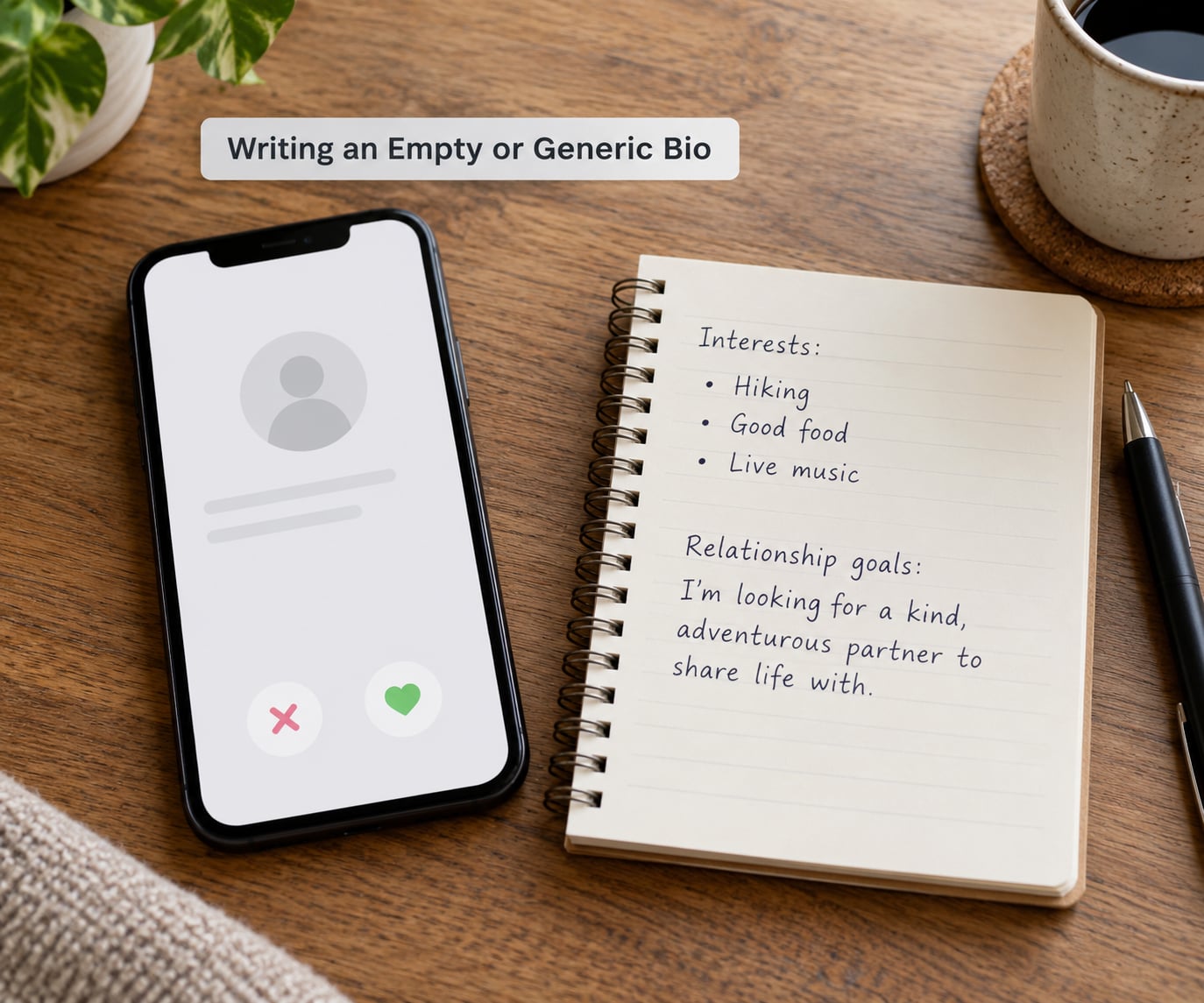
An empty or generic bio is the most common problem, and the easiest to fix. “Love to laugh, love to travel, looking for someone real” could belong to any of the thousands of profiles in your feed, so nobody can tell whether it means you.
What to write when your dating app bio says nothing
Replace each category with a detail from inside that category. Travel becomes the specific trip you take every October. Dogs becomes the breed you argue about. Food becomes the dish you burn on purpose. One real detail does more work than a paragraph of labels.
- “Love to travel” becomes “Two flights every year and I still check the weather first.”
- “Dog person” becomes “One loud beagle, one quiet cat, no regrets.”
- “Good food, good vibes” becomes “I will argue about the best taco in a five-mile radius.”
- “Looking for something real” becomes “Here for something that turns into a Tuesday night habit.”
Users on r/PetPeeves and r/AskReddit describe profiles made of nothing but a name, an age and a run of emojis, and the reaction is almost always the same: it reads as low effort, or worse, as a catfish.
2. Using Cliches That Do Not Sound Like You
Cliches are not a crime, they are just noise. “Partner in crime,” “wanderlust,” “fluent in sarcasm,” “proud dog dad” and “looking for the Pam to my Jim” have all been said by thousands of people, and a reader cannot tell you apart from any of them.
The fix is not to invent a new catchphrase. It is to keep the same energy and drop the borrowed wording. Someone who genuinely loves to travel can say that they plan every trip around a good bakery, which tells you more about travel, food and how they plan things than “wanderlust” ever did.
3. Making Your Intentions Unclear
Clear intentions are the single biggest upgrade to a dating app bio, because most swipe fatigue comes from guessing. When someone cannot tell whether you want a relationship, a Saturday or a friendship, the safe move is to pass.
You do not need a manifesto. One sentence is enough, and it works best when it describes you rather than filtering them. “Here for a relationship, not a situationship” reads better than “no games, no drama, no flings.” Same information, no warning label attached.
4. Writing a List of Dealbreakers
A bio dominated by what you do not want feels negative, and people read it as a scorecard of your last relationship. “No players,” “no drama,” “no liars” and “no toxic people” all point at the same wound.
Across r/dating_advice and r/OnlineDating, the consensus is consistent: negativity in a bio filters nobody out because those people were never going to match anyway, and it pushes away everyone who was. Say the positive version instead. “Looking for someone honest and easy to talk to” screens for the same thing without the scar tissue on display.
5. Overloading the Bio with Personal Details
There are two failure modes here. Some people write nothing, others write their entire autobiography into a space that holds about four sentences. Both lose the reader, and the second one loses them mid-scroll.
Use a quick triage. Keep anything that hints at what a normal Saturday looks like. Trim anything that explains a past relationship, because that is a third-date conversation. Save anything about your family, your divorce or your finances for a real chat, where context makes it land instead of alarming. On privacy, keep your workplace, your last name and your social handles off the bio entirely — those details help strangers find you, and dating apps already share far more than people expect.
One r/OnlineDating poster wrote a full paragraph about working in an event planning department and ended by describing himself as the guy with a dynamic personality and immense creativity. His own read was that it sounded like a job application, and he was right. Cut the role, keep the parts of it that show personality.
6. Claiming to Be Effortlessly Funny
Stating that you are funny, or trying hard to prove it in the first line, usually produces the stiffest bios on the platform. Setup, punchline, punchline, done reads like a bit you are performing rather than a person talking.
Pick one light moment and let it sit in a normal sentence. “My sister still brings up the Thanksgiving I set the smoke alarm off with an actual croissant” is a funnier line than “expect dad jokes,” and it does not announce itself. Inside jokes work the same way — they land with the two people who share them and shut out everyone else.
7. Saying You Are Just Being Themselves
“Just being myself” is not authenticity, it is an absence of information. It is what everybody writes, and it asks the reader to supply every detail themselves, which is work nobody volunteers for.
The trick is being specific and still leaving room. A concrete detail or two gives the reader something to grab onto, while an unlisted corner of your life gives them something to ask about. That gap is where a conversation starts.
8. Using a List of Adjectives Instead of Examples
Adjectives are cheap claims. Adventurous, ambitious, caring and funny describe what you wish to be seen as; examples describe what you actually did last Tuesday.
A useful test is to swap the label for a sentence a friend could picture. Not “adventurous” but “will drive three hours to reach a trail I read about once.” Not “caring” but “I am the one who remembers everyone’s birthday and who hates it.” If a reader cannot picture the moment, the adjective is doing nothing.
9. Making the Bio About Physical Appearance
Bios that describe height, eyes, physique or looks are spending their few lines on information your photos already handled, and often better. It also makes the profile interchangeable, because everybody describes themselves the same flattering way.
Spend those lines on what you do with a free evening, what you argue about, and the kind of relationship you want. Someone who cannot see your face can still picture the Tuesday.
10. Bringing Negativity or Bitterness into the Bio
Criticism of an ex, of the app, or of people in general reads as unresolved. “Dating is stupid,” “my ex ruined this,” “everyone on here is a liar” — each one invites the reader to wonder what you will say about them next.
You can still hold a real boundary without the bitterness. “Single, no kids, not looking to be a placeholder” sets the terms plainly. If you need to be blunt about something, keep it to one short line and stop there rather than letting it become the tone of the whole profile.
11. Trying to Impress with a Long Essay
A long bio is not a compelling one. When someone is scrolling between photos, four tight lines beat four hundred words every time, and length by itself is the most common reason a good bio gets ignored.
Cut it down to three moves: a short opening line, one specific detail, and one invitation to reply. Per-app, most bios cap out at a few sentences, and prompt-based apps reward one answer at a time rather than a wall of text, so write for the box you are filling in instead of the platform in general.
Try this shape: I am a [specific thing]. Currently [small current detail]. Ask me about [one thing only you would enjoy explaining]. It takes about fifteen seconds to read and gives a match three ways in.
12. Skipping the Profile and Using the Bio as a Resume
Photos, prompts and the free-text bio each do a different job. Photos get you looked at, prompts give people a topic to answer, and the bio is the only place where your voice comes through in full sentences.
When the bio repeats what the photos and prompts already say, it wastes the one slot that can sound like a person. Drop the job title your prompt already covers, drop the list of hobbies your photos demonstrate, and use the space for how you talk and what you actually want.
Frequently Asked Questions
How long should my dating app bio be?
Four lines or fewer is the sweet spot on most apps, and prompt-based apps want even less, usually fifteen to thirty words per answer. Anything past the first screen is wasted. Keep one opener, one specific detail and one invitation to reply, and move the rest into conversation.
Should my dating app bio mention what I am looking for?
Yes, in one line. Saying what you are after filters the wrong people early and gives the right people a reason to reply. Write it as a description of you rather than a list of conditions on them. Something like here for a relationship works better than no games, no drama, because the positive framing attracts the same people without the negative tone.
Is it better to be funny or genuine in a dating-app bio?
Genuine wins, and funny is a bonus. Humor that has to announce itself reads as pickup-line energy, and inside jokes shut everyone else out. The most likeable bios sneak one light, true detail into an ordinary sentence and get on with the point. If a line makes you check how it sounds before posting it, cut it.
Should I update my bio when my preferences change?
Update it, and update it early rather than late. If you are done with casual dating or your work situation has changed, the wrong matches keep arriving, and the bio is where you can say so in one sentence. Small edits help too, since a bio you wrote a year ago rarely sounds like you now. Change one thing at a time and give it a week.
How do I make a dating-app bio stand out without sounding generic?
Swap a category for a detail from inside it. Instead of love to travel, name the trip you take every year or the airport you always get lost in. Instead of dog person, name your dog or argue about breeds. Specificity is what separates a memorable bio from a forgettable one, because a stranger can only respond to something they can picture. One strange, honest detail beats five tidy ones.
Should my bio mention my job, education, or other resume details?
Only if the job says something about how you live. Product designer in a city with good food gives a match something to ask about, while a bare job title reads like a form field. Education rarely earns a line unless it is central to your life right now. Keep your company name, workplace and last name off the bio.
Conclusion
Start with one line tonight. Replace whatever vague phrase is doing the least work in your bio with one specific detail you would happily explain for ten minutes, add a sentence about what you are actually looking for, and finish with something a stranger can answer.
That is the whole job of the text: not to impress, but to hand someone an easy reason to write back.