
A single slow reply tells you almost nothing. What actually answers the question is a pattern: response times stretching out, replies shrinking, and conversations that only happen when you start them. This guide covers how to tell if someone is losing interest over text by comparing a stretch of real conversations against what that person’s texting used to look like, so you get an honest read instead of a guess at midnight.
The whole process takes about ten minutes of scrolling back through your messages. The hard part isn’t the analysis, it’s resisting the urge to send a fourth message while you’re doing it.
Table of Contents→
- What You Need Before You Start
- Step-by-Step: How to Tell If Someone Is Losing Interest Over Text
- 1. Compare the change with their usual texting habits
- 2. Notice when replies get shorter and less personal
- 3. Check who is starting the conversations
- 4. Look for reduced interest in making plans
- 5. Read the tone, not just the timing
- 6. Test the connection with one clear, low-pressure invitation
- 7. Decide whether the change is temporary or consistent
- 8. Communicate or move on respectfully
- Common Mistakes
- Frequently Asked Questions
- How long should I wait before asking if someone is losing interest over text?
- Does a slow reply mean someone is losing interest?
- What if someone leaves me on read but still replies later?
- Is it bad if their texts are getting shorter?
- How can I tell if someone is not interested without sounding desperate?
- Should I stop texting first if I feel the connection fading?
- Conclusion
What You Need Before You Start
Most people read the wrong evidence. They screenshot one conversation, stare at the timestamps, and build a case. You need a baseline first, and a baseline only works if you gather a few things before you start interpreting.
Enough conversation history to judge a pattern. One exchange cannot tell you anything. Scroll back far enough to see at least ten or fifteen exchanges across several days, ideally two or three weeks. If the relationship is new and you do not have that yet, then you do not have enough data, and no amount of analyzing will create some.
A note on what their normal rhythm actually is. Before you compare, write down their usual pattern in a sentence or two. Fast or slow? Morning person or night text? Sends long paragraphs or short lines? Most people misremember their own texting history, and they usually remember the version that supports whatever they are hoping for.
A sense of their life right now. New job, sick parent, exam season, new baby, a friendship ending badly. A person who normally replies in ten minutes and suddenly replies in eight hours is telling you something about their week before they tell you anything about their feelings.
One honest question to ask yourself. Not what they mean, but what you want to do with the answer. Some people only want permission to leave. Others want permission to wait. Both are fine, but knowing which one you are looking for keeps the analysis honest.
Step-by-Step: How to Tell If Someone Is Losing Interest Over Text
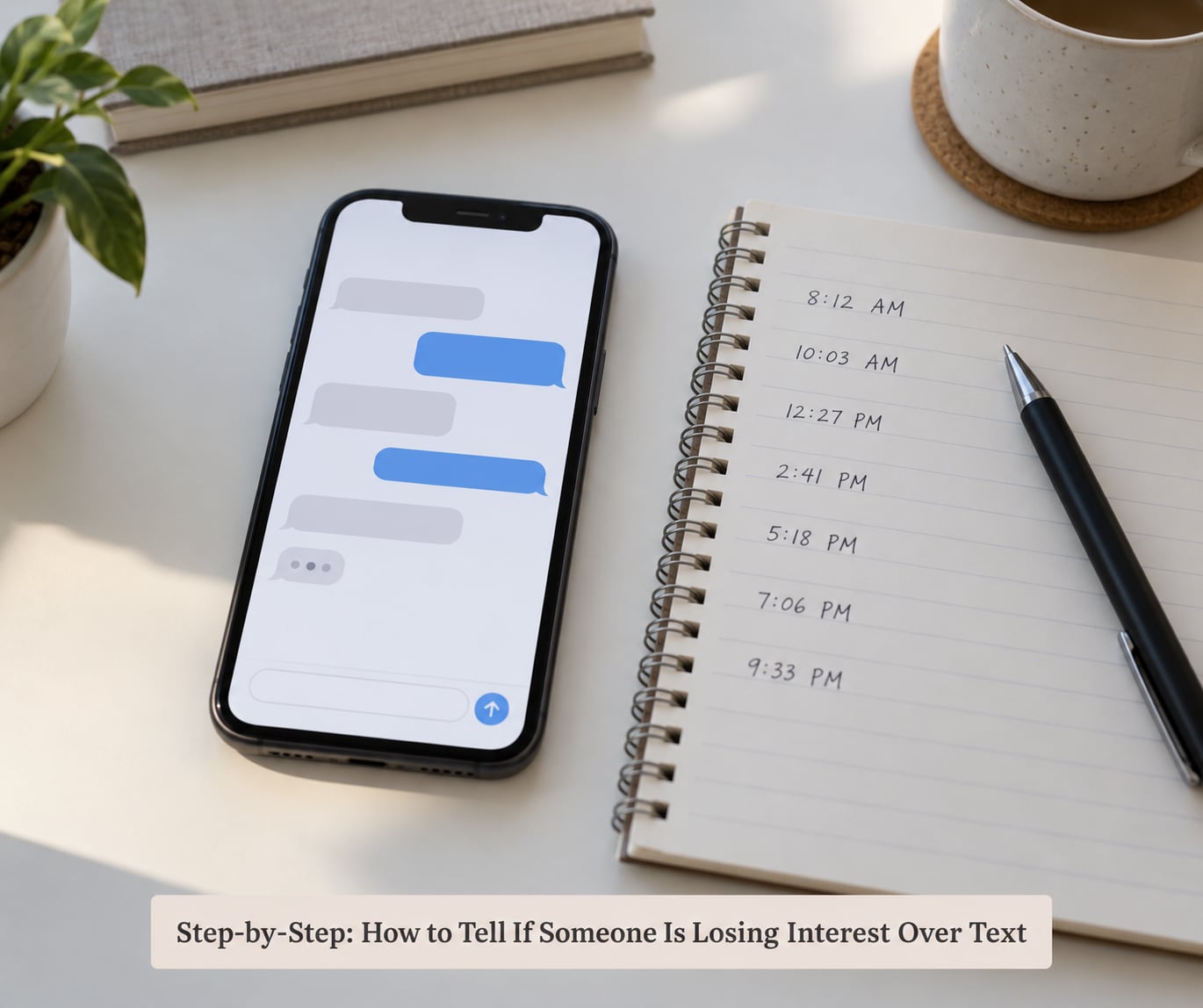
1. Compare the change with their usual texting habits
Start here and skip the rest if you take only one step. One delayed reply is noise. A sustained change from someone’s established texting rhythm is a signal.
Pull up three recent conversations and note how long their replies took, roughly how long those replies were, and whether they asked you anything. Do the same with three conversations from three or four weeks ago. Write the two sets side by side, even if it’s just in your notes app.
What you are looking for is a direction, not a single data point. Reply gaps that grew from about ten minutes to two hours are meaningful. Gaps that grew from ten minutes to forty minutes are usually just a busy week.
2. Notice when replies get shorter and less personal
Message length is one of the more honest signals available, because it’s hard to fake consistently. Three or four lines of actual content usually becomes one line. Long stories become summaries. Sent details, voice notes, and inside jokes quietly disappear.
The part people miss is the questions. Interest shows up as curiosity: asking about your day, remembering a thing you mentioned last week, following up on something you said. When your messages are full of questions and theirs are full of acknowledgements, the balance has shifted.
Watch for the dry texting version of this too, where replies stay polite but empty. “Haha,” “Right,” “Nice” are not hostile, but they are conversation-free. One of those in a chat where they used to be funny and specific is worth noticing.
3. Check who is starting the conversations
Count the first messages. Go back through the last twenty exchanges and ask, honestly, who typed first each time. Then do the same for the twenty before that.
Initiation is where the clearest signal usually lives, because it costs something. Opening a conversation means choosing to, deciding you want to hear from that person right now. When you are writing almost every opener and almost every follow-up after a gap, that is a one-sided arrangement, and people who are genuinely interested do not usually settle for it.
The follow-up matters too. Who chases after two quiet days? If you have been the one re-opening every silence, note it. One person always initiating is the most common complaint in dating advice forums, and it is rarely solved by trying harder.
4. Look for reduced interest in making plans
Plans are where words meet effort. Someone who wants to see you can usually find a time. Watch what happens when you suggest something concrete: a day, a place, an hour.
Signs of pulling back here include answers that dodge the detail. “Yeah we should do something soon” with no follow-through. Dates that get rescheduled twice and then never rebooked. Enthusiasm about the idea and zero action on the logistics. Or agreeing instantly and then going quiet before the plan happens.
Keep it in proportion, though. Shift work, exams, travel, caring for someone, and money all change people’s ability to say yes. The signal is not one cancellation. It is enthusiasm without logistics, repeated across weeks.
5. Read the tone, not just the timing
Dry texting is easy to spot because it feels flat. Conversations get factual. Questions stop getting asked. Replies land hours later with the emotional content stripped out. Whole days pass where nothing personal is exchanged at all.
Emoji use is worth a glance but not much more. People run out of emoji the same way they run out of energy, and some people never used many to begin with. Treat a shift as supporting evidence, never as the main case.
Timing can also carry tone. Replies that arrive right after you go to sleep, or only late at night when nobody expects a response, suggest someone who wants contact on their terms rather than connection with you.
6. Test the connection with one clear, low-pressure invitation
After you have read the pattern, stop analyzing and give them one easy thing to say yes to. A short call, a coffee this week, a question that only needs a sentence in return. Keep it specific and keep it light.
Examples that work well: “Catching you later today, or tomorrow morning?” or “Free Thursday? Would be good to hear how your week went.” No accusation, no long paragraph about how things have changed. You are gathering one more piece of evidence, not delivering a verdict.
What you are watching for is follow-through. A genuine no, given quickly and kindly, is useful information. So is a yes that becomes a no. What tells you the most is the same pattern repeating: you extend yourself, they respond warmly enough to keep you there, and nothing concrete ever comes of it.
7. Decide whether the change is temporary or consistent
Here is a simple framework. One unusual stretch calls for patience. Several shifts across multiple weeks, including reduced effort from you that goes unmatched, calls for a conversation or a decision.
Temporary usually looks like this: they explain the delay without being asked, they make it up within a couple of days, and their usual rhythm returns roughly intact. If the honest answer is that they texted flat for two weeks and then came straight back to their normal self, you had a hard fortnight, not a fading relationship.
Consistent looks like this: no explanation offered, no correction attempted, and each week the effort goes down a little further. You rarely get a single dramatic moment. It is a slow slide, which is exactly why it is hard to name.
8. Communicate or move on respectfully
If the pattern is consistent, say what you noticed once, plainly and without blame. “I’ve noticed we’ve been talking less and I’m getting a bit quiet from you. Is something going on?” That question deserves an actual answer.
Watch the reply carefully. Defensiveness is informative. Silence is informative. So is a warm, clear answer that says their interest has shifted, because that is an honest ending rather than a slow one, and honest endings are easier to recover from.
If you want out, keep it short and take the ambiguity away from them. “I have enjoyed getting to know you, but I don’t think we’re on the same page, so I’ll step back here.” Then actually step back. No follow-up message, no check-in a week later, no leaving a door open you have no intention of walking through.
Common Mistakes
Overanalyzing a single delay. One person took six hours to reply during a work trip. You built an entire theory on it. Response times are only meaningful against a baseline, so pull up the baseline before you build anything.
Sending repeated messages to force a response. The second message often gets an answer, but it is a politeness reply, not a real one. You also end up explaining yourself three times to someone who was never going to show up.
Reading one exchange in isolation. The message that stung you might be the hundredth message in a week when they have been steady. Change lives in the trend, not the screenshot.
Becoming more available to compensate. Answering faster, texting longer, agreeing to more. Effort spent winning someone back rarely works, and it costs you your own pace in the relationship.
Demanding reassurance before you have evidence. “Do you even like me?” asks someone to reassure you rather than to tell you the truth. If you are asking that question, you already know something has changed and you are looking for permission to feel it.
Two habits help more than anything else here. Keep your own life loud enough that you are not waiting by the phone, and give any situation a defined window, roughly two or three weeks of steady contact, before you decide it is settled either way.
Frequently Asked Questions
How long should I wait before asking if someone is losing interest over text?
Give it two to three weeks of ordinary contact before you say anything. Most text habits settle quickly and a hard stretch at work or home fades on its own. If the shift is still there after that, and you have seen it across several conversations rather than one slow reply, a calm question is fair. Short, low-pressure and without blame tends to get the most honest answer.
Does a slow reply mean someone is losing interest?
Not by itself. Reply speed tracks how busy someone is, how they like to communicate, and what else is happening in their life. What matters is the direction. If their usual speed was quick and it has stayed slow for weeks with no explanation, treat it as a signal. If it dropped for a day or two and came back to normal, it was just a life.
What if someone leaves me on read but still replies later?
Late replies are not the same as no reply. Plenty of people read messages while busy and answer hours later without any change in interest. The pattern to watch for is the delay growing every week, the replies getting shorter, and you becoming the only one starting conversations. If the delayed replies are still warm, curious and specific, you are looking at a busy texter, not a fading one.
Is it bad if their texts are getting shorter?
Shorter messages are worth noticing, especially when they come with fewer questions and less personal detail. Length on its own is weak evidence, because some people write short by habit. Strong evidence is shorter replies combined with other shifts: no initiation, no plans, no follow-up. One short answer after a full day tells you very little. A month of them tells you plenty.
How can I tell if someone is not interested without sounding desperate?
Make one clear, low-pressure invitation and let their response carry the information. A question like catching them later today, or asking for a quick call this week, asks for a small commitment without accusing them of anything. If they decline but stay warm and suggest another time, that is a person interested in pacing. If they decline and never offer anything else, you have your answer.
Should I stop texting first if I feel the connection fading?
If you are always the one starting, the follow-ups are already telling you where this sits. Give it one honest, low-pressure attempt first, because clarity beats guessing. If you get another vague answer, stop texting and let them come to you. Silence from your side is a legitimate boundary, not a tactic, and if they do not fill it, that is a complete answer on its own.
Conclusion
One delayed reply is noise. A repeated change in response time, message length, initiation and follow-through is a pattern, and patterns are the thing worth taking seriously. Decide first whether you want clarity or an exit, gather three weeks of evidence against their normal rhythm, make one clear low-pressure invitation, and then let the follow-through decide it for you.