
A safe background check before a date means looking only at information that is already public: court dockets, arrest and conviction history, sex offender registries, marriage and divorce filings, and the profile photos the person has already posted. Add a reverse image search and a scam check, and you can do the whole thing in about twenty minutes without a subscription, without a credit card, and without crossing into someone else’s privacy.
Here is the honest version up front. A background check can tell you whether a court record exists under a particular name in a particular county, and whether a profile photo has been lifted from somewhere else. It cannot tell you who is actually holding the phone, what someone intends to do on a date night, or whether a person is safe. Even the dating apps that sell the idea say it plainly in their own copy: checks reduce risk, they do not verify identity. Treat what you find as information, then let your in-person safety plan do the rest of the work.
Below is the process in the order I would run it, starting with a sixty-second version.
Table of Contents→
- The Sixty-Second Version: What to Check, in What Order
- What You Need for a Safe Background Check Before a Date
- Step-by-Step: How to Do a Safe Background Check Before a Date
- 1. Define What You Need to Verify
- 2. Look Only at Information the Person Has Shared or Made Public
- 3. Use a Reverse Image Search Responsibly
- 4. Check for Scam and Identity Red Flags
- 5. Verify Serious Claims Through Reputable Sources
- 6. Use a Two-Person Safety Plan
- 7. Decide Whether to Meet, Delay, or Decline
- Common Mistakes When Checking a Date’s Background
- Impersonating someone else to get information
- Pretexting, or lying to get someone to confirm details
- Doxxing and contacting family or coworkers
- Paying a private investigator before a first date
- Paying a “record removal” or “data suppression” fee
- Confronting someone with a screenshot of their record
- Believing a record proves guilt
- Doing the check and never checking yourself
- Over-researching until you talk yourself out of a good date
- Frequently Asked Questions
- Bottom Line: What to Do First
The Sixty-Second Version: What to Check, in What Order
- Run the profile photo through a reverse image search. Duplicate or mismatched hits come first because they answer the identity question fastest.
- Read the profile the way a stranger would. Does the stated job, city, age and story line up, and does the account look established or three days old?
- Search the National Sex Offender Public Website and your state or county court portal for the name and state they gave you.
- Check marriage or divorce filings only if the profile suggests it, then stop.
- Ask one more ordinary question and watch how the answer is explained.
- Tell one trusted person the first name, the venue and the time, and set a check-in text.
If any of those steps produces a hard contradiction, you are done. You do not need a private investigator to tell you that a profile photo belonging to a different person is a problem.
What You Need for a Safe Background Check Before a Date
You need fewer tools than most people expect. Everything in the first two steps of the process is free and takes a browser.
- The details they already shared. Full name, city, state, approximate age, job title, and any social links on the profile. If the profile gives you nothing but a nickname, that is itself a signal.
- A phone or computer with a browser, and a second device if you want to run a reverse image search while keeping the profile open.
- A reverse image search tool. Google Lens, Bing Visual Search and TinEye all work from a phone. You upload a saved screenshot of the profile photo and compare what comes back.
- Official public-record access. The National Sex Offender Public Website, run through the U.S. Department of Justice, and the court record portals maintained by state and county court systems. The National Center for State Courts maintains a directory that points you to the right portal for your state.
- A county court registrar or clerk’s office. This is the free, offline option that a lot of people never hear about. Many clerks will run a name search at a public service kiosk or tell you what to search for on their website.
- Consent, in the form of a normal conversation. A quick “what do you do for work?” or “where are you from originally?” is both warmer and more effective than any search tool.
- One trusted person who knows the first name, the venue and roughly when you expect to be home.
- A safe meeting plan that you write down before you leave the house, not after.
On cost and timing, be skeptical of anything with the word free in the headline. A lot of the people-search sites that rank for this question are subscription traps: you get a blurred preview, then a trial that quietly becomes a monthly charge unless you remember to cancel. The official court and registry sources cost nothing and do not ask for a card.
It also helps to know, before you start, what each method can and cannot tell you. Almost every one of them has a hard limit.
- Reverse image search. Shows whether the profile photo is original, reused, or from another account. Takes under a minute. It cannot show you whether the person in the photo is the person texting you.
- Sex offender registry search. Shows registered individuals matching a name and state. Takes under a minute. It says nothing about people who are not registered, or are registered somewhere else.
- County or state court portal. Shows dockets, filings, and sometimes disposed and dismissed cases. Takes a few minutes, or a same-day visit. Sealed, expunged, or federal cases in another system stay out of reach.
- County court registrar in person. Shows the same records, plus help reading the index. Same day, during business hours. It cannot produce records for a name you do not have.
- Marriage and divorce filings. Shows whether a dissolution was filed and roughly when. Under a minute. It cannot show you whether a marriage is current in another state or country.
- Paid people-search report. Bundles the above plus address history. Minutes, or several business days for a formal report. It still cannot establish identity, intent, or anything that is not already public.
Notice how often that last limit repeats. That is the point.
Step-by-Step: How to Do a Safe Background Check Before a Date
This is the process I would run, in this order, before a first date with someone I met online. It takes roughly twenty minutes and it is entirely free if you stick to official sources.
1. Define What You Need to Verify
Write down the one or two things you actually need to know. “Is this person who they say they are” is a good question. “Is this person safe” is not a question a search box can answer, and chasing it is what turns a reasonable precaution into an obsession.
Most people who feel uneasy can usually name a specific trigger: the profile will not do a video call, the stated job does not match the link, the account was created days ago, or a mutual friend said something vague. Ordinary uncertainty, the feeling that a photo is a bit too polished, is not a reason to start digging. Specific inconsistency is.
If you cannot name a trigger, the right amount of checking is a live video call and a public venue.
2. Look Only at Information the Person Has Shared or Made Public
Start where they want to be found. The profile bio, the photos they posted, the Instagram handle they linked, the professional page for a job they named. Read it as an outsider would and look for the boring stuff: does the timeline hold together, do the photos span more than a few weeks, does the job description match a real business, does the stated city match the weather and the landscape in the background pictures.
Stay out of the places you were not invited into. Private accounts, family members’ profiles, old email addresses, a partner’s social media, a school yearbook you had to guess at. That is not a background check, it is a surveillance campaign, and it is the line that turns a precaution into something harmful.
Also resist the urge to read meaning into silence. A person with almost no public footprint is not automatically hiding something. Plenty of ordinary people post almost nothing.
3. Use a Reverse Image Search Responsibly
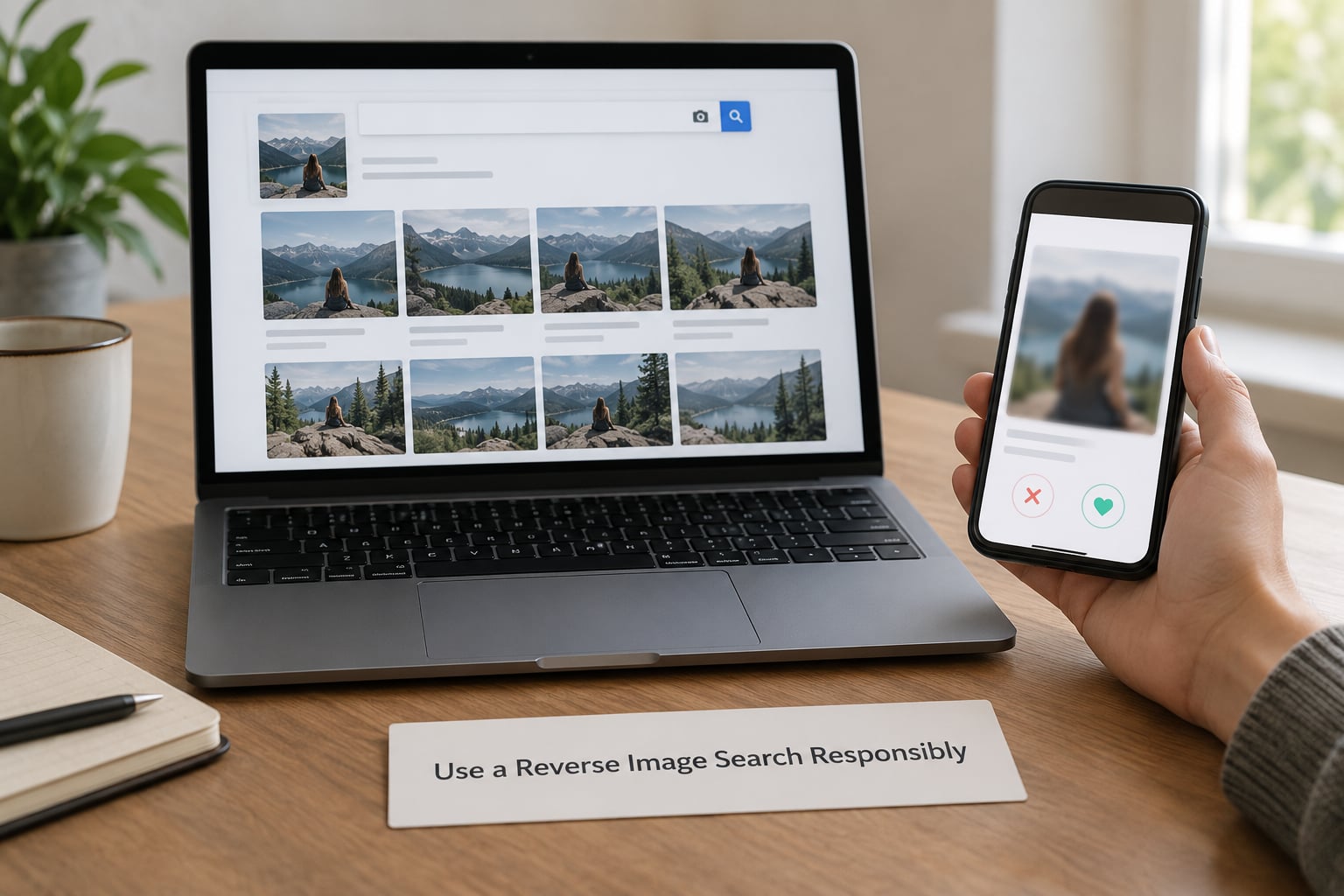
Save a screenshot of the profile photo and run it through a reverse image search. You are looking for three outcomes.
The good outcome is a handful of hits that all look like the same person on platforms they linked to, or the photo used by a band, a restaurant, or a news story that makes sense. The neutral outcome is almost no results, which usually means the photo is not widely indexed. The bad outcome is a different person entirely, or the same photo attached to several unrelated accounts in several cities.
One more useful signal is the age of the account the photo belongs to. A profile built out of someone else’s pictures almost always borrows a photo that has been online long enough to be indexed.
Stop immediately if the search drags you into a private, sensitive or explicit result. You do not need to open it to know it was not meant for you. Close the tab, and treat nothing on that page as a conclusion about the person.
4. Check for Scam and Identity Red Flags
Scam signals are easier to spot than record signals, and they matter more before a first meeting. Run through this list.
- Names that do not match. The profile says one thing, the email or workplace page says another, and neither is ever explained.
- Pressure to move off-platform quickly. A long conversation then a request to switch to a messaging app where the conversation disappears from the app’s reporting tools.
- Reluctance or failure on a video call. Everyone has a bad camera eventually. Repeated refusal across a week is a pattern, not bad luck.
- Any request for money, a card, a gift card, a crypto wallet, or a flight to visit them. This ends the conversation. No check, no method, no exception.
- Links. Before opening anything they send, look at the actual address. Watch for a familiar name on an unfamiliar domain, extra words before the real domain, and shortened links you cannot read.
- Accounts that are new or nearly empty. A profile with no posts and no history is cheap to build.
- A story that changes. The job, the city, the reason for being in town, or the reason they cannot meet. People improvising a persona are inconsistent by definition.
A reverse phone lookup on the number they text from is a quick, lawful check on whether that number appears on obvious scam lines or is brand new to the carrier. It is not a substitute for the conversation, but it takes a minute.
5. Verify Serious Claims Through Reputable Sources
When someone claims something checkable, verify the claim through a source with a reason to be accurate, not through a source that profits from your anxiety.
If they say they work at a hospital, a school, a law firm or a company, look up the organisation’s own public website and find the team page or staff directory. Most large employers publish one. If the name is not there and the person is vague about the department, that is worth a direct question, not a conclusion.
For court records, the honest order of preference is: the county or state court portal first, the clerk’s office in person second, a paid people-search aggregator last. Data brokers scrape and resell records, so their results can be months old, misfiled, or attached to the wrong person with a similar name.
Keep the scope narrow. You are checking a stated fact, not building a case.
6. Use a Two-Person Safety Plan
This is the step most articles skip, and it is the one that protects you. Searching cannot do this job.
- Tell a trusted person the first name of the person you are meeting, the venue, and what time you expect to be home.
- Set a specific check-in text. If it does not arrive, your contact knows to call you, and you have agreed in advance what they do next.
- Meet in a public, staffed place, ideally one you chose and can leave without explaining.
- Keep your own transport. Do not depend on a drink, a ride, or a new friend for a way home.
- Keep your location sharing on for the duration.
- Say early, in your own words, what you will not do. “I do not go to anyone’s home on a first date” and “I do not drink when I am with someone I have just met” are complete sentences that end arguments before they start.
- Leave for any reason. You never owe a reason, an explanation, or a refund of someone’s evening.
If someone resists the plan, argues with it, or tries to get you to change it at the last minute, that reaction is more informative than any record you could have found.
7. Decide Whether to Meet, Delay, or Decline
Most checks end in one of three places, and only one of them is a yes.
Meet. Details are consistent, the photo is original or explained, the conversation was easy, they respected a video call, and they went along with a public venue and a check-in plan.
Delay. The free sources were thin or confusing, or the profile is simply sparse. Ask one more question in a normal way and watch the answer. Most ambiguities resolve themselves in a second conversation.
Decline. The photo belongs to someone else. The story changed. There is a hard contradiction you cannot get a straight answer about. Or there is a serious record and they did not mention it when asked plainly. In that last case, you do not need to decide whether they are guilty. You are deciding whether to spend an evening with them, and you are allowed to say no without a file.
Ending the conversation is always an option. Blocking and reporting inside the app takes about ten seconds and helps the next person.
Common Mistakes When Checking a Date’s Background
Almost every mistake here is either illegal, counterproductive, or both.
Impersonating someone else to get information
Getting into a dating account, a social account, or anyone’s workplace system under a false identity is a crime in most places, and it is the fastest way to turn a background check into a harassment case. The fix is simple: look only at what is open to the public, or ask directly.
Pretexting, or lying to get someone to confirm details
Calling a person’s employer pretending to be a recruiter, or messaging their family with a fake story, crosses from checking into deceiving. It is also a good way to be blocked, reported, and known as the person who did that. Fix: use the organisation’s published staff directory instead, and never contact coworkers, family, or former partners.
Doxxing and contacting family or coworkers
Posting someone’s address, workplace, or family details anywhere is doxxing. So is calling their family to ask about them without consent. Sharing another person’s personal information is one of the clearest lines in this whole guide, and it is a line worth holding even when you are worried. Fix: keep what you find to yourself, use it to make a decision, and never publish it.
Paying a private investigator before a first date
A licensed investigator costs real money and can legally do things you cannot, including confirming identity in ways a search cannot. For a first date, that is wildly disproportionate to the question. Fix: a live video call and a reference question get you most of the value. Save the professional route for situations with real stakes, like a business partner or a house-sharer.
Paying a “record removal” or “data suppression” fee
Nobody legitimate can erase a court record, and anyone charging you to do it is a scam. The same goes for “unmasking” services offered to break a paywall. Fix: walk away from any page that asks for payment before showing you what you came for.
Confronting someone with a screenshot of their record
Showing up with a printout turns a safety question into an accusation, and it hands that person your findings. You do not need to prove anything to end a conversation. Fix: decide quietly, then decline, block, or report without explanation.
Believing a record proves guilt
This is the most common mistake in the whole category, and it is the one that does the most damage. An arrest is not a conviction. A charge can be dismissed. A case can be sealed or expunged, and older records often linger after expungement in aggregator databases. Identity theft puts other people’s records under real names. A record is a starting point for a question, never an answer.
Fix: before drawing any conclusion, match the record on date of birth, middle name, and location. Common names produce dozens of matches, and a large share of what people find online is simply the wrong person. If you are going to raise something with a real person, ask first, and listen to the answer.
Doing the check and never checking yourself
Data brokers and people-search sites scrape public records, court filings and social data, and your own details may already be sitting on several of them. Search your own name while you have the tools open. It is the fairest thing in this article, and it makes the whole conversation less one-sided.
Over-researching until you talk yourself out of a good date
Read too much into minor inconsistencies and you will find a reason to cancel on everyone. Matchmakers who work in this space say it constantly: research is a brake, not a steering wheel. Fix: set a limit before you start, write down the specific thing you needed to verify, and stop when you have answered it.
Frequently Asked Questions
How to do a background check on a potential date?
Run it in this order: reverse image search their profile photos, read the profile for inconsistencies, search the National Sex Offender Public Website and your state or county court portal by name and state, check marriage and divorce filings if something suggests it, then decide. Spend about twenty minutes. Stop at the first hard contradiction, and pair the whole thing with a public venue and a check-in plan with a trusted person.
Can I view someone’s criminal record for free?
Yes, through official sources that do not ask for a credit card: the National Sex Offender Public Website, run by the U.S. Department of Justice, and the court record portals maintained by state and county court systems. The National Center for State Courts keeps a directory of state court sites. Many county clerks will also run a name search for you at a public kiosk. Be aware that results can be incomplete, sealed, or belong to someone with a similar name.
Is it legal to background check someone you are dating?
Generally, yes, as long as you stay within public records and do not misrepresent yourself. The Fair Credit Reporting Act and consumer reporting rules govern what an employer or landlord can do with a formal report. Taking a few public pages for your own safety is a different situation, but impersonation, pretexting, and doxxing are illegal almost everywhere, and so is harassing someone with what you find. When in doubt, ask the person directly.
Can a background check be done in a day?
The parts that matter can be. A reverse image search, a sex offender registry search, a court portal search and a marriage filing search all return in under a minute, and a courthouse visit can often be done the same afternoon. Formal background check reports that pull from many databases usually take several business days. If you are checking before a date tomorrow, the fast public sources are the realistic option.
How can I confirm a date is real without sounding needy?
Ask for a live video call early, while it is still a normal thing to do, and pair it with a joke or a practical reason such as wanting to agree on where to meet. Ask about their job or where they are from and then check the organisation’s public website. Verifying a stated fact feels ordinary. Announcing that you ran a search on them does not, and it tends to be the part that lands badly.
Will they know I background checked them?
Public record and registry searches do not notify anyone, and a person has no way of knowing you looked. Two exceptions are worth knowing: a few dating apps can notify users that a verification check was requested, and paid people-search services may keep your search in their own logs. Neither tells the other person what you found. The bigger risk is the opposite one: assuming a check is invisible and getting careless about how you behave afterwards.
Bottom Line: What to Do First
Reverse image search the profile photo, then search the sex offender registry and your county court portal by name and state. That is the whole high-value core, it is free, and it answers the identity question faster than anything else you can do.
Then scale your effort to the situation. Before a first date, a video call and a public venue are proportionate. After a few meetings, checking a stated job against a public staff directory is reasonable. Before you share your address, your keys, or anything you cannot get back, a more thorough look is fair and a professional check is not out of the question.
And keep the limits in view. A clean record is one data point, not a verdict, and a bad one may belong to someone else. What actually keeps you safe is the plan you make before you leave: a venue you chose, a way home that does not depend on anyone at the table, and one person who knows where you are. Search for what you need to know, then let the plan handle the rest.
Last reviewed in 2026. Official court and registry sites change their interfaces often, so if a link behaves oddly, search the court system for your county directly rather than trusting a third-party directory.
No paid placements on this page. Nothing here is sponsored or affiliate-linked, and we do not receive anything for naming a service.