Is online dating harder for women? Not in one simple, measurable way. It is harder in specific ways and easier in others: women usually receive far more attention, then carry the filtering, safety work, and expectation management that attention creates. Men usually receive silence. Both sides report the same exhaustion.
That answer matters because most people misread their own experience. A woman with 200 matches may assume she is doing something wrong when the real problem is the quality of the attention. A man with four matches in a week may assume he is unattractive when the algorithm simply is not surfacing him. Different problems, same wasted effort.
Below is a look at what the research and real user accounts actually show, where the disadvantages land, and what tends to help. It covers app-based dating in the US, mostly in the heterosexual apps, with notes on where the picture changes for LGBTQ+ daters.
Table of Contents→
- Is Online Dating Harder for Women Than for Men?
- What Makes Online Dating Harder for Women?
- Is Online Dating Harder for Every Woman?
- Are Men Struggling With Online Dating Too?
- What Can Women Do to Make Online Dating Easier?
- How Can Partners Make App-Based Dating More Equal?
- Frequently Asked Questions
- Conclusion
Is Online Dating Harder for Women Than for Men?
Short answer: it is harder for women in volume, safety work, and social pressure, and harder for men in visibility and sheer response rate. Neither side gets an easy version.
Women are rarely short on attention. The complaint from users on r/OnlineDating and r/TwoXChromosomes is not a lack of matches but a lack of intent behind them, and the unpaid work of sorting through messages to find anyone who means it. Men are rarely short on attention either, in the sense that almost nobody is messaging them, and that silence gets read as a verdict on their appearance.
Two very different problems can produce the same tired feeling. After that, the answer changes with age, sexual orientation, gender identity, race, disability, income, location, relationship goals, and which app you picked. Anyone who tells you online dating is uniformly harder for one gender has met maybe one app.
A quick look at the pattern most people describe:
| What you notice | More common in | What it feels like |
|---|---|---|
| Large volume of matches or messages | Women | Filtering work that never ends |
| Very few matches, little response | Men | Invisibility and repeated rejection |
| Unsolicited explicit content | Women | Having to delete and report |
| Ghosting after a good conversation | Both | Wasted time and doubt |
| Doing the planning and screening | Women | Dating as a second unpaid job |
| Carrying all the rejection | Men | Confidence hit that compounds |
What Makes Online Dating Harder for Women?
Four mechanisms keep coming up: attention that arrives without intent, safety work that does not split evenly, expectations set by curated self-presentation, and an emotional load of filtering that nobody counts.
None of these apply to every woman or every man, and the dynamics shift completely outside heterosexual dating apps. On apps serving queer women, for instance, the gender ratio problem is largely gone and the pool is far smaller, which trades one kind of scarcity for another.
Why Do Women Receive More Unwanted Messages?
Because volume is cheap for the sender and expensive for the recipient. Writing one message to hundreds of profiles costs the sender a minute of effort and costs a woman real attention, and a stream of that gets sorted, read, and often deleted.
Researchers and users describe the same sequence on apps built around swiping. Women report unsolicited explicit images arriving within minutes of a match, sometimes before any real conversation. Other messages are pure validation seeking, a request for attention with no interest in an actual date.
The key point for anyone searching “is online dating harder for women” is that message volume is not a success metric. More matches have not historically produced more dates, relationships, or satisfaction for women; the extra volume mostly adds screening work. Forum threads on girlsaskguys.com and quora.com return to this repeatedly: matching is easy, matching with someone you actually want is the hard part.
So a large inbox is not winning. It is a queue of strangers to be assessed.
How Do Safety Risks Affect Women Differently?
Risk is not evenly priced. Women are more often the party who has to verify a stranger’s story, share less precise location details, and arrange a first meeting in a public place with an independent way home.
The practical list is short and worth repeating. Check whether the profile photos have appeared anywhere else, since reverse image searches are easy. Keep your home, workplace, and daily routine out of your profile. Meet in a busy public place and tell a friend where you will be. Keep your own transportation so you can leave when you want, not when you have to.
These are habits, not guarantees. No checklist can make an unknown person safe, and no app feature can either. A serious risk is the one that comes after the date, when a stranger has your address pattern, your workplace, or someone you care about.
If that happens, most apps have a report and block function, and local and national hotlines handle harassment, stalking, and threats. Using them early is more effective than trying to handle it alone.
What Is App Fatigue and Why Does It Affect Dating?
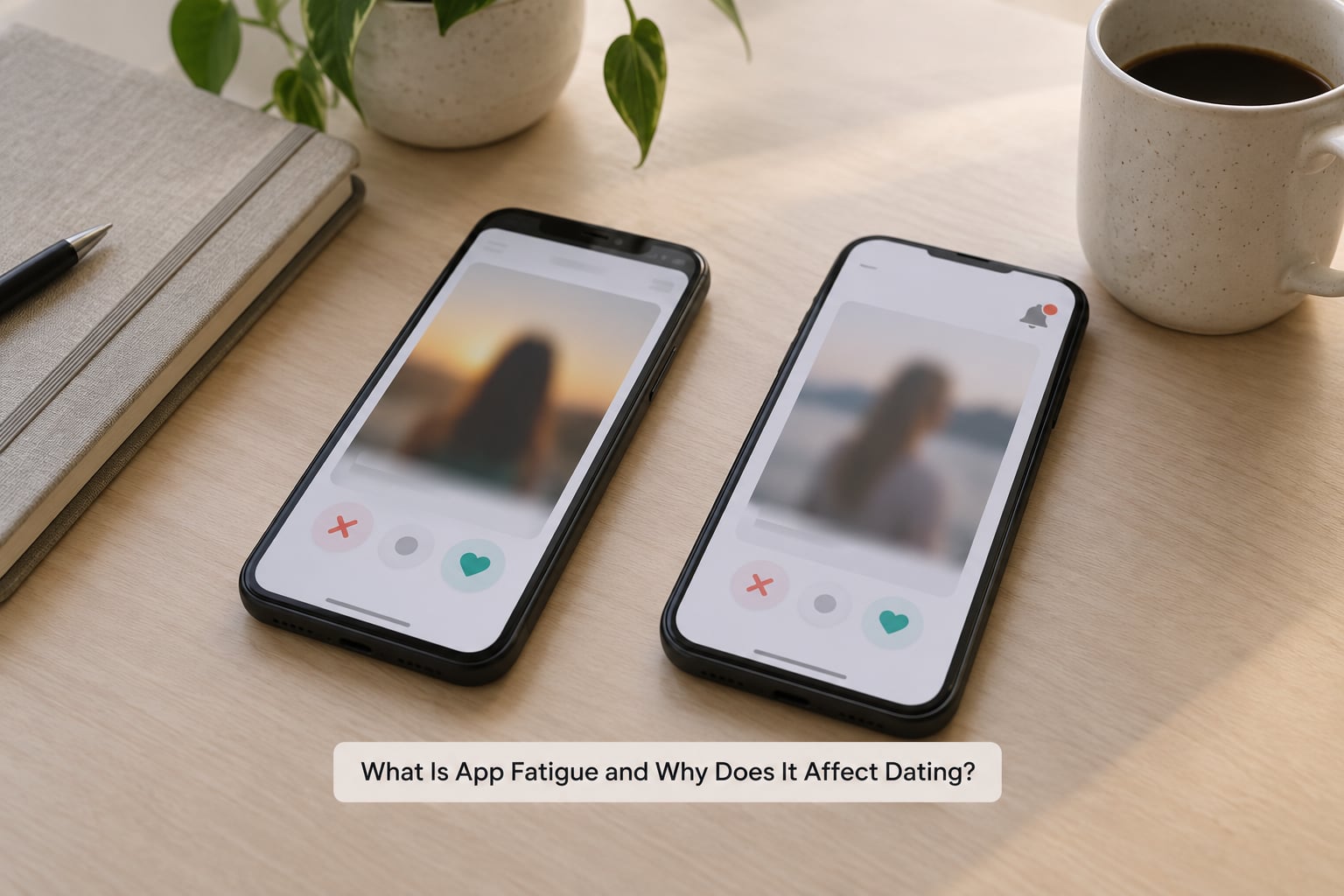
App fatigue is the burnout that comes from repetitive swiping, unanswered messages, and the constant low-grade pressure of an algorithm that rewards activity rather than good outcomes. It shows up as dread before opening the app rather than excitement.
The numbers researchers and trade press have circulated are striking. A widely cited Forbes Health survey found around 78% of people overall reporting dating fatigue, with roughly 80% of women against 74% of men. Average time spent swiping and messaging runs close to 51 minutes a day, which is a part-time workload for an activity most people do in the evening.
Fatigue changes behavior. People get slower to reply, less curious, more literal. Conversations that could have gone somewhere die because nobody had the energy left to ask the second question, and that dead conversation is then counted as evidence that online dating does not work for you.
Then there is the quit-and-return cycle. People delete the apps, feel better for a few weeks, and reinstall them during a lonely month. The re-entry is what makes it feel hopeless: you start from zero matches with no memory of the conversations that came before.
Why Do Women Face More Dating Labor?
Some dating work is unpaid and unevenly distributed. Writing a profile that reads well, choosing photos that do not look like a passport photo, filtering out low-effort openers, planning the date, and remembering what was discussed last time all fall to women more often in heterosexual apps.
Plan says women should signal interest first, which on some apps means the conversation does not happen at all unless she moves. On others, a man’s first message is the filter she has to read hundreds of times, and the emotional cost of a leering or crude opener is different from the cost of a blank.
Individual experiences vary a lot here. Plenty of women describe a low-maintenance, mostly pleasant process, and plenty of men describe doing all the screening and planning. The pattern is a tendency, not a rule, and it matters mostly because it is invisible from the inside. Nobody budgets for it.
How Do Expectations Make Dating Feel Harder?
Every profile is a highlight reel edited to look like the best week of someone’s year, and then you are asked to make normal judgments from it in about fifteen seconds.
That produces predictable mismatches. Someone’s whole profile signals marriage and kids, and their actual opening message is about something else entirely. Someone appears confident and intentional, then does not reply for nine days. Research on online dating and the discussions on r/dating_advice point to the same conclusion: mismatched intentions, not lack of options, cause most disappointment.
What reduces the friction is boring and effective. Put your actual goal in your profile. Use photos taken in the last year. Say what you are available for, whether that is a walk, a coffee, or a long drive. When someone asks for a date, give a specific time and place instead of a vague maybe.
Clearer intentions do not guarantee better matches, but they stop you from spending a month on the wrong conversation.
Is Online Dating Harder for Every Woman?
No, and the question becomes unanswerable as a general statement the moment you look at who is actually on the apps.
Age is the biggest factor people notice. Women in their 20s often have a large pool and more incoming interest, which means more screening and more harassment. In your 30s the pool typically narrows as people filter for stability, and the search feels more deliberate. Past 40 many women report a real contraction, and users in r/TwoXChromosomes describe it plainly rather than pretending it is a mindset problem. Men over 40 tend to feel the invisibility side instead.
Other factors shift the picture just as much. Sexual orientation changes which apps are even usable, and how small the pool is. Disability affects whether an app is accessible at all, and whether a first date needs to be planned around accessibility. Race changes who messages whom, and how quickly. Income changes what you can do on a date, and which apps you can afford. Location matters enormously, because a sparse market produces a much thinner menu than a dense one.
Goals matter too. Someone who wants a long relationship and someone who wants something casual are looking for different people, and neither is wrong, but they will keep missing each other.
Are Men Struggling With Online Dating Too?
Yes, and the honest version of this article has to say so. Men report low response rates, matches that never turn into messages, and conversations that end with no explanation at all.
Choice overload hits them too. Every profile is a small decision, and the same handful of highly active profiles show up again and again, which makes the whole pool feel thin no matter how many matches technically appear. The frustration often gets framed as a complaint about women’s standards, and that framing tends to end the conversation before anything useful gets said.
Men also carry the initiation burden, since a conversation usually requires a first message that will mostly be ignored. Building a profile that produces a reply takes real effort, and the feedback is immediate and public in the sense that a silent inbox feels like a verdict on your face.
So the two experiences can coexist: women dealing with overwhelm, men dealing with invisibility, and both of them tired. Different disadvantages, similar cost. Reading one side as a win usually means you have not listened to the other.
What Can Women Do to Make Online Dating Easier?
Most of the useful changes are about narrowing and clarifying rather than trying harder.
- Pick apps that match your goal. A relationship-focused app with prompts beats a swipe app if you want a relationship. A paid tier helps mainly when it gives you filters or visibility in a specific crowd, not as a general fix.
- Use filters as a real tool. Age, distance, and deal-breaker filters cut the queue before you spend any time on it. Adjust them when the result is too thin, rather than reading the same profiles.
- Keep location details vague. A general area rather than a neighborhood, and no workplace or school.
- State your boundaries plainly and early. A short line in your profile saves hours and removes people who were never going to be interested.
- Make your profile legible. Recent photos, one or two sentences about your actual life, and a clear note about what you are looking for.
- Prioritize reciprocal conversations. Invest in people who answer your questions and make plans. The queue length is not a measure of your value.
- Report harassment instead of absorbing it. Blocking alone leaves the account active for the next person.
- Take breaks on a schedule. A fixed off day for apps is cheaper than a sudden three-week crash followed by starting over.
None of these make the apps fair. They make your week shorter and your attention better spent.
How Can Partners Make App-Based Dating More Equal?
Plenty of the load sits with the other person in the conversation, and it is worth saying what actually helps instead of what does not.
Write the first message yourself, with something more specific than a greeting, and accept that it may go unanswered. Share the planning, including the logistics of getting there and getting home. Read the profile well enough to ask about something in it. Respect a stated boundary the first time it is stated, and treat a no as a complete sentence rather than a stage of a negotiation.
Skipping a date with a short message costs far less than disappearing. And when a woman describes harassment or a safety problem, believing her and helping her block or report it is the difference between a bad week and a dangerous one.
The broader point is simple. Dating apps are a tool, and the burden of using them safely has quietly defaulted to one side. Anything that moves it back toward shared work is a real improvement.
Frequently Asked Questions
Do women get more matches than men on dating apps?
On most mainstream apps, women receive far more matches and messages than men, largely because more men send the first message. That volume rarely converts into more dates for women; it becomes a screening job. Extra messages from people seeking attention, casual encounters, or explicit content add work rather than opportunity. Matches are a poor measure of success, and message volume says very little about your chances of a real connection.
Why do men and women both say online dating is exhausting?
Because the fatigue comes from different problems that cost the same amount of energy. Women report sorting through low-intent attention, managing expectations, and doing most of the planning and screening. Men report silence, low response rates, and matches that never turn into conversations. A widely cited Forbes Health survey put reported dating fatigue near 78% overall, with about 80% of women against 74% of men.
Is it harder to find a relationship online as a woman?
It depends heavily on what you are comparing. Compared with offline dating, online dating offers more access to people outside your circle, which helps people who are divorced, moving, or in small towns. Compared with how it goes for men on the same apps, women face more unwanted attention and more expectation management. Women also report more work converting matches into actual dates, which is the step that decides the outcome.
Should you quit dating apps if they make you unhappy?
A short, planned break usually helps more than an abrupt permanent exit. Most people report feeling better within a few weeks of stepping back, and the habit is easier to restart deliberately than out of loneliness. Deleting the app also wipes your matches, so conversations worth continuing are worth moving to regular messaging first. The clearest signal to quit is dread that shows up before you even open the app.
Does online dating get harder for women as they get older?
Many women say it does, mainly because the pool narrows and filters get more specific around stability, family, and finances. In your 20s the practical problem tends to be volume and screening; past 40 it is often a thinner pool of people who share your goals. Some of that is real, and some of it is a change in what people are willing to accept, so it is worth separating the two before deciding the apps are not working.
Conclusion
The answer to whether online dating is harder for women depends on which part you are measuring. Women carry more attention, more screening, more safety work, and more expectation management. Men carry more silence and more rejection. Both groups report real exhaustion, and the data suggests women report it at slightly higher rates.
Start with the friction you can actually change. Pull up the apps you are using, list what each one is doing for you, and cut the ones that are not. Then check three things: whether your filters are doing real work, whether your profile states your actual goal, and whether your location details give away more than you want. That audit usually takes an hour and tells you more than another month of swiping will.