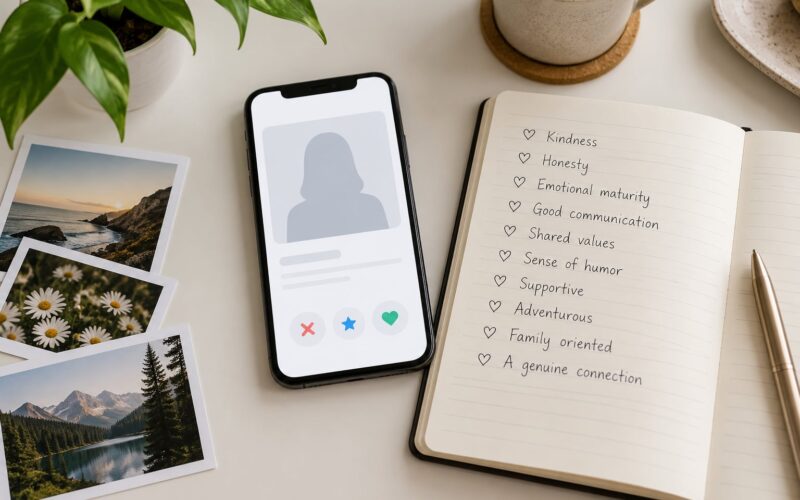
Dating with social anxiety is not about becoming a confident person overnight. It is about treating each date as a small, low-stakes practice session you can survive, learn from, and repeat until the whole thing stops feeling like a test you are failing.
So how to date with social anxiety? Practically, it means working through a short sequence of small, repeatable habits instead of waiting for nerves to disappear. This guide covers the whole path: setting a goal you can actually hit, writing a profile that does not require you to perform, getting through the message stage, picking a setting that does not drain you, holding a conversation when it stalls, and deciding what to do afterwards. Nobody needs perfect confidence, a big social circle, or an expensive evening to follow it. This is general information, not medical advice; anything involving treatment or medication belongs with a qualified healthcare professional.
Last reviewed for October 2026.
What You Need
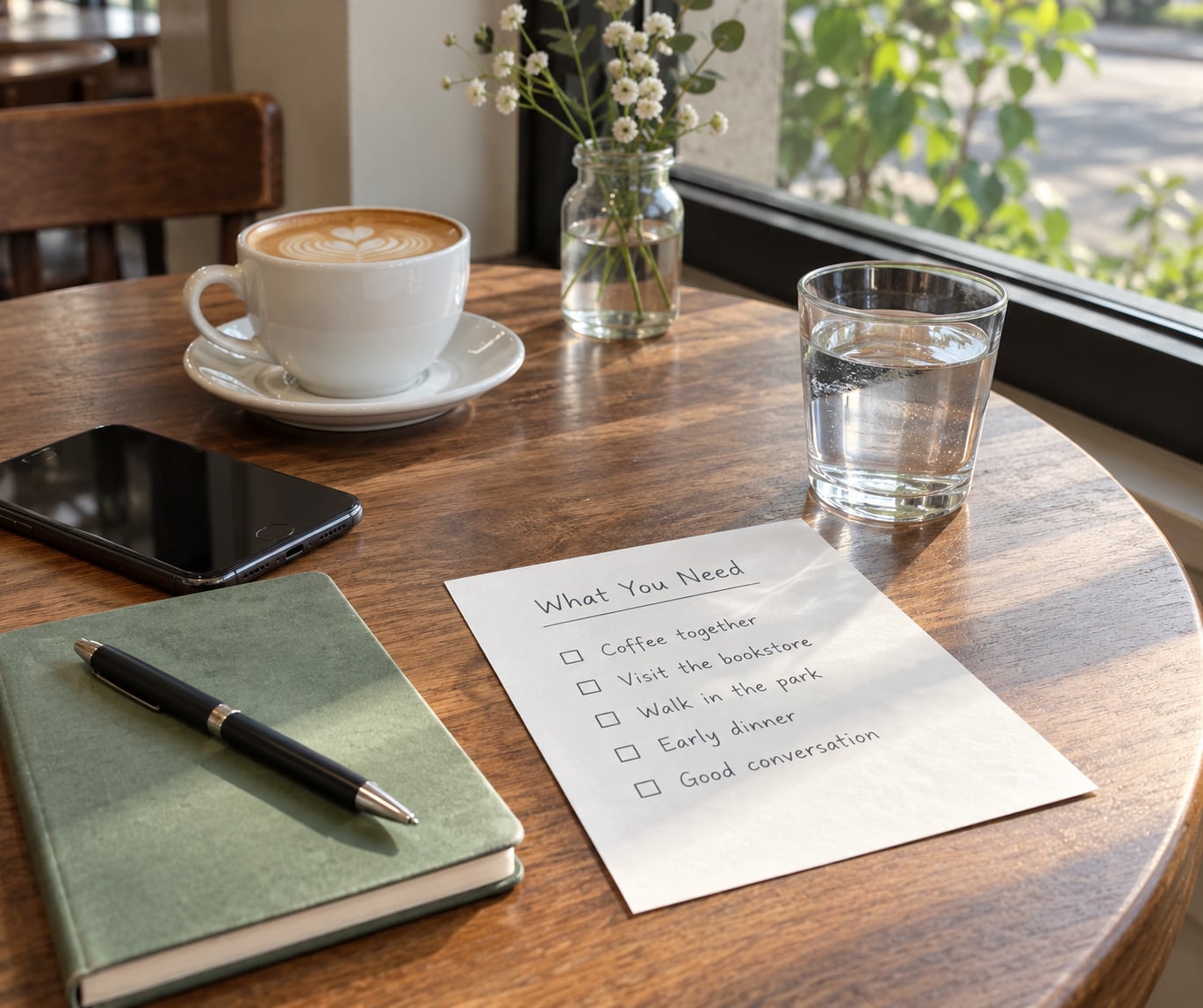
You need far less than you think, and more of it is internal than external.
A setting with a wall you are not facing
Sit so you are not directly opposite your date if you can, and pick somewhere you already know. A café you have been to, a bench in a park you have walked through, a bookshop you could leave in two minutes without making it a scene. Familiarity is the whole point. New places add sensory work on top of conversation work, and you have enough to do already.
A one-line plan written down
Before you leave, write one sentence about what the evening is for. Coffee and forty-five minutes of conversation. A walk and an honest answer about whether to meet again. When the moment comes where your brain starts improvising worst-case scenarios, you look at the paper and it tells you the truth: this was always going to end, and it was always allowed to end.
A small grounding strategy
Pick one thing you will do when anxiety spikes and decide it in advance. Both hands flat on the table. Four seconds in, four seconds out, six times. Naming five things you can see. Walking to the counter and back. Something small enough to do without anyone noticing is worth more than a technique you would be embarrassed to use.
Realistic expectations
Decide in advance what a good date means. Not chemistry, not a second date, not being charming. Good means you showed up, you stayed for a while, and you were honest about how you were doing. You are training a skill, and the only way to train is to keep showing up at a difficulty level you can tolerate.
Step-by-Step: How to Date with Social Anxiety
Six steps, in order. Each one is small on purpose, and each one builds the muscle the next one needs.
1. Set a Low-Pressure Dating Goal
Start with one objective per week that you could complete on your worst day. Send one thoughtful message. Answer one profile question. Attend one short public activity where nobody knows you. Write it down and treat finishing it as a win, even if nothing else happens.
Measurable goals take the pressure off because you are no longer waiting to feel confident before acting. Confidence is a by-product, not a prerequisite.
How to tell it went well: you did the thing, and you can name roughly how hard it felt on a scale of one to ten. That number is the real progress marker. Anxiety rarely drops dramatically on the first try, but the difficulty you can tolerate usually creeps up over a few weeks.
Fallback for a high-anxiety week: shrink the goal instead of skipping it. The action gets smaller, the habit stays intact. A week where you sent one message still counts as a week of practice.
2. Create an Honest Dating Profile
Write like you speak. Short sentences, one or two specific details instead of a paragraph of adjectives. Describe your actual life rather than an edited version of it. Write it, then read it out loud to yourself; anything you stumble over is not sounding like you.
Practice your opener as a spoken introduction rather than a speech. Two sentences: who you are and one thing you are actually into. Practice it three times and stop. Rehearsing more than that tends to add pressure rather than remove it.
Use one clear photo of your face at a normal distance. People with social anxiety often want to hide behind a sunglasses shot or a distant group picture, and it quietly signals that you are hard to reach.
Low-pressure openers are questions other people can answer easily: what got you into that hobby, what you are reading right now, whether you would rather be at the beach or the mountains. Avoid questions that demand a performance or a status update.
Before posting, show it to one trusted person. Not for approval, just for the twenty seconds of eyes-on-it that stops the loop of imagining what someone might say about you.
3. Start With Small, Predictable Conversations
For most socially anxious people the chat stage is harder than the date. There is no visible feedback, no exit, and hours to replay a sentence you thought was fine.
Ask short and specific. A question with a clear answer is easier for you and easier for them, and it gives you something to respond to without generating a story.
Match the energy they give you. If they write two lines, write two lines. Answering within a day or so, when you have thought about it properly, reads as interested rather than unavailable. You do not owe instant replies to make someone feel wanted.
Build in an easy pause. If a message sits for a while because you were working or resting, that is a normal life, not evidence that you are losing interest. You can say so plainly if it comes up: sorry, rough day, but I did want to reply properly.
Sample replies that show interest without rapid-fire messaging: answering their question and adding one detail of your own, or saying what you thought of something they mentioned. Leave space for them to answer it. Silence after a message is not a verdict.
4. Choose a Date Setting That Feels Manageable
You want four things in a first-date setting: it is public, it is well-lit, it has somewhere to sit with your back supported, and it has a natural finish time.
Coffee and a walk are the reliable defaults. A walk is especially good on anxious days because you are moving, side by side, and not performing eye contact continuously. A café is good if you need structure and a visible exit. A museum or a small activity works if silence feels like failure but constant talking feels worse.
Avoid for a first date: crowded bars where you have to shout, anywhere with long unstructured waits, and anything with a fixed multi-hour commitment like a dinner followed by drinks. Do not pick a venue because it looks impressive on a profile photo. You are optimizing for your nervous system, not your image.
Proposing it does not have to be delicate. Something like: how about coffee on Saturday afternoon, maybe a walk after if it is going well? That sentence does three useful things. It sets a daytime hour, it names a short format, and it leaves the second part genuinely optional, which means you are not trapped if you need to go home.
5. Use Conversation Anchors That Carry the Whole Evening
Most advice on how to date with social anxiety focuses on surviving the nerves. Conversation is the part you can actually train, and it starts with stopping treating it as a performance.
Ask something open. Make one observation about what is in front of you, or about something they just said. Share something comparable rather than impressive. Listen for a hook, then ask a follow-up about it. Ask, observe, share, listen. Four moves, repeated, will carry a full hour.
When a silence shows up, most people read it as awkward. Usually it is just a pause. You can name the object in front of you: this place has good bread, has anyone told you about the album I played in the car? Concrete observations give your mouth something to do while your chest does its thing.
When you genuinely cannot find the next thread, ask a question you have not asked yet. People are usually waiting to be asked. What is something you have changed your mind about recently? What is your week actually like? What are you trying to get better at, badly? Most stalled conversations are two people being polite in opposite directions.
On a low-energy day, give yourself permission to talk less. Lifting an energy level you do not have is how anxious people end up exhausted by dinner. One good question and one honest answer beats twenty minutes of filling space.
6. Evaluate the Date and Decide What Comes Next
Judging the date on four things is the habit that makes the whole thing sustainable. When you ask how to date with social anxiety without burning out, the answer is an honest scorecard rather than a verdict.
Look at four things: were you comfortable enough to be yourself, was there mutual interest, was there some chemistry, and what did it cost you in recovery time? One awkward silence does not settle any of them.
Do a short check-in within about an hour of getting home while the details are still accurate. Three lines: what went well, what felt hard, and whether you want to see them again. Set it down after that and do not reopen it tonight. This is the moment where post-date rumination usually starts, and a written version of the same facts stops it from spiraling.
If you want to see them again, say so in the follow-up message within a day. Simple, specific, and short. If you do not, or if a second date is more than you can manage yet, you are allowed to say that. Something like: really glad we met, but I think I am not quite ready to keep dating right now is a complete sentence.
A second date does not have to be a bigger production. Same format, slightly more time, same kind of place. Repeat what worked.
Common Mistakes
Forcing eye contact to prove you are fine
Staring at someone to demonstrate confidence usually reads as intense rather than relaxed, and it costs you the ability to think. Look at the space between their eyes and their eyebrows, let your gaze drift while you listen, and come back when you speak. Fix: drop the performance. Tip: nobody else is running the eye contact audit you are.
Rehearsing the date for hours
Hours of preparation turn a conversation into an exam you expect to fail. Five minutes of preparation on logistics and one or two topics is plenty; anything beyond that is rumination wearing a productivity costume. Fix: cap prep at ten minutes, write it down, close the notebook. Tip: sounding slightly unprepared is cheaper than sounding hollow.
Oversharing to build intimacy fast
Dumping your hardest diagnosis on a first date to speed things up tends to overwhelm both people and to set up a dynamic as therapist rather than partner. Disclosure works best as a small true thing about now, not a full history. Fix: one sentence, then get back to the evening. Tip: you can be honest and still be in your right to keep some things back early.
Choosing crowded or high-stakes venues
A packed bar or a two-hour dinner in front of other diners maximizes exactly the things you find hard: noise, sustained eye contact, being watched, and no graceful exit. Fix: default to a short public daytime format with seating. Tip: the venue is a decision you get to make, not a test you have to survive.
Treating rejection as proof of personal failure
Reading a lack of interest as a verdict on your worth is the single most expensive habit in dating with social anxiety, because it turns one message into weeks of avoidance. Most non-matches are about timing, direction, or the other person’s own preferences. Fix: separate the outcome from your value in one sentence, then send the next message. Tip: people who report steady improvement are the ones who went on a second date after the first went badly.
Agreeing to dates that are already too much
Saying yes to a long evening, a group setting, or a plan with five other couples because you are afraid of disappointing someone is a way to guarantee avoidance later. Fix: propose your own format instead of accepting the default. Tip: a shorter date that you finish calm is worth more than a longer one that ends in a two-day recharge.
Frequently Asked Questions
Should I tell someone I date that I have social anxiety?
Tell them early and keep it short, if you want to. Something like: I get quite anxious in new social situations, so I might need a minute now and then. It frames the condition as ordinary and sets up an easy explanation for any pause. Many people wait until anxiety is visible, which is usually the moment they regret not saying it. You are also entitled to say nothing; it is a choice, not an obligation.
How do I handle awkward silence on a first date with social anxiety?
Most silences are shorter than they feel, and the other person is usually not analyzing it. Try one of three moves: make a concrete observation about the place, the food, or something nearby; ask a question you have not asked yet, such as what they have changed their mind about recently; or name it lightly with a joke about your own nerves. If none of that comes, sit with it for thirty seconds. It usually fills itself.
What if I feel overwhelmed or need to leave a date early?
Leaving is a valid outcome and is easier than recovering from a night you pushed through. Use the smallest workable exit: say you need the restroom and take a few slow breaths, then text a friend so someone knows where you are. If you are leaving for good, keep it simple: thank them, say you are not feeling well and would like to head home, and offer to reconnect later. You do not owe a full explanation. If symptoms are severe or recurring, speak with a healthcare professional.
Can I use dating apps if I am socially anxious?
Yes, and for a lot of people apps are the easier stage. There is time to think before replying, and a match already signals some interest, which removes the guesswork of approaching a stranger. The hard part is usually the first message, so lower the stakes: reply to something on their profile rather than inventing an opener. Send a few messages, keep your response time reasonable, and step away when you feel the spiral starting. Set a daily limit so the app does not become a rumination surface.
Should I change my anxiety medication before dating?
Do not change anything on your own. Whether medication needs adjusting, pausing, or continuing depends on your own health history, and stopping or changing it without guidance can make things worse rather than better. If side effects such as drowsiness or feeling flat are getting in the way of dating, raise that directly with the prescriber or pharmacist, who can look at timing, dosage, or alternatives with you. If you are in therapy, the same goes for pacing up sessions or changing your approach mid-course.
Conclusion
Learning how to date with social anxiety is repetition with a manageable difficulty level, not a transformation. One weekly goal, one honest profile line, one short message, one short public date, one written check-in afterwards. Small enough that a bad week does not undo the last month.
So start tonight. Pick one low-pressure goal for the next seven days, write down the one-sentence plan for your next evening, and agree in advance that you are measuring whether you showed up, not whether you were charming. If anxiety is disrupting your daily life beyond dating, a therapist or prescriber is the right next conversation, not a dating app.