
Distance is not the problem. A long distance relationship stops working when it stops feeling mutual — when contact keeps happening but loses its warmth, when one person carries nearly all the planning and reassurance, and when the future stops having a date attached to it. If you are searching for the signs a long distance relationship is not working, you are probably already feeling the drift and trying to name it honestly.
The most reliable way to read your situation is to look at patterns rather than snapshots. A bad week after a missed call is normal. The same behaviour repeating for months, with no attempt to change it, is the signal. Long distance couples can absolutely make it work — military spouses, international pairs and people separated by careers do it every day — and the fix usually is not “be closer.” It is shared effort, honest timelines and repair after conflict.
Below are the ten signs worth taking seriously, what each one actually looks like in practice, and the question to ask yourself about it. Read the whole list first, then come back to the two or three that describe your week.
Table of Contents→
- Signs a Long Distance Relationship Is Not Working at a Glance
- 1. Communication becomes less frequent or less meaningful
- 2. One person consistently avoids making plans
- 3. Conversations stay limited to logistics
- 4. There is little curiosity about each other’s lives
- 5. Promises about the future keep changing
- 6. Arguments follow the same unresolved pattern
- 7. Trust is breaking down through secrecy or inconsistency
- 8. The relationship only feels alive at convenient moments
- 9. Your schedules remain impossible long after the excuse
- 10. You feel lonely, unsupported, or emotionally disconnected
- Frequently Asked Questions
- How do you know if it’s a hard phase or the end of it?
- How often should you talk in a long distance relationship?
- What is the 7/7/7 rule for long distance relationships?
- Is breaking up because of long distance valid?
- Should I stay if the relationship makes me anxious all the time?
- How do I bring up problems without sounding needy?
- What to Do First
Signs a Long Distance Relationship Is Not Working at a Glance
| Sign | What it looks like day to day | Why it matters |
|---|---|---|
| 1. Communication fades | Replies shift from minutes to hours or days; calls get skipped; conversation stops going past surface detail | Contact without warmth is a habit, not a connection |
| 2. Plans get avoided | Visits are cancelled, rescheduled, or never proposed by one person | A relationship nobody plans is one nobody is building |
| 3. Only logistics | Every call covers schedules, money, chores and who said what | Coordination is not intimacy |
| 4. Little curiosity | No questions about your work, friends, family or goals | Disinterest is easier to build a life around than disinterest is to fix |
| 5. The future keeps shifting | “Soon” becomes a season, then a year; no city, no date, no plan | Vagueness protects a person from ever being held to anything |
| 6. Arguments never repair | The same fight returns; apologies arrive without change; silence lasts days | Unresolved conflict erodes respect slowly |
| 7. Trust thins out | Unexplained absences, changed stories, basics you cannot verify | Opacity and dishonesty feel identical from the outside |
| 8. Only the highlights feel alive | Warmth on birthdays, holidays and visits, silence in between | You may be in love with a version of someone you only see |
| 9. The excuse never expires | Work, family, money and visas stay in the way year after year | A reason without an end date becomes a decision |
| 10. You feel alone in it | No one to lean on; low mood most days; relief when calls are cancelled | A relationship that adds loneliness is costing you something real |
Nothing on this list is a one-time dealbreaker on its own. What matters is repetition plus absence of effort — two or three of these showing up consistently over a few months is a different situation than one rough month.
1. Communication becomes less frequent or less meaningful
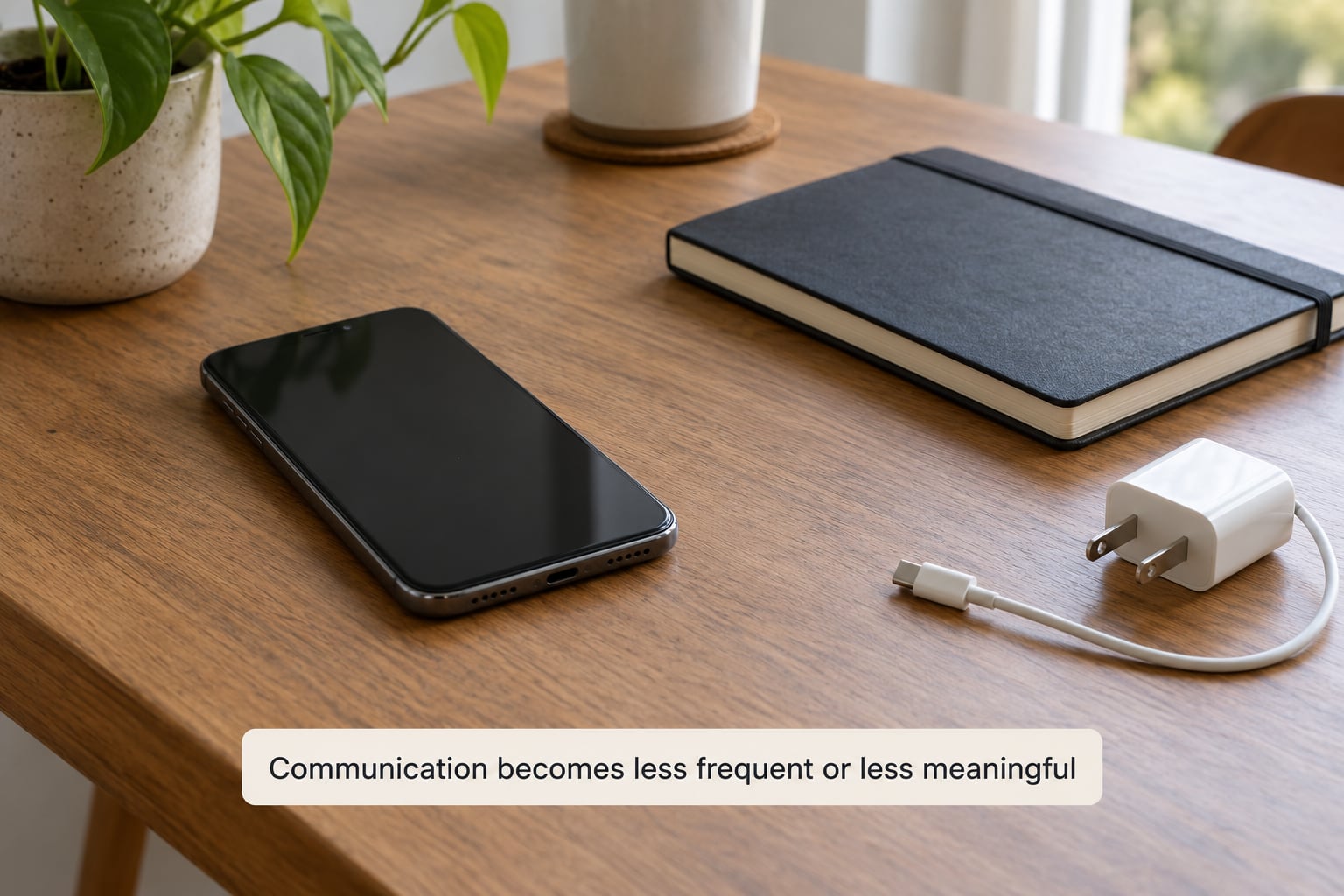
The clearest sign is not that contact stops. It is that contact becomes flat, superficial or feels like maintenance rather than a place you go to feel close. You can see it in the gap: someone who used to answer inside twenty minutes now answers the next morning, or replies to a question about their day with a single word.
Depth is the other half. Ask whether you still talk about things that have nothing to do with coordinating your lives — a strange thing that happened at work, a worry you cannot name, something you were looking forward to. Couples in this stage report trading hundreds of messages about weather, pets and dinner, and going weeks without a real conversation.
People describe relationships where days and weeks pass without a call, and a book they bought to read together sits unfinished on the shelf. That kind of detail is worth remembering, because a missing habit and a missing appetite for each other look almost identical from outside.
Fading contact shows up as shorter, later and shallower than it used to be
Compare last month with three months ago, not with a version of this relationship you saw once. Write down how long a typical reply takes, how many minutes you talked last, and whether you both asked questions. If the trend line is flat or falling and your partner shows no awareness of it, that is the sign.
The question to bring to the conversation is simple: “What has changed in how much we talk, and is there anything making it harder?” You are asking about a pattern, not accusing anyone of a mood.
2. One person consistently avoids making plans
In a relationship that is working, both people occasionally lose their grip on the calendar. In one that is failing, the same person is always the one who cannot travel, cannot get time off, cannot commit to a date more than two weeks out, and never proposes an alternative.
Watch the pattern around cancellations. A single cancelled visit with a real reason and a replacement date is life happening. Repeated cancellations that get rescheduled and then quietly never rescheduled again are a decision being made without telling you.
There is a sharper version of this: the person who is “conveniently unavailable” long enough to avoid a real conversation about commitment. Nothing is ever formally promised, so nothing can be held against them. If that is your situation, name it plainly to yourself, because you cannot negotiate with someone who never makes a promise.
3. Conversations stay limited to logistics
There is a version of closeness that is entirely functional. You confirm the flight, the rent, the call time, who is picking up groceries, and then say goodbye. Nothing is risked, nothing is revealed, and neither person has to manage a reaction.
This is not the same as an argument-filled relationship. It is quieter and easier to mistake for stability, which is why it lasts. People describe talking every single day and still feeling hollow, and they are not being dramatic — they are accurately describing a relationship with no self-disclosure in it.
Here is the test: after a call ends, did either of you learn something new about the other’s inner life? If your calls have gone weeks without that, the communication sign and the disconnection sign are both present.
4. There is little curiosity about each other’s lives
Early in a relationship, people are hungry for details — the terrible boss, the argument with a sibling, the half-formed plan to change careers. When that hunger fades, so does the sense of being known, and it often happens quietly enough that neither person notices until someone else points it out.
Notice the specific gaps rather than the general feeling. Does your partner ask about your coworkers by name? Do they remember what your sister is going through? Have they ever asked what you want your life to look like in five years, and listened to the answer?
Another version shows up when you share good news. Someone who is genuinely invested reacts with happiness. Someone who has checked out responds with “that’s nice” and changes the subject. Relationship writers have been pointing this out for years, and it has not gone out of date: not sounding excited for your good news is one of the most reliable emotional-investment tells there is.
5. Promises about the future keep changing
Every long distance relationship needs an answer to three questions: when does the distance end, who moves, and what happens in the meantime if nothing changes by a specific date. Healthy couples disagree about the details and still have a direction.
Unhealthy couples have “soon.” Soon becomes the end of this year, then next year, then a vague reference to circumstances changing. The date moves every time it approaches, and it moves because arriving at it would require a choice.
Temporary distance and indefinite distance mean very different things
A deployment with a known return date, a six-month work assignment, a parent in hospital — these are temporary. The anxiety is real, and so is the strain, but the timeline has an end you can both point at.
Indefinite distance is different in kind. It has no end date, no owner and no plan, and it can run for years while sounding like a plan. Ask directly what the distance would look like in a year if nothing changed. An honest answer names a city and a timeframe. A vague one tells you what you need to know.
6. Arguments follow the same unresolved pattern
Conflict is not the warning sign. Unresolved conflict is. In a working relationship, a fight ends in some version of repair — an apology, a change, a plan to talk about it once someone has cooled down.
In a failing one, the same dispute comes back on a loop. The argument gets louder rather than shorter, defensiveness replaces listening, and going quiet becomes the strategy. Partners describe taking hours or days to respond as punishment rather than as needing space.
Screen-only distance makes this worse. Without physical presence, there is no shoulder to lean on, no way to hand someone a glass of water mid-argument, no way to leave the room and come back. Irritability and shorter tempers are normal in that setup, which is exactly why so many couples chalk them up to “just the distance.”
A useful question for yourself: after the last real argument, did anything change? If not, and the pattern has repeated, the problem is not the disagreement.
7. Trust is breaking down through secrecy or inconsistency
Ordinary privacy and secrecy look different. Privacy is a locked phone and a boundary you respect. Secrecy is a story that changes, an absence you cannot account for, and a growing sense that important parts of their life happen where you are not allowed.
Inconsistency is the quieter version. The same person is warm at midnight, flat at noon, and gone for a day without notice. You start reading tone and response time like a stock ticker, which is exhausting and easy to do accidentally when you cannot see their face.
Not being able to verify the basics is worth naming. If you do not know where they live, who their close friends are, or whether their story about last weekend held together, you are trusting someone you cannot check. That is not a personality flaw. It is a lack of information running in one direction only.
If any part of this involves threats, stalking, monitoring you, or pressure to cut off your people, that is not a relationship problem to solve together. Confidential helplines and victim-support services exist for exactly this, and reaching out is not an overreaction.
8. The relationship only feels alive at convenient moments
Look at your calendar from the last six months. If the warmth is concentrated around visits, holidays, birthdays and the week before a trip, with low-grade silence everywhere else, you are experiencing a highlight reel rather than a relationship.
This pattern is easy to miss because the high points are real and enjoyable. You come home tired and happy for a few days, then the distance reassembles itself and you spend most of your time in the gap between visits. After a while, visits themselves can start feeling confusing instead of restorative, because the reunion highlights what is missing.
Another small tell: noticing relief when a call is cancelled. When missing someone produces dread, a cancelled call costs you something. When it produces a loosening in your chest, something has shifted.
9. Your schedules remain impossible long after the excuse
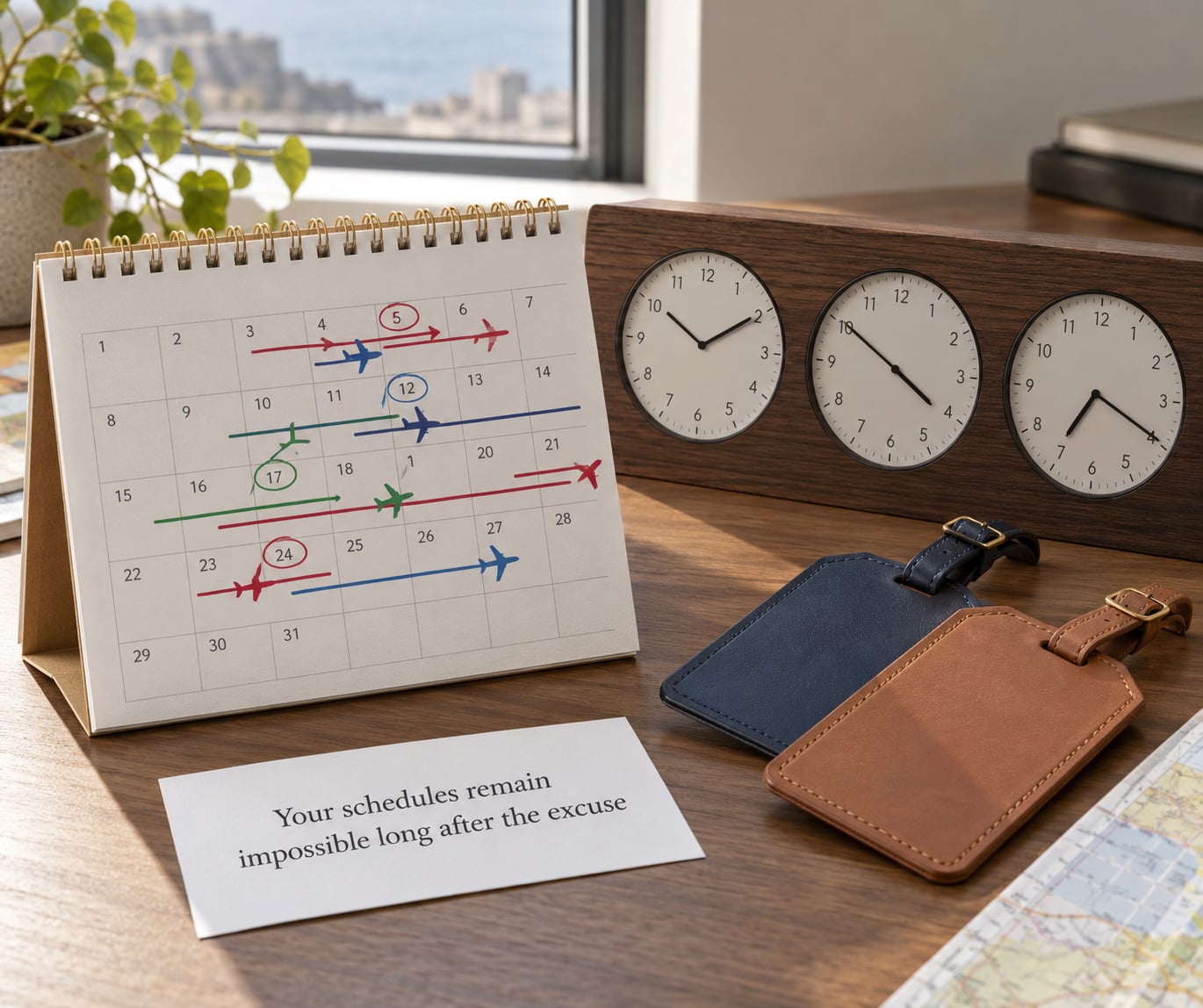
Work is busy. Family needs help. Time zones are brutal. All true, and all survivable for a while. The sign is not the obstacle itself but whether the obstacle still has an expiry date after you have both stopped pretending it does.
Watch for the time-zone asymmetry that so many people describe: one person permanently doing the emotional labour of waking up early or staying up late, and nobody acknowledging it. Repeatedly absorbing that cost without discussing it turns a practical problem into a resentment you cannot point at, because there was never a decision to resent.
Ask what has to change in six months for a visit to be possible, and who is making that change. If the answer is always a general condition rather than a specific action by a specific person, the distance has stopped being a situation you are both dealing with and become the arrangement itself.
10. You feel lonely, unsupported, or emotionally disconnected
This is the sign people recognise last and take most seriously. There is a specific loneliness that belongs to long distance relationships — the 11pm when you have nobody to tell about your day — and it is not the same as the loneliness of being alone. The distinguishing question is whether you feel lonely despite having this person.
Other versions: there is no one you would call first with bad news; you manage hard moments alone by default; you have stopped telling them things because they would not land. Over time that becomes not sadness but detachment, and detachment is much harder to reverse than sadness.
Attachment style often shapes how this shows up. Anxious-leaning partners read silence as rejection and end up monitoring; avoidant-leaning partners experience closeness as pressure and pull back, which reads to the other person as indifference. Neither is a character defect, and both respond well to explicit conversation about frequency and reassurance rather than to guessing.
Frequently Asked Questions
How do you know if it’s a hard phase or the end of it?
Look at what happens after a rough stretch. In a hard phase, the pattern improves once you name it: a call gets made, a visit gets rebooked, someone says sorry and does something different. In a failing relationship, the same behaviour returns after months, and raising it produces deflection rather than change. One bad month is weather. Six months of the same distance with no effort is climate.
How often should you talk in a long distance relationship?
There is no magic number, and couples who fixate on one often end up resenting the schedule instead of enjoying the call. What matters is whether contact is predictable and warm. If you find yourself dreading unanswered messages or counting hours, frequency is usually not the issue — consistency and depth are. Agree on what a normal week looks like and adjust when life changes.
What is the 7/7/7 rule for long distance relationships?
It is an idea people borrow from relationship circles: every seven days, seven days, and seven months, be open to deepening the connection. Some pairs use it as a gentle reminder to make time, others ignore it once they are together. Treat it as a prompt rather than a rule. Regularity matters more than any specific interval, especially when one partner is the only one keeping the rhythm going.
Is breaking up because of long distance valid?
Yes. Distance is a condition, not a reason to stay in something that is not working, and people break up over it while loving each other completely. The question worth asking is whether anything about this specific person would make it work if you lived in the same city. If the honest answer is no, waiting only adds months to the same outcome.
Should I stay if the relationship makes me anxious all the time?
Some anxiety comes with distance and some comes from how you are being treated. Distance anxiety tends to settle when you get clarity, consistency and a date. Anxiety that grows when your partner is evasive, inconsistent or dismissive does not settle, and it is not something you are meant to tolerate indefinitely. Persistent anxiety that affects sleep, work or eating deserves support from someone qualified, not just more effort on your side.
How do I bring up problems without sounding needy?
Describe the behaviour, not their character, and keep it small and specific. Instead of accusing them of pulling away, say you have noticed replies now take most of a day and ask what is going on with their schedule. Ask one question, then let them answer without filling the silence. Most people who are checking out are avoiding a specific conversation, and naming it plainly is what gives them the chance to answer.
What to Do First
Start by counting which of these ten are genuinely recurring rather than occasional. Three that come and go is a difficult stretch. Six that never change is a relationship that has stopped moving, and it deserves a conversation rather than more patience.
Then pick a calm time, not the aftermath of a fight and not right after a cancelled call. Describe what you have noticed in specific terms, say how it feels for you, and ask one clear question: “Is there a version of this where the distance ends, and what does it look like?”
Listen to the specifics. A concrete plan with a date and a name attached to it means the relationship has somewhere to go. More vagueness, a changed subject, or a promise to talk about it soon means the answer is already known.
If you would rather not have this conversation alone, a couples counsellor who works with long distance relationships can give you both something neutral to push against. And if several of these signs describe something coercive rather than just distant, confidential support services are the right first call, not the relationship.
Nothing on this list means the relationship cannot be saved. It means you have stopped guessing and started looking. That is the harder thing to do and the only one that tells you anything worth knowing.