
Handling time zones in a long-distance relationship comes down to one habit: find the small window where you are both reliably awake, protect it with a fixed anchor, and let everything else happen asynchronously. Setup takes about an hour, the monthly reset takes thirty minutes, and it removes most of the scheduling friction that couples blame on distance.
In short:
- Write down both schedules in writing, with the zone attached, so nobody works from memory.
- Find one overlap window you can rely on most days, and one longer anchor each week.
- Assume no reply is expected outside a partner’s waking hours.
- Send the asynchronous stuff on purpose: voice notes, photos, a shared journal, scheduled messages.
- Recheck the plan when daylight saving or work schedules change, not after the fourth missed call.
Table of Contents→
- What You Need to Handle Time Zones in a Long-Distance Relationship
- Step-by-Step: A Routine That Survives the Time Zone Difference
- 1. Confirm Each Person’s Time Zone and Daily Schedule
- 2. Choose a Small Overlap That Works Reliably
- 3. Learn How to Handle Time Zones Without Constant Mental Math
- 4. Build a Repeatable Weekly Connection Plan
- 5. Plan Date Nights That Account for the Difference
- 6. Set Boundaries for Quiet Hours and Last-Minute Changes
- 7. Recheck the Routine When Your Schedules Change
- Common Mistakes That Break a Cross-Time-Zone Routine
- Frequently Asked Questions
- How should you handle time zones in a long-distance relationship?
- What if one partner is often asleep when the other is free?
- How do you keep virtual date nights fun with a big time difference?
- Should every scheduled event include the time zone?
- How do you adjust the schedule when daylight-saving time changes?
- Conclusion: Start With One Overlap Window This Week
What You Need to Handle Time Zones in a Long-Distance Relationship
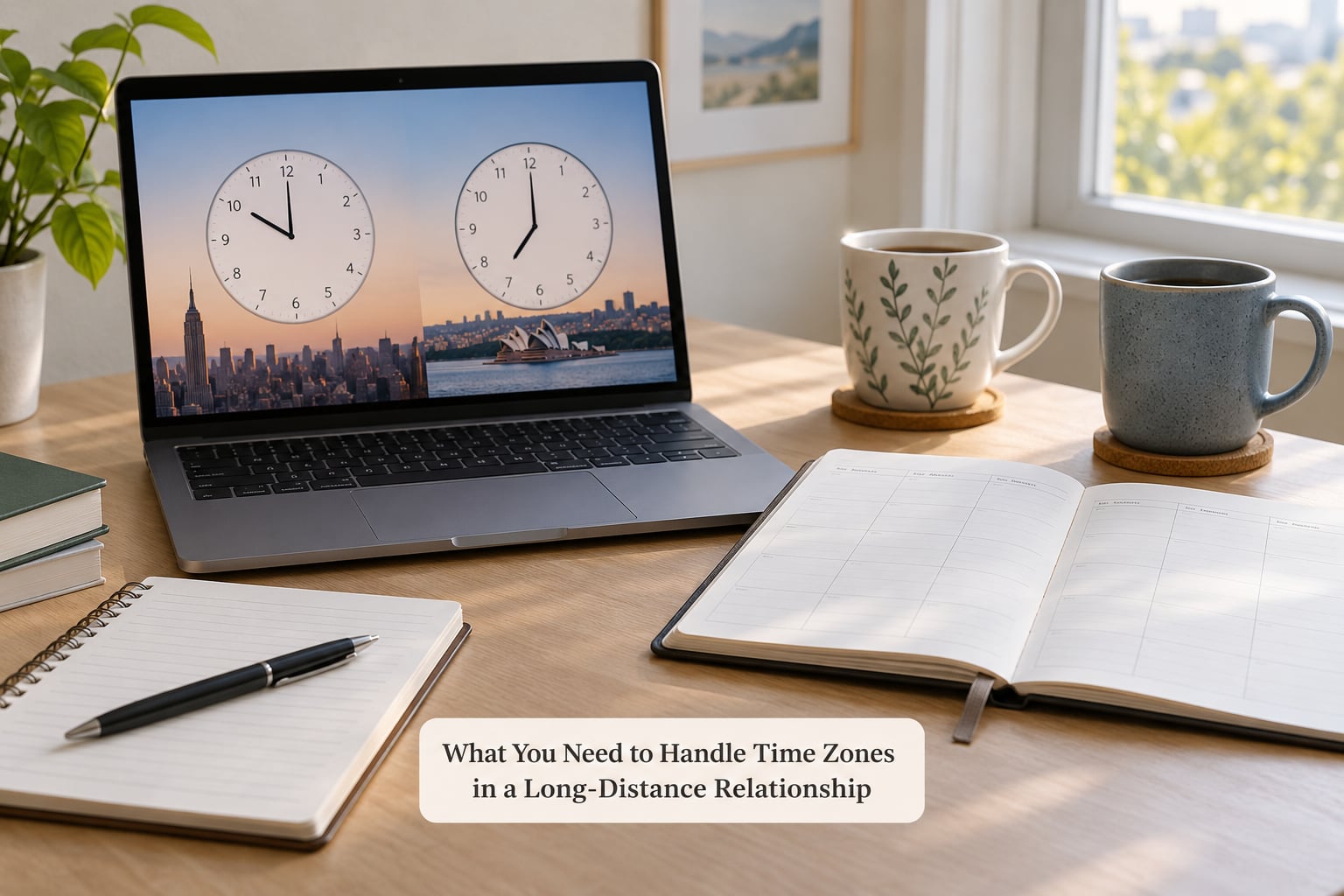
You need four things, and none of them cost anything.
An accurate time reference, kept somewhere you both look. Phones convert time zones automatically, which quietly causes errors when one person reads a notification at the wrong hour and assumes it is an apology or a brush-off. Write the zone next to every time, for example 21:00 GMT+8, and the problem mostly disappears.
A shared calendar that both of you can edit. It does not have to be an elaborate app; a shared document with a week view works. The important part is that adding an event takes under a minute, so it becomes something you do rather than something you debate.
One video calling option you have both already used. Switching platforms is a time zone problem of its own. Pick one, test it on the connection you actually have, and agree on a backup voice-call number in case the video drops.
An agreed planning routine. Twenty minutes on the first Sunday of the month is enough to confirm anchors, schedule any visits, and name the one thing that will probably change. Agreeing in advance when you will talk beats improvising the same conversation every night.
An “our hours” card is the cheapest upgrade. One note with two columns: when you are usually awake, and when you are usually asleep. Couples who swap photos and voice notes “for the other person to wake up to” have turned the time difference into a small gift rather than a scheduling problem.
Step-by-Step: A Routine That Survives the Time Zone Difference
Seven steps, in the order that avoids the most arguments. The test of each one is simple: does it still work in a bad week, when both of you are tired and busy?
1. Confirm Each Person’s Time Zone and Daily Schedule
Start by writing down the facts instead of assuming them. Each of you lists your current zone, your working hours, your commute, when you go to bed and wake up, and the recurring obligations that do not move: school pick-up, gym class, a weekly therapy appointment, night shifts that rotate.
Include the things that are easy to forget, like the fact that one person’s weekend is the other person’s Monday morning, or that a parent on the other side cannot take a call between 7:30 and 8:15 because that is the school run. The pattern is familiar: a barrage of messages at an hour you never agreed to, and a partner who sleeps through the whole thing.
How do you know it worked? The other person can read your list and predict your Tuesday without asking.
2. Choose a Small Overlap That Works Reliably
Work out the overlap by doing the clock math once, in writing. Take the earlier person’s usual wake time and the later person’s usual bedtime, convert both to the same zone, and see where the ranges intersect. Most couples land somewhere between 45 minutes and two hours on weekdays, and considerably more at weekends.
Here is the shape of it by gap size:
| Hours apart | Realistic weekday overlap | What works best |
|---|---|---|
| 3 hours or less | Several hours | Flexible daily calls, plus normal weekday plans. Spontaneity costs little here. |
| 6 hours | 1 to 2 hours | One fixed evening anchor, three or four days, with text and voice notes carrying the rest. |
| 9 hours | 45 to 90 minutes | Two calls a week at the same time, a shared journal, and a long weekend call instead of daily short ones. |
| 12 hours or more | Under an hour | One long call a week, heavy use of scheduled messages, and a visit every few months. Rotate who sleeps late. |
The rule that holds up is simple: one dependable hour beats five unreliable ones. A schedule that works most weeks survives a bad Tuesday; a schedule that only works when both people are lucky does not.
Watch for the two schedules that break the arithmetic. Shift work and small children mean your available hours are not a simple 9-to-6 block, so build the overlap around the actual texture of the week, not the average day.
3. Learn How to Handle Time Zones Without Constant Mental Math
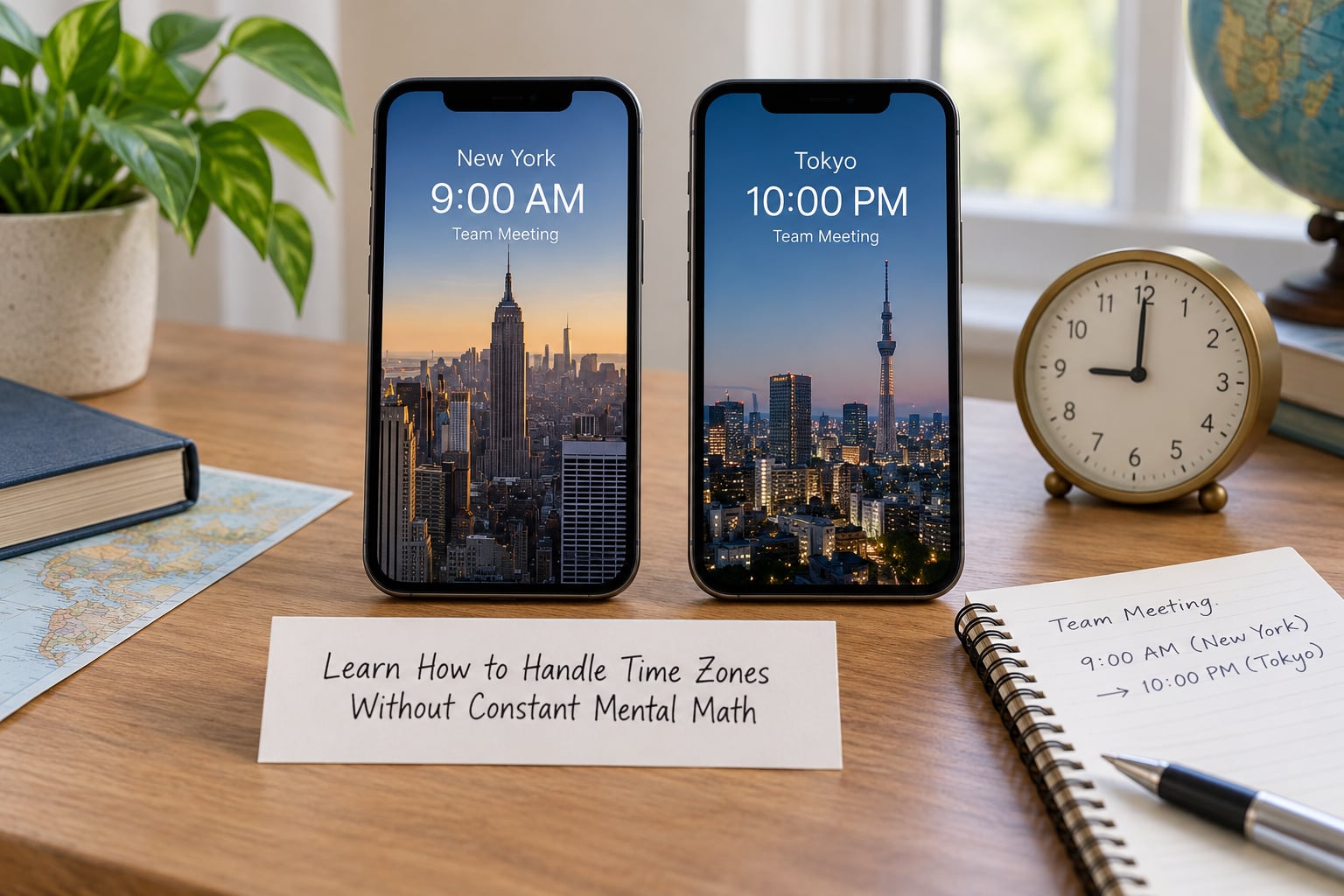
Set the conversion up once so you stop re-checking it. Every phone has a second clock or a world clock screen; add both zones to it, then bookmark it. Put a note on the fridge or the desk that reads something like: “her 9pm is my 2pm”. Concrete and slightly boring, which is the point.
Always write the zone on the invite: “Sat 14:00 GMT+8”. When a date lands near midnight for one of you, name both dates in the message. “Your Friday” and “my Saturday” is the single most common source of mismatched expectations, and it takes two seconds to prevent.
Use scheduled or delayed sends for anything time-sensitive. A message set to arrive at 08:00 local time reads as thoughtfulness, not as a demand on someone’s sleep.
How do you know it worked? Nobody has to ask “what time is it for you” during the call. That question should basically disappear within a month.
4. Build a Repeatable Weekly Connection Plan
Routine is doing the heavy lifting here. Routines survive bad weeks because they do not require a decision. Decide in advance which days you speak live, then stop treating the other days as missed opportunities.
A workable shape for a 6 to 9 hour gap: three shorter live calls, one long weekend call, and a morning or evening ritual on the days you do not speak. The ritual can be tiny and it is the thing people miss most. A photo of the coffee, a voice note before work, one line about what is annoying them today.
Build in a fallback. If someone has a genuinely bad day, the pre-agreed fallback is a voice note instead of a rescheduled call, not a cancellation. A fallback is what keeps a missed call from turning into a small argument about being disrespected.
5. Plan Date Nights That Account for the Difference
Match the format to the gap rather than copying a date night that assumes you share a room. For a 12-hour difference, a shared dinner is impossible, so a long call with a meal each side works better. Cooking the same dish, or ordering the same thing, gives you something to compare.
For smaller gaps, try a walk together on a video call, a game you can play across time zones, a shared playlist you add to at different hours, or reading the same chapter and arguing about it later. Alternating formats week by week stops the routine from going stale.
Book the ordinary dates too, not just anniversaries. A Friday-night call is a date night. People in this kind of relationship are usually good at celebrating the big markers and terrible at the ordinary weeks, and the ordinary weeks are most of the marriage.
6. Set Boundaries for Quiet Hours and Last-Minute Changes
Agree on the rules that stop every message from being an emergency. Write down: no unannounced calls, no calls during sleep hours, expected reply lag of a few hours, and what counts as genuinely urgent.
Then agree on the list of legitimate reasons to be unavailable, so each one does not trigger an apology: illness, overtime, elder care, small children, moving house, a funeral, a power cut. Couples who pre-agree this list stop apologising for ordinary life, and the relationship gets calmer even when nothing about the schedule has changed.
A useful sentence for the moment one person is asleep mid-call: “You are not ignoring me, you are asleep, and we agreed on Thursday at 9.” Guilt tends to live in the gap between what is actually happening and what you assume is happening.
7. Recheck the Routine When Your Schedules Change
Put a short review in the calendar once a month, and treat the two daylight saving changes as a scheduled appointment rather than a surprise. In the US and most of Europe, clocks shift in March and November; in the southern hemisphere, those two months are reversed. Half the countries in the world do not observe it at all, so one of you may be the only person whose clock moves.
Run the review over a real week rather than an ideal one: work shifts, exams, childcare, a new commute, a holiday in the other person’s country. Adjust the anchor time first, because that is the one that decays fastest.
And review the relationship side of it too. A time zone gap that works fine for two years can quietly become the wrong fit when one person’s work, health or family situation changes. Keeping the numbers current makes that conversation easier to have while it is still a scheduling problem.
Common Mistakes That Break a Cross-Time-Zone Routine
Guessing the time, then reading the result as a statement about the relationship. The fix is one line of notation: the zone, attached to every time, every time.
Expecting instant replies across the whole waking day. A reply lag agreed in advance stops a delay from meaning anything at all, and it removes the impulse to overthink a quiet afternoon.
Letting one person do all the scheduling. That is the fast route to resentful quiet. Split it: one of you holds the calendar, the other holds the boundaries about when you are reachable. Neither job is smaller than the other.
Sacrificing sleep for calls. A permanent early alarm for someone else’s sake erodes the relationship slowly, and it usually shows up as irritability nobody connects to the time zone. Rotate the inconvenience, or shorten the call and keep the anchor.
Treating a missed call as rejection. It is nearly always a schedule, a shift, a sleeping child or a bad day. Build the fallback into the plan and this one mostly disappears.
Trying to make every live moment line up. You will not catch their friend’s birthday party at 3am, and no scheduling system fixes that. What you can control is showing up for the parts of their day that repeat.
Three quick tips. Put the anchor in writing and treat it like a meeting. Keep one ritual that is only a few minutes long. And once a month, ask one question: is this schedule still the one we want?
Frequently Asked Questions
How should you handle time zones in a long-distance relationship?
Find the hours where you are both reliably awake, protect one of them with a fixed weekly anchor, and design everything else to work asynchronously. Write the time zone next to every time you agree on, agree on a reply lag that matches real waking hours, and schedule voice notes or photos for the moment your partner wakes up. Most couples need one dependable hour, not five flaky ones.
What if one partner is often asleep when the other is free?
Stop treating your free hours as the only possible meeting time and start designing a second slot. A morning or lunch call suits many 9 and 12 hour gaps, and shifting the anchor on alternating weeks spreads the early start around instead of giving it to one person permanently. If one partner works nights or has small children, build the overlap around that schedule from the start rather than trying to fit around it later.
How do you keep virtual date nights fun with a big time difference?
Change the format rather than the date. A 12 hour gap rules out a shared dinner, so pick something that survives the offset: cooking or ordering the same dish, a walk on video, a game, a shared playlist you add to across the day, or reading the same chapter. Alternate formats week by week, and schedule the small things too, because ordinary Friday nights matter more than the anniversary.
Should every scheduled event include the time zone?
Yes, for anything you agree on by message, because it prevents the most common mismatch of all: one person saying Friday and the other hearing Saturday. Write it as 21:00 GMT+8 rather than 9pm. For quick daily check-ins during a call, skip it. The notation earns its keep on plans, dates and travel, and becomes noise the more often you add it.
How do you adjust the schedule when daylight-saving time changes?
Put both clock changes in the calendar when you set up the routine, in March and November for the US and most of Europe, and treat the shift as a reschedule rather than a surprise. Recalculate your overlap window the week before, then move the anchor time by an hour if it now lands badly. Remember that one partner’s country may not observe it at all, and neither of you is wrong.
Conclusion: Start With One Overlap Window This Week
Time zones are the one part of distance you cannot fix by trying harder, and that is good news, because it means you can solve them on paper. Work out the real overlap, protect it with an anchor, make the rest asynchronous, and agree the etiquette so a quiet hour never gets mistaken for a cold shoulder.
So do the first part this week. Compare both calendars against a real one, name the one hour you can both rely on, and put it in writing with the time zone attached. Everything after that gets easier.