You can raise your confidence that someone online is who they say they are, but you will never get proof. The way to verify someone you met online is real is to cross-check what they told you against independent sources: run their photos through a reverse image search, look at how old their accounts are, watch whether their story stays the same over weeks, and get a live video conversation before you share anything private.
Ten minutes of checking catches most fakes. Fifteen minutes does not catch everyone, because AI-generated photos now exist that appear in no search engine at all. Here is what actually helps.
Table of Contents→
- What You Need
- Step-by-Step: How to Verify Someone You Met Online Is Real
- Common Mistakes
- Frequently Asked Questions
- Can someone fake a video call?
- What if someone has no social media at all?
- Is it legal to look someone up before meeting them?
- How can I tell if a dating profile photo is AI-generated?
- Can I check whether someone is married or has a criminal record?
- Should I send money to someone I have never met in person?
- Conclusion
What You Need
You need very little, and all of it is free. Before you start, gather the raw material rather than jumping straight into a search engine.
- Their profile photos, saved. Screenshot them full-screen, then crop them down to the person alone. Cropping gets rid of the app interface that confuses image matching.
- Every detail they gave you. Name variants, city, job, employer, school, age range, hobbies, where they were born.
- A phone with a camera. You will want it for a live video call.
- A reverse image search tool. Google Images and Bing Visual Search both accept an uploaded image. TinEye is another option and indexes older pages differently.
- Ten to fifteen minutes for the basic check. A deeper investigation takes longer and rarely adds much.
One thing to have in mind before you begin: the goal is to find contradictions, not to collect proof. Nobody reaches certainty about a stranger online, and anyone promising you that is selling something.
Step-by-Step: How to Verify Someone You Met Online Is Real
- Compare their profile against what they tell you over conversation.
- Check that their social accounts existed before you started talking.
- Reverse image search every photo they have sent you.
- Ask for a live video call and watch how they respond.
- Corroborate one detail outside the app, gently.
- Decide whether to keep going, based on the pattern, not one moment.
Start With Their Profile and Conversation
The cheapest check is free: re-read what they wrote on the profile and compare it to what they have said since. Job, city, age, pets, where they went to school. Do the details line up across a month of messages, or has the story quietly moved?
Watch for small drifts. Someone who said Manchester in week one and London in week four might have a perfectly good reason. Three different cities in three weeks usually means one.
Notice how they write, too. Consistent typos and lowercase sentences are a real signal about this person, but they are not a signal about honesty. Plenty of honest people type badly. Threads on r/OnlineDating make the same point from the other side: a lot of genuine people get accused of being fake for reasons that have nothing to do with them.
Two things that look suspicious but mean little on their own: a nearly empty profile, and a new account. Some people are just private, or just joined last month. Treat both as neutral until you have something else.
Check Their Social Media and Public Footprint
Account age tells you more than follower count, and it is much harder to fake. A profile created the day you matched, with no posts and no tagged photos, is a different situation from one that has been posting steadily for years.
What to look for, in rough order of usefulness:
- Posting history. Real photos over months beat a polished feed of ten posts from launch week.
- Tagged photos. People tag friends. A wall of untagged solo selfies is thinner evidence than it looks.
- Mutual connections. A friend you both know is worth a lot, and it is easy to check by asking one question in a different app.
- Details that match. The same dog, the same street, the same job title mentioned across two platforms.
You do not need their password and you should not ask for one. A friendly script works better: “I am a bit private too, so no pressure at all. Would you be comfortable sending me your Instagram or wherever you post most? I would happily share mine.”
If they refuse every public channel, note it and keep going. One private person is not a red flag. A person who cannot name a single account they have ever posted on, anywhere, for years, is telling you something.
Run a Reverse Image Search
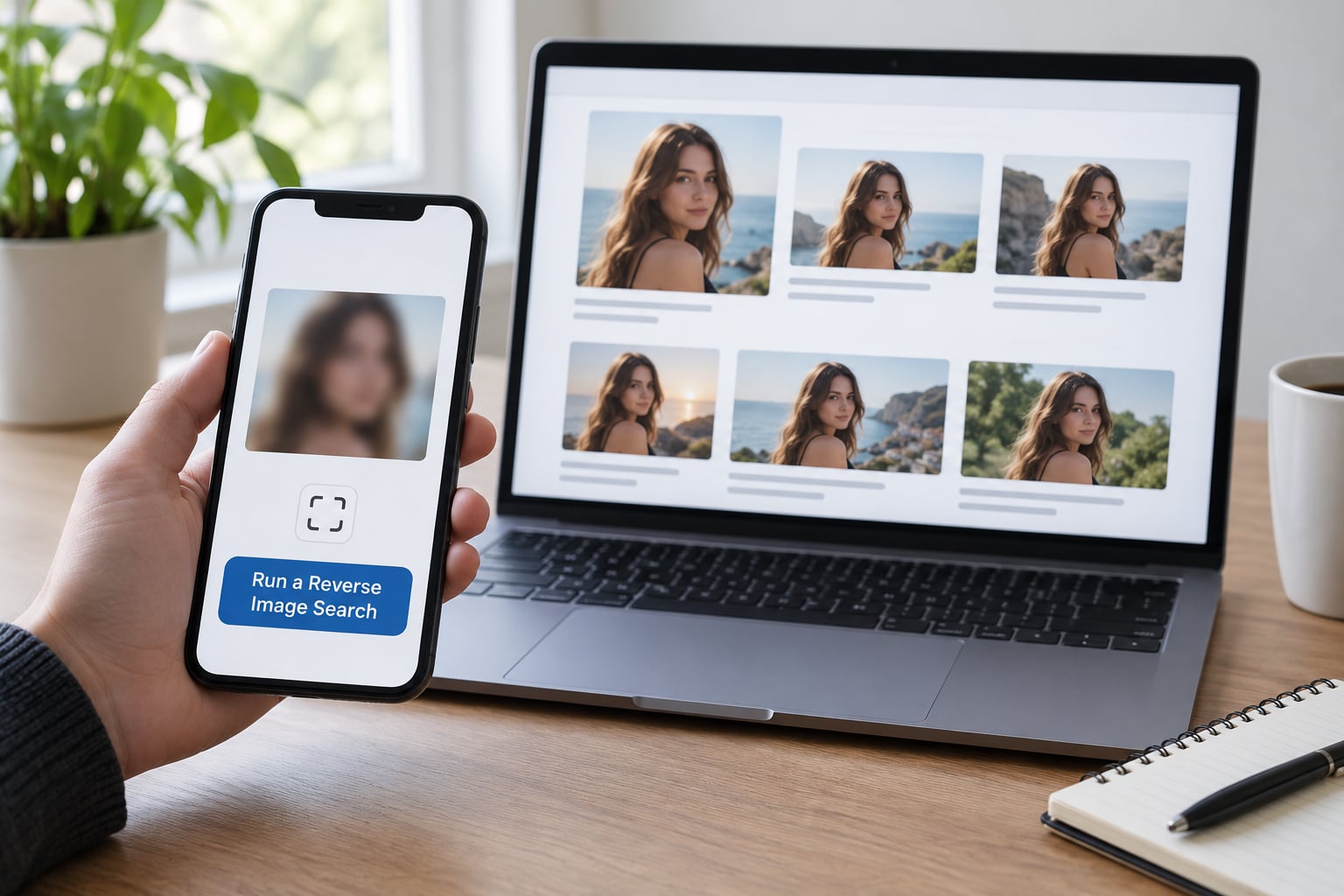
Here is the actual click path, because most guides skip it. Screenshot the photo. Crop it to just the face or just the body, with no app buttons in frame. Open Google Images on a computer or phone, select the camera icon, and choose to upload the file. Bing Visual Search works the same way with the camera button in the box.
Do this for every photo, not just the main one. The photos someone texts into the chat later are usually the ones you most want checked, and they are the ones people forget.
How to read what comes back:
- The same face under a different name is the finding that ends the investigation. Stop and reconsider everything.
- A free photo library hit means the photo was taken by someone else. Common with travel and fitness shots.
- A celebrity or public figure means impersonation.
- Unrelated images only means the search did not match. That is not proof of innocence, it just means the search engine has nothing.
- No results at all is worth noting, especially for a brand-new photo-heavy profile. In the past, no result usually meant a private person. Now it can mean an AI-generated face.
That last point has changed the old playbook. People in r/catfish describe a wave of profiles whose faces turn up nothing anywhere, because they were never photographed. The visual tells are covered further down.
Have a Live Video Conversation
A live call is the strongest single check most people can run, because it is hard to fake convincingly at short notice. It is also not proof of safety. Someone who passes a video call can still be a scammer, and someone who is genuinely camera-shy is not lying to you.
How to suggest one without making it an accusation: “I am not much of a photo person either, honestly. Would you be up for a quick video chat this week? No pressure at all if your camera is broken.”
During the call, watch for a few things. Does the lighting match the room they describe? Do they move naturally and respond to your questions without delay? Are background details stable, or does the scene change when they move? Filters that smooth skin heavily are common and not on their own suspicious.
How they respond matters as much as what you see. Refusing repeatedly, rescheduling several times, or only offering voice notes is the strongest behavioural red flag people report. If someone did three video calls last month and suddenly cannot do one today, ask why directly and judge the answer.
Confirm Key Details Without Being Intrusive
Verification works best as slow corroboration. Over a few weeks, one detail will come up again in passing, and you can quietly check it against a public source.
A restaurant they recommended closes. A team they claim to support actually plays on Saturday. A school they mention has a public staff page or an alumni notice. A building they described matches the one in their photos once you look at the street signs.
This works because the check is invisible. You are not interrogating anyone, you are paying attention.
There is a hard limit on what you should ever ask for. Never request passwords, account logins, bank details, card numbers, tax documents, copies of an ID, or a video of anything intimate. A real person who likes you will not need those, and a scammer who does is telling you exactly what they want.
And the moment money enters the picture, stop and slow down. Requests for gift cards, crypto, wire transfers, or a business investment are not identity questions. They are the whole point of the contact.
Decide Whether It Is Safe to Meet or Share More
Decide on the pattern rather than a single moment. Someone can have one odd photo and still be genuine. Someone who is consistent across five independent checks and respectful about your boundaries is in a different category from someone who passes one video call.
Signs the check went well: details line up over time, they answered reasonable questions without defensiveness, they respected a slow pace, and they did not need your money, your address, or your login.
Reasons to stop contacting: inconsistencies that never resolve, pressure to move fast, refusal of any verification combined with reluctance to meet, requests for money or intimacy, attempts to isolate you from friends, or mocking you for checking (“you are too paranoid”). That last one comes up constantly in forum threads and it is itself information.
If you is stopping, do it in this order:
- Screenshot everything: the profile, the chats, any requests for money, the URLs and usernames used.
- Save the photos they sent with the original file, not just a screenshot.
- Report the profile in the app. Reporting flags the account and its photo for review.
- Block, and tell one person you trust what happened.
- If money moved, contact your bank or card issuer the same day and ask about a recall. Report to your national fraud reporting body; in the US that is the FTC or FBI IC3, in the UK Action Fraud, and elsewhere your local police or consumer protection agency.
Signs of AI-Generated Photos
When a reverse image search returns nothing, a generated face is one explanation alongside ordinary privacy. A few visual tells are worth knowing, though none of them prove anything alone.
- Background details that dissolve into smudges when you zoom in.
- Earrings or jewellery that differ between the two ears.
- Hair that blends into a collar or shoulder without a clear edge.
- Symmetry that reads as too perfect: identical freckles, evenly placed features.
- Skin texture that is either oddly smooth or inconsistently sharp.
- Teeth that look strange when they smile.
- Ages that seem to drift slightly across a set of photos from the same profile.
Compare several photos side by side rather than judging one. Real photos have small inconsistencies too, and the whole point of a good generator is that it does not look like a generator.
Common Mistakes
Treating a video call as absolute proof. A call raises confidence and proves very little on its own. Keep checking other channels. If someone has passed a call and still asks for money, the call was not the deciding factor.
Confronting someone aggressively. Accusations before you have facts tend to end the conversation, and you lose the chance to gather more. Ask a question, watch the answer, then decide quietly.
Sharing sensitive details too early. Address, workplace, daily schedule, family details, bank details. You can share them later in a real relationship, which costs you nothing and tells you a great deal about the person.
Relying on a single search result. No matches means no match, nothing more. One clean search is not a verdict in either direction, and paid people-search services return reams of irrelevant data for common names. Free methods run end to end in a few minutes and catch nearly everything a scammer would slip on.
Assuming a verification badge means verified. Photo and ID checks on some apps confirm the person holds the document and matches the selfie. They do not confirm the name, the age, the intentions, or the marital status. Scams still come from profiles carrying badges.
Ignoring boundary violations. If someone gets irritated by reasonable questions, or by you saying no, that reaction is the finding. Walk away from it.
Arranging an unsafe first meeting. If the person checks out, still meet in a public place in daylight, tell a friend where and when, keep your own transport, and take your phone. Do not go to a second location, a private home, or an out-of-the-way place because they asked nicely.
Frequently Asked Questions
Can someone fake a video call?
Yes, though it has become harder. Recorded loops break as soon as you say something unexpected, and most prerecorded calls cannot handle a live question. Deepfake video calls are developing quickly, so treat a call as useful evidence rather than proof. Weigh it alongside story consistency, account age and how the person responds to boundaries.
What if someone has no social media at all?
Plenty of genuine people keep a very small or private online presence, and that is their right. Check whether the accounts they do have have history rather than judging the number of accounts. If they are consistently private but answer questions calmly and respect your pace, that reads as privacy. If they cannot name a single account they have ever used, weigh that differently.
Is it legal to look someone up before meeting them?
In most places, looking at publicly visible pages is fine. Reading a public profile, viewing public posts and running a reverse image search are ordinary searches. Rules differ by country and they change, so check locally if you are unsure. Where it stops is impersonating accounts, accessing anything behind a login you have no permission for, publishing private details, or continuing contact after someone asks you to stop.
How can I tell if a dating profile photo is AI-generated?
Look at background detail that dissolves when you zoom, mismatched earrings, hair with no clear edge against a collar, unusually perfect symmetry, and teeth that look wrong in a smile. Compare several photos from the same profile side by side and look for age drift. None of these proves anything alone, because a good generator avoids obvious tells. Combined with a reverse image search returning nothing, they are worth a conversation.
Can I check whether someone is married or has a criminal record?
You cannot reliably do either from a name alone. Public records are scattered across court databases that vary by state or country, and most reputable services will not sell you criminal history. A marriage announcement, a tagged photo at a wedding or a public partner mention may show up, but absence of any of that means nothing. Set expectations honestly: this is the limit of open-source verification.
Should I send money to someone I have never met in person?
No. Gift cards, crypto, wire transfers and business investment offers are the point of most romance and pig-butchering scams, and a real person who likes you will not need them. Sending money is also the point at which verification stops mattering, because no amount of checking protects the money. If you have already sent something, contact your bank or card issuer immediately and report it to your national fraud body.
Conclusion
Start with the cheapest check. Compare what they told you against what they have written, run every photo through a reverse image search, and look at whether their accounts existed before you matched. Then ask for a short live video conversation in a way that leaves them an easy out.
If the details hold up across those steps, keep going slowly and stay safe at the first meeting. If they do not, you have your answer already, and you do not owe anyone a second chance.