Dating app red flags are early warning signs that show up in someone’s profile, in the way they message, or in how they behave once things start moving. They suggest the person may not be who they claim to be, may not be genuinely available, or may put you at risk. Catching one at the profile stage costs you a swipe. Catching it after you have fallen for someone costs a great deal more.
This list is built around one idea: red flags rarely arrive one at a time, and a single odd detail is usually harmless. What matters is a pattern, and where in the process that pattern shows up. I have split these twelve flags by stage, from reading a profile through the first few weeks, so you can jump straight to the part of the process you are actually in.
Two words I use constantly. A red flag is behavior that could physically, verbally, or emotionally harm you, or that points to deception. Act on it early. A yellow flag is one strange data point that has an innocent explanation. Note it, watch for a second data point, and decide later. People on r/datingoverthirty put it better than most advice columns have: red flags are meant to be reliable signs that someone might be abusive, not a running tally of personality tics that irritate you.
Table of Contents→
- Dating App Red Flags to Watch For at a Glance
- 1. A Profile Photo That Does Not Match in Person or Video
- 2. Inconsistent Identity Details
- 3. Pressure to Move Quickly Off the App
- 4. Requests for Money, Gifts, or Financial Help
- 5. A Story That Keeps Changing
- 6. Sexual Pressure or Boundary Testing
- 7. Excessive Anger, Jealousy, or Control
- 8. Refusal to Meet in a Public Place
- 9. Excessive Messaging or Attention Without Substance
- 10. Discriminatory, Hateful, or Overly Generic Conversation
- 11. Links, QR Codes, or Suspicious Requests to Click
- 12. Repeated Boundary Violations or Unwanted Contact
- Frequently Asked Questions
- Conclusion: Start With Patterns and Protect Your Boundaries
Dating App Red Flags to Watch For at a Glance
This table is the whole article in one screen. The severity column tells you how fast to move.
| Red flag | Where it shows up | Why it matters | Prudent action |
|---|---|---|---|
| Photo does not match live video | Video call or in person | Stolen or old photos, or a hidden appearance | Ask for an unplanned live video; treat refusal plus excuses as a red flag |
| Inconsistent identity details | Chat and profile | Signals a constructed persona | Ask neutral, specific follow-ups; watch the pattern, not the slip |
| Pressure to move fast or off-app | First few messages | Removes the platform safety net | Keep the pace you want; say so plainly and watch the reaction |
| Asks for money, gifts, or help | Any stage | Romance scam pattern | Decline, end contact, report. Never send funds or financial details |
| Story keeps changing | Weeks of chatting | Deception or no real identity behind the profile | Name the specific contradiction once, calmly, and watch what changes |
| Sexual pressure or boundary testing | Chat and early dates | Consent disregard, often escalating | Block and report. You never owe an explanation |
| Excessive anger, jealousy, control | Chat and first meetings | Monitoring and intimidation | End it before you are invested; document if it escalates |
| Refuses a public place | Before meeting | Private location removes witnesses | Offer a busy public venue. A hard no is an answer |
| Constant attention with no substance | Early chat | Love bombing and manufactured intimacy | Slow down and ask one real question; redirect to real conversation |
| Hateful or contemptuous talk | Chat, first date | How they treat others predicts how they treat you | One unfamiliar belief is not proof; a repeated pattern is |
| Links, QR codes, download requests | Chat | Account takeover and phishing | Never tap. Verify inside the official app or service only |
| Contact after you asked for none | After unmatching | Boundary disregard, possible harassment | Block, report, save evidence. Do not reply again |
1. A Profile Photo That Does Not Match in Person or Video
The clearest version of this one is not subtle. You meet, and the person in front of you is a stranger, or you join a video call and the face changes, or the profile picture is a well-known celebrity or a photographer’s model.
The softer versions matter just as much. Photos that are obviously four years old, heavy filters that smooth out every facial feature, group photos where you are guessing which person is the match, and profile galleries with no photo taken in the last year all point the same direction: the profile is a sales pitch, not a person. Of all the dating app red flags to watch for, this one is the cheapest to check and the easiest to fake around, so it is worth spending a minute on.
How to test it: ask for a spontaneous video call. Not scheduled for next week, not a “call me when you’re free” that never happens. Something like, “I’m curious what your voice sounds like, let’s do a quick video now if you’re up for it.” A busy person says not tonight. A person with nothing to hide says yes in under a minute.
Do not treat a camera preference as a verdict on its own. Someone with anxiety, a bad connection, or a private work life may genuinely hate video. The flag is refusal plus a chain of excuses, especially if they will happily move to a phone call or an app you have to download.
2. Inconsistent Identity Details
Age, city, job, relationship status, how long they have lived somewhere, where they went to school. When these drift apart between the profile and the conversation, you are not dealing with someone who forgot a detail. Small lies are how a fake story gets tested before it gets told.
Ask neutral, boring questions that a real person answers easily. “Which part of town are you in?” “How long have you been at that job?” “How did you and your ex meet?” Real details come with texture: the commute, the annoying manager, the year the dog died. Invented ones stay flat and repeat.
One small mistake is not a flag. People misremember their own timelines constantly. A pattern of contradictions is.
3. Pressure to Move Quickly Off the App
Here is the contradiction that confuses people most: some advice says moving to Instagram fast is a scam signal, and other advice says hesitating to move is a red flag. Both are describing a real pattern, they just point at different halves of it.
The half that matters is who is in a hurry and what they are buying with the urgency. Urgency aimed at money, at your address, at access to your accounts, at a private location, or at commitment is the half worth worrying about. Someone who is excited to see you, answers your questions properly, and is fine with a plan three days out is not doing something suspicious.
What is worth noticing: pressure to move to a platform where the app’s reporting tools and photo record no longer exist, repeated switching to new apps, or anger when you say you would rather chat for a while. Multiple users on r/dating report getting angry when they said they were not ready to meet, which is the clearest example of what this looks like when it is not about a scam at all.
A line that works: “I’d like to keep talking here a bit longer, and I’d like to pick a public place when we do meet.” How they receive a reasonable boundary tells you more than any profile.
4. Requests for Money, Gifts, or Financial Help
No legitimate reason to ask someone you have not met for money holds up under any scenario. Emergency medical bills, a stranded phone, a work visa fee, a laptop that died before a freelance payment lands, an investment opportunity with a great return, or a birthday gift sent through a payment app that asks for your card details. Each of these appears in romance scam scripts, and they work because the script includes real affection alongside the ask.
The pattern before the ask matters as much as the ask. Long conversations, rapid escalation, a reason you cannot come in person, and then a financial emergency that resolves if you wait a few days.
Declining is a complete response. You do not need a speech. And you do not need to keep the conversation open to stay polite. If money ever comes up, end it, report the account, and if you have already shared any financial or login information, change your passwords and contact your bank’s fraud line the same day.
5. A Story That Keeps Changing
They met their ex at a climbing gym, then at a wedding six months ago. They have two kids, then one. Their job is medical sales in Denver, then logistics in Phoenix, then they are between roles. Small contradictions get corrected. Constant ones do not.
Specific follow-up questions do more than accusing. Ask what the climbing gym was called, ask who was at the wedding, ask how long they had the Phoenix job and why they left. A person with a real life has small true details. A person running a script either gives you a vague answer, changes the subject, or gets annoyed at the question.
The annoyance is the finding. Being curious about someone’s actual life should not be a conflict.
6. Sexual Pressure or Boundary Testing
This one gets worse, not better, so it gets less attention than it should. Unwanted sexual messages, demands for photos you have not offered, guilt about your pace, threats to tell people you are talking to them, comments about your body that turn into a test of whether you object, or a slow campaign of pushing each boundary to see what sticks.
Any adult who respects you will not treat your no as a negotiation. One test is a yellow flag and worth naming out loud, plainly, once. A repeat after a clear no is a red flag with a simple response: block, report, and if they created accounts elsewhere or threatened you, save screenshots first.
Trust the discomfort. You are not required to find a reason before you are allowed to stop replying.
7. Excessive Anger, Jealousy, or Control
Everyone gets annoyed on a bad day. The difference between frustration and control is what comes next: does it end, or does it become a demand about your clothes, your friends, your job, where you are, who you are talking to, or what you post?
Watch for a fast escalation from a small trigger. Someone who is jealous of your coworkers on day three, who asks you to send your live location, who needs to know who you are with before you leave the house, or who reacts to a friendly text from another man with silence or hostility. Multiple Reddit threads describe the same mechanism, framed well by one r/AskReddit user who called it a red flag when someone constantly makes you question how they feel about you.
It should never feel like a guessing game to know where you stand.
8. Refusal to Meet in a Public Place
“Come over, I want to cook for you.” “Let’s park at the trailhead, it is more private.” “My place is closer than yours.” A request for a private home visit, a secluded outdoor spot, or a visit to their workplace removes the witnesses that make you safe.
Sometimes there is an innocent reason: a first date with a camera-shy friend of the same sex, a shift that ends at 2am, a genuinely anxious person. That is fair, and a compromise usually exists. A busy cafe, a bar with a host, a restaurant where the staff know you exist.
A flat refusal to any public option, especially after you offer one, is a yellow flag that becomes a red flag when combined with any other item on this list. You set the venue or you do not go.
9. Excessive Messaging or Attention Without Substance
Constant texting, replies within seconds at 2am, an instant and intense connection before a single real conversation has happened, and a stream of compliments that never turns into a specific question about your life. On its own, this reads as enthusiasm. Repeated across many people, it is how manufactured intimacy is built, and it is why the most useful check is whether attention ever turns into substance.
This is where red flags wear green flags as a disguise. Over-complimenting, immediate availability, mirroring your exact texting style, treating you as the best thing that has ever happened to them in week one, and instant agreement with everything you say can all be signs of someone shaping a version of themselves around your desires. One r/AskWomenOver30 thread on this exact theme ran to hundreds of comments, which tells you how many people are trying to work out which attentions are real.
The test is simple: does the conversation get more specific over time, or does it stay flattering and surface level? A real person has specifics, including inconvenient ones.
10. Discriminatory, Hateful, or Overly Generic Conversation
Look at how someone talks about the people they have already lived with. Referring to every ex as crazy, describing a whole gender as one problem, contempt for a coworker, a religion, an ethnicity, a political group, or a family member. One unusual belief or one unfamiliar worldview is not evidence of harm and nobody owes you political agreement.
A repeated pattern of contempt is different, because it shows how they treat anything they have decided is lesser. Bios that lead with what they refuse, rather than what they want, are worth a hard pass; one woman on r/AskWomenNoCensor described how exclusionary bios made her disengage even when she fit every listed criterion.
The other half of this one is too generic to read. A bio that says almost nothing, no interests, no specifics, nothing you could picture, reads as low intent. Someone on r/AskReddit made the same point about zero-effort profiles, and they are not wrong. It costs ten seconds to say what you actually do on a Tuesday.
11. Links, QR Codes, or Suspicious Requests to Click
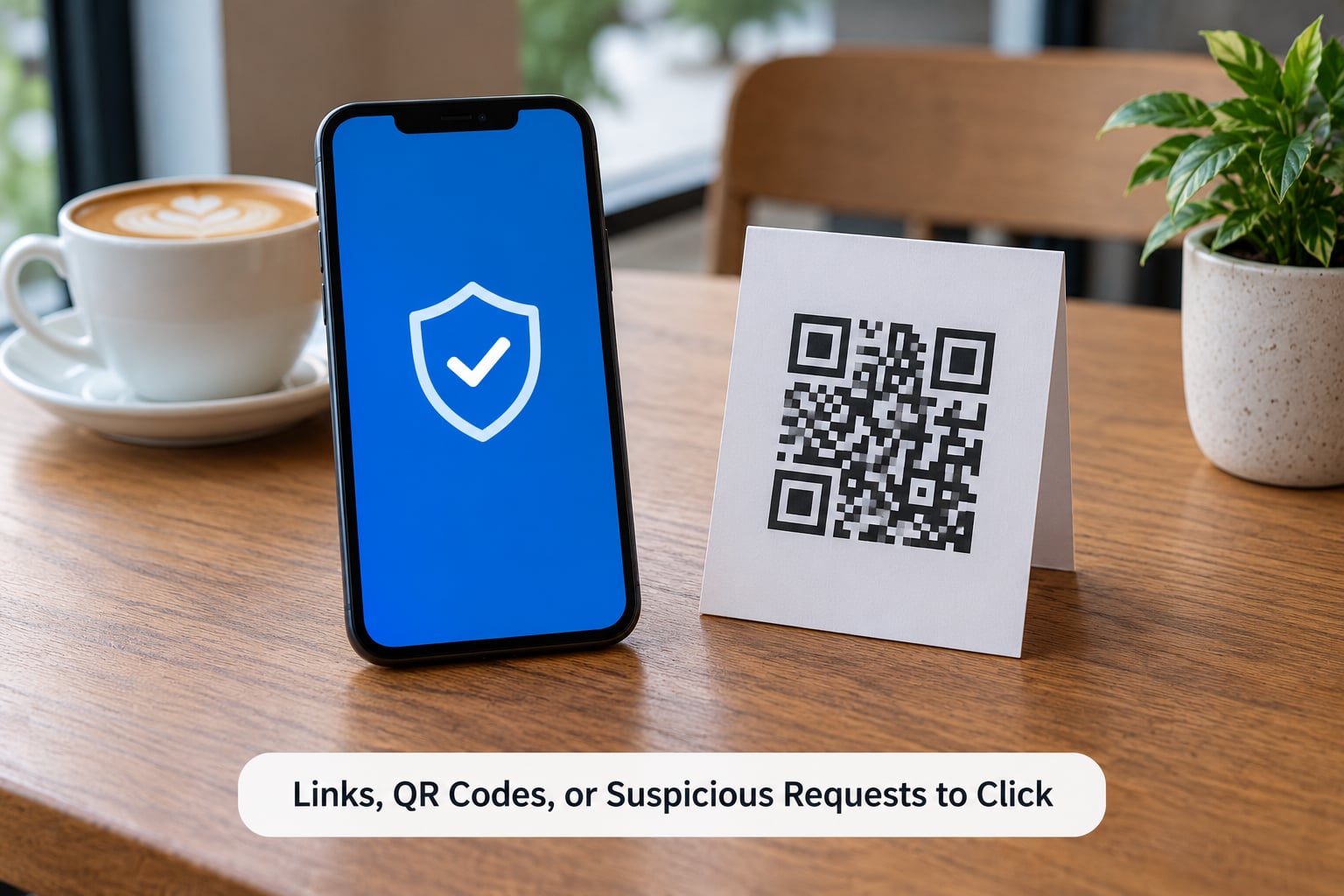
A link to “verify your account,” a QR code you are asked to scan with your phone camera at a table, an invitation to install an app from a link because the app store version “is broken,” a page that asks you to sign in again after you have not signed out. These are phishing and account takeover attempts, and on dating apps they arrive dressed as intimacy: “I made you a playlist,” “look what I found for us.”
Never tap. Never enter a password, a verification code, or card details anywhere a stranger sent you, even if the page looks perfectly real. Legitimate services will route you through their own app or the address you type yourself, and no real person dating you needs your login to say goodnight.
If you already entered something, change that password immediately, sign out of all sessions, and enable two-factor authentication.
12. Repeated Boundary Violations or Unwanted Contact
A misunderstanding is a person hearing your no once and adjusting. A boundary violation is a person hearing it and choosing again: new accounts after you unmatch, messages that ignore your stated preferences, affection or sexual remarks you have already told them to stop, and any contact that continues after you asked for none.
This is the flag with the clearest documentation value, and it is where most of the dating app red flags to watch for turn into something you can act on. Screenshot messages with dates, block, and report inside the app, because reporting is what triggers action on accounts used to scam people. Then leave it alone. Do not reply to explain, and do not feel obligated to be gracious about it.
If the behavior includes threats, stalking, or anything involving an immediate risk, that is a different set of authorities, not a dating app support queue. In the US, romance scam reports go to reportfraud.ftc.gov, and the app’s own safety tools usually list a route to local support organizations.
Frequently Asked Questions
Is it a red flag when someone wants to meet immediately?
Not on its own. Plenty of people are genuinely excited and honest about it. What matters is whether you get to choose the venue and the timing, and whether you are still allowed to keep asking questions first. Red flags appear when the urgency is aimed at a private location, at money, at your personal details, or at commitment. If the request is simply to meet, and you would rather chat for another week, saying so should produce patience rather than anger.
What is the 3-3-3 rule for dating?
It is a communication guideline for the first three dates: no more than three texts a day, no calls lasting longer than three hours, and no meeting more than three times a week. It is a social convention, not a safety tool, and it mainly exposes imbalance. If you are the one sending all eleven messages and none are returned, that is useful information about interest, not a rule you are breaking.
What are subtle red flags on a first date that seem normal in the moment?
Watch for the small ones that look like ordinary nerves: arriving very late with no message, ordering for you and correcting the waiter when you order your own, steering every topic back to you rather than asking questions, checking their phone constantly while telling you they are off it, and turning a light disagreement into a joke that lands on you. Individually they are nothing. Two or three of them together usually mean the evening was carefully managed rather than enjoyed.
How do I know if a dating profile is fake?
Look for internal inconsistency first, then verify rather than guess. Reverse image search their main photo, ask for an unplanned live video call, check whether their stated job, city, and age match across accounts, and look for a real posting history with comments from real people. Any one of these can be explained away. A profile that passes none of them, combined with a request for money or a private location, is not worth investigating further.
What should I do if I spot a red flag while dating?
Work down the severity. For a single yellow flag, note it in a private place and wait for a second data point rather than deciding on one odd detail. For a red flag, a money request, sexual pressure, or a refusal of any public venue, end the conversation with one clear sentence, then block and report inside the app. Save screenshots first if the contact continues after you have gone. You are not obliged to give anyone a reason, and you never owe them a second explanation.
Conclusion: Start With Patterns and Protect Your Boundaries
If you take one thing from the dating app red flags to watch for, make it this: slow down and judge patterns instead of moments. Every flag on this list is survivable on its own. Two or three of them in the same week are not.
Keep your financial details, your address, and your login credentials to yourself no matter how the conversation feels. Meet in public, tell a friend who you are meeting and where, and get yourself home with your own transport. When someone’s conduct creates fear or pressure, block, report, and stop explaining yourself.
One last thing nobody on the apps says out loud, and a thread in r/AskReddit that readers clearly needed: run the same scan on yourself. You are allowed to have interests, a sense of humor, and standards, and you are allowed to admit which of these twelve you show to other people.