Most fake dating profiles fall apart under three kinds of pressure: a close look at the photos, a close reading of the messages, and a request to talk live. You do not need a private investigator or a paid tool — you need about ten minutes and a process that runs in the same order every time.
This is how to spot a fake dating profile in practice: the process I wish someone had handed me before my first year of dating apps. It covers the checks in order, from the thirty-second scan through reporting the account. Last reviewed in October 2026, and it works on Tinder, Bumble, Hinge, Match and anywhere else profiles get created.
Table of Contents→
- What You Need
- Step-by-Step: How to Spot a Fake Dating Profile
- Check the Profile for Obvious Inconsistencies
- Inspect the Photos for Signs of Stolen or Misleading Images
- Read the Messages for Manipulative Patterns
- Verify the Identity: The Move That Exposes a Fake Dating Profile
- Search for a Corroborating Online Footprint
- Test the Claim Without Sending Money or Sensitive Information
- Recognize Emotional Pressure and Scam Requests
- Stop, Block, and Report When the Pattern Continues
- Common Mistakes
- Frequently Asked Questions
- Does a missing social media account mean a dating profile is fake?
- Is a reverse image search really reliable for catching a fake dating profile?
- Can someone tell that I looked them up with a reverse image search?
- Is refusing a video call proof that a profile is fake?
- What should I do if I already sent money to someone I met online?
- How do I report a fake dating profile?
- Conclusion
What You Need
You need very little, and none of it costs anything.
- A private device. Check on your own phone or laptop, ideally one other people do not have access to.
- A browser with image search. Chrome, Safari, Edge or Firefox all have a camera or lens option built in.
- A second way to reach them later. If you move a conversation to an app, keep the dating app thread open until you have met in person.
- One trusted person who knows where you are. Send them the venue, the time and the profile name before a first date.
- A screenshot habit. Capture anything odd early, because evidence tends to disappear when you finally need it.
One privacy note worth knowing: searching for someone’s photo with a reverse image tool sends them no notification and leaves no trace on their account. You are not breaking any rules by checking, and you cannot be caught doing it.
Step-by-Step: How to Spot a Fake Dating Profile
The process below is nine checks that move from fast to slow. Stop at the first one that feels wrong; there is no prize for finishing all nine. Checks one through eight are about gathering evidence, and the ninth is about acting on it.
Check the Profile for Obvious Inconsistencies
Start with what the profile claims rather than what it shows. Read the age, the location, the job, the education and the stated interests as a set of claims that should agree with each other.
A 34-year-old in Manchester who lists a job in Dublin, went to a school that closed in 2011 and mentions a hometown three time zones away is not necessarily a scammer, but the details are doing nothing for you. Genuine profiles tend to be boringly specific.
Bio text is the fastest tell. An empty profile, three emojis, or a paragraph that could belong to literally anyone in any city usually means the operator runs the same text across many accounts. Open a second tab, paste a distinctive sentence from the bio into a search engine, and see whether it appears on other profiles.
Inspect the Photos for Signs of Stolen or Misleading Images
Photos carry most of the deception, so this is where your time is best spent. Screenshot each photo at full size rather than relying on the app’s compressed version, then work through four checks: continuity, context, originality and age.
Continuity. Look across the gallery for a changing camera, a changing haircut colour, a freckle or mole that appears and disappears, or a person who looks like a different person under different lighting. Different decades of dental work in the same set of teeth is a strong signal.
Context. Real people photograph themselves in real places: a friend’s kitchen, a car with a visible plate blurred, a trail with a recognisable view. A gallery of nothing but model-quality portraits, with no tagged friends and no messy backgrounds, has been curated or purchased.
Originality. Use your browser’s lens or camera-on-image feature: Google Lens in Chrome, Visual Look Up in Safari, or the camera icon in the Bing or Yandex image pages. Search the whole-body shot first, since cropped faces match badly. If results appear showing the same person under a different name, stop reading the profile and read the search results.
Age. Hairstyles, phone cameras and photo quality date images. A set of photos that all look like 2015 next to a profile claiming a recent career change is worth a question.
If the search returns nothing, resist the urge to celebrate. Plenty of ordinary people have no indexed footprint, and scammers crop images or flip them horizontally to dodge exact matches. A clean search is neutral, not exonerating. Run the face-focused engines as well, since Yandex matches on facial geometry and catches images that a file-match search misses, and search the background: crop out the person and search the landmark, the wallpaper, the nightclub sign.
Read the Messages for Manipulative Patterns
Chat is where the script shows. Watch for warmth that arrives faster than any relationship realistically develops, and for questions that never quite get answered.
- Rapid intimacy. Declarations of love, “missing you already”, or future plans inside the first few days.
- Generic replies. You mention a specific detail and the answer comes back as flattery plus a redirect. Type something distinctive and see whether it registers.
- Off-platform pressure. A push to WhatsApp, Telegram, Instagram or email, usually with a reason about privacy or a broken app.
- Avoidance of specifics. Every question about location, work or daily life gets a story that dissolves when probed.
- Scripted setbacks. The camera never works, the connection drops, they are always just leaving, and there is always a reason.
One story that changes shape each time you ask about it matters more than any single strange answer. People forget details constantly; consistent invention takes effort.
Verify the Identity: The Move That Exposes a Fake Dating Profile
This is the check that resolves most cases. Ask one open-ended, specific question that has no single right answer and cannot be prepared: what did your Sunday look like, which local spot do you take friends to, what is the worst decision you made on your last holiday.
Then compare the answer with everything public about them. A generic or vague reply under one question is normal. Generic replies under five questions is a pattern.
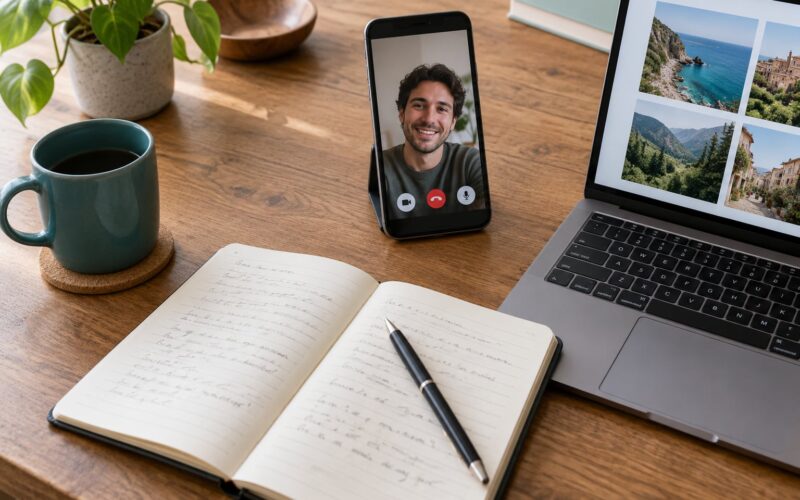
After that, suggest a live video call. Keep it ordinary — a fifteen-minute coffee before you would ever meet in person is a reasonable ask. Here is the useful calibration: one declined call is a personality, three declines with invented excuses is a pattern, and a feed that looks off, barely moves, repeats a phrase or ends when you go quiet is a technical tell rather than a human one. Awkward, quiet or bad lighting is not evidence of anything. Many genuinely shy people hate video.
If the call happens and the person matches the photos, looks comfortable and answers like a person, the video call is the single strongest identity check available. Most romance scams do not survive it, and the ones that do are relying on short clips rather than a conversation.
Search for a Corroborating Online Footprint
Search what they already told you rather than what you suspect. If they said they teach at a specific school, run the school name and the subject. If they said they ran a half marathon, look for the results list.
Cross-reference any handle they share and read the account like a detective: posting history going back years beats a feed created last month, and a private account with no content proves very little. If their claimed city appears on a housing page or a long-standing local business account, that is corroboration worth something.
Stay on the ordinary side of this. Stalking an address, tracking a phone or digging through a partner’s accounts crosses a line, both legally and practically. And remember that a missing footprint is weak evidence: plenty of real adults keep private profiles and no public history at all. Weight what you find, do not treat it as a verdict.
Test the Claim Without Sending Money or Sensitive Information
Verification has safe versions and unsafe versions, and the unsafe ones are popular for a reason.
Safe: suggest a public video call, propose a public venue for a first meeting, ask them to describe something only they would know, use the platform’s own verification feature if one exists, or send a photo of yourself that is harmless if it leaks. Unsafe: sending money in any form, including a gift card and including money for a “delivery fee” or “visa”.
Never share a government ID number, a passport photo, bank or card details, a password, a one-time code, or your home or workplace address. No legitimate interest in you requires any of those. Also hold back intimate images until after you have met, because they are the currency most used to keep a victim paying.
Recognize Emotional Pressure and Scam Requests
There is a clear line between awkward dating and manipulation, and it is not about warmth. It is about control.
Manipulation involves secrecy (do not tell your friends about me), urgency (a flight tonight, an emergency, a limited window), isolation (your family would not understand), guilt or disappointment if you hesitate, tests of loyalty, and any request for money, gift cards, cryptocurrency, or a link you have to open.
Two patterns are worth naming specifically. Love bombing is affection deployed at industrial scale in the first days so that your judgement arrives too late. Pig butchering is the romance scam version where the relationship ends with an offer to invest on a platform that turns out to be a fake exchange, where your deposit appears to grow and then cannot be withdrawn.
One emergency request is the moment to pause everything, not the moment to help. Nobody who has just met you should need your savings. Legitimate organisations do not collect payment in gift cards or crypto.
Stop, Block, and Report When the Pattern Continues
If the checks stack up, do not deliver a verdict to the other person. Confronting a suspected catfish teaches them exactly which detail gave them away, and some of them will simply open another account the same evening. Block, report, and let the platform’s systems handle it.
- Screenshot first. Capture the bio, every photo, the message thread and anything with a name, handle or payment request. Do this before you block, because blocking removes access.
- Block the account. Stop replying. There is no benefit to a final message, and continuing is how time theft turns into financial theft.
- Report inside the app. Use the report control on the profile or thread. Every major platform routes reports to a moderation team that can remove the account and, if money was involved, to law enforcement.
- Report financial losses. In the US, file at ReportFraud.ftc.gov and at ic3.gov for criminal complaints. If money moved, contact your bank or card issuer immediately — recovery is sometimes possible in the first hours, and never later.
- Secure your own accounts. If you shared a password, an ID or financial details, change passwords, enable two-factor authentication, and consider a credit freeze and your national fraud alert if identity documents went out.
You do not need certainty before you block. Uncertain is a perfectly good reason to end a conversation.
Common Mistakes
Calling someone fake over one photo. A slightly filtered face proves nothing, and starting with an accusation gives you a bad ending either way. Correction: judge patterns, not pixels, and keep your doubt to yourself until the evidence is a pattern.
Ignoring small contradictions because the conversation feels warm. Feeling good is not a verification method. Correction: read the messages with the checklist in hand, not with your hopes.
Oversharing early. Work, address, daily schedule and family details handed over in week one give someone material whether they are a scammer or just a creep. Correction: answer personal questions proportionately, and keep the specifics for after a public meeting.
Accepting a private or remote meeting because they travel often. A private address, a car, a hike and a video call that keeps dropping are all ways to keep you from being seen in public. Correction: first meetings happen where staff can see you, and you get there in your own transport.
Trusting phone verification alone. A verified number proves a phone line exists, nothing more. Correction: verification badges confirm a live selfie matched a photo at that moment; they say nothing about character, intentions or who is currently typing. Treat them as a photo filter, not a reference.
Prevention is mostly habit. Investigate before you invest emotionally, keep conversations on the platform until you have met, agree on a check-in plan with someone, and treat any request for money or intimate images as the end of the conversation rather than a hurdle to clear.
Frequently Asked Questions
Does a missing social media account mean a dating profile is fake?
No. Plenty of genuine people keep every account private or use none at all, especially over 50 or after a divorce. Treat social presence as supporting evidence rather than a requirement. What matters more is whether the accounts that do exist line up with the claims in the profile: an older account with real posting history and a face that matches is stronger evidence than a brand new feed full of reposts.
Is a reverse image search really reliable for catching a fake dating profile?
It is one reliable layer, not a verdict. It reliably finds stolen photos, celebrity images and catfish packs reused across accounts. It fails on freshly cropped, flipped or retouched images, and on AI-generated faces that match no existing file. Run more than one engine, search the background separately, and treat no results as neutral rather than as proof that somebody is genuine.
Can someone tell that I looked them up with a reverse image search?
No. Running an image search from your own browser is anonymous. The person whose photo you searched receives no notification, no view and no friend request, and their account shows nothing unusual. Search engines see the request the same way they see any other search. The exception is behaviour rather than tooling: repeatedly liking or commenting on their posts can get your account noticed.
Is refusing a video call proof that a profile is fake?
One refusal is not proof. Introversion, anxiety, bad lighting, a broken camera and dislike of being recorded are all common among honest people. What matters is the pattern: repeated refusals with invented excuses, a call that ends at the first awkward moment, or a video feed that barely moves, looks pixelated or drops when you ask a direct question. Three declines with excuses is where I stop explaining it.
What should I do if I already sent money to someone I met online?
Call your bank or card issuer right away, then report it. In the US, file at ReportFraud.ftc.gov and at ic3.gov, and keep every receipt, screenshot and transaction reference. Speed matters most in the first hours. Do not delete the thread, because it is your evidence. Tell someone you trust, because the follow-up contact from a real criminal is often a second wave of pressure to pay a recovery fee.
How do I report a fake dating profile?
Screenshot the profile and the conversation, block the account, then use the report control inside the app on the profile or the message thread. Platforms forward reports involving payment details to law enforcement. Add a report at ReportFraud.ftc.gov for romance fraud and at ic3.gov for criminal complaints. A short factual report with screenshots moves faster than a long emotional account of the conversation.
Conclusion
Start with consistency: read the profile as a set of claims, inspect the photos for continuity errors and search them, and check whether the answers in the messages hold up under one specific question. Then verify with a live conversation, because that is where impersonation runs out of road.
Never send money or intimate images, and keep personal details for after you have met in public. If the warning signs persist after that, you do not need proof. Screenshot it, block, report, and move on.