What to say in a first message on a dating app comes down to three things: keep it short, anchor it to one real detail from their profile, and finish with something easy to answer. That takes about thirty seconds to write and it is the difference between a chat that goes somewhere and one that never gets opened.
Most matches do not die because someone was not interested. They die because a stranger sent a message that could have been sent to anyone. A photo of a dog gets more replies than a paragraph about how honest and adventurous you are, because the second one asks a reader to do the work of figuring out whether you are talking to them.
Below is a repeatable method, twelve openers you can adapt tonight, and the specific mistakes that get messages filtered before they are ever read. I have used the same three-part formula on my own matches for years, and it is the version that survives contact with real inboxes.
Table of Contents→
- What You Need
- What to Say in a First Message on a Dating App: Step-by-Step
- Common First-Message Mistakes and Quick Fixes
- First-Message Examples by Dating Situation
- Frequently Asked Questions
- Should I use emojis in a first dating-app message?
- How long should I wait before following up if someone does not reply?
- Should my first message mention relationship goals or deal-breakers?
- How can I recover when I accidentally send an awkward first message?
- Should I use the same first message on every dating app?
- Conclusion: Start With One Specific Detail
What You Need
You do not need a clever personality, a thesaurus, or a saved folder of lines. You need one specific thing from their profile and about fifteen seconds of attention.
One specific profile detail. A photo, a prompt answer, a listed hobby, a dog, a job, a city. Specific beats impressive every time. “That dog looks like it has strong opinions” can only have been written about this person. “Great profile” could have been written about four hundred people this week.
A genuine reaction to it. One sentence that shows you looked and have an opinion. It does not have to be a compliment, and honestly it works better when it is not. Reactions can be curious, teasing, sympathetic, or plain amused.
A short prompt that is easy to answer. This is where most people get it wrong. An open-ended question is one that cannot be answered with a single word or a yes or no. “What is your favorite trail?” is a dead end. “What is the last thing that made you laugh out loud?” gets a paragraph.
Write in your own voice. If a line would sound wrong coming out of your mouth at a bar, do not send it. Templates are scaffolding, not a personality, and readers notice when the seams show.
What to Say in a First Message on a Dating App: Step-by-Step
12 first-message ideas you can adapt tonight
Each of these is a structure, not a script. The bracketed part is the only thing you have to change, and you have to change it for it to work at all.
- Travel photo plus a real question. “That cliff trail in your third photo looks brutal. How long did it take you?” Works when someone posts travel shots, because it asks about effort rather than scenery. People like talking about the story behind a photo more than the photo.
- Pet reference. “Is that a rescue? Our [dog/cat] showed up on our porch two years ago and never left, so I respect the commitment.” Works for pet profiles, and the small story about yourself is what keeps it from sounding like a catalogue.
- Food with a preference at stake. “Serious question: is the taco place from your story better than the one you tagged last month?” Works when someone posts food, and a mild debate is far easier to reply to than a compliment.
- Hobby you might share. “You mentioned climbing. I went once, hated every second of it, and would happily go again. What got you into it?” Works for activity profiles, and admitting you are bad at something reads as honest rather than try-hard.
- Self-deprecating humor about their photo. “I have no idea what is happening in photo four, but it looks like a strong night was had.” Works with playful profiles. Keep the joke aimed at the situation, never at how someone looks.
- Shared value, stated plainly. “You put ‘weekend hikes’ in your prompt, and that is basically my love language. Where is your favorite so far this year?” Works when a profile states something about how they live. Naming a shared value early saves both of you weeks of small talk.
- Mutual friend or shared connection. “We have three mutual friends, which either means we have excellent taste in people or a very small friend group.” Works when the app shows shared connections, and it gives them an easy story to confirm or correct.
- Profile gap opener. “Your bio is two lines and both of them are about work, so I am working with very little here. Best guess: you are funny and terrible at texting back?” Works on sparse profiles, and the self-aware framing turns a weakness into a joke instead of a problem.
- Answer their prompt. “Your answer about the worst cooking disaster is hard to beat. Mine involved a smoke alarm and a call to my landlord.” Works on prompt-heavy profiles, which is most of Hinge and Bumble. Responding to the prompt itself is the single most direct reply path available.
- Two-choice question. “Mountains or ocean for a long weekend? I have strong opinions and no follow-through.” Works almost anywhere, and picking between two options takes someone about three seconds to do. People in r/OnlineDating mention this format again and again for exactly that reason.
- Hypothetical scenario. “If you got a free month off tomorrow, would you travel somewhere warm or finally fix the thing you keep meaning to fix?” Works when you want a revealing answer with no pressure attached to it.
- Date seed, low pressure. “There is a dumpling place near me that I keep telling people about. You can hold me to that later.” Works when you can see an actual overlap in plans. A 27-year-old Reddit user described a direct first-message approach with a real plan working, and the key is that the date is a suggestion, not an ultimatum.
Keep the message short and easy to answer
Two or three sentences is the target. Under fifteen words for the first line is stricter than most people think, and it is useful discipline.
The structure is simple: greeting, detail, hook. “Hey” or their name. Then the specific thing you noticed. Then the question or prompt that gives them something to work with.
A long first message works against you in two ways. It signals that you had a lot of time to fill, and it asks the reader to sort your priorities before they have decided they like you. Length also makes it harder to spot the one good line in the middle, and there usually is one good line in the middle.
There is one reliable exception. If the profile is unusually thoughtful and you can match it without performing, a slightly longer message can signal that you read carefully. Two short paragraphs still, no essays, no life story, no list of your accomplishments.
Personalize the detail before you send
Vague and specific sound similar until you put them side by side. “Hey, your profile is really interesting, what are you up to this weekend?” could be sent to anyone and gets read the same way.
“Saturday or Sunday is looking open on my end, and I saw you posted about the farmers market. Which day works better?” That one names a detail, states something about you, and offers a choice instead of an open question. The reply path is obvious.
Making the shift usually takes one extra step: replace a category word with the actual thing. Not “your dog” but “the very serious-looking dog in photo two.” Not “you seem active” but “the 6am trail photo is a choice.” The category is interchangeable; the specific thing is not.
When a profile gives you almost nothing, work with what exists. The usual profile is a handful of photos, a job, and one line of bio, so the photo is often your only real material. Comment on the setting rather than the person: the bar looks packed, that bookshelf is impossible, someone clearly took that photo on a boat. You can also ask rather than assert. “Two prompts and no bio is a bold strategy, what is the one thing you would have written?” is honest about the gap and invites them to fill it.
Avoid making the message feel like an interview
An interview asks a series of closed questions and expects short answers. It feels like work, so it gets answered minimally or not at all.
A closed question: “Do you have any siblings?” A true or false question: “Are you a cat person?” A dead end: “What is your favorite color?” Each of these can be answered in under a second, and a second is not enough to start a conversation.
An open-ended prompt gives them room: “What is the most chaotic thing in your apartment right now?” or “Tell me the story behind the least believable photo.” These invite a real answer with a little personality in it, which is the whole point.
For a casual goal, keep it light and let the story do the work. For a serious relationship goal, you can add a small signal of intent without turning it into a screening form. “Looking for something real” is fine. A paragraph about your five non-negotiables in a first message is not, and it reads as a form to be filled out. For long distance, ask something that establishes whether logistics are even possible, ideally with humor: “Before I plan anything, how far is your nearest airport to me?”
Read the profile and match the energy
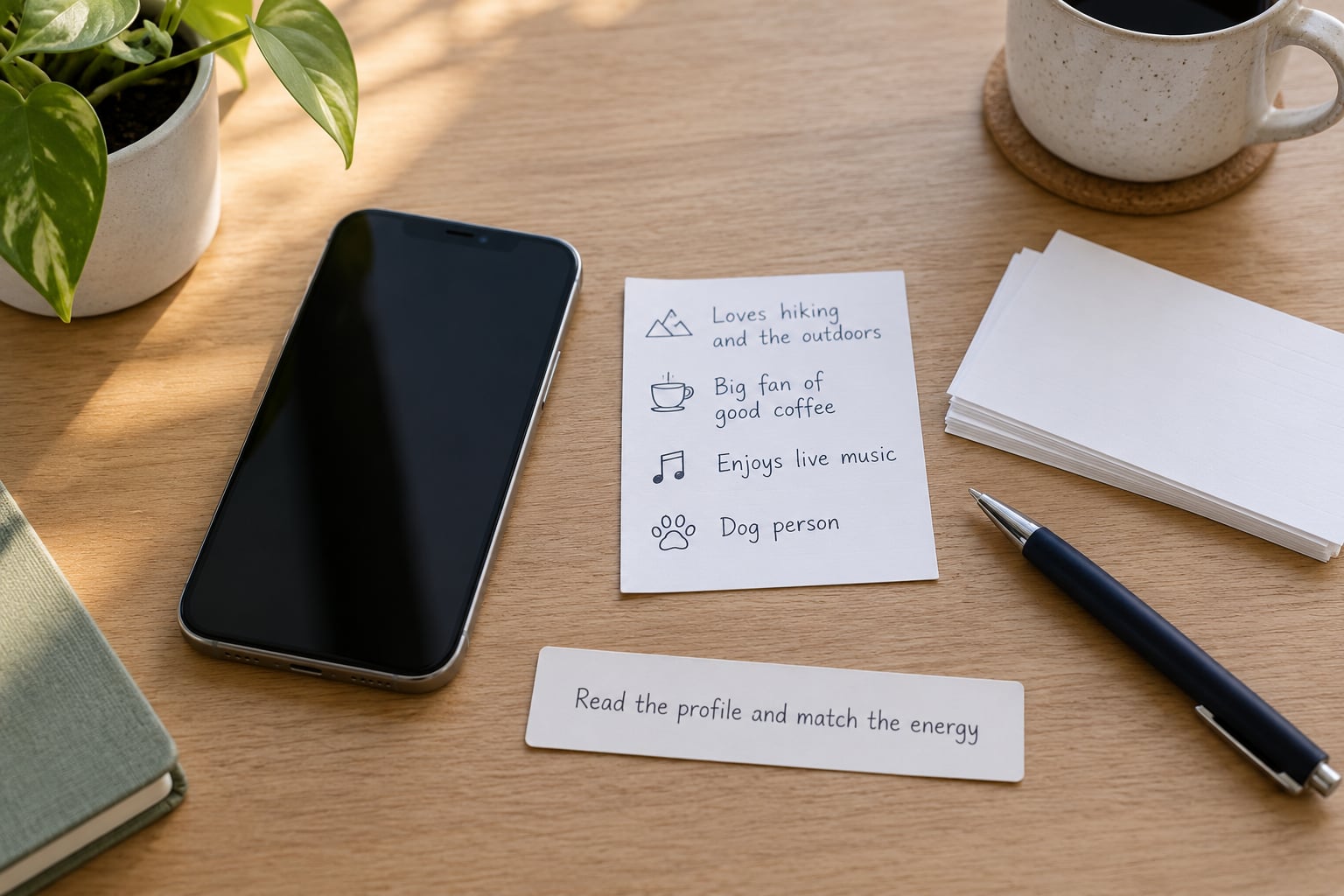
Profiles leak intent, and matching it saves you both a week of wasted messages.
Heavy joke use, playful prompts, and teasing bios mean the person is comfortable with light banter, so you can be funny. Long thoughtful answers about career and family signal someone who wants substance, and a joke as an opener will land flat. Clear relationship-goal prompts mean intent is the first thing on their mind, and answering it is polite. Lots of activity photos and travel tags mean you have plenty of hooks to work with.
For sparse or ambiguous profiles, keep a neutral default: specific detail, warm reaction, easy question. It works with almost anyone and never misreads the room.
One more signal worth noticing is the age range in the room. In r/datingoverthirty, r/datingoverforty and r/datingoverfifty, people repeatedly describe openers built on conversation rather than appearance, and they report that what gets ignored is a compliment with no substance behind it. Referencing something about how someone lives lands better than referencing how they look.
Send it, then assess the response
Run it over once before you hit send. Is there at least one detail that could only apply to this profile? Is there a real question or is it a demand? Would you be comfortable reading it out loud? Did you use their name correctly and not a name you guessed?
Send it while it is fresh. Waiting hours to write to a fresh match mostly signals that you were worried, and the message reads calmer in the first hour anyway. If you are online later, the timing matters far less than the content.
If they reply, follow their lead. Answer the question, add one line about yourself, and hand the conversation back. Keep the ratio roughly even rather than doubling up on yourself.
If they do not reply, you get one follow-up, sent after a few days. Keep it light and add something new, and never reference the silence. “I just remembered, this weekend’s dumpling plan still stands” is fine. “Just checking in” is not, because it asks them to manage your feelings.
One follow-up, no reply means it is over. People in these subreddits describe the same pattern repeatedly: sending three or four messages into an empty thread does nothing but make the profile less likely to be chosen later.
Common First-Message Mistakes and Quick Fixes
Most ignored messages fall into a handful of recognizable categories. Each one has a direct replacement.
1. The generic opener. “Hey,” “Hi there,” “You’re pretty.” Replace with: name plus one detail plus one question. “Hey, that photo of the marathon finish line is brutal, was it as miserable as it looks?”
2. The copy-and-paste line. Same text to fifteen people. Replace with: at least one clause that could not be sent to anyone else. If you can swap the name and have it still read true, you have not personalized anything.
3. The overlong paragraph. Four sentences about your life. Replace with: the best line you wrote, and cut the rest. Most of what people delete from a long opener is filler they added to seem thorough.
4. Compliments about appearance only. Women in r/OnlineDating and r/AskMenAdvice describe these as low effort, and men report that they do not produce replies any more reliably than saying nothing. Replace with: a compliment about a choice, a habit, or something they made or did.
5. Forced jokes. Humor has real variance, and what lands with one person dies with the next. Replace with: dry understatement about the situation rather than a punchline aimed at the person.
6. Questions with no context. “What do you do?” at someone right after they listed their job. Replace with: a question that shows you read it. “How did you end up in that field, was it a plan?”
7. Multiple messages before they answer. A follow-up, then a second follow-up, then a joke to rescue the vibe. Replace with: one message. Silence is information, and it is information you should let stand.
8. Leading with what you want. Asking for their number, a date, or a commitment in message one. Replace with: a conversation opening, and let the ask arrive a few messages later once there is something to ask about.
Before you send, do a fast read for three things: one specific detail, one genuine reaction, one easy prompt. Miss any of the three and the message is not ready, no matter how charming the rest of it is.
First-Message Examples by Dating Situation
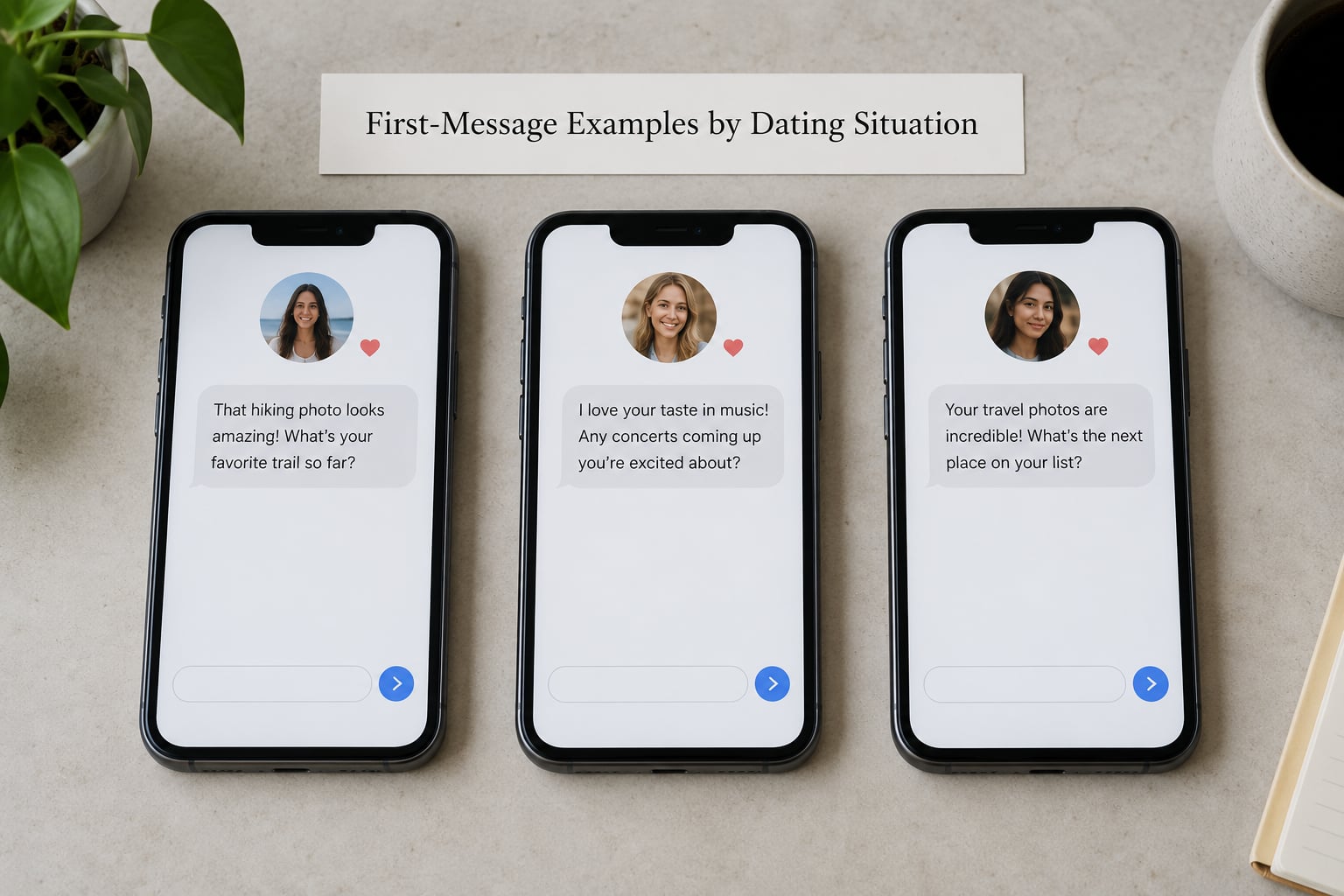
The formula does not change, but the tone does. Here are the same method adjusted for the situations readers ask about most.
Casual dating. “Your bio says you will lose a game of anything, so I have to ask: what is the one thing you actually win at?” Light, competitive, and it invites a story rather than a yes.
Serious relationships. “You mentioned wanting a partner for the long run, and that is exactly where I am. What does a good ordinary Tuesday look like for you?” It answers the intent question and asks something revealing about daily life.
Long distance. “Straight logistics check: what is your time zone, and are you realistically free for a monthly visit? No pressure either way.” Honest, kind, and it saves weeks of chat if it is not going to work.
Same-sex matches. “That photo of you at the show is fantastic. Who were you there to see?” Interests are the fastest common ground, and the question works the same regardless of who you are messaging.
Profiles built around a pet. “Is the dog in every photo the same one? Because the middle one has clearly learned how to work a camera.” Warm, observant, and it gives them room to show off the answer.
Fitness profiles. “You trained for a marathon, I trained for a half and complained the entire time. Was the full one worth it?” Admitting a smaller effort keeps it real instead of competitive.
Food profiles. “The pastry photo is causing me actual distress. What is the one place you would drive an hour for a slice?” Specific and easy, with a built-in story.
Travel profiles. “How many countries was the trip to, and which one would you go back to tomorrow if you could?” Gives them the fun part of answering.
Music profiles. “The vinyl collection is a serious flex. What is playing right now while you are ignoring the rest of us?” Playful without being about appearance.
Sparse profiles. “Two photos and no bio, bold. What is the first thing you would add if you had ten more seconds?” Honest about the gap and hands the floor to them.
Profiles heavy on goals. “Your prompt about the year ahead made me think, so: mine involves a lot more walking than the picture suggests. What is yours?” Matches their seriousness without becoming a résumé exchange.
When you are genuinely unsure. “I have to confess I have no idea what is happening with the canoe, but I respect it. How did that happen?” Curiosity with nothing riding on it, which is the safest of all of these.
Frequently Asked Questions
Should I use emojis in a first dating-app message?
One emoji is fine if it is something you would actually use in a normal conversation. It adds warmth and softens a message that might otherwise read flat. Ten emojis, a row of hearts, or a wink in a serious opener usually reads as nervous or as something you copied from a list. If the profile is full of emoji, matching that level is safe. If it is not, plain text usually lands better.
How long should I wait before following up if someone does not reply?
Give it a few days, then send one short message that adds something new rather than referencing the silence. Mentioning that you waited puts pressure on them to apologize for their own inbox, which is a strange thing to ask. After that second message with no answer, stop. Sending three or four messages into an empty thread does not revive a conversation, and it makes your profile less likely to be chosen later.
Should my first message mention relationship goals or deal-breakers?
Goals, yes, briefly. Saying that you are looking for something serious takes one clause and shows you read the prompt, which respects both of your time. Deal-breakers, no. A first message is for a conversation, not a screening form, and listing what you will not accept makes you sound like a form letter. Deal-breakers come up naturally once you are actually talking, and they are much easier to raise as a question than a rule.
How can I recover when I accidentally send an awkward first message?
Acknowledge it in one line and move on. Saying something like I got a bit nervous, want to start over with a better question works better than pretending nothing happened, and people in r/OnlineDating report exactly this kind of reset saving conversations. Do not write a long apology, do not explain what you meant, and do not send three follow-up messages trying to fix it. One short line and a genuinely better second message is the whole recovery.
Should I use the same first message on every dating app?
The structure can stay the same, because short, specific and easy to answer works everywhere. What changes is what you can reference. Bumble gives you Opening Moves, where you can answer a prompt she wrote, which is a much stronger opener than a bare question. Hinge rewards answering a specific prompt from her profile. Tinder has less to work with, so the photos carry more weight. Change the hook, keep the formula.
Conclusion: Start With One Specific Detail
What to say in a first message on a dating app is simpler than most guides make it sound. One detail from the profile that proves you read it, one honest reaction, one question that is easy to answer. Two or three sentences, written in a voice that sounds like you.
Open your next match, find the single most specific thing on that profile, and write the first line before you have time to overthink it. Then edit it once for anything you could have sent to anyone else.