You know you’re ready to date again when thinking about a new person feels like curiosity rather than relief. Most people wait for a date on the calendar to tell them it’s fine, and most people get it wrong. There’s no magic number of days after a breakup that flips a switch — what actually changes is how you think about the ex, how you spend your evenings, and whether you want company or you need someone to make the quiet stop.
The honest answer takes about ten minutes of honest questions, not a countdown. This guide walks through seven steps you can work through this week, plus the mistakes that make people jump back in too soon and start over with the same result. It’s a 2026 refresh because the advice itself hasn’t changed much, but the pressure to be “back out there” certainly has.
Table of Contents→
- What You Need
- How to Know When You Are Ready to Date Again: Step-by-Step
- 1. Check Your Emotional Distance From the Previous Relationship
- 2. Identify What Has Actually Changed
- 3. Define What You Want This Time
- 4. Reconnect With Your Daily Life
- 5. Test Readiness With Small, Low-Pressure Steps
- 6. Notice Your Reactions During and After Dates
- 7. Decide Whether You Want to Continue, Adjust, or Pause
- Common Mistakes
- Frequently Asked Questions
- Where to Start
What You Need
Before you ask anyone else how to know when you are ready to date again, you need three things in place. None of them require money, a new place, or a certain income, which is good, because those are the false prerequisites that keep people stuck for years.
Enough distance from the previous relationship. Not neutral distance — actual distance. If their voice still rearranges your whole afternoon, or you check their page before you check your email, you don’t have enough yet. Not because something is wrong with you, but because a new person will land in the middle of that weather and you’ll blame them for the forecast.
A real grasp of what ended. Not a courtroom verdict and not a tidy summary. You need to know which part was yours, which part was theirs, and which part was just two people wanting different things. People who reflect on what the relationship taught them, rather than cataloguing what the other person did wrong, tend to feel ready sooner. That pattern shows up again and again in r/BreakUps and r/dating_advice threads.
A willingness to go slowly. The fastest way to feel ready is to stop demanding a fast result. If you can accept a few unremarkable coffee dates where nothing happens, you can handle whatever happens next.
How to Know When You Are Ready to Date Again: Step-by-Step
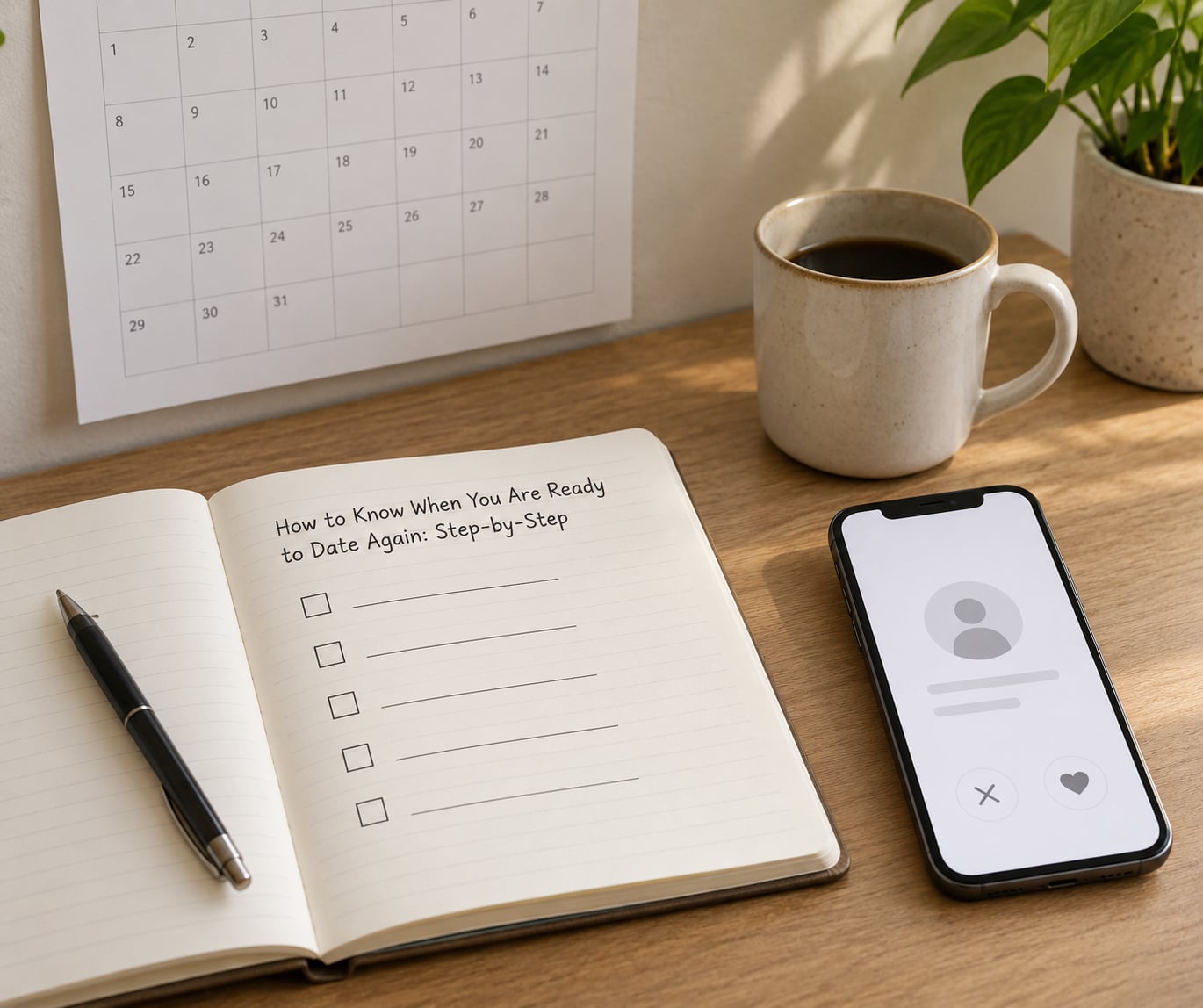
Work through these in order. Each step is a checkpoint, and the point isn’t to pass all seven on the first sitting. It’s to see which ones you’re quietly skipping.
1. Check Your Emotional Distance From the Previous Relationship
The test is boring on purpose: say the ex’s full name out loud, then think about them for ten minutes without steering your mind to something neutral. What happens in your chest? A flicker of annoyance or sadness is normal and human. Feeling like you need to prepare a defence, or like you need them to know you’re okay, means there’s unfinished business.
Watch for the two most common tells. The first is rehearsing conversations you expect to have with them — you’re still dating them in your head. The second is using the idea of a new person to escape a feeling. A therapist’s chair catches this faster than any app does; the Gottman Institute and the Center for Growth and Connection both frame readiness as something you assess internally, not by a calendar.
This sounds like you if: you can hear their name without bracing, and you don’t check their profile for news.
2. Identify What Has Actually Changed
Ask yourself one question: what is different about my life now that wasn’t different eight months ago? Good answers are concrete — the lease ended, the friendship group got tighter, you went back to a hobby you dropped, you learned you don’t want that dynamic again. Bad answers are temporary — Christmas is over, it’s a new year, a new app feels fun, a friend is hosting a party.
Distraction and change feel identical from the inside, which is why this step trips people up. One leaves you slightly more grounded the next day. The other leaves you more tired, because you were never really present in the first place.
This sounds like you if: you can name one change you made for yourself, not one that happened to you.
3. Define What You Want This Time
Plenty of people get stuck because they never decided what they were signing up for. Serious relationship? Companionship on a Sunday? Just someone to see a film with? No idea, and open to finding out? All four are legitimate answers, and they’re mutually exclusive in a way that matters.
The failure mode is going in with a hidden agenda. People who treat “find a partner” as the goal tend to get the worst outcomes, because every interaction turns into an evaluation of a candidate rather than a conversation with a person. Decide what you want, write it down, and let a first date be a small test of fit rather than a verdict on your own attractiveness.
This sounds like you if: you can describe your ideal Saturday six months from now without mentioning another person.
4. Reconnect With Your Daily Life
Your life has to be worth sharing before you can share it. This step is about a week that already works — a routine that fills your time with something other than waiting for a text.
Some examples from people who did this well: a Thursday climbing gym that replaced two evenings of scrolling, a book club that turned into an actual friend group, a standing Sunday call with a sibling, learning to cook three meals properly instead of ordering out. None of it needs a partner’s permission, and all of it makes dating easier because you’re adding to a life rather than escaping one.
The forum consensus is consistent: people who rebuilt a friend-first social life reported the best results. If you don’t currently have three people you could text at 2pm, that’s the thing to fix first — not your profile.
This sounds like you if: cancelling a plan this weekend would annoy you, not devastate you.
5. Test Readiness With Small, Low-Pressure Steps
Don’t leap. Set yourself a small experiment and watch how it feels. Refresh an old profile. Go to the thing a friend invited you to months ago. Say yes to a coffee with someone you’ve met twice. None of these commit you to anything, and all of them give you real data about whether dating feels neutral or loaded.
Pay attention to the afterglow, not the moment. A good first outing leaves you energised or flat, never wired. If you’re buzzing and anxious and checking their profile before you get home, you may be running on adrenaline rather than readiness. If you feel nothing at all, that’s information too — usually it means the connection isn’t there yet, not that you’re broken.
This sounds like you if: you can name one thing you’re looking forward to, and it isn’t a text.
6. Notice Your Reactions During and After Dates
This is where readiness either holds up or folds. Can you stay curious through an awkward silence, or does it turn into a verdict on your personality? Can you disagree with someone without rehearsing a defence? Can you go home afterwards with your evening intact, or does every date require you to cancel something?
Compare every new person to the ghost of your ex and dating becomes exhausting for everyone around you. The comparison is normal early on and worth naming to yourself out loud — “I’m doing it again” breaks the spell faster than willpower does. Boundary-setting gets a test here too: what happens when someone asks for more than you want to give in the first month?
This sounds like you if: you left the date curious about them, not relieved to be home.
7. Decide Whether You Want to Continue, Adjust, or Pause
Here’s the part most articles skip: readiness is a decision you keep making, not a state you reach once. After a few weeks of low-pressure dating you may find you want to keep going, want to slow down and be more specific about what you’re after, or want to take another break. All three are fine, and none of them means you failed.
Pause without shame if dating keeps surfacing old patterns, if your anxiety climbs every time you meet someone new, or if you find you’re attracted to unavailability out of habit. Some people make the healthiest decision of all and simply stay single for a while. That’s a choice, not a failure, and it deserves the same seriousness as putting yourself out there.
This sounds like you if: you can explain, in one sentence, what you’re doing next and why.
Common Mistakes
Using dating to fix loneliness. The correction: wait until you can sit alone through a whole Saturday without reaching for your phone. If you can’t, a new person will fill the gap and you’ll mistake relief for compatibility. People who date as a distraction tend to report the same pattern repeating, which is the clearest evidence that the motivation, not the person, was the problem.
Confusing rebound intensity with connection. Feeling a lot early on feels like chemistry and is often just unfamiliarity plus adrenaline. The correction: check the feeling again after six weeks of ordinary contact, when the novelty has worn off and only the actual person is left.
Idealising your ex. The comparison trap is the most common one I see, and it flattens every new person into a rerun of someone who may not have deserved the rerun. The correction: write down two specific things you genuinely missed. If the list won’t fill a page, you were probably attached to a version of them that existed mostly in your head.
Treating readiness as a milestone. Waiting until you feel “completely healed” is the same as waiting forever, because nobody arrives there. The correction: look for enough, not complete. Enough that the past doesn’t run the show is enough to start.
Letting other people’s timelines run yours. Friends, siblings and new couples all have opinions about your love life, and repeating your schedule to them is exhausting. The correction: tell people once that you’re dating when it feels right, and then don’t justify it again.
One last tip worth stealing from most of the advice in this space: keep a short list of what you want, and read it before every first date. It takes two minutes and it reliably keeps you honest.
Frequently Asked Questions
How long after a breakup should I start dating again?
There is no waiting period that applies to everyone. People report dating again after six weeks, two years, or never, and all of those outcomes can be fine. Use the seven checks above instead of a calendar. If the ex can still rearrange your whole day, take more time. If you want company mainly to stop the quiet, wait. If you’re genuinely curious about who someone new might be, there’s no reason to delay further.
What is the 3-6-9 rule after a breakup?
The 3-6-9 rule suggests your feelings change on a schedule of roughly three months, six months, and nine months after an ending: the sharpest pain tends to soften around three months, life feels more settled around six, and most people report feeling more like themselves by nine. Treat it as a rough map rather than a deadline. Two people who lost the same relationship can be worlds apart at the six-month mark.
What is the 3-3-3 rule for dating?
The 3-3-3 rule comes from the Gottman Institute’s concept of the magic ratio, which looks at how interactions divide into three buckets: positive, negative, and neutral. In dating terms people often adapt it into three three-month phases: three months to notice your patterns, three months to rebuild your routines, three months to see who you actually want to meet. It’s a useful pacing idea, not a test you pass or fail.
What is the 7-7-7 rule?
The 7-7-7 rule is a simple memory exercise: break your last relationship into seven joyful moments, seven hard moments, and seven moments of profound change. Doing it takes about fifteen minutes and it is one of the fastest ways to see whether you can hold the whole relationship at once. If you can only list small joys and small hurts, you may have stopped looking closely a while ago.
Am I ready to date again or just lonely?
Loneliness wants company. Readiness wants connection. Test the difference by checking what you hope a new person does for you. If the honest answer is that they’d make the empty evenings stop, that’s loneliness. If you can name the kind of person you want to meet and why, and you’d be fine if it took months, that’s readiness. Watch the timing too: urgency that spikes right after seeing a friend’s couple photos is usually envy, not readiness.
How do I know if I am over my ex?
You’re not completely over it, and you don’t need to be. A better test is whether you can hold the ex without shrinking. You miss them sometimes and still make plans. You hear their name and feel a pang without needing to win an argument with them. You compare new people less than you used to. What grows in place of over-ness is your own sense of self — the person you are now isn’t only the person who lost something.
Where to Start
Do one thing this week: write the answers to the seven checks on paper, then pick the one with the worst answer and do something small about it. Maybe it’s rebuilding a friendship, maybe it’s deciding what you actually want, maybe it’s telling a well-meaning relative to stop keeping score.
Then choose one low-pressure way to be around people, and go. Your first dates out of a relationship gap are information gathering, not a test of whether you’re attractive, worthy, or over it. Nobody is grading you, and the only person waiting for a verdict is you.