Learning how to meet your partner’s parents for the first time comes down to four things: talk with your partner beforehand, learn a few real details about their family, bring easy questions and honest answers, and treat the evening as a two-way introduction rather than an audition. Most first meetings are genuinely ordinary. The nerves come from the stakes feeling bigger than they usually are.
I have sat on both sides of this table. The version that works best is calm preparation, not perfect performance. Parents pick up on effort and sincerity far more quickly than charm or a fancy outfit, and they are usually just as nervous as you are.
This guide is gender-neutral on purpose. The same advice works whether you are meeting your boyfriend’s parents, your girlfriend’s parents, or a blended family with step-parents in the room. Where family traditions differ, the answer is almost never a rule from a list. It is a five-minute conversation with your partner the week before.
Updated for October 2026.
Table of Contents→
- What You Need
- Step-by-Step: How to Meet Your Partner’s Parents for the First Time
- 1. Talk With Your Partner Before the Meeting
- 2. Learn a Few Things About the Parents
- 3. Choose an Outfit That Fits the Setting
- 4. Prepare Conversation Topics and Questions
- 5. Bring a Small, Thoughtful Gift If Appropriate
- 6. Arrive Early, Be Warm, and Follow Their Lead
- 7. Show Interest in the Relationship, Not Just Your Partner
- 8. End Gracefully and Follow Up
- Common Mistakes
- Frequently Asked Questions
- How soon should I meet my partner’s parents for the first time?
- What should I wear when meeting my partner’s parents?
- Is it a good idea to bring a gift when meeting my partner’s parents?
- What if I get nervous and cannot think of anything to say?
- Should I tell my partner if the first meeting goes badly?
- How long should a first meeting with my partner’s parents last?
- Conclusion
What You Need
You need less than most people expect. No research project, no new wardrobe, no speech prepared. Here is the full preparation list.
- A conversation with your partner. Thirty minutes together, in person or on a call, covering the occasion, the setting, names, family dynamics, and the subjects they would rather you avoided.
- An outfit decided a day ahead. Try it on. If you would not wear it to a casual restaurant with people you like, it is too much or not quite right.
- Three to five details about each parent. Their work, hobbies, a trip they took, a story about your partner as a kid. Enough to start conversations, not a dossier.
- Six or seven easy questions in your head. Safe, open, and answerable without deep personal disclosure.
- One small gift, if a gift fits. Optional in many families, expected in others. Ask your partner which it is.
- A plan for afterward. A twenty-minute debrief with your partner, and a short message or note the next day.
That is the whole kit. If you can do those six things, you are more prepared than the large majority of people walking into a first meeting.
One more thing worth having: a rough time limit. Decide with your partner whether this is a two-hour dinner, an afternoon coffee, or a full evening. Knowing when the visit ends takes a lot of pressure off the last hour, when nerves tend to spike.
Step-by-Step: How to Meet Your Partner’s Parents for the First Time
1. Talk With Your Partner Before the Meeting
Start here, because this conversation removes most of the risk. You want to leave it knowing the occasion, the setting, the boundaries, and the temperature of the family.
Ask things like: Are we coming for dinner or for a longer evening? Do your parents know much about me? What do they do for work and what do they love talking about? Are there health issues, food restrictions, or religious practices I should know about? Have you told them anything specific about me? Is there anything we should not discuss?
Pay special attention to the last one. Almost every awkward moment people report comes from a subject a partner clearly hoped would stay off the table: a divorce, an old argument, money, or a mutual friend nobody likes.
You will know the conversation worked when you could both describe the evening without disagreeing about the plan. If you are still unsure after twenty minutes, ask one more direct question rather than guessing.
2. Learn a Few Things About the Parents
The single most repeated piece of advice in online discussions is the same: ask your partner for family intel before you go. Names, jobs, hobbies, and topics to avoid.
Pick two or three items per parent that you can ask about without sounding like you read a file. A retirement project, a season of football they follow, a trip abroad, a dog they are fond of. A memory your partner has already shared about them is even better, because you can follow up naturally.
Keep the research shallow. Two real details will carry a two-hour dinner. Twenty facts will make you sound like a detective and the conversation will stiffen.
3. Choose an Outfit That Fits the Setting
Dress one notch above what the hosts are wearing, and no more. If they are in jeans and a t-shirt, you want a clean shirt and chinos. If it is a more formal family occasion, match the formality you see coming out of your partner’s wardrobe on a holiday.
- Choose clean, ironed clothes that fit well. Avoid anything you have never worn in front of anyone.
- Choose solid or subtle patterns. Avoid large logos and loud graphics.
- Choose closed-toe shoes you can walk in. Avoid brand new shoes you are still breaking in.
- Choose one small detail you enjoy. Avoid heavy cologne or strong fragrance.
- Choose breathable fabrics. Avoid stain-prone colours and all white.
Two practical notes. Leave any outfit with ripped knees, worn-through elbows, or visible logos at home, because parents notice these far more than you expect. And check the weather: arriving damp or visibly cold is a bad first impression in a way that has nothing to do with your personality.
Comfort matters more than style here. If you cannot relax in what you are wearing, you will spend the evening tugging at it instead of listening.
4. Prepare Conversation Topics and Questions
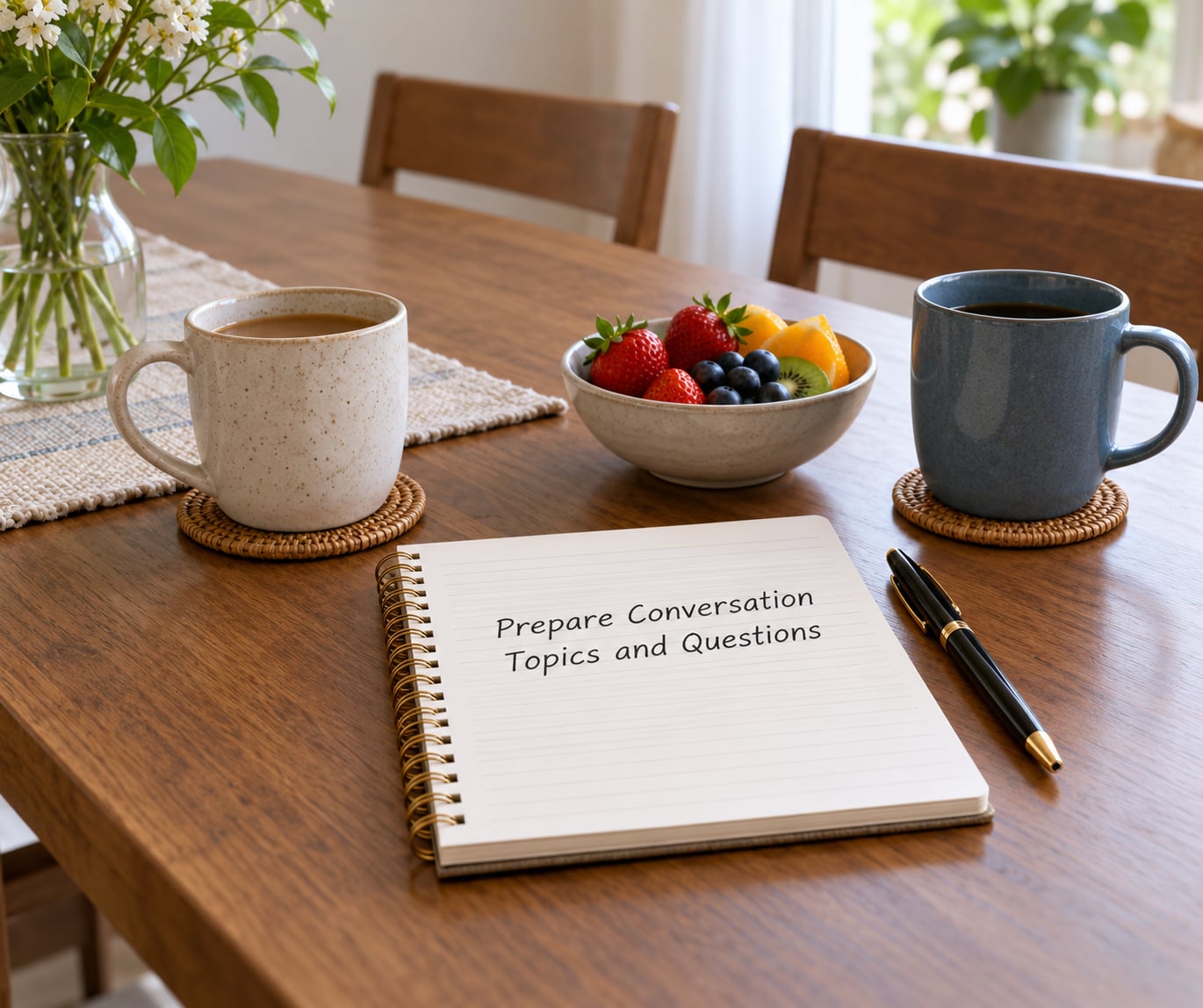
Good questions are open, easy to answer, and let the other person talk about themselves. A question that begins with what, where, or which usually beats one that begins with do you.
Try a handful of these:
- What have you two been up to lately?
- What is something in this area you would tell a visitor to see?
- What did you do before this job?
- What is a meal you would cook for someone you wanted to impress?
- What are you both looking forward to this year?
- How did you two meet?
- What were [partner’s name] like at this age?
- What do you usually do on a Sunday when nobody needs anything?
The childhood question is quietly the best one on this list. Parents love talking about their kids, and it gives your partner a natural place to join in.
Add three backup topics for a quiet moment: what is everyone reading, what podcasts or shows are worth a look, and where do they go when they want a good meal nearby. Having somewhere to go when a silence lands removes the pressure to fill every second.
The skill is listening, not delivering. Most people who remember a first meeting warmly were not the funniest person in the room. They were the one who asked a follow-up question and waited for the real answer.
5. Bring a Small, Thoughtful Gift If Appropriate
Ask your partner whether a gift is expected, because customs differ widely. In many families a gift is unnecessary and slightly odd; in others showing up empty-handed reads as an oversight.
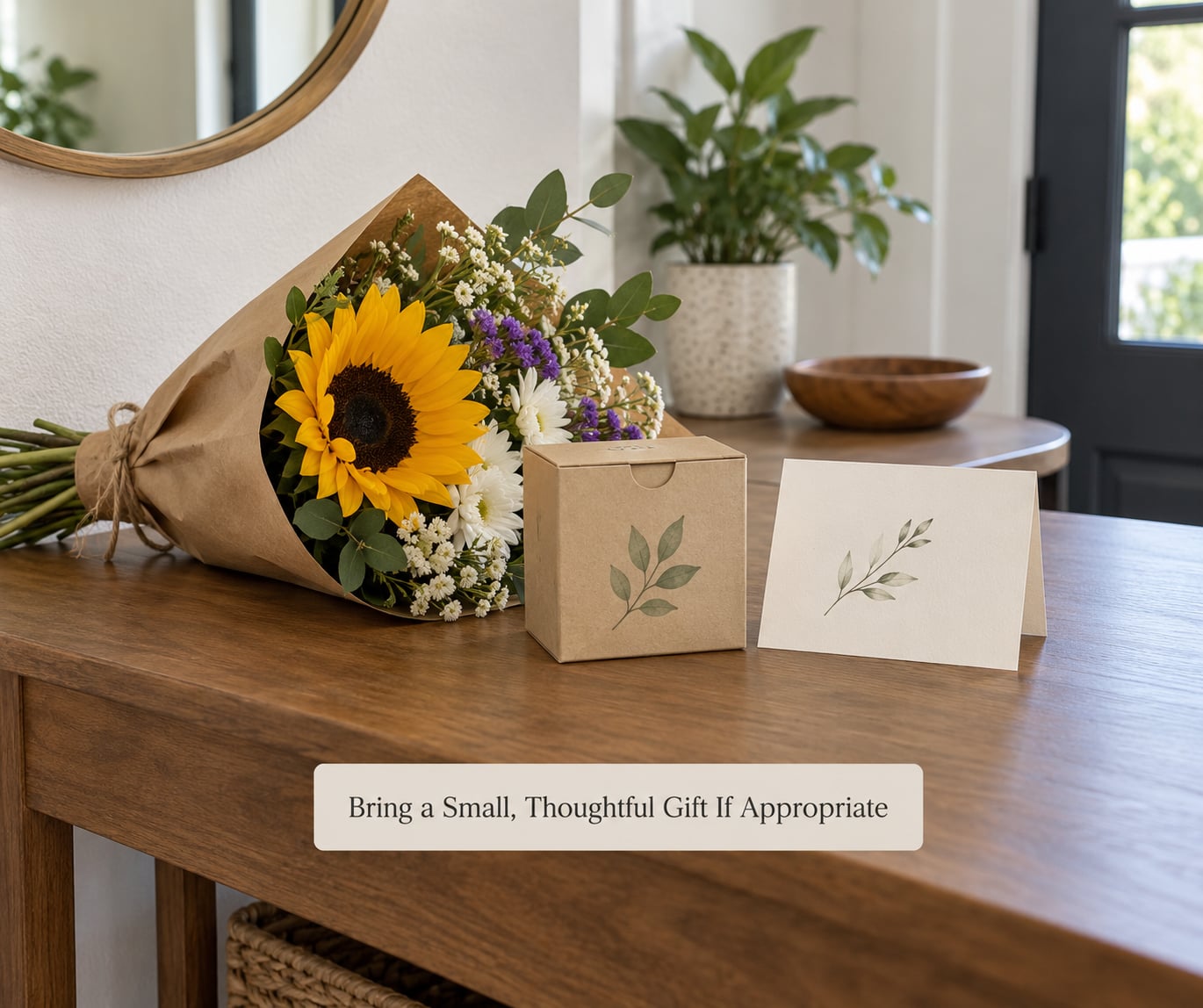
When a gift fits, keep it modest. Flowers for the parent who loves the garden, a good box of tea or coffee, chocolates, a bottle of wine if they drink, or something tied to a hobby you heard about. A handwritten card saying thank you for having me does more work than anything expensive.
Avoid anything that creates an obligation to reciprocate, anything large, and anything personal enough to be presumptuous. A gift should open a door, not imply expectations.
If they wave it off or seem awkward, let them. Say thank you for having me, then move on without insisting. Half the anxiety people report about gifts is about the moment of giving, not the gift itself.
6. Arrive Early, Be Warm, and Follow Their Lead
Aim to arrive about ten minutes early, not thirty. Early enough to show you are not flustered, late enough that you are not hovering in someone’s kitchen before the potatoes are done.
Let the parents choose the greeting. Some households hug, some shake hands, and some expect a light handshake plus a shoulder touch. If you are unsure, a smile with your hand half-raised gets the right answer every time. Mirror what they do and you cannot get this wrong.
Names are a real sore point for people. Ask your partner what to call them. In many families the polite default is the full name plus a title on arrival, then first names once they invite it. Others never use titles at all. Using first names when they expected a title is mildly awkward; the reverse is worse, so err toward formality and let them correct you.
Other basics that hold up: phone on silent and out of sight, shoes off if you see a row by the door, a short thank-you at the door, and an offer to help with whatever is happening in the kitchen even if you are told not to. Accept food and drink when offered even if you are not hungry. Say yes first and manage it quietly afterward.
Match the room’s energy. Talkative hosts want conversation; reserved hosts often relax once someone asks them a direct question about their life. Quiet is not rejection. Several people in online threads said their terrifying first meeting turned out fine simply because the hosts were as nervous as they were.
7. Show Interest in the Relationship, Not Just Your Partner
You are meeting two people who spent twenty-five years raising the person you care about. Treat them as people with full lives, not as a checklist to clear.
Ask follow-up questions. When someone mentions a garden, a job change, or a grandchild, stay on it for two more minutes. That is where a first meeting turns into a connection rather than an interview.
Give both parents equal attention. Spending the whole evening talking to one of them is one of the most common mistakes, and it reads as rude rather than nervous. Split the conversation, and include each parent in the same threads.
Never compare. Do not say their child used to do this, or that your own parents do that, or anything that puts two households in a ranking. It is funny in a group of friends and insulting at a dinner table.
On hard questions, be honest and unhurried. When someone asks what your intentions are, say what is true now without inventing a timeline: I care about [name] and I am not going anywhere. When they ask about marriage or children, it is fair to say it is early and you want things to keep moving at a pace that works for both of you. You are allowed to buy time with a question back: I would love to hear what you were hoping for at this stage.
If a question is unfair or hostile, do not get defensive. Answer briefly, then turn to something else. Staying calm reads as confidence, and confidence is what most nervous readers are actually trying to fake.
8. End Gracefully and Follow Up
Do not leave so early it feels like a raid, and do not outstay your welcome. Two to three hours for a dinner is usually right, and around ninety minutes works well for a first coffee. Watch for the signals: an offer to bring dessert, a glance at the time, dishes starting in the sink.
Before you go, thank both parents specifically rather than generically. Thank you for the meal, thank you for letting me hear about the garden, thank you for making me feel welcome. Specific thanks sticks; a flat thanks does not.
In the car, talk it through with your partner straight away, while it is fresh. What landed, what felt odd, what you would say differently. Do not do this in front of the parents.
Then follow up the next day with a short message or a handwritten note. Two or three sentences is plenty: thank you for dinner, mention one thing you talked about, and say you would like to do it again soon. A reply that is warm and quick tells you both that you passed. Silence or a one-word answer is information, and your partner deserves to hear how you read it.
Common Mistakes
Almost every bad first meeting comes from one of a handful of predictable errors.
Overpreparing. Memorized answers, a rehearsed speech, a personality that is not yours. Parents have met people like you before, and they find them tiring. Fix: prepare topics, not lines. The recurring advice on r/LifeAdvice and r/Advice is consistent on this point — just be yourself, which is easier to do if you have stopped trying to be someone else.
Getting defensive about a hard question. A clipped answer turns curiosity into a fight. Fix: answer in one or two sentences, warmly, then ask something back. If you genuinely need a moment, say you would rather talk about it another time and mean it kindly.
Raising relationship business. Do not bring up moving in, money, wedding timelines, or a difficult patch you had last month. The first meeting is not the venue. Fix: agree in advance with your partner on a topic boundary, and hold to it.
Focusing on one parent. Fix: every twenty minutes, ask the other one a question. Put your phone away so your attention goes where you aim it.
Arriving late or overstaying. Ten minutes early, then leave when the evening naturally closes. If you are unsure, your partner can signal it.
Talking through the whole visit. Nervous people often fill every gap. Fix: aim for a two-to-one ratio where they talk twice as much as you do.
Bringing an expensive gift. It changes the temperature of the evening and can feel like a bid for approval. Fix: modest, useful, easy to accept.
Wearing something borrowed-from-a-different-life. A suit to a casual dinner reads as trying too hard. Fix: one notch above the hosts, nothing more.
Now the part almost no guide covers: what if it goes badly, or they do not like you?
Watch for the early signs. Repeated short answers, no follow-up questions, one parent talking and the other silent, everyone checking their phone, a question about your income that sounds like a verdict. If you see two or three of these, they are already there.
What helps: slow down and ask better questions, address both parents, and stop trying to be liked. Warmth aimed at the person who is warming up to you gives them something to work with. If the evening is winding toward a disaster, an early and polite exit beats a bad performance: I do not want to take more of your evening, but thank you for having me.
Then talk to your partner without rehearsing a verdict. One difficult dinner is a bad dinner, not a verdict on the relationship. People describe disapproval that faded within weeks far more often than permanent rejection, and a large share of first meetings that felt terrible were reported later as completely fine.
If your partner’s family has a different religion, culture, or structure, ask your partner what the visit looks like at home in their family before you assume yours is the norm. On r/DesiWeddings, meeting the family is described as a staged process with several meetings, not one dinner, and knowing that in advance changes the whole approach.
A few calm-meeting tips that help more than anything else you can prepare:
- Arrive with one question ready and your phone silent.
- Accept the first drink or plate even if you barely want it.
- Keep your hands visible and uncrossed; open posture reads as comfort.
- Ask your partner’s parents what they would advise for someone new in your situation.
- Have one honest sentence about your own life ready, and change the subject if it turns into a lecture.
And one mindset worth taking seriously: you are evaluating them too. Notice whether they are kind to you and to each other, whether they let your partner speak, and whether they are curious or hunting for flaws. People who find their partner’s family warm and welcoming are often the ones whose partner says the same about them afterwards.
Frequently Asked Questions
How soon should I meet my partner’s parents for the first time?
Most couples land somewhere between a few months and a year in, and no rule decides it. Meet them when your relationship is stable, when you can be yourself around each other, and when you can handle their possible disapproval without falling apart. Meeting too early puts pressure on a relationship that has not formed its own footing yet.
What should I wear when meeting my partner’s parents?
Dress one notch above what the hosts are wearing. For a casual dinner that means a clean shirt, chinos or dark jeans, and closed shoes. For a formal family occasion, match the formality you would wear for a wedding. Skip anything with holes, large logos, or a brand new fit you have not worn before, and choose something you can relax in.
Is it a good idea to bring a gift when meeting my partner’s parents?
Ask your partner first, because expectations differ by family. When a gift fits, keep it modest: flowers, a good box of tea or coffee, chocolates, or a bottle of wine if they drink. Add a short handwritten card. Avoid anything large or expensive, since an extravagant gift changes the mood of the evening and can feel like an attempt to buy approval.
What if I get nervous and cannot think of anything to say?
Nerves fade once someone answers your first question, so stop worrying about the whole evening and prepare for the first two minutes. Ask about their week, their work, a trip, or what your partner was like as a kid. Then follow up on the answer instead of launching the next question. Silence is only awkward if both people try to escape it.
Should I tell my partner if the first meeting goes badly?
Yes, and do it soon rather than after a day of guessing. Debrief in the car or as soon as you are home, while the details are clear. Try to describe what you observed rather than what you concluded: they barely asked me anything, or your dad did most of the talking. Your partner often knows the dynamic better than you do.
How long should a first meeting with my partner’s parents last?
Two to three hours works well for a dinner, and around ninety minutes is plenty for a first coffee or an outing. There is no perfect duration, and going much longer than the invitation implies creates pressure. Agree on a rough end time with your partner beforehand so neither of you is left wondering when it is appropriate to go.
Conclusion
Here is what to do first, in order. Have the conversation with your partner about the plan and the boundaries. Learn two or three real details about each parent. Pick an outfit a day ahead and try it on. Bring six easy questions and one modest gift if the family expects one. Arrive ten minutes early, ask about their life, listen to the answer, and give both parents equal attention.
Then thank them specifically before you leave, message them the next day, and tell your partner honestly how it felt while it is still fresh.
That is the whole job. You are not auditioning for a family you may end up spending decades around. You are two sets of people getting to know each other, and the nerves are simply what caring about the outcome feels like before you know how it turns out.