Talking about marriage without pressure comes down to one move: say what you want for yourself, ask one open question, then stop talking. Pressure does not come from honesty, it comes from ultimatums, deadlines, guilt, comparisons and hints. Take those out and the same conversation becomes two people comparing long-term vision instead of one person waiting for a yes.
Most couples who get this wrong are not being aggressive. They are being unclear about whose timeline it is. When you say we should talk about getting married, your partner hears a demand wearing a hat. When you say marriage is something I want in my life, and I am curious where you land, the pressure drops out of the room. Below is the whole process, with the exact words to say at each step, plus the answers for the two hardest cases: not yet, and never.
Table of Contents→
- What You Need
- Step-by-Step: How to Talk About Marriage Without Pressure
- Common Mistakes That Make It Worse
- Frequently Asked Questions
- What if my partner does not want to talk about marriage?
- How do I bring up marriage without sounding pushy?
- What if my partner wants to wait and I am ready sooner?
- How should I respond if my partner is unsure about marriage?
- Is it okay to discuss a marriage timeline early in a relationship?
- How can we handle family or social pressure about getting married?
- Conclusion
What You Need

You need four things before the conversation, and none of them are courage. You need a reason, some time, a private place, and a boundary you are willing to hold without demanding a matching date.
A reason worth saying out loud
Decide whether you are raising this to clear up expectations, to understand your partner’s view, or to talk about a possible timeline. Those are three different conversations, and mixing them is where most of the pressure sneaks in. A question about views is genuinely neutral. A timeline conversation is not, and pretending otherwise is the thing that erodes trust later.
Enough time and a private room
Thirty unhurried minutes beats a ten-minute talk in a car. You also need both people rested, fed, and not already mid-argument. A conversation that starts with an unresolved fight does not get to the real topic; it just gets a new audience for the old one.
A line you will not cross this week
Decide what you are not asking for. Not a proposal, not a date, not an answer on the spot. Having that limit in your head is what stops you filling silence with escalating language. It is also the honest framing to say out loud: this is not an ultimatum, and I am not asking for an answer tonight.
Step-by-Step: How to Talk About Marriage Without Pressure
1. Check Your Reasons and Readiness
Start with yourself, because most pressure is aimed outward when it should be aimed inward. Write down what you want and why, in two sentences. If the second sentence contains everyone is getting married, my parents, my age, or we are wasting time, you are carrying a borrowed timeline, and borrowed timelines are the ones people hear as demands.
Also check how you will handle a no. If a not yet would genuinely wreck the week, say so to yourself now, not out loud. Guilt that leaks mid-conversation is the pressure you were trying to avoid.
2. Choose the Right Time and Setting
Pick a moment with no event on the horizon, no argument in the last hour, and no audience. A walk works well because there is no eye contact pressure and no screen to hide behind. A car works. A kitchen at 9pm on a weeknight when the kids are asleep works better than most people expect.
Bad timing looks like: during a disagreement, in the week after a family visit, while either of you is under deadline pressure at work, right after a pregnancy or a job loss, or in the middle of wedding-planning logistics that one of you is already enjoying. Raise the topic when nothing else is moving.
3. Open the Conversation Without Demanding an Answer
Use an opener that asks permission before it asks a question. Permission-taking removes the ambush feeling, and it costs you nothing if the answer is not tonight.
- Permission to ask. Can I ask you something about our long-term plans? No wrong answer, and no pressure to have one today.
- Curiosity about their picture. What does your ideal life look like at forty? I want to understand how you see it.
- Sharing without a claim. Marriage is something I want in my life, and I am not asking you to agree with me. I just did not want to go around carrying it alone.
- Test the water first. How do you feel when our families ask us about wedding dates? This one is gentle because it starts with them rather than with you.
Notice what is missing: no date, no we need to, no complaint about how long they have taken. On r/askwomenadvice, the advice that keeps coming back is exactly this shape — explain when you would like to be married, then ask for their feelings without demanding a matching timeline. It is in r/Waiting_To_Wed too, a whole community built around the stalled-timeline problem, where the fix is still a direct conversation rather than more hints.
4. Ask, Share, and Listen
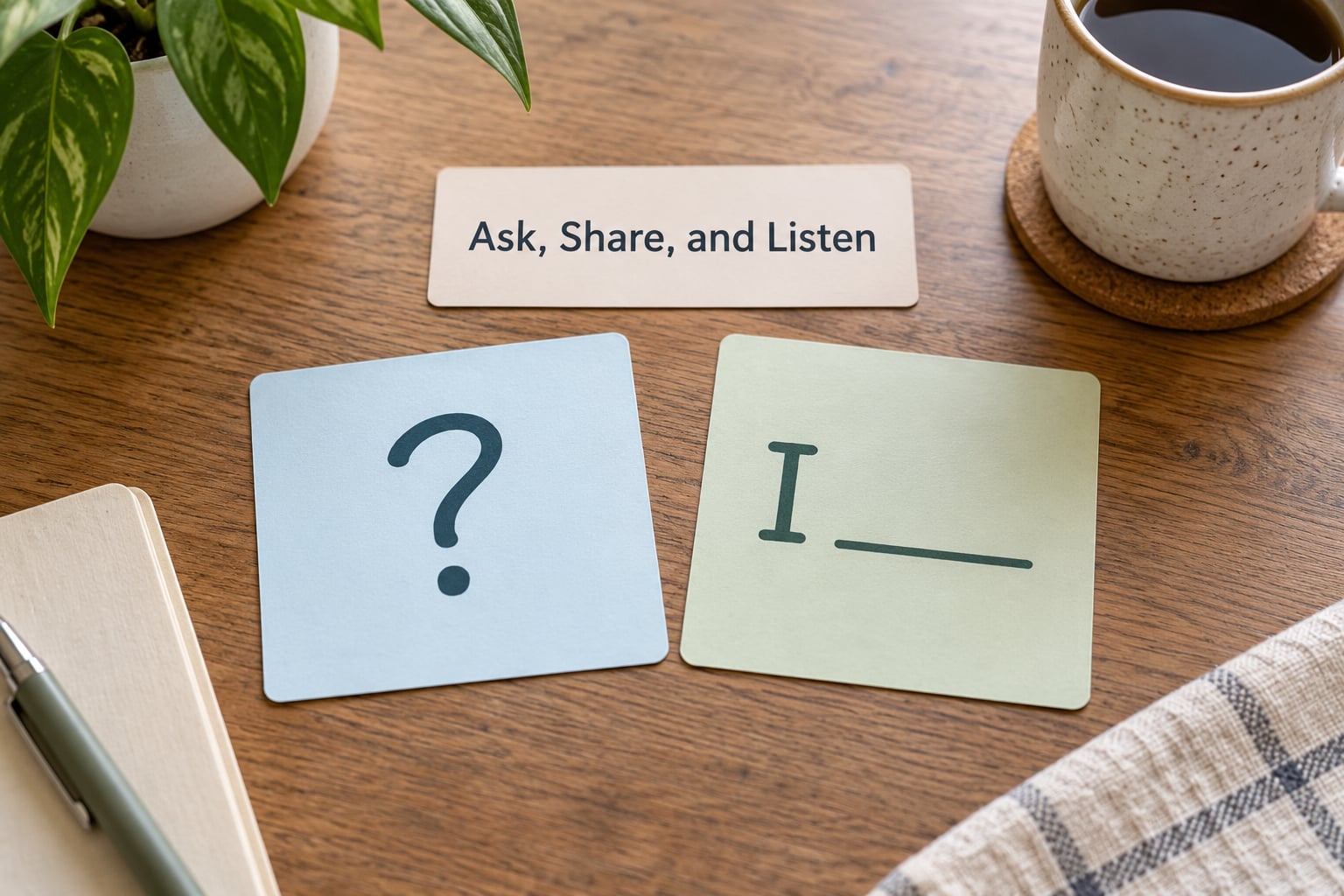
Once the topic is open, switch to open-ended questions and I-statements, then actually be quiet. The mechanics are simple and they are the whole ballgame. Ask something the answer to which cannot be one word. Say what you feel using I, not what you accuse using you. Summarise what you heard before you reply to it, and do not skip the summarising.
The single most useful habit is mirroring: so what I am hearing is that the money feels less settled than it did a year ago, and that is the piece you want to be steady on before anything else moves. People relax when they feel accurately understood, and they rarely get that from a partner mid-argument.
Here is the swap list. Every rephrase on the right removes a deadline, a comparison or an accusation, which is where pressure actually lives.
- Instead of: So when are you going to propose? Try: I am ready to talk about where we are headed. Do you have a sense of your own timing?
- Instead of: After everything we have been through? Try: I know the last year has been hard, and I want a future with you. Where are your thoughts?
- Instead of: Our families would be so happy. Try: My family is asking again. I would rather we decided than answered them.
- Instead of: Do you even want to marry me? Try: How do you feel about getting married, genuinely, no need to dress it up?
- Instead of: You never want to settle down. Try: I notice the last few dates we talked about the future, we drifted. I would like to talk about it on purpose.
- Instead of: If you loved me you would want this. Try: Marriage matters to me. I can hear that it is a harder yes for you than for me.
- Instead of: I have waited long enough. Try: I have been carrying a lot of hope about this. I would like you to know that, and I would rather not keep guessing.
- Instead of: We are getting old. Try: I have started to think about the next decade and I want to hear what you see there.
When you get an answer you did not want, resist the negotiation reflex. You do not have to solve it in the same conversation. Thank you for telling me. I am not going to argue you out of it, and I am not going to pretend I feel fine about it either. Can I come back to this in a month? That sentence does more for the relationship than any argument you could win, because it proves you can hold your own feeling without making it their job to fix.
5. Agree on a Next Step, or a Pause
Close with something small and specific. Options worth using: a date on the calendar for a proper conversation, a shared list of the topics you each want covered, a promise to revisit a specific question, a premarital counselling session booked together, or an explicit agreement to take two months and come back to it.
A pause is a real answer, not a brush-off, as long as it has a shape. Let us put this aside until the end of the quarter, and I will bring it up again then even if nothing has changed. What drains people is the endless open loop, not the waiting itself.
Then keep the cadence light. Fifteen minutes every few weeks about how you are both doing, no agenda, keeps the future a shared topic instead of a loaded one. A relationship where the future only comes up when someone raises marriage is a relationship where the future has quietly become a complaint.
Common Mistakes That Make It Worse
Most painful marriage conversations are not a disagreement about marriage. They are a disagreement about technique. Seven moves account for nearly all of it.
Pressure disguised as honesty. I just need to be honest with you often precedes an accusation rather than a feeling. Say the feeling first, then the question.
The ultimatum dressed as clarity. Propose by Christmas or we are done converts a preference into a condition, and no conversation survives that. If you genuinely have a limit, it deserves its own conversation, with time to be heard, not a deadline dropped into an evening out.
Equating marriage with commitment. Plenty of committed couples have no plans to marry, and plenty of marriages have been proposed on impulse. Ask what marriage means to your partner rather than treating it as a proxy for whether they are in.
Dredging up old promises. You said three years ago that you would marry me guarantees a fight about the past and avoids the present question. Old quotes are not evidence about a person today.
Interrupting to solve. The moment you start advising, mid-sentence, listening stops and the partner learns to stop giving you real information. Wait until they finish, then ask one clarifying question before you offer anything.
Turning it into a contest. If the talk has become about who is more committed, who is more ready, or who compromised more last summer, you have left the marriage question and entered a scoreboard. Say so and change the subject: can we get back to the actual question, which is what we both want?
Hints, public hints, and the wedding venue site left open on the laptop. Once your partner picks up the subtext, every future conversation reads as a campaign. That is the point where you owe a repair.
For readers who have already been there, repair comes before more talking. Acknowledging it works faster than pushing through it, which is the consistent finding in forum threads. You can say: I have realised I have been putting pressure on you about this, and I hear that it has made you shut down rather than open up. I am sorry. I still want to talk about the future, but not from that place. Can we start again? Naming the pattern is uncomfortable and it is usually the fastest way back in.
One distinction is worth keeping close. Not ready yet points at a time, a circumstance or a fear that may change: money, a bad previous marriage, a parent illness, a sense of not having finished growing up. Not willing points at the idea itself. The difference matters because the first responds to patience and information, and the second does not. You can only tell them apart over time and through honest questions, not in one conversation, and the process r/Waiting_To_Wed describes at length is exactly this slow sorting.
Family and friends sit outside the relationship, and they need their own conversation. MumsNet threads show how much of the pressure lands on women specifically, and how rarely anyone hands them language for the dinner table. Short scripts help: we are not engaged yet, and we would rather not have a date announced for us, or yes, eventually, and no, I am not taking questions on it. Agree in advance on one line you both say, so neither of you is improvising in front of an aunt.
And when the same wall appears three conversations in a row, consider a third party. A couples counsellor or a premarital session is not an admission of failure; it is a faster route through the bit where both of you are too close to see the pattern.
Frequently Asked Questions
What if my partner does not want to talk about marriage?
Ask permission first and keep the ask small: can I tell you what marriage means to me, and you can tell me to save it for later. If they still shut down, stop repeating the topic and change what you are asking for. Ask why it is hard to discuss, not when it will happen. A partner who will not open up usually has a reason, and it is rarely that they have never considered it.
How do I bring up marriage without sounding pushy?
Separate your timeline from their speed. Say that marriage is something you want for yourself, name roughly when, and then ask for their feelings without requesting a matching date. Drop ultimatums, comparisons and hints entirely, because that is what pushy sounds like from the other side. If you find yourself waiting for a specific outcome, wait less.
What if my partner wants to wait and I am ready sooner?
Mismatched timelines are common and rarely fixable by repeating yourself. Ask what the waiting is about, because the answer is usually a real concern like money, a past divorce or unfinished goals. Then decide for yourself how much longer you want to carry it. Name a horizon for yourself, tell them what you will do at the end of it, and leave the ultimatum out of the room.
How should I respond if my partner is unsure about marriage?
Thank them for telling you, do not argue, and do not perform being fine. Say that you are not going to pressure them and that you are not pretending the answer is easy either. Then ask one gentle question about what would need to be true for the uncertainty to shrink. Unsure is worth patience. Unwilling is a different conversation entirely, and you can only tell them apart over time.
Is it okay to discuss a marriage timeline early in a relationship?
Yes, provided you are sharing a timeline rather than extracting a promise. Early on, curiosity lands better than pressure because there is less history to read it against. Phrase it as a long-range question about the next five or ten years. If your partner reacts as though you are rushing them, you can accept that signal without treating it as a setback.
How can we handle family or social pressure about getting married?
Deal with it as its own conversation, not as a reason to push your partner. Agree on one short line you will both use, something like we are not engaged yet and we would rather set our own dates. Decide in advance who answers which relative. After that, redirect them to the relationship generally rather than the wedding date, which is usually what they actually want.
Conclusion
Start with the smallest version of this conversation. Pick a calm evening with nothing else scheduled, say why marriage matters to you in one sentence, ask one open question, and then let the silence do its work. That is the whole method — own your timeline, ask with curiosity, and refuse to attach a deadline to their answer.
What you do not do this week is just as important: no ultimatums, no hints, no comparing your relationship to anyone else’s. If you have already been applying pressure, open with the apology rather than another ask. And if the same wall is there after three honest tries, a counsellor will get you further in one hour than another year of hints.