
Questions to ask before getting engaged are the money, children, family, and communication prompts couples work through before a proposal, so the hard disagreements show up while they are still cheap to fix. Twelve of them cover nearly everything that causes trouble later, and none of them need a workbook or a weekend of forced honesty.
Most couples already know the romantic part. What they skip is the logistical part, because money, children, in-laws, and conflict feel too heavy for a picnic table. Then the topic resurfaces at two in the morning in year three, with a mortgage attached.
The format matters as much as the content. Pick one topic, set aside an hour when neither of you is exhausted, and take notes if you want them. Twelve questions crammed into a single evening reads like an interrogation and produces short, dishonest answers. Last updated October 2026.
Table of Contents→
- Questions to Ask Before Getting Engaged at a Glance
- 1. Are We Equally Committed to Marriage?
- 2. Do We Want the Same Kind of Marriage?
- 3. How Do We Handle Money Differently?
- 4. Do We Agree on Children and Parenting?
- 5. What Does a Healthy Relationship Look Like to Each of Us?
- 6. How Will We Handle Disagreements?
- 7. What Do We Each Need From Our Families?
- 8. How Will We Support Each Other’s Careers and Ambitions?
- 9. Are Our Expectations for Intimacy Aligned?
- 10. What Happens If One of Us Gets Sick or Needs Care?
- 11. Have We Discussed the Boring but Important Logistics?
- 12. Are We Both Choosing This Relationship for the Right Reasons?
- Frequently Asked Questions
- How long should we wait to get engaged after asking these questions?
- Should we speak with a relationship counselor before getting engaged?
- What if my partner refuses to answer one of these important questions?
- How do we discuss engagement concerns that are still unresolved?
- Is it normal to feel unsure about getting engaged after a long relationship?
- A Simple Final Check Before You Say Yes
Questions to Ask Before Getting Engaged at a Glance
The twelve questions below fall into five groups. There is no order, but there is a logic: start with the ones where a mismatch would actually change your future, and save the logistics for last.
| Group | Question | What it settles | A concerning answer sounds like |
|---|---|---|---|
| Values | 1. Are we equally committed to marriage? | Whether both people are choosing this freely | “I guess I’m ready whenever you are.” |
| Values | 2. Do we want the same kind of marriage? | Ceremony, roles, religion, time together | “We’ll figure it out after the wedding.” |
| Values | 12. Are we choosing this for the right reasons? | Motivation behind the decision | Anything involving a pregnancy, a deadline, or family pressure |
| Money | 3. How do we handle money differently? | Income, debt, saving, spending, prenups | “Don’t worry about it, it’s nothing.” |
| Money | 11. Have we discussed the boring logistics? | Chores, accounts, passwords, subscriptions, pets | “You just do it your way and I’ll do mine.” |
| Children | 4. Do we agree on children and parenting? | Whether, how many, when, who raises them | “I never want kids, but I’d change my mind for you.” |
| Children | 10. What if one of us gets sick? | Insurance, caregiving, medical decisions | “It’ll never come to that.” |
| Daily life | 5. What does a healthy relationship look like to each of us? | Time, affection, independence, space | “I don’t need to say it, you should just know.” |
| Daily life | 6. How will we handle disagreements? | Conflict style, apologies, repair | “I don’t really argue, I just get quiet for a while.” |
| Daily life | 9. Are our expectations for intimacy aligned? | Consent, contraception, closeness, honesty | Pressure, evasion, or shame about the topic |
| Family and work | 7. What do we each need from our families? | Holidays, visits, childcare, interference | “My parents will be fine with anything.” |
| Family and work | 8. How will we support each other’s careers? | Location, schedules, relocation, caregiving | “My job comes first, obviously.” |
Two rules keep this from turning into a fight. First, one topic per conversation. You will get further with four clear conversations about money than one two-hour meeting that covers everything and ends in a stalemate.
Second, listen to how an answer arrives, not just to its content. A partner who is nervous and works through it is different from a partner who rolls their eyes, changes the subject, or tells you that question is premature. Tone is information.
1. Are We Equally Committed to Marriage?
Ask whether you each want the same thing, for the same reasons, with the same amount of certainty. Plenty of engagements stall quietly because one person is enthusiastic and the other is keeping a calendar open, and nobody says it out loud.
Useful versions of this question:
- What does marriage mean to you, in one sentence, in your own words?
- Are you choosing marriage because you want it, or because of a deadline, a pregnancy, family expectation, or fear of starting over?
- If we broke up next year, what would you want to have done differently?
Watch for asymmetry. “I don’t really care either way” and “I’ve imagined this for years” are not the same answer. If one of you is doing most of the planning, proposing, and telling family, the commitment is not evenly held.
Pressure is worth naming directly. Age, religion, a parent’s illness, or the fact that everyone at work is engaged can all quietly push a timeline. Couples who name the source of pressure tend to relax once they see it was never really theirs.
2. Do We Want the Same Kind of Marriage?
Two people can both want marriage and still be planning two different marriages. One imagines a large Catholic wedding with a joint household budget. The other imagines a courthouse, a shared apartment, and separate bank accounts, and neither has said so.
Run through the visible decisions first: ceremony size, whether anyone religious officiates, how you will handle each other’s faiths or lack of one, and whether you want a legal marriage, a wedding, or both.
Then go quieter. Who earns more and who does more housework? Do you expect to move to the other person’s city? How much time do you want alone, and how much do you want together? People often assume their partner shares their default. Default settings are rarely shared.
A useful test: describe an ordinary Tuesday evening ten years from now, out loud, for two minutes each. Listen for whether you described the same evening.
3. How Do We Handle Money Differently?
Money is the topic couples skip most and regret most. On forums, the same themes keep surfacing: undisclosed debt, one partner paying for everything, and a savings account one person treats as off-limits.
Ask the plain version and the specific version. Specific wins.
- What income do you bring in, and what debt are you carrying right now?
- Do you want joint accounts, separate accounts, or one joint account for shared costs?
- What does a normal weekend of spending look like to you, in dollars?
- What is your saving goal for the next five years?
- Would you sign a prenuptial agreement, and how would you feel if I wanted one?
The bill-splitting question that settles more than any other
Ask whether you will split household costs proportionally to income or split them equally. Two couples can each think they are being generous while planning completely different budgets. One plan means the lower earner quietly subsidizes the household; the other means both contribute the same and neither feels like a burden. Neither is wrong. Unstated is the problem.
Then cover the unglamorous items that cause actual fights: subscriptions nobody cancels, who pays the car insurance, what happens if one of you loses a job, and whether you will take on debt for a wedding at all.
4. Do We Agree on Children and Parenting?
Whether you want children is the single largest fork in the road most couples reach, and it is the one where a polite nod is more damaging than a fight. People soften this question because the answer feels final, so they say “I guess” and hope it resolves itself later.
Get specific, in this order: do we want children at all, how many, with what spacing, and what does our timeline look like relative to careers and family health?
Then talk about the day-to-day. Who handles mornings, who handles bedtime, what do we do about discipline, whose career bends when a child is sick, and what does childcare cost in our area. Include your own parents, because “my mum will help” becomes a daily schedule fast.
Two things worth saying out loud. A child-free marriage is a complete life plan, not a compromise, and nobody should trade it away to keep a relationship. And if either of you has fertility concerns, a history that affects pregnancy, or a strong preference about testing, that is medical information you need before an engagement, not after.
5. What Does a Healthy Relationship Look Like to Each of Us?
People assume that because they feel loved, the other person feels loved the same way. Ask for specifics instead: what makes you feel most appreciated, how much time alone do you need to feel like yourself, and how do you like to be told that you are loved?
Emotional availability is part of this. How many hours a day do you want company, how do you signal a bad day, and what should I do when you want to be quiet? Some people need to talk it out immediately. Some need twenty minutes of silence first. Both are normal, and mixing them up reliably feels like rejection.
Boundaries are worth naming too: how much do you share about your relationship with friends, what are your dealbreakers about friendships with other people, and how much of your private life do you want kept private as a couple.
Sexual compatibility is not a separate topic so much as part of this one, and it deserves its own conversation with real language rather than innuendo.
6. How Will We Handle Disagreements?
Everyone has a conflict style, and most people find out their partner’s during the first real fight. Ask about it before that happens: what do you do when you are upset, how long do you need to cool down, and how do you want an apology to go?
The questions to ask before getting engaged on this topic are the ones about repair. After an argument, do you want to talk it out immediately or the next day? What does a real apology include for you: an admission, a change, or a specific plan? How long can a disagreement sit open before it becomes a wall?
Take a real recurring disagreement and run it as a scenario. One of you keeps rescheduling a weekly night out for work; the other reads it as a ranking. In the scenario, walk through the last time it happened, what each of you were actually feeling, and what you would each do differently next time. Scenario practice takes the sting out, because you are both describing someone else.
Note the warning signs: one partner never disagrees, which usually means disagreement is being hidden rather than avoided; or one partner is the only one who ever repairs.
7. What Do We Each Need From Our Families?
Families rarely cause trouble on purpose. They cause trouble by having standing invitations, opinions, and expectations that were never renegotiated after you got together.
Ask where each of you will spend the major holidays, how often you want to visit your parents, and whether you want to visit together or separately. Then ask the harder ones: who gets told about a job change first, who decides if a relative can stay with you, and who handles the calls your parent makes to you about your partner’s career, weight, or spending.
Supportive family participation looks like help you both agreed to. Interference looks like a relative whose opinion outranks one partner’s. The distinction is not about loving your family less. It is about where your household’s authority sits.
Couples from blended or chosen families should be just as direct. Stepchildren, custody schedules, and ex-partners still in the picture all need a named policy rather than an improvisation at the next holiday.
8. How Will We Support Each Other’s Careers and Ambitions?
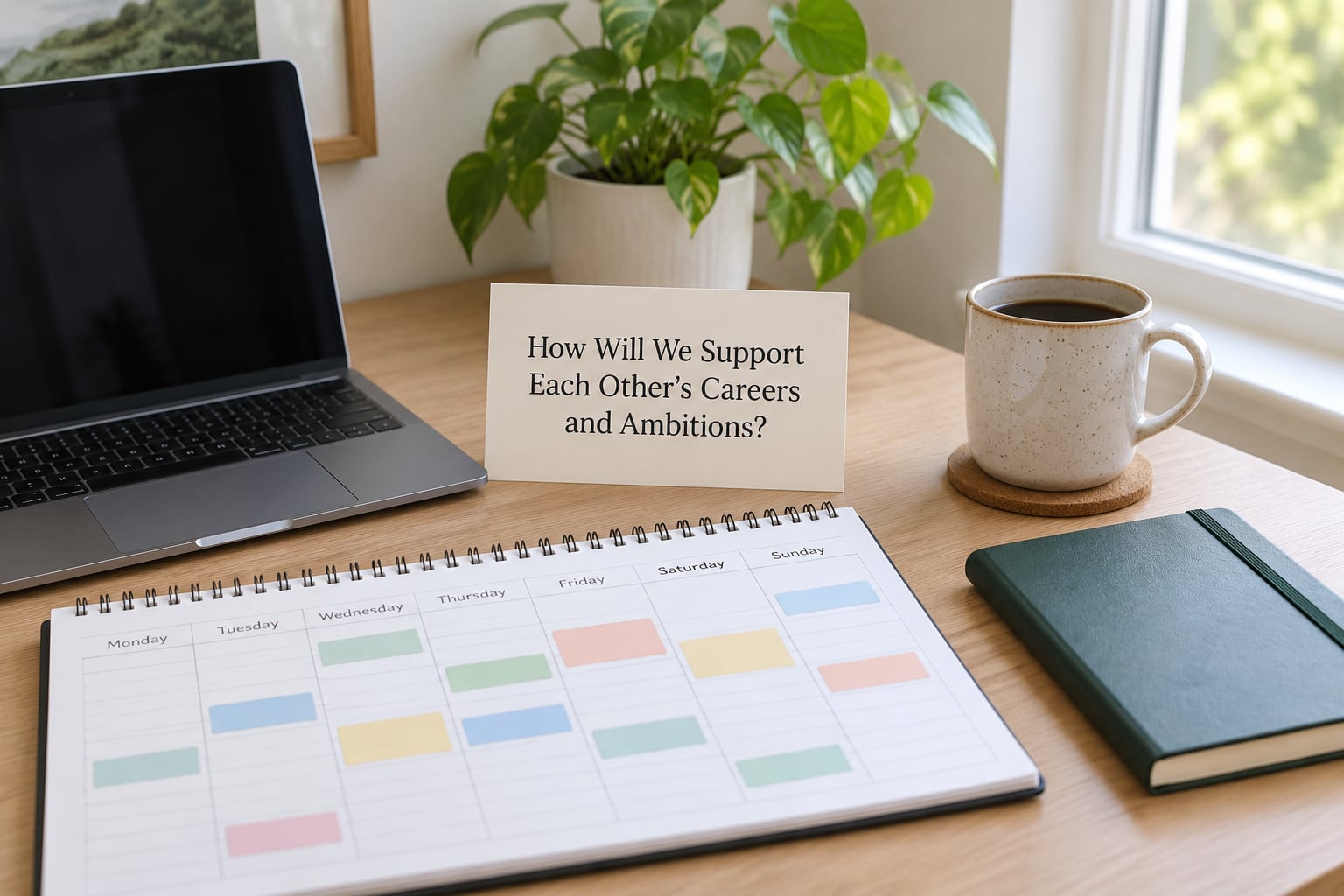
Ambition gets support in daylight and resentment in the dark. Ask where you want to be in five years, whether you would relocate for a job, and how you would handle a year where one career clearly outpaces the other.
The concrete version: if you took a parental leave or became the primary caregiver for two years, what could the other person realistically contribute, financially and in hours? Couples who have never asked this tend to discover the answer during the leave, at the worst possible time.
Also settle the daily logistics early. If one of you works late most weeks, what does the other get back? Are you fine with a partner who travels four nights a month? Does one career get to be the flexible one permanently, and is that choice mutual?
9. Are Our Expectations for Intimacy Aligned?
The purpose of this conversation is compatibility and consent, not testing your partner. Frame it that way, because anything else invites defensiveness.
Ask what intimacy means to each of you, how often you each want it, and what makes it feel good rather than obligatory. Then cover the practical parts: contraception and pregnancy intentions, boundaries with previous partners, and how you would want things to change over time as life gets busier.
You are allowed to ask whether your partner has had any sexually transmitted infections or has been tested recently. Full disclosure of a sexual history is a request that most people resent, and it is not a reasonable condition of marriage. Current status and willingness to get tested are reasonable conditions, and a partner who refuses either one deserves a serious look.
Also talk about how you will handle it when one of you says no. That single answer tells you more about a long marriage than any other question on this list.
10. What Happens If One of Us Gets Sick or Needs Care?

Illness is an ordinary part of life that couples routinely plan for in every other area. Ask what health insurance each of you carries now, what your deductible situation is, and what happens to coverage if one of you loses a job or gets let go.
Then talk about caregiving. If one of you had a serious illness for six months, who would take time off, who would manage appointments, and could you both afford it? What about mental health treatment or a disability that never goes away?
Two documents are worth discussing and easy to set up. A healthcare proxy names the person who makes medical decisions for you if you cannot. A financial power of attorney handles money. They are simple forms, and talking them through is far less romantic than finding out in a hospital that nobody can authorize anything.
Ask about your partner’s mental health history too, and your own. What happens to the relationship during a bad stretch, who do you call, and what helps you come back up. Also settle the wedding-specific version: what happens to the deposit if one of you becomes ill in the month before.
11. Have We Discussed the Boring but Important Logistics?
Every relationship has an operating manual, and most couples never write it down. These are the small agreements that prevent large resentments later.
- Where will you live after the wedding, and what is the actual commute for each of you?
- How are chores split, and who is the person who notices something is not done?
- Do you want joint or separate passwords and streaming accounts, and whose phone is unlocked?
- What are the recurring subscriptions, and who cancels them?
- What are the rules about guests, overnight stays, and locking the door?
- What happens to the pets you each already have?
A shared checklist does more work here than a conversation, because chores are not emotional and do not need an emotionally intelligent answer. Write the list down in a note on your phone and revisit it every few months.
The one to watch is digital privacy. Couples routinely have different rules about what counts as private, and assuming the strictest rule already applies is a reliable way to be hurt. Ask directly.
12. Are We Both Choosing This Relationship for the Right Reasons?
Last, and most important. People get engaged for reasons that have nothing to do with the person in front of them: a pregnancy, a deadline, family approval, sunk years, loneliness, or a fear that starting over at your age would be harder than staying.
Ask yourself honestly what would still make you choose this person if the ring were not an option, and if no one you know would ever hear about the decision. Then ask the same of your partner, and listen to the answer rather than the emphasis.
Then do the simplest check available. Is there love, respect, compatibility, and a willingness to keep dating deliberately once the excitement fades? Engagement is not the end of courtship. It is the point at which the courtship becomes a marriage, and people who skip that step tend to notice the gap around year two.
If the honest answer includes “I am staying because I have invested a lot,” that is worth saying out loud to someone outside the relationship.
Frequently Asked Questions
How long should we wait to get engaged after asking these questions?
Most couples need more than one conversation. Budget three or four sessions spread over a few weeks, because money on a Saturday night and career plans after a holiday land very differently. If a topic genuinely cannot be resolved, treat that as information about readiness rather than something to hurry past. Engagement is easy to postpone and expensive to get wrong.
Should we speak with a relationship counselor before getting engaged?
It helps, and the earlier the better. Couples counselors and premarital counselors routinely work through structured inventories built from exactly these categories: money, family of origin, conflict, values, and parenting. You do not need a serious problem to justify it. Many people book the first session as an objection test and leave with a much clearer picture of what they are agreeing to.
What if my partner refuses to answer one of these important questions?
That refusal is itself an answer, and worth examining calmly rather than as a confrontation. Ask why, and be specific: maybe the topic feels like an accusation, or the answer is genuinely complicated, or they see the question as premature. Give them a second attempt a few weeks later. If the same question stays shut after that, you are deciding with real information rather than assumptions.
How do we discuss engagement concerns that are still unresolved?
Name the specific gap rather than the general feeling. Instead of saying we are not ready, say we have not agreed on whether we want children and that a proposal would skip that decision. Set a date to return to it, and keep it. Repeatedly postponing a conversation tends to look like agreement, and a proposal made in that gap usually surfaces the same disagreement later, at a much higher cost.
Is it normal to feel unsure about getting engaged after a long relationship?
Yes, especially after several years together. Long relationships provide more evidence of compatibility and less evidence about the unglamorous parts, since those were never tested. Feeling unsure usually means you are thinking carefully rather than that something is wrong. The useful check is whether the uncertainty has a shape you can name. A vague unease is harder to resolve than a specific, unanswered question.
A Simple Final Check Before You Say Yes
Pick the three topics that would genuinely change your life if they went badly. For most couples that is children, money, and money again in a different form, or money, family boundaries, and conflict. Do not cover all twelve. Three that get a real answer beat twelve that get a polite one.
Then take the private step. Each of you sits alone with the three questions and writes your own answer before you compare notes. The point of writing separately is that you find out what you actually think without the social pressure of reacting to the other person in real time. Most couples who do this discover they had assumed agreement that was never verified.
Compare answers. Where you match, you have a foundation. Where you differ, you have a project. The difference matters more than the number of disagreements.
If a major issue is still unclear, postpone the answer. Postponing is not failure. An engagement you are unsure about becomes a wedding, a shared mortgage, and possibly a child before the uncertainty has anywhere to go. Uncertainty is a reason to investigate, not an automatic reason to disengage, and questions to ask before getting engaged exist to turn a vague worry into something you can actually work on.