
You are not being ungrateful for wanting time. When your partner’s work swallows the evenings, the weekends and the holidays, the honest fix is a specific conversation about a specific pattern, followed by boundaries you actually keep. This guide walks through how to handle a partner who works too much, step by step, in about an hour of prep and one calm conversation.
Hard work is not the villain here. Plenty of people work hard and still show up for the people they love. The problem is a pattern where the work keeps winning, and where every time a milestone is met, the goalposts move a little further out.
What follows is the conversation-based plan I would want someone to hand me six months ago: how to work out what is actually happening, what to say, what a real boundary looks like, and how to keep your own life running while you wait for change.
Table of Contents→
- What You Need
- Step-by-Step: How to Handle a Partner Who Works Too Much
- Step 1: Decide whether the problem is the schedule or the imbalance
- Step 2: Describe the impact without attacking
- Step 3: Ask for a realistic change
- Step 4: Build a schedule that includes recovery and connection
- Step 5: Agree on what happens when deadlines keep winning
- Step 6: Review the arrangement and revise it
- Common Mistakes
- Tips
- Frequently Asked Questions
- Conclusion
What You Need

None of this works if you walk into the conversation with a feeling instead of a record. Before you talk, spend twenty minutes turning the vague sense of “we never see each other” into four concrete things.
Document the pattern for two weeks
Write down when they actually stop working, when you eat dinner together, how many plans get cancelled, and how often you are the one initiating. A shared calendar or a notes app is enough. Reviewers on relationship forums describe the same moment of clarity: it is the first time the pattern becomes a number rather than a mood.
A typical picture looks like four evenings a week ending at 11pm, one cancelled date in the last month, and a shared holiday that turned into a catch-up sprint at the kitchen table.
Name your practical needs, not your feelings about their character
Write three to five needs in plain, checkable language. Two evenings a week where work stops at dinner. One full day each weekend that belongs to both of you. Holidays planned before the quarter starts. A date that does not turn into a project review.
Split your list into negotiable and nonnegotiable
Some things you would like. One or two things you cannot live without. Keeping the lists separate stops you from accidentally handing over a dozen requests that will all get refused, which teaches you nothing.
Choose the moment carefully
Not Sunday evening, not the morning after a bad week, and definitely not thirty minutes before a board meeting. Pick a stretch when you are both fed, calm and unhurried, and start early enough that the conversation does not have to end at bedtime.
Bring a pen, not a grievance list. You want a shared record, not an argument to win.
Step-by-Step: How to Handle a Partner Who Works Too Much
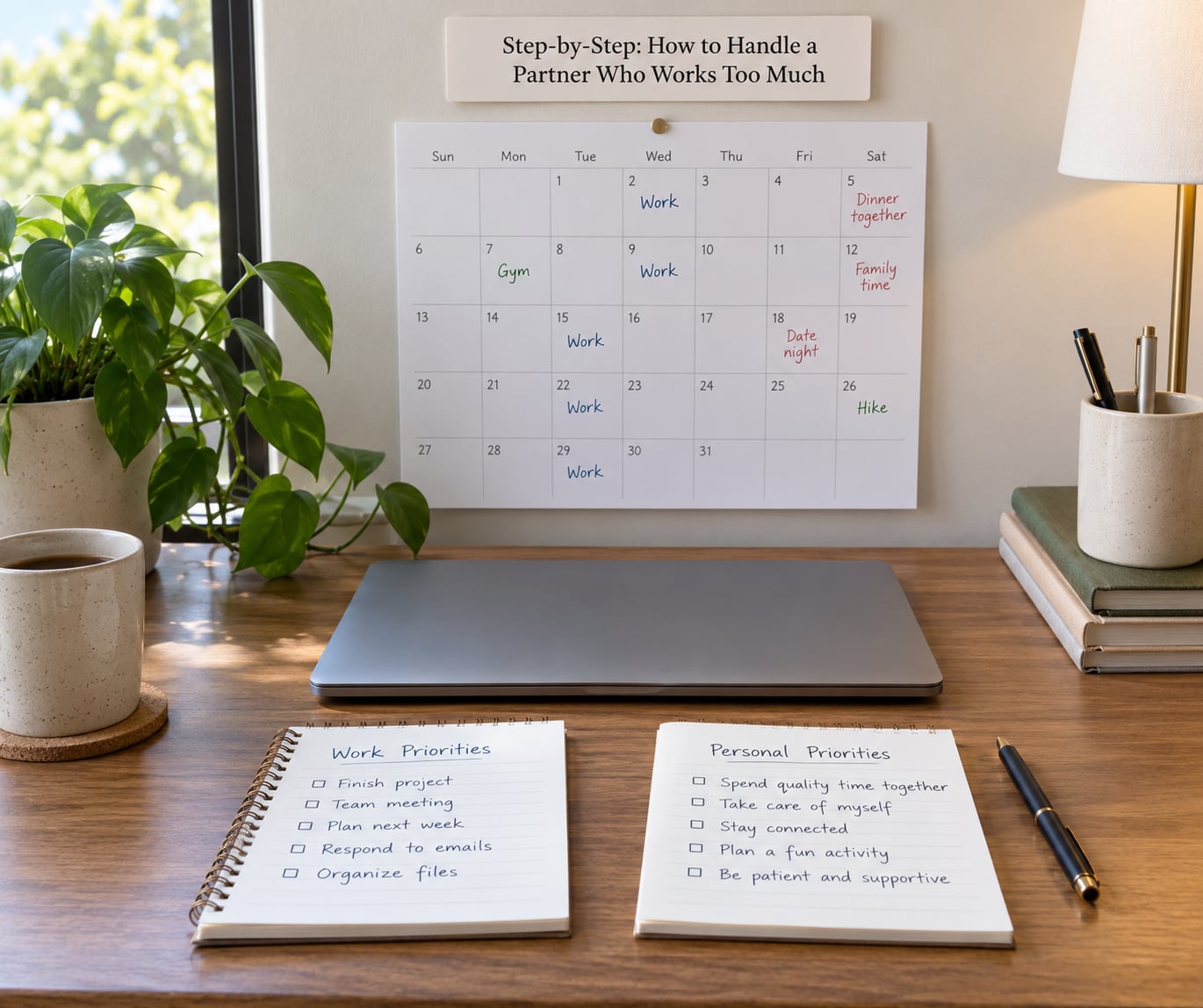
Step 1: Decide whether the problem is the schedule or the imbalance
Ask your partner directly what they consider non-negotiable, and what would change if one thing moved. A genuinely demanding job has external deadlines you can both see. An outsized ambition has goals they set themselves and can revise. Compulsive overworking has no finish line at all, and rest triggers guilt rather than relief.
Those three problems need three different responses, and confusing them wastes months. A deadline-heavy season is a scheduling problem. Ambition is a negotiation. Compulsivity usually needs professional support.
Step 2: Describe the impact without attacking
Use observations, then your feeling, then the need underneath it. “We have eaten dinner together four times in three weeks, and on the others I am alone by seven, and what I need is two evenings where your laptop is closed.”
Stay off labels. Words like selfish, distant, always unavailable and workaholic turn a scheduling conversation into a character trial, and a character trial has no solution. Gottman’s research on couples names criticism, contempt, defensiveness and stonewalling as the four riders that predict relationship breakdown; chronic work imbalance shows up there fast because contempt is contagious.
There is also an absence that is easy to miss. Someone can sit beside you for three hours and never once ask about your day. That is emotional neglect rather than a calendar problem, and it deserves its own name in the conversation.
Step 3: Ask for a realistic change
This is where most attempts fail, because “I need you to work less” is unfalsifiable. It sounds like asking for a smaller salary. Replace it with one measurable request and a line that keeps the tone steady:
I am not asking you to quit your job. I am asking for two evenings a week where your laptop is closed at dinner and stays closed. Can we start with Wednesday and Friday?
Specificity is what makes the request workable. One ask, two named nights, a start date. When people describe what finally worked, it is almost always this shape: I am not asking for a different career, I am asking for a different shape to the week.
Offer to hold part of the load. If they will protect two evenings, you can take more of the household admin on the other four. That is a trade, not a sacrifice, and it is far easier to agree to.
Step 4: Build a schedule that includes recovery and connection
A plan that depends on motivation collapses the first bad week. Put the shared time in the calendar as a real entry with a start time, not as an intention. Two to three protected evenings, one full weekend day, and a holiday booked before the busy period rather than during it.
Then agree on the rules around contact. Notifications off after a set time. No work talk on the protected evenings, including at dinner. If one of you has a genuine deadline, the other gets planned time later in the same week, which is a fair trade rather than a punishment.
Some couples find that side-by-side time works better than opposite ends of the sofa. You do not have to be doing something together for it to count as connection.
Periods of known intensity deserve a written plan. Two hard weeks of launches, a residency, a wedding season. Agree in advance which dates are carved out and what gets deferred, so the busy stretch does not quietly become the new normal.
Step 5: Agree on what happens when deadlines keep winning
Every plan needs a failure mode. Decide now, while you are both calm, what you will do if the schedule slips again: what you will stop waiting for, what you will start doing with your own evenings, and when you will both talk about it again.
This is not a punishment and it is not a threat to leave. It is a plan for your own independence. A reader in a Reddit relationship_advice thread described the version that stuck best: stop being the unpaid support staff, then say so plainly. Another, on r/AskWomenOver60, said the shift happened when she stopped reorganising her nights around his availability and started keeping her own.
Decide the review date before you need it. Two to four weeks out is enough to see whether the pattern moved.
Step 6: Review the arrangement and revise it
At the checkpoint, look at behaviour rather than intention. Did the evenings actually stay clear? Did cancelled plans come with an alternative, or did they just disappear? Did you build your own life rather than waiting?
Name the improvements out loud. A partner who hears that the new arrangement is working will protect it; a partner who hears only what is still broken will eventually stop trying.
Then adjust one thing at a time. Two protected evenings working means ask about more, not everything at once. Nothing has changed means you go back to Step 1 and re-check whether you are looking at a schedule problem, an ambition problem or something that needs a professional.
Common Mistakes
Bringing it up at the worst possible moment
The ten minutes before bed, the drive back from their parents’ house, the morning they are already behind. The subject is never wrong, only the timing. If a conversation has gone badly twice, pick a different slot rather than pushing through the same one.
Competing with their work through guilt
Sarcasm, the long sigh, the comment about how nice it must be to have a job you can abandon. It does not move the schedule and it does teach them to associate you with the pressure. Say the request plainly and then stop repeating it in the same conversation.
Treating a hard quarter as a permanent condition
This is the mistake readers regret most. A bad season that lasts months still feels permanent from the inside, so people lose a year of their own life waiting for a normal week that never arrives. Ask for the busy stretch to end on a specific date, and hold yourself to the same.
Neglecting your own needs while you wait
Some readers in relationship forums say the cost of the imbalance was not the late nights, it was stopping their own degree, their volunteering, their friends. Waiting is only reasonable if you are still building something while you do it.
Becoming their employee, driver or project manager
Helping with their work can slide into absorbing their schedule, their deadlines and their admin. One Reddit thread drew a sharp line here: resign as the unpaid staff, then decide whether you still want the relationship. It is worth noticing how much of your partner’s job you are quietly running.
Tips
Respect the work, then be clear about the cost. Saying “I know this matters to you and I am asking for something too” takes the sting out of the ask without softening the request.
Support the stress where you can. Ask what would help on a hard week. Some people want logistics handled; some want to be left alone for two hours. Guessing wrong is not a failure, asking is not nagging.
Protect your own time on the calendar. Gym, friends, a class, a project. Time that is not scheduled around someone else’s calendar is the first thing to disappear and the hardest thing to rebuild.
Watch for the mental-health layer. Anxiety, depression, ADHD and, less commonly, thyroid problems all show up as relentless overwork and racing thoughts. A doctor can rule out the physical and mental causes, and that check makes the rest of this plan much clearer.
Know when you need more than a better schedule. If your partner will not discuss it, gets furious at every mention of time, or has stopped asking about your life entirely, a boundary conversation will not fix that alone. Individual therapy first, then couples work, is the order most therapists suggest, because each person has to be able to sit in the room before the two of you can.
A note on language: “depleted husband syndrome” is a phrase many women use, and it is not a clinical diagnosis. It describes the feeling of being married to someone who is home but unreachable. The same thing happens with any gender, and plenty of readers say their own overworking looks exactly the same from the outside.
This is general educational information, not therapy. If the situation is affecting your sleep, your health or your sense of yourself, a licensed therapist or a couples counselor is the right next step.
Frequently Asked Questions
What is depleted husband syndrome?
Depleted husband syndrome is a colloquial phrase, not a clinical diagnosis, for the feeling of being married to someone who is physically present but emotionally unreachable. It usually describes a partner so consumed by work that affection, attention and shared time quietly stop happening, leaving one person doing all the emotional and household labour alone. The label is gendered, but the pattern shows up with any partner in any relationship.
How much work is too much in a relationship?
There is no magic number of hours, because a fifty-hour week that ends at dinner and a forty-hour week that fills every evening can leave very different amounts of shared time. The practical test is what the schedule leaves behind: two protected evenings a week, one full weekend day, and dates that are not cancelled for work. If those do not exist and no plan is coming, the hours are too many for the relationship.
How do I talk to my partner about work hours without nagging?
Pick a calm moment, describe the impact with specific observations, and make one measurable request. Say something like: I am not asking you to quit your job, I am asking for two evenings where your laptop is closed after dinner. Bring a pen so you can agree on the days together. A request with a day and a time attached can be answered; a general complaint about their dedication cannot.
What do I do when my partner cancels plans for work?
Stop treating cancellations as weather. Ask for a replacement time on the spot rather than waiting for a gesture that never comes: Thursday does not work, so can we do Saturday morning instead? Track how often plans get cancelled without an alternative offered. After a few weeks you will have a clear picture, and the pattern is easier to raise as a pattern than as a single complaint.
How to handle a partner who works too much when nothing changes
After three or four unproductive conversations, stop negotiating details and name the outcome. Tell them what you will do if the schedule stays as it is: keep your own evenings, plans and money organised independently rather than waiting for their availability. Then set a review date. Change usually appears as a shift in behaviour rather than agreement, and if nothing has moved by the date you set, that is information about the answer.
Is my partner a workaholic or just dedicated?
Dedicated people finish. They get to an end point, feel finished, and can stop without anxiety. Compulsive overworkers move every finish line, feel guilty when they rest, and experience a personal day off as a loss rather than relief. Watch how they respond to a holiday that is genuinely booked: is it a hard deadline, a negotiated preference, or something no amount of planning will change?
Conclusion
Start with one evening this week. Choose a calm moment, describe what the current schedule costs you in plain words, and make a single specific request: two evenings a week when the laptop stays closed. Then keep building your own week, because a life that waits for someone else’s calendar is the part that quietly goes missing.
A relationship can survive a demanding season. What it cannot survive is a season with no end date and no visible boundary.