If you are searching for how to keep your phone number private when dating online, the answer is short. Stay inside the app, hand out a second number instead of your personal line, and give the real one only after you have met in person. The habit takes about twenty minutes to set up and about one sentence to enforce.
Worth saying plainly before we start: a number is not dangerous on its own. Most people who misuse one already had your first name and your photos. What changes when a stranger holds your personal number is that they can look you up, keep reaching you after you unmatch, and push on the accounts that use your number to prove who you are.
Table of Contents→
- What You Need
- Step-by-Step: How to Keep Your Phone Number Private When Dating Online
- Use a Separate Number for Dating
- Check the App’s Privacy and Blocking Settings
- Avoid Automatically Syncing Your Contact List
- Keep Conversations Inside the App at First
- Share a Secondary Number Instead of Your Personal One
- Verify the Match Before Giving More Information
- Know What to Do If Your Number Is Exposed
- Common Mistakes
- Frequently Asked Questions
- Is it safe to give out my cell phone number when dating online?
- Can people tell if I’m using a Google Voice number?
- What can a scammer actually do with my phone number?
- How do I get a free burner number for dating?
- Which dating apps do not ask for a phone number?
- Does dialling 67 or 141 hide your number when you call?
- Conclusion
What You Need
None of this needs a special app except one thing: a number that is not the one attached to your bank, your job and your family group chats. Here is what I would have ready before the first match.
- A secondary or virtual number with its own account and its own voicemail greeting, so nothing routes back to your personal line.
- A password manager. Dating messages are where passwords get reused after a data breach, and recovery flows are the real prize for anyone holding your number.
- A verified email address that you can get into without a text message, in case a recovery code ever comes to you unexpectedly.
- Updated privacy settings on each dating app, including contact syncing, number discoverability, read receipts and location access.
- A decided boundary about when contact information changes hands, so you are not renegotiating it in the middle of a conversation at midnight.
Step-by-Step: How to Keep Your Phone Number Private When Dating Online
Use a Separate Number for Dating
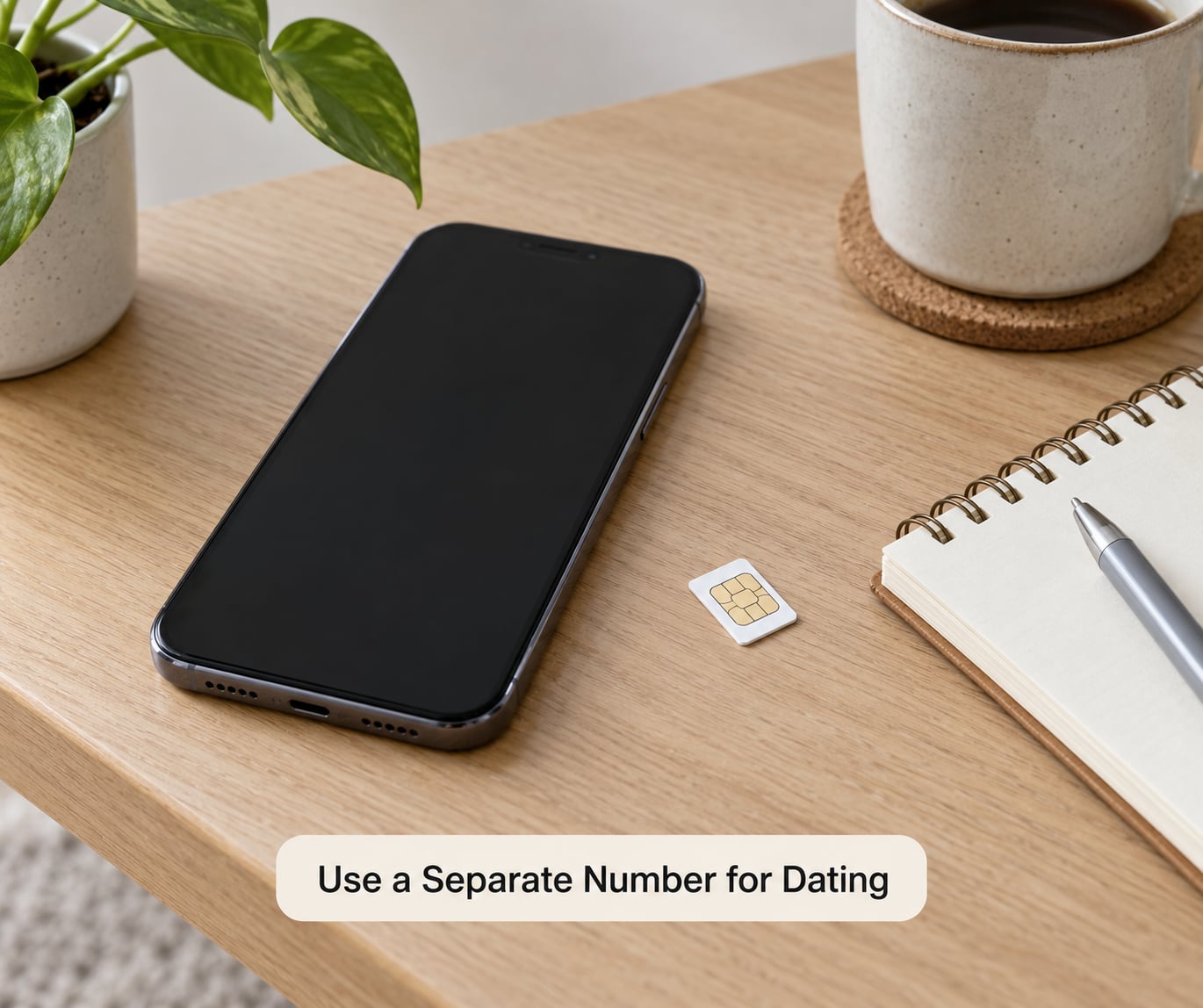
Give the app a number that is not your personal line. Google Voice is the free option most people in the US try first, and it works for texting and calls, but it has honest limits: some carriers label messages from it, photos sent through it reveal it is not your carrier line, and dating apps run checks that flag internet-routed numbers. People in r/Googlevoice also report long waits and numbers simply not being available when they try to claim one.
Carrier-backed virtual numbers are the quieter option because they behave like a real line, and they usually cost a few dollars a month. If you would rather not pay anything, the second line on an existing family plan works, as long as it is a line nobody texts you personal news on. A cheap prepaid handset is the most private option and the most annoying one to carry.
Check the App’s Privacy and Blocking Settings
Open each app’s settings menu and look for the controls that decide what a match can learn about you. On an iPhone, look under Settings, then Privacy and Security, then Contacts, and turn off Contacts for the dating apps. On Android, the equivalent sits under Settings, Apps, the app itself, then Permissions, where Contacts and Phone should both be off. Exact labels move around between app and OS versions, so hunt for the Contacts and Phone permission entries rather than trusting a fixed path.
Inside the app, three settings matter most. Turn off anything labelled discoverable by phone number or similar, since that is what lets a person who has your digits find your profile without a match. Turn off read receipts if unanswered messages bother you more than the other way round. And find the block and report buttons now, on a quiet afternoon, so that using them later does not require hunting through five menus.
One small extra, since people often ask about it. In the US, dialling *67 before a call hides your number for that call, and *82 blocks caller ID on the line. The equivalent prefix in the UK and Australia is 141. These hide your number from the person being called, not from the carrier, and they do nothing at all for texts.
Avoid Automatically Syncing Your Contact List
When a dating app asks for access to your contacts, say no until you know what it does with them. Uploading lets the app show you which of your contacts are already on it, which means a match who knows you can see that mutual friend and use it as an in. Some apps then prompt you to reach out to people you know, which quietly moves your conversations off-platform before you have vetted anyone.
Limited contact matching is a fair middle ground if you want the feature, since it matches rather than uploads. And check the names saved inside your own contact cards. If your card has a work address or a full legal name attached to your number, anyone who saves you and syncs their phone is copying all of it, not just the digits.
Keep Conversations Inside the App at First
Messaging inside the app is genuinely useful, not just a way to stall. You can block and report from there, screenshots of a conversation exist as a record, and a match who behaves badly loses access to you entirely when you unmatch.
Repeated pressure to move off the app is worth reading as information about the person rather than as proof they are keen. Someone who handles a polite no well is telling you something useful about how they handle everything else. Reddit dating communities describe this pattern constantly, and the common thread is that the push usually arrives early, arrives fast, and comes with a reason that is hard to argue with.
Share a Secondary Number Instead of Your Personal One
Once you have chatted enough to want to plan a meeting, give the second number. Say it plainly, because the way you hand it over sets the expectation: this is the number I use for dating, and my personal one is not something I hand over before we have met. A person who respects that is telling you something. A person who argues about it has answered your question.
Keep the greeting on that voicemail vague, and never let it announce where you are or that you are single. If it rings for an unexpected match, a stranger who now has a second number still has nowhere to push.
Verify the Match Before Giving More Information
Verification works in both directions. Run the number they are calling or texting from through a free reverse lookup before you meet, because checking a prospective date works exactly the way checking yourself does. Then ask for a short video call, and compare what you see with the photos on the profile and with the accounts they have posted under over the past few years. Consistency across three sources is a much better signal than any single impressive one.
Some lines do not move, whatever the verification looks like. Never send money or gift cards to someone you have not met, never send identity documents or a bank detail, and treat intimate images as something you cannot take back. A request for any of these, at any stage, ends the conversation.
Know What to Do If Your Number Is Exposed
Most readers land on this topic with a problem rather than a plan, so here is the order I would work in. Stop replying first, because replies are proof the number is live and that someone is willing to keep going. Block the number, then screenshot everything before you do, since screenshots of threats, explicit messages or impersonation are what a platform, a carrier or the police will ask for.
Report inside the app as well, using the same screenshots, and note the date and time of each message. Then check account security on anything tied to your number: turn off SMS-based password recovery on your email and bank, change reused passwords, and check for forwarding rules or unfamiliar devices. Contact your carrier if someone claims to be impersonating you to your contacts, and go to local authorities or a national fraud line for threats, extortion or money loss. Reporting early is what makes any of that recoverable.
Common Mistakes
- Sharing your number to prove a profile is real. Your number proves nothing about a person. A short video call and a check of their existing accounts prove far more, and neither costs you anything permanent.
- Using the number attached to work, family or banking. That number is your identity in a dozen other systems. Move dating to a line of its own before you match, not after a bad experience.
- Tapping accept on contact syncing without reading. It is a one-tap prompt and it quietly connects your profile to your friends. Decline it, and use limited matching if you want the feature at all.
- Answering unknown numbers after unmatching. A stranger calling a number that should not know them is the first sign the number leaked. Do not pick up, do not confirm who you are, block it.
- Posting your number in a public profile bio or a social post. A number in a public feed gets scraped. If a number must be visible to a date, send it in a private message.
- Treating a polite second number as a full stop. A secondary number is a layer, not a shield. The habits above are what make it useful, and they cost nothing to keep.
Frequently Asked Questions
Is it safe to give out my cell phone number when dating online?
The number itself is rarely the problem; the person holding it is. Most people who misuse a number already had your first name and your photos. What a real number adds is the ability to run a reverse lookup, learn your full name and workplace, and keep messaging you after you unmatch, since blocking on the app does not touch a phone number. A second number removes the first two of those three.
Can people tell if I’m using a Google Voice number?
Often, yes. Some carriers label messages from it, sending photos through Google Voice reveals that it is not your carrier line, and dating apps run checks that flag internet-routed numbers. A patient person can also simply notice the pattern. That is why a virtual number works best as a screening layer that keeps your personal line unreachable, rather than as a disguise you are relying on to fool someone.
What can a scammer actually do with my phone number?
More than most people expect. They can trigger password-reset codes while pretending to be your email provider or bank, look you up by name and employer, hold you to ransom after an intimate exchange, or keep texting from fresh numbers after you block the first one. Turning off SMS-based account recovery closes the most damaging of these, and it takes a few minutes in your account settings.
How do I get a free burner number for dating?
Sign up for a secondary-number service with its own account and a separate voicemail greeting, then use that number for dating only. Google Voice is the usual free option in the US, though people in r/Googlevoice report long waits and numbers that are not available when they try to claim one. Carrier-backed virtual numbers are harder to detect but usually cost a few dollars a month.
Which dating apps do not ask for a phone number?
A few let you sign up with only an email address, though most mainstream apps now require a number and verify it by text. If you want no number on the account at all, register with a secondary number instead, and check each app’s privacy settings for the option that turns off profile discovery by phone number. Also avoid signing up by linking a social account, which links your identity another way.
Does dialling 67 or 141 hide your number when you call?
In the US, prefixing a call with *67 hides your caller ID for that single call, and *82 blocks it on the line. In the UK and Australia the prefix is 141. These codes hide your number from the person you are calling, not from the carrier, and they do nothing for text messages or for anyone who already has your number saved.
Conclusion
The first thing to do takes five minutes: open the privacy settings on every dating app you use, turn off contact syncing and phone-number discoverability, and get yourself a second number before you match with anyone new. Chat inside the app, hand over the second number when you want to arrange a meeting, and say out loud that the personal one comes later.
That last part is the whole trick. Knowing when to keep your number private only helps if the boundary is stated clearly and repeated without apology, because the right response to the request is itself useful information about the person asking.