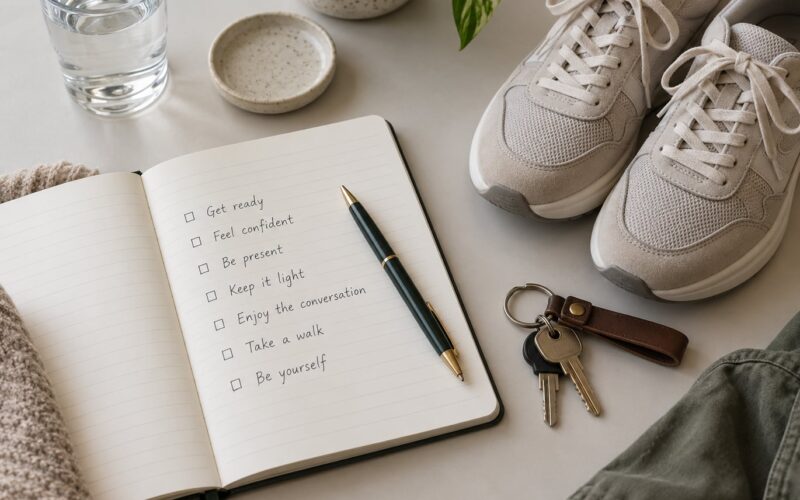
To be confident on a date, stop trying to perform calm and start treating the evening as a two-way check. Decide beforehand what you actually want to know, pick a venue you can relax in, and pick an outfit you have already worn before. During the date, ask real questions, listen to the answers, and let a few seconds of silence pass without rescuing it. Confidence is a habit you practise, not a personality you either have or lack.
It takes about ten minutes of preparation and about ninety minutes of conversation. The hard part isn’t the tips, it’s the voice in your head telling you that everyone can see you sweating. Almost everyone feels that way on a first date. The people who look calm aren’t calmer, they’ve just stopped treating nerves as a problem to hide.
Table of Contents→
- What You Need
- How to Be Confident on a Date: Step-by-Step
- Prepare Your Mindset Before the Date
- Choose an Outfit That Helps You Feel Put Together
- Arrive Early and Settle In
- Start With Questions That Invite Real Conversation
- Listen Instead of Trying to Impress
- Handle Nervous or Awkward Moments
- Show Interest Without Overdoing It
- Close the Date and Follow Up Thoughtfully
- Confident Versus Try-Hard
- Common Mistakes
- Frequently Asked Questions
What You Need
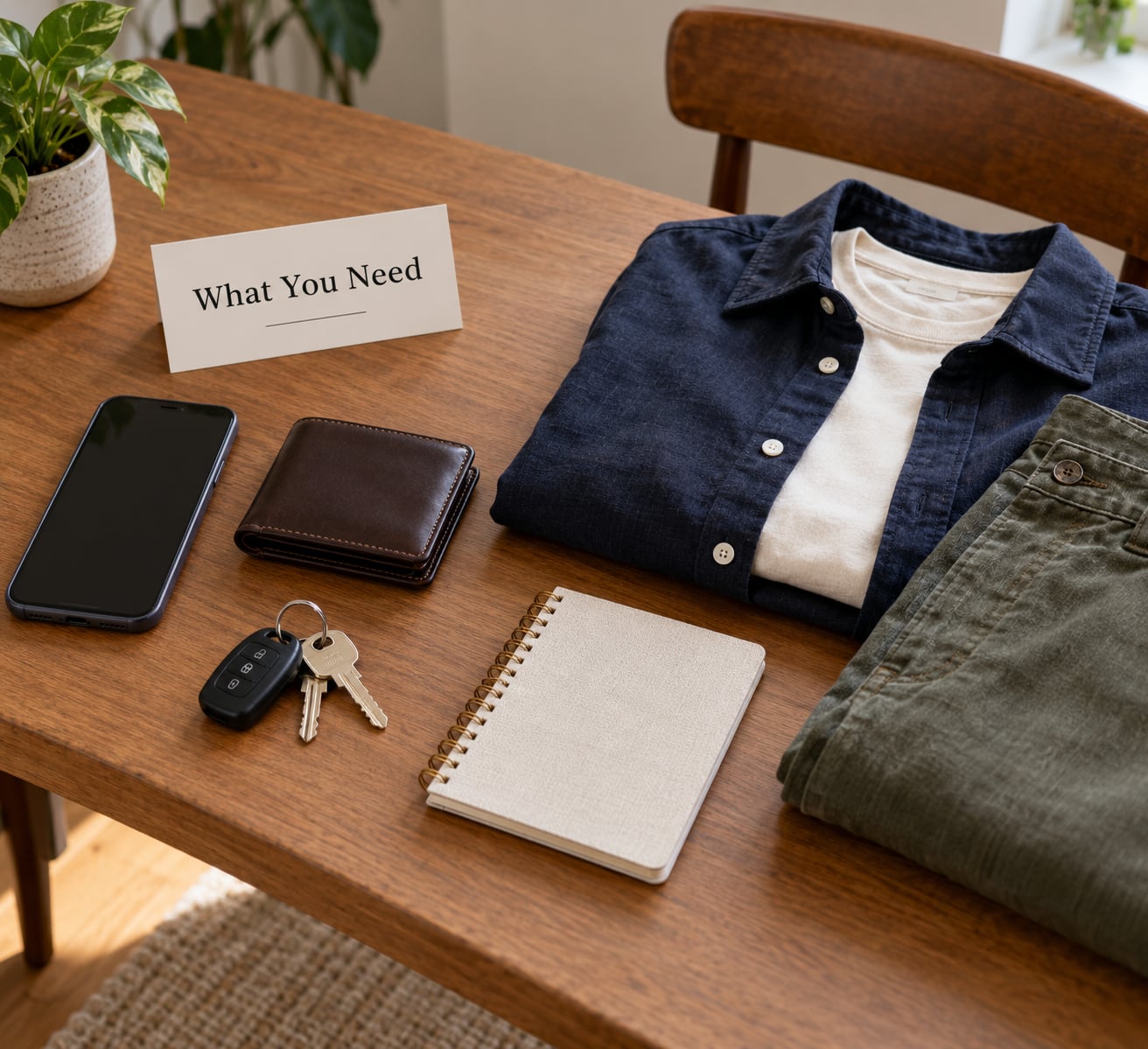
Confidence on a date is built from small decisions made in advance, not from personality traits you wish you had. Before you get ready, settle these four things and the evening writes itself.
- A venue you picked. Somewhere with seating, moderate noise, and a table away from the door and the speakers. Loud bars make conversation work and people who can’t hear each other never find out whether they like each other.
- Two conversation anchors. Not a script, just two threads you genuinely want to pull on, like a work story that went sideways or a trip you took recently. That’s enough. You don’t need a bank of material.
- An outfit already in rotation. Something you’ve worn a couple of times and know feels fine. Novelty is the enemy here.
- A loose plan for the bill. Decide in advance whether you’re offering, splitting, or taking turns. People waste a surprising amount of mental energy in the last four minutes of a date negotiating something they could have decided on Tuesday.
- A phone that will stay in your pocket. Face down, silent, out of sight. Not because you’re playing a game, but because your attention is the actual currency of the evening.
How to Be Confident on a Date: Step-by-Step
Prepare Your Mindset Before the Date
The biggest shift is from audition to evaluation. You’re not there to be approved. They said yes, which means they want to be there, and now you get to find out whether you want to be there too.
Write two or three things you want to know by the end of the evening. What do they do for fun, what do they want out of dating right now, would they be bored by a quiet Sunday. Questions like these do more for your nerves than pep talks, because they turn the evening from a performance into an investigation you are running.
On the night, run square breathing a few times: inhale for four counts, hold for four, exhale for four, hold for four. Slow exhales are what actually calm you down, so make the out-breath the long one. Five rounds takes under a minute.
Choose an Outfit That Helps You Feel Put Together
Wear what you feel good in, then stop thinking about it. Check the forecast and the venue’s dress code, not a stranger’s photos. Clean shoes matter more than people expect.
The test is simple: would you wear this to a dinner with friends on a Wednesday? If yes, it’s fine for a date. Overdressing to signal effort usually backfires, because the effort is louder than the outfit.
Arrive Early and Settle In
Get there ten minutes early. That single buffer removes the most common source of rushing, which is the thing other people read as nerves.
Before you sit down, use the restroom, check the menu, and put your phone away. A man who walks in fifteen minutes late is carrying apology energy for the rest of the evening. A man who was early is carrying nothing.
Walk in at a normal pace, shoulders down, hands free. Opening the door doesn’t require a performance.
Start With Questions That Invite Real Conversation
Skip the interview opener and go for something specific about the place you’re in. It gives you both something to react to, which is what conversation actually is.
Open-ended questions do the work. How did you end up in your current job. What got you into that hobby. What’s something you recently changed your mind about. Then follow up on the detail instead of jumping to the next question, because the detail is where people sound like themselves.
A good follow-up sounds like this: “Wait, you’ve been doing that since college? What made you keep it going?” That tells them you were listening, and most people relax when they realise that.
Listen Instead of Trying to Impress
People tend to feel more confident on a date when they’re interested in the other person than when they’re focused on their own performance. It’s the one piece of advice that shows up in almost every thread I’ve read on the subject.
Listen for the emotion under the words rather than waiting for your turn. When someone describes a long commute, the interesting part isn’t the distance, it’s whether they like it. Ask about that. Then share something back, briefly, so it reads as a conversation and not an interrogation.
Match their pace rather than their volume. If they’re answering in short sentences, don’t launch into a five-minute story.
Handle Nervous or Awkward Moments
Nerves showing up mid-date is normal, and pretending otherwise makes it worse. Some things that genuinely help:
- Slow your speech down deliberately. Nervousness speeds you up, and slowing the pace by about a fifth reads as calm immediately.
- Drop your shoulders and unclench your jaw. People hold tension high and don’t notice, and the visible part is mostly in the face.
- Keep both feet on the floor. It sounds trivial, but it stops your legs bouncing, and bouncing is contagious.
- If your voice shakes, take a drink of water first. The pause looks unhurried instead of panicked.
- Name it once, lightly: “I’m a bit nervous, I haven’t been on a first date in a while.” Said early and plainly, it usually dissolves in a few seconds. Several people in r/dating say exactly this works, and the logic holds: they already agreed to be there, so your nerves are not news to them.
For silence, resist the urge to fill it immediately. Three or four seconds of quiet looks like a comfortable pause to anyone else in the room. You can break it with something observational, like a comment about the music or the food, rather than with a rushed anecdote about yourself.
Show Interest Without Overdoing It
Interest is shown by attention, not by intensity. Ask follow-ups. Make eye contact for a sentence or two, then look away naturally rather than staring. Turn your body toward them when they speak.
Compliments get specific or they sound generic. Noticing that they mentioned a trip twice and asking about it beats telling them they’re attractive, which most people find pressuring on a first meeting.
If you think you want to see them again, say so plainly at the end rather than hinting. Suggesting the next date is an ordinary thing to do, and it’s much more confident than waiting for them to arrange it and hoping they do.
Close the Date and Follow Up Thoughtfully
End before either of you wants it badly. Roughly ninety minutes is usually right, and many commenters in r/dating and r/datingadviceformen keep the same point: leave while it’s still good and you’ll both want a second one.
Thank them at the door, specifically. Thanks for a lovely evening, I’m glad you picked this place, works far better than a generic it was nice meeting you.
Message later that evening or the next morning, and mention something specific from the conversation. Three sentences is plenty. Don’t interrogate yourself about the timing; there is no right window, and overthinking the follow-up is the single most reliable way to talk yourself out of a good date.
Confident Versus Try-Hard
People rarely mean confidence when they say act confident. They mean it without sounding rehearsed. Here is what the difference looks like in practice.
| Situation | Reads as confident | Reads as try-hard |
|---|---|---|
| Arriving | Ten minutes early, settles in, no announcement of arrival | Texting three times to confirm they found the place |
| Phone | Silent and out of sight unless there is a reason | Checking the screen, or putting it face up on the table |
| Speaking | Normal pace, comfortable with pauses | Rapid, constant, as if silence means failure |
| Questions | Asked because he or she is curious | A prepared list worked through in order |
| Compliments | Specific and about one thing | About appearance, repeatedly, in the first ten minutes |
| The bill | Offered once, no ceremony, no counting it out | Reaching first and making a small production of it |
Every item in the left column is a matter of doing less, more comfortably.
Common Mistakes
Mistake one: over-preparing. Rehearsing an itinerary for the conversation leaves you stranded when it goes off-script, which it will. Fix: two anchors and a willingness to be boring occasionally.
Mistake two: forcing humour. Jokes land when you forget you’re trying. Fix: aim for one light moment, not a running set, and let the other person set the tone early.
Mistake three: talking continuously. Filling every gap feels safer to you and exhausting for them. Fix: after you finish a point, stop talking. The pause will do more for how you come across than another sentence would.
Mistake four: assuming they’re already out of their league. Talking up to someone is uncomfortable for you and easy for them to read. Fix: you’re peers who both chose to be there. They may not have, by the way, and a date is a reasonable time to find that out.
Mistake five: using alcohol as a confidence tool. Two drinks can undo a careful hour. Fix: one, or none, and pick water when you want to be present.
Mistake six: ignoring your own comfort. Staying two hours past the point where you enjoy yourself. Fix: decide before you go how long you want to be out. Confidence includes the ability to leave.
A few extra habits help over time. Confidence on dates builds between dates, not just in the hour before, so keep doing things that make you feel like a person with a life: a class, a regular café, a call with a friend. And after a bad date or a ghost, wait a day before you decide anything about yourself. A single evening is a very small sample size.
Frequently Asked Questions
Is it normal to be nervous on a first date?
Yes, and it’s worth saying plainly: nearly everyone is nervous, including the person across the table. Nerves are a physical response, not evidence that you are bad at dating. Treat them as background noise rather than a signal to act on. Slow your speech, drop your shoulders, and keep the conversation moving. The people who read as confident are usually the ones who feel exactly the same and have simply stopped apologising for it internally.
How can I gain confidence when dating overall?
Build it in the gaps between dates. Keep a small social life so conversations come from real experience rather than effort. Take dates as low-stakes meet-and-greets, which is the framing most often repeated as useful in dating forums. Practise saying what you want plainly, and after each date write down one thing you did well and one adjustment, rather than reviewing the whole evening. Repetition desensitises more reliably than any technique.
What should I do and not do on a first date?
Do arrive slightly early, put your phone away, ask open questions, follow up on details, and end while it’s still going well. Don’t rehearse a script, check your phone, over-compliment someone’s appearance, drink heavily, or stay long after you’ve stopped enjoying yourself. Pick somewhere with moderate noise and real seating. Keep it to about ninety minutes so that a second date feels obvious rather than obligatory.
What is the 3-3-3 rule for dates?
The 3-3-3 rule is a social media dating convention, not established advice: meet someone three times within three months before deciding on a relationship. Plenty of people treat it as a hard rule and end relationships that were going nowhere, or stay in ones that were. It’s useful mainly as a prompt to pay attention to consistency over time, since actions repeated across weeks tell you more than one good evening does.
What is the 3 6 9 rule for dating?
It’s a variant of the same idea with a different window, generally framed as deciding on the relationship after three, six, or nine months. Treat all of these numbers as a suggestion for when to review things rather than a deadline. Nobody can tell you the right month. The useful part is the review itself, which is much better than the arithmetic.
Do you kiss on a first date?
Only if you both clearly want to, and only then. Watch the signals rather than guessing: leaning in, sustained eye contact, closing physical distance, touching your arm or hand. If you’re unsure in the moment, you are allowed to wait, and plenty of good second dates start without a kiss. Pressuring someone who has gone quiet or leaned away is the point at which a good evening turns into a memory they’d rather not have.
Start tonight, not tomorrow. Pick the venue, choose the outfit, and write down two questions you actually want answered. That is enough preparation to make the first ten minutes the easiest part of the evening instead of the hardest, and the rest takes care of itself. Updated for 2026.