An effective dating profile does one job at a time: your first photo earns the swipe, your bio and prompt answers earn the reply, and a clearly stated intention filters for someone you actually want to meet. Most weak profiles blur those three jobs into one paragraph of hobbies and end up invisible. You can fix that in an evening, and it costs nothing but honesty and a little editing.
The version below takes about two hours the first time, then twenty minutes per update. There is no secret phrasing and no trick that dodges the algorithm. There is specific detail, a photo order that tells a story, and a closing line that gives someone an easy way in.
Table of Contents→
- What You Need
- Step-by-Step
- Frequently Asked Questions
- What should I write in a dating profile bio when I do not have an interesting hobby?
- How many photos should I use on a dating profile?
- Should I write a different dating profile for every app?
- Why am I getting few matches even though my profile seems detailed?
- How often should I update my dating profile?
- Is it better to be funny or genuine in a dating profile?
- Conclusion
What You Need

Before you type a single word, gather four things. Writing first and thinking later is how profiles end up generic, because you fill the empty space with whatever comes to mind instead of what is actually true.
A rough draft of your life right now. Not your whole life story. Where you live, what your week looks like, what you did last weekend, what you want to be doing in six months. Three or four lines is plenty to start.
Two or three recent photos. Recent means taken within the last year or so, and not the ones where you looked twenty-five. Over-50 regulars on dating forums say dropping older photos and adding one current detail did more for their match rate than any bio rewrite they tried.
A short list of your dating priorities. Pick the two or three that actually matter: serious relationship, casual dating, friendship, open to seeing where it goes, ENM or poly. Four lines of priority is a filter; ten lines is a novel nobody finishes.
Concrete examples of who you are. This is the part people skip. Instead of “I love cooking,” write that you make a specific dish on Sunday and have opinions about it. Instead of “I’m a beach person,” note that you will drive two hours for an off-season swim but only in September. Detail is the raw material of a profile that reads like a person.
Step-by-Step
Step 1: Choose Photos That Show Your Real Life
Most people get this backwards: they save their best photo for last. Photo one is the only one most people will ever see, so it has to do the heavy lifting.
A workable gallery runs about six slots. Slot one is a clear head-and-shoulders shot, looking at the camera, natural light, a plain-ish background, a real expression rather than a rictus grin. Slot two is full body, because people want to know what they are getting. Slot three is the activity shot: cooking, climbing, gigging, walking a dog, throwing a frisbee. Slot four is a candid shot in a real setting. Slot five is a group photo. Slot six is the fun one: a goofy picture, a costume, a bad outfit you loved.
Group photos are useful but never first, since nobody can tell which face you are. Same-angle selfies repeated five times read as filler, so vary the angle and the light. Skip the mirror selfie in a dark bathroom, and skip the photo of your sunset, your car, your cat.
On the practice of obscuring other people’s faces: people in dating advice forums describe it as one of the fastest ways to read as threatening. Leave the faces alone. If someone dominates your photo enough that you are wondering, take a different photo.
How do you know which photos work? Watch conversation, not the swipe count. A photo that produces likes but no messages is doing its job badly, and it usually means the image is attractive while telling nobody anything.
Step 2: Write a Specific Introduction
The introduction is the part most profiles waste. Two or three sentences, no travel-thirst cliché, no quote about being a backpacker at heart.
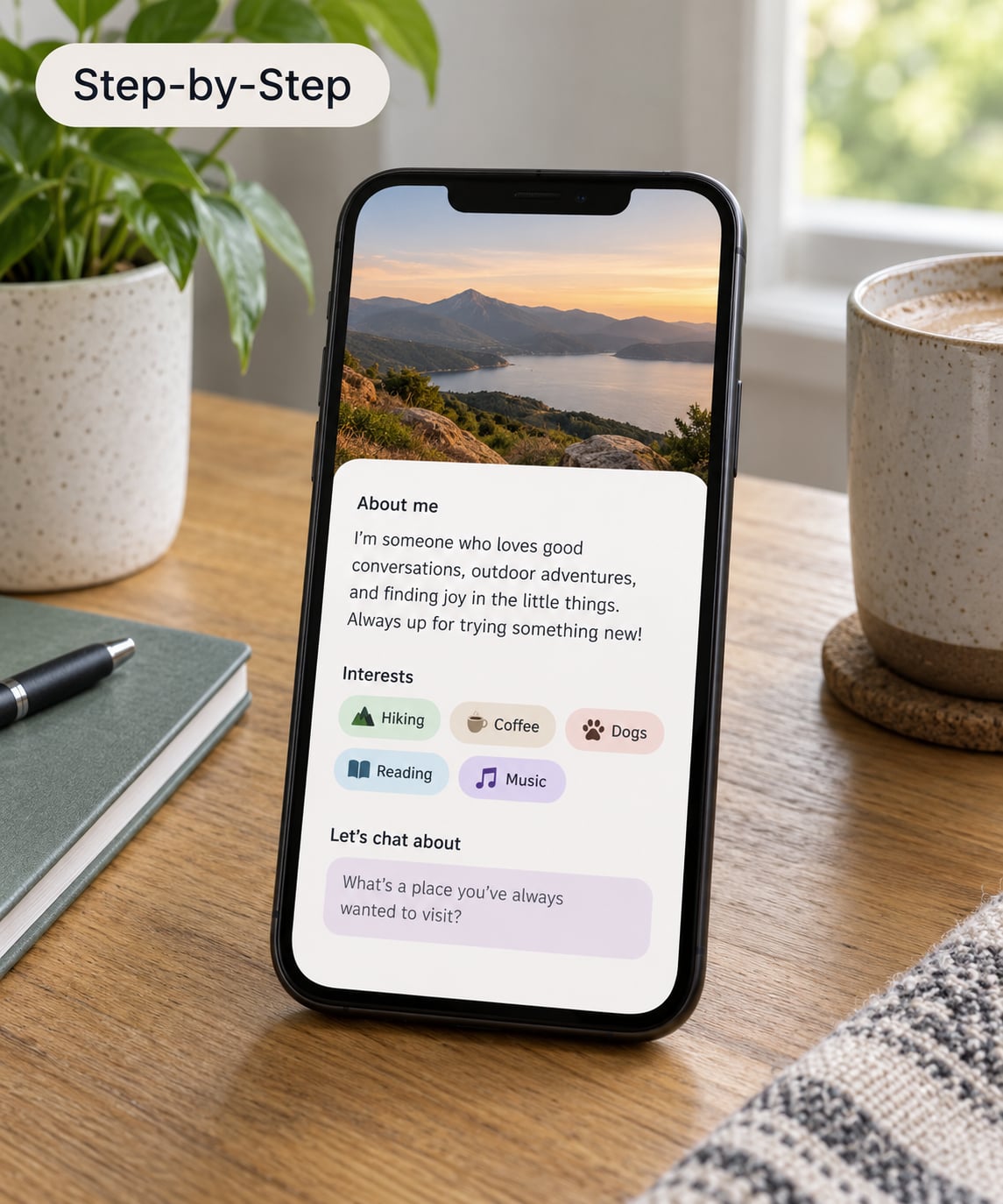
Try this frame: who you are in one clause, what your actual life looks like now, and what you are hoping to find. “Thirty-eight, freelance illustrator, most weekdays spent arguing with a cat who wants my keyboard. Looking for something steady, ideally with someone who has a dog and tolerates strange working hours.” That does identification, situation and intention in three lines.
Write it out loud before you paste it in. If you would not say it to a friend at a bar, do not put it on your profile. Tone is the second-most-common reason matches die at the first message, because nobody can hear your tone in text.
Proofread once, slowly, and read the profile backwards. Typos are not a dealbreaker but they signal that nobody else read the thing before it went live.
Step 3: Show Personality Instead of Listing Facts
A list of facts describes anyone. “Teacher, 34, likes hiking and wine.” Swipe. The fix is to attach a small strange detail to at least one fact, so the reader gets a picture of how you think.
- Weak: “I love movies.” Strong: “I have watched the same comfort film so many times I can do the voices, which is a problem for everyone else in the room.”
- Weak: “Travelled to 40 countries.” Strong: “The trip I talk about most involved a delayed flight, a wrong bus and the best soup of my life in a town I cannot name.”
- Weak: “I’m a homebody.” Strong: “My ideal Saturday is a long walk, a grocery shop that is technically a date, and being asleep by ten.”
- Weak: “I don’t like drama.” Strong: “My patience runs out at around three messages of vague texting, which I am told is very on-brand for me.”
Notice that none of those examples say something negative about other people. Sarcasm is risky too: a joke that lands in your head can read as smug in a text box, and a joke that needs explaining will not get explained.
A useful split other profiles tend to follow is roughly seventy percent about you and thirty percent about the kind of person you would enjoy. Do not describe a checklist. Do say the thing that would make a compatible person lean in.
Step 4: Make Your Interests Matchable
Interests only help if a stranger can imagine doing them with you. “Music, travel, food” is three categories; “live music” plus “Sunday markets plus cooking from a very specific cookbook” is three invitations.
The quickest upgrade is to add a current one. People over forty on r/datingoverfifty keep saying the same thing: a recent trip, a new hobby, a rebuilt habit, or an old hobby described differently. Anything with a timestamp reads as a life in motion rather than a life paused.
Platform matters here more than anywhere else. Hinge leans on prompt answers, so put your personality and specificity there rather than cramming it into a bio box. Tinder is photo-led, so your interests are background and your photos are the ad. Bumble opens the conversation, which means the profile’s last job is explaining why you are worth the opener. OkCupid and eHarmony are question-based, so answering every question thoughtfully matters far more than one perfect paragraph.
Coffee Meets Bagel limits the number of profiles you see per day, which means each one has to work harder. One clear detail beats a paragraph.
Step 5: State Your Dating Goals Clearly
Stating what you want is a filter, and filters feel rude only when they are framed as exclusion. Instead of a paragraph about what you refuse to deal with, say what you are hoping for.
“Looking for something serious” is clear and unremarkable. “Looking for a relationship, not a situationship” is clear and reads as a wound. “Here for a relationship, open to how that looks” does the same work without the chip on the shoulder.
Name the structure plainly too. ENM, poly and open relationships are ordinary arrangements now, and putting it in the bio saves both people weeks. Someone in a forum thread asked exactly how to say this without scaring people off; the answer is to say it in the same tone you would say you have a cat. One clause, no essay, no apology.
The gap forum users complain about most is mismatched intention: matches that promised serious and turned out casual. Saying it in plain words is what stops that, and you will get fewer matches and better ones.
Step 6: Invite a Simple Conversation
End with a low-effort opening. Most matches never write because they cannot think of a reply, not because they were not interested.
A good closing line is specific enough to answer and open enough to continue. “Tell me the most boring thing you do on a Tuesday” does more work than “So, what are you up to?” It gives a reply that is already a personality.
Ask yourself one test: could a stranger reply in ten words without researching your life? If not, rewrite it.
Common Mistakes
Here is what to delete, and what to put in its place.
- Vague bios. “Just here for the laughs” tells nobody what you find funny. Fix: one concrete example of the kind of humour you actually enjoy.
- Overused openers. “I love travel, dogs and long walks” is on every profile in the feed. Fix: keep one of those, but attach the specific detail only you would know.
- Negativity about other people. Never list what you dislike about women, men or exes. It filters for bitterness rather than compatibility. Fix: delete the sentence entirely.
- Excessive qualifiers. “Must be tall, non-smoker, animal lover, ambitious, well-read” reads as demanding and filters for a very narrow field. Fix: keep the two that would genuinely end it and move on.
- Empty promises. “Looking for my soulmate” promises an outcome instead of describing a life. Fix: say what you want to do together.
- Mismatched intentions. Writing serious-sounding copy while swiping right on anyone. Fix: make the copy match your actual behaviour, not your hoped-for behaviour.
- Too much detail. A 400-word essay gets skimmed. Fix: keep the bio tight and move the depth into prompt answers.
Here is a final checklist before you go live. Read it out loud to a friend who will be honest: does photo one show your face clearly, is the bio free of typos, can you point to one detail per section that nobody else would write, do you state what you are looking for, does the closing line invite a reply, and is there not a single sentence about people you dislike?
One last habit worth keeping: change one thing at a time, then wait a week or two before judging it. People ask constantly whether editing a profile hurts visibility, and the honest answer is that nobody outside the app knows. Your own data is better than the rumour, so keep a note and stop rewriting everything at once.
Frequently Asked Questions
What should I write in a dating profile bio when I do not have an interesting hobby?
You do not need an interesting hobby, you need a specific one. Pick anything ordinary that is genuinely yours and describe the detail: the Sunday roast you are particular about, the swimming pool you go to alone, the dog you walk at six. People are not scanning for hobbies, they are scanning for a reason to reply. Specificity on a small thing reads far more interesting than a vague claim about being adventurous.
How many photos should I use on a dating profile?
Four to six works well. The first should be a clear head-and-shoulders shot, the second full body, and the rest should add range: an activity, a candid moment, a group, and one fun one. Quality beats quantity, so drop anything that is blurry, very old, or has other people cropped into a red box. Very few people swipe past six.
Should I write a different dating profile for every app?
Keep the same personality, change the emphasis. On Tinder the photos carry the profile, so trim the bio to a line. On Hinge put your specificity in the prompt answers. On OkCupid and eHarmony answer every question carefully, because that is where the matching actually reads you. Bumble needs a closing line that makes the opener easy. Your core voice should not shift between apps.
Why am I getting few matches even though my profile seems detailed?
Detailed is not the same as specific. Long bios listing travel and dogs read as interchangeable, and interchangeable profiles get skipped. Check three things: is your first photo clear and recent, does your bio contain at least one detail nobody else would write, and do you state plainly what you are looking for. Also check your age and distance filters, which quietly remove more profiles than a weak bio does.
How often should I update my dating profile?
Refresh it when something real changes, such as a new job, a move, a new hobby or a shift in what you are looking for. Otherwise a monthly glance is plenty. Change one element at a time and give it a week or two before judging the result, because you will not know which change did anything if you rewrite everything at once.
Is it better to be funny or genuine in a dating profile?
Genuine, with a light touch. A joke that needs context gets ignored, and sarcasm is regularly misread in text as smugness. Self-deprecating humour aimed at yourself is safer than humour aimed at your ex, because it shows you can laugh without making someone else the punchline. The tone that works best sounds like your voice on a good day, not a punchline you worked on.
Conclusion
Start with one thing tonight. Put your clearest, most recent head-and-shoulders shot in position one, then rewrite your introduction so it contains a single specific detail that only you would write, then leave it alone for seven days.
When you come back, judge the conversations rather than the numbers. Match volume is a rough signal, but replies are the honest one, and replies are what this whole guide was aimed at.