How to handle conflict while traveling as a couple comes down to three habits: agree on the rules before you leave, use a planned signal the moment you start heating up, and repair before the day ends. Most travel fights are not about the vacation at all. They are about tired brains, tight schedules, and two people who never get a break from each other.
Here is the honest part. It is very common for couples to argue on a trip. Almost every couple I have traveled with has hit at least one tense evening, usually somewhere around day two or three when the novelty wears off and the logistics start demanding attention.
What separates the couples who recover well is not having fewer disagreements. It is having a routine for the ones that show up.
Table of Contents→
- What You Need
- How to Handle Conflict While Traveling as a Couple: Step-by-Step
- Set Shared Expectations Before the Conflict Starts
- Choose a Good Time and Place to Talk
- Describe the Problem Without Blaming Your Partner
- Listen to Understand, Not Just to Respond
- Make a Joint Decision and Adjust the Plan
- Take a Break Without Turning It Into Withdrawal
- Repair the Connection and Agree on What Comes Next
- Common Mistakes
- Frequently Asked Questions
- What if my partner and I argue every time we travel?
- Is it okay to take a break while traveling with my partner?
- How do we resolve a disagreement in public without embarrassing each other?
- What if one of us wants more planned activities than the other?
- How do we keep a travel conflict from ruining the rest of the trip?
- Should couples discuss serious relationship problems while on vacation?
What You Need
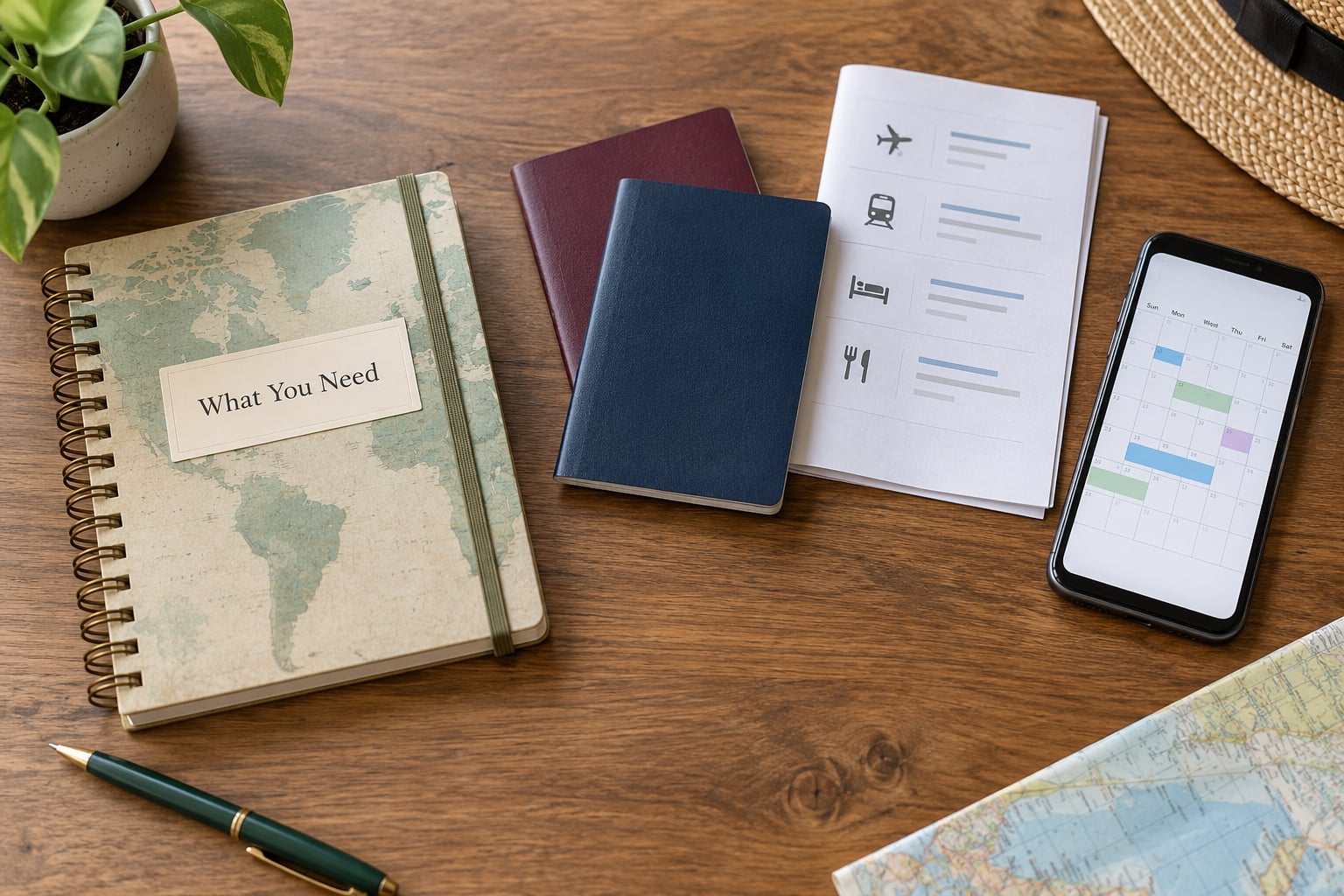
None of this costs money. Most of it takes twenty minutes on the couch a week before departure, and it prevents the majority of the arguments you would otherwise have standing in a hotel lobby at 9 p.m.
- A shared trip agreement. One page, written down, covering money, pace, alone time, and how decisions get made.
- Logistics in one place. Flights, hotel confirmations, addresses, and the local emergency number saved in both your phones.
- A pause signal. One agreed phrase or gesture that means I need twenty minutes, with no follow-up questions allowed.
- Planned time alone. Not leftovers. Booked into the day, the same way a dinner reservation is.
- A named backup for hard moments. A couple therapist you could call within a day, or a travel insurance line, or whoever.
Write the agreement down rather than keeping it in your head. The moment one person remembers a rule as a rule and the other remembers it as a suggestion, you have an argument that never existed in words.
How to Handle Conflict While Traveling as a Couple: Step-by-Step
Set Shared Expectations Before the Conflict Starts
Spend an hour before you go. Split the page into money, pace, plans, privacy, sleep, and flexibility, and write down one honest sentence for each.
On money, decide which spending is decided and which is shared. A daily figure you both stop at works better than a total, because a total turns into a running mental tally all week. On pace, be specific: three guided things per day, or one anchor per day with the rest free.
On privacy, say what each of you needs. Phone at dinner, no work email after 6 p.m., headphones mean do not ask me what is wrong. On sleep, agree who checks the door, who sets the alarm, and what happens when one person needs a different bed.
Finish with the flexibility clause. Something like: if one of us is running on empty, we drop the next planned thing without needing permission. That sentence prevents the exhaustion argument you will otherwise have at hour nine on day three.
Choose a Good Time and Place to Talk
Never have the real conversation while rushing, hungry, or standing. Delayed flights, missed connections, and arguing on a street corner in the heat turn small issues into big ones because neither body has capacity to think.
Good moments look like this: after a meal, sitting somewhere quiet, at least an hour before the next scheduled thing, when both of you have had real food and water. Not the ten minutes before you need to check out.
Also pick a place where the volume stays low. A corner table in a hotel lounge beats a bench in a busy train station. You want to be able to say the sentence without the whole platform hearing it, and you want no audience at all.
Describe the Problem Without Blaming Your Partner
Swap accusations for observations, feelings, needs, and requests. It sounds stiff once and feels natural after three uses.
Instead of you never plan anything, try: when we had four hours free and no plan, I felt anxious and left out of the decisions. Could we agree on one anchor activity each morning?
Instead of you are always on your phone, try: when you are scrolling during dinner, I feel ignored. I need twenty uninterrupted minutes with you before we eat.
Stay away from mind-reading and ultimatums. If it always means or never, the other person stops hearing the actual problem and starts listening for the accusation. Say the behavior, the feeling, the request, then stop talking.
Listen to Understand, Not Just to Respond
This is where most travel arguments fail, because both people are busy assembling a rebuttal instead of hearing anything.
Try this loop. Listen without interrupting. Then say: so what I hear is that the early starts are fine, but being told about them the night before feels like being managed. Did I get that right? If they correct you, thank them and adjust. You have now done something almost no one does mid-argument, which is being corrected.
Validate the feeling even when you disagree with the conclusion. That does not mean the feeling is right. I get why a cancelled train puts you on edge, and I would be annoyed too, and we still need to figure out the bus.
When both people feel strongly at once, slow the whole thing down and take turns. Ten minutes each, no interruption, then five minutes of rest, then swap. A timer on your phone keeps it from feeling endless, and it stops the louder person from setting the pace for the whole conversation.
Make a Joint Decision and Adjust the Plan
End the talk with something concrete, or the fight just reruns tomorrow with a new trigger. Generate two or three options instead of arguing for one position.
For the train strike: stay in this town tonight and take the slow route tomorrow, or push on to the coast now and lose the hike, or book the night train and split a compartment. Then trade-offs out loud. Which option costs you the most, and which costs the other person the most?
Pick together, write it down, and put it in the shared calendar so you both stop renegotiating. Then move on. Decision fatigue is one of the biggest reasons travel arguments escalate, and one settled decision removes a whole round of them.
Take a Break Without Turning It Into Withdrawal
A break works when both people know what it is and when it ends. A break that feels like being abandoned does not de-escalate anything.
Say it plainly: I am too tired to keep talking about this well. I am taking twenty minutes, I will be at the cafe, and I want to finish this conversation at four.
Then actually do something regulating. Walk, swim, shower, sit outside, call someone who likes you. Not ten minutes of scrolling and refreshing the same feed.
Come back on time, and start with what you understood rather than with what you want. If you cannot make twenty minutes, take forty and set the new time out loud. Long couples who travel often say that scheduling admin time separately from couple time is what keeps the schedule from feeling like surveillance.
Repair the Connection and Agree on What Comes Next
Most couples stop at the apology and wonder why the mood stays tense. A real repair has three parts: acknowledge the specific hurt, say what changes, and confirm the agreement.
Something like: the thing that hurt was feeling shut out in front of my family, not the plan itself. Next time I will tell you I feel out of the loop before I go quiet. Can we agree that neither of us decides anything big without the other?
Then say it out loud together, and treat it as settled. Repair attempts work best when they are immediate. If you need longer, set a specific time and honor it.
Finish with a small shared activity, not more talking. A walk, a swim, dinner without a phone on the table. Couples who do a short post-trip debrief over coffee or a drink report less buildup of resentments than those who go straight back into planning mode.
Common Mistakes
These are the patterns that turn a normal disagreement into a ruined trip. Each one has a straightforward fix.
Arguing in public. Correction: use the pause signal and talk later. Volume alone changes what your partner can say, because shame reads as confirmation that they are the bad one.
Postponing every hard conversation. Correction: set a time before the problem hardens. That applies to the trip too. A deferred conversation travels with you and gets louder.
Keeping score. Correction: drop the tally of past offenses. Old arguments in a new city only give both of you more material. Bring it up after the trip if it still matters.
Assuming what the other person meant. Correction: ask one clarifying question before responding. On Reddit relationship boards, the most common thread title is some version of I thought I made it clear, and most of those resolve in one conversation.
Treating rest and flexibility as negotiable. Correction: schedule them like anything else. A no-plan afternoon belongs to whoever needs it, and it costs the trip nothing.
Making one person carry all the logistics. Correction: split the admin. Uneven emotional labor is a real and underplayed source of trip friction, and one person booking everything resents it long before anyone says so.
Letting phones and work bleed into every hour. Correction: agree on device-free windows. Shared no-phone time tends to be the single most effective reconnection tool travelers report.
It also helps to sort the tension into two buckets before you react to it.
| Normal travel tension | Worth a closer look |
|---|---|
| The argument is about a specific plan or a specific moment | The same fight reappears on every trip, whatever the destination |
| Both of you can name what each of you wants | One partner never has to explain, and the other never has to be understood |
| You recover within a day and plan the next one together | You separate for the rest of the trip and avoid being alone together |
| Tension tracks exhaustion, hunger, or tight schedules | Tension shows up even when the trip is calm and both of you are rested |
| You both apologize for something in the last day | The same remarks get made again days later with no acknowledgement |
Fatigue is the most common trigger in that first column. A weekend away after a hard month is not the same test as a calm week at home, so judge the relationship by what shows up when you are both rested.
Frequently Asked Questions
What if my partner and I argue every time we travel?
A repeated travel fight usually points to one or two fixed disagreements, not to travel itself. Common ones are money, pace, and planning control. Write down what happened after the first three trips and you will usually find the same two topics. Fix those in the pre-trip agreement, then test whether the fights drop. If they do not, that is worth a conversation about the underlying pattern rather than another holiday.
Is it okay to take a break while traveling with my partner?
Yes, and it is often the healthiest option. What matters is that the break is announced rather than disappeared into, and that it has a return time attached. Say where you are going and when you will be back, then do something that calms you down. Coming back on schedule is what keeps a break from reading as punishment or abandonment.
How do we resolve a disagreement in public without embarrassing each other?
Use a short agreed signal and save the conversation for somewhere private. Even saying let us talk about this later, in a neutral tone, is enough to close the public part of the dispute. Do not keep scoring points in the moment. The goal in public is only to get both of you out of the situation without adding a public layer to the real problem.
What if one of us wants more planned activities than the other?
Split the day instead of choosing one pace for both of you. Agree on one or two anchor plans everyone does, then let the planner fill the rest while the other person takes the open blocks. Rotate who sets the anchors so the same person is not always being organized and the same person is not always being asked. Write it in the shared calendar and stop renegotiating.
How do we keep a travel conflict from ruining the rest of the trip?
Repair it within the same day, then let it go. A specific acknowledgement, a concrete change, and a shared activity usually take twenty minutes. Unresolved tension bleeds into every later decision, so most of the damage comes from the hours and days you carry it. If you cannot repair today, set a specific time and keep it, and plan one small good thing for the two of you.
Should couples discuss serious relationship problems while on vacation?
Notice patterns, but do not settle them on the road. Travel magnifies everything, and decisions made while exhausted, away from home, and without support usually need revisiting. Use the trip to identify the issue clearly and, if it feels serious, book a couples therapist before you go so you are not paying to talk about it in a hotel room at midnight. You can always change flights if the trip itself is the problem.
Start with one hour and one page before you go. Agree on money, pace, alone time, and a pause signal, and write all four down. That single conversation solves more travel fights than anything you can do mid-argument, because the hardest ones to fix are the ones neither of you planned for.
This guide was last reviewed in 2026.