
The money talk goes best when it is scheduled, small, and about the future instead of about who spent what. The version of how to talk about money with your partner that works is a 30-minute conversation with one topic, one shared document, and a date already in the calendar for the next one.
Couples who have gone quiet on money for years often assume they have a numbers problem. They have a scheduling problem. Prepare your own figures first, pick a calm moment, share facts instead of verdicts, agree on one plan, then repeat it on a fixed cadence.
Table of Contents→
- The Short Version
- What You Need
- Step-by-Step: How to Talk About Money With Your Partner
- Common Money Personalities and How to Work With Each
- Common Mistakes
- Frequently Asked Questions
- How do I talk about money with my partner if we have very different incomes?
- Should couples have separate accounts or a fully shared budget?
- How do I bring up debt without blaming my partner?
- What if my partner does not want to discuss money at all?
- How often should we review our finances together?
- When is a financial adviser or counselor appropriate to involve?
- Conclusion
The Short Version
- Pick one topic before you open your mouth. A list of eight items is an argument waiting to happen.
- Start with how money felt in your family, not with your balance. Background first, balances second.
- Schedule it when nothing is wrong. A bill arriving today is a bad reason to talk tonight.
- Say facts and feelings with I statements. No verdicts, no labels, no scorekeeping from old arguments.
- Leave with one written decision and one owner for it. A conversation without a written outcome is the loop.
- Meet again on a fixed date, 30 minutes, one topic. Regular beats thorough every single time.
What You Need
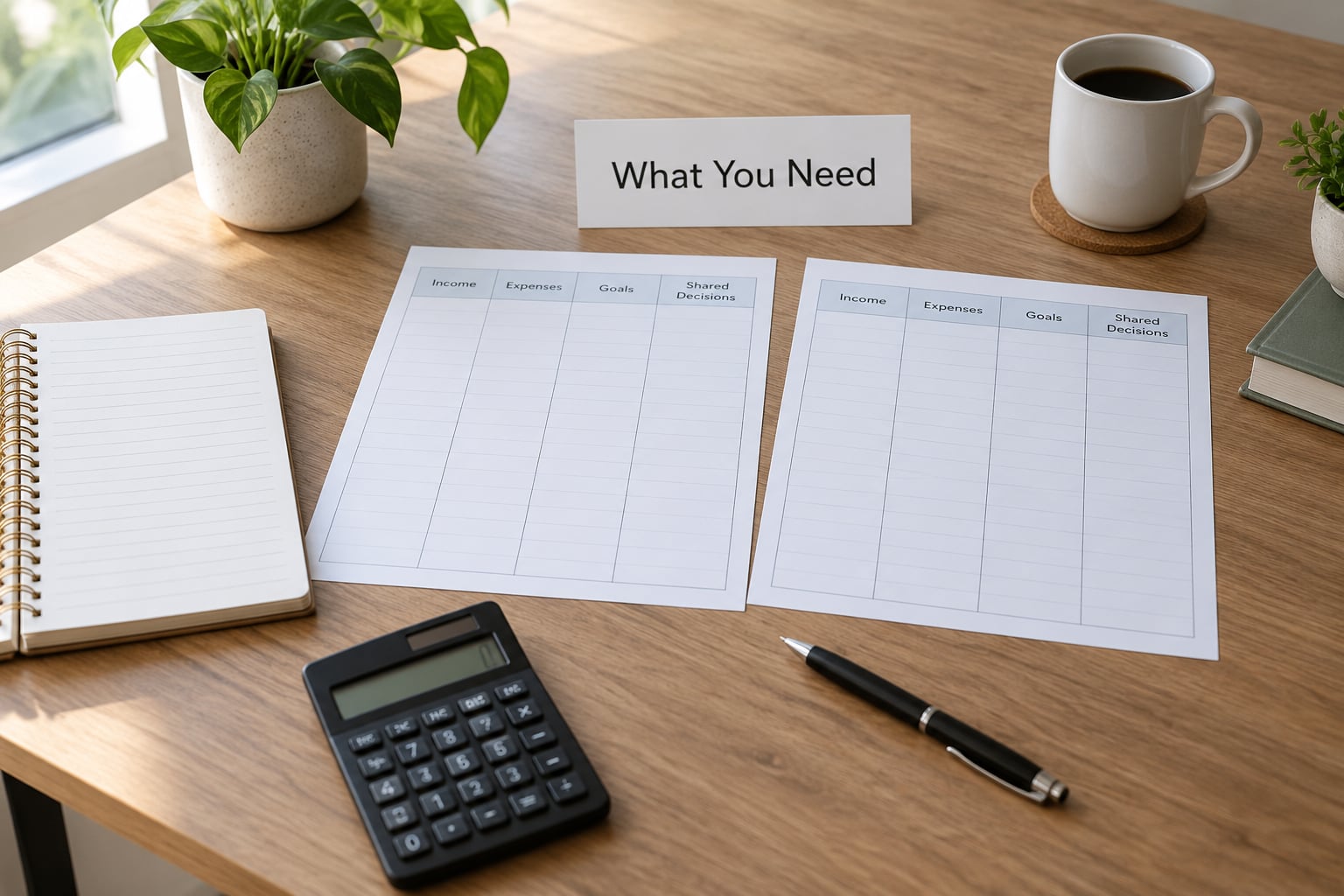
None of this is complicated, and none of it is shared before you start. You are walking in to describe your own position clearly, not to audit anyone.
- Thirty quiet minutes. A car ride, a walk, or a kitchen table after the dishes work better than the sofa during a movie.
- Your own numbers. Take-home pay, fixed bills with due dates, what you spent on variable costs last month, what you owe and at what rate, what you have saved.
- A list of everything. Every account, loan, card, and subscription either of you has, including the ones you opened alone.
- Your top three priorities. If you had to name three things money has to do for you in the next five years, what would they be?
- The specific decision. One thing you want answered by the end of the conversation, written on a piece of paper before you sit down.
- One shared place to write. A spreadsheet in a cloud drive or a budgeting app you both have access to. Not a document one of you owns and edits.
Leave a number out and write “unknown” next to it. A blank is information, and you can plan around it. A guess, once said out loud, becomes a fact you have to argue down later.
Step-by-Step: How to Talk About Money With Your Partner
1. Decide What You Need to Discuss
Most money conversations fail because they try to solve a marriage in one sitting. You need one or two topics, not a full financial review.
Good first topics are small and concrete: how the rent gets split, which recurring bills are going up, whether the emergency fund gets contributions before the holiday, what happens to the car payment if someone loses hours. A large topic like “we need to get our life together financially” is not a topic. It is a mood.
Write your decision at the top of the shared document in one sentence. “Decide whether we open a joint savings account for the emergency fund by the end of this month.” Now you both know what success looks like before anyone gets tired.
You know the conversation worked when the first three sentences out of your partner’s mouth are about the topic, not about how you brought it up.
2. Choose a Calm Time to Talk
Timing is the single biggest lever, and most couples pick the worst possible moment on purpose.
Do not start after a bill arrives, after an argument, after a layoff, or at eleven at night when one of you is ready for bed. Those conversations start with the nervous system already arguing. Pick a slot when you are both awake, fed, and not due anywhere: a weekend morning, a drive to the store, dinner that you deliberately do not clean up yet.
Say the date out loud in advance. A line like “I want to talk about our money stuff Saturday morning, nothing is wrong, I just want to get ahead of it” does more work than anything that happens in the room. Naming it as routine keeps it from sounding like an ambush.
Put the phone in another room. If your talk keeps ending early, this is usually why.
3. Share the Numbers Without Accusations
Neutral facts are the whole game. Every sentence should be something a camera could have recorded.
The rule of thumb is simple: describe the number and what you need, never what your partner is. “My card statement came to 1,400 this month and I want to understand where it went” is a workable sentence. “You spent 1,400 this month” starts a fight you will not finish.
Some lines that work as openers:
- “Here is what comes in and what goes out for me, and I want to hear yours on your terms.”
- “I have a credit card balance I need to tell you about, and I would rather say it now than have you find it later.”
- “We both grew up seeing money handled differently. Can you walk me through how it worked in your house?”
- “If we got a ten-thousand-dollar windfall tomorrow, what would you want to do with it?”
That last one is the most useful question in the whole conversation. Hypotheticals feel safer than real numbers because nobody is on trial, and the answers usually reveal what your partner actually values: debt first, a house first, a sabbatical, or paying somebody back.
Ask more than you tell in the first ten minutes. You will learn something, and the people who get to speak first tend to set the tone for everything after.
4. Agree on a Shared Plan
A conversation becomes useful when it ends in a written decision with a name on it. One or two items is plenty.
Most households need to settle four mechanics, and each is a values decision dressed up as logistics:
- Joint, separate, or both. A joint account for shared costs and a personal account each is the arrangement most couples land on, because it funds the household without either person losing their own spending money.
- A spending threshold. Pick a number where you check in before buying: “above 200 we text each other first.” Small purchases do not need permission, and saying so out loud prevents the threshold from turning into control.
- An emergency fund. A few months of basic costs, agreed on before it is needed. Agreeing in advance means nobody is deciding under pressure later.
- Debt order. Agree which balances get attacked first and by how much each month, so nobody privately assumes it is being prioritized.
Two neutral frameworks help because neither one was invented by the person with more power in the room. The 50/30/20 rule sends 50 percent to needs, 30 percent to wants, 20 percent to savings and debt. The 7-7-7 rule puts 7 percent each into savings and investing, debt payoff, and spending now, with the remaining share as the balance to spend. Neither is law, and both work better as a starting draft you both edit than as a verdict you deliver.
If your incomes are very different, say the split out loud as a percentage or a fixed amount, decided openly, rather than letting one person quietly cover the gap and accumulate quiet resentment. Unequal earnings create friction when the arrangement is invisible, not when it is unequal.
You know it worked when the document has a name next to each action and a date next to each name.
5. Create a Follow-Up System
One good conversation does not fix a pattern. A short recurring one does.
Call it a money date. Thirty minutes, a recurring day and time, one topic, a shared document that stays open between meetings. Most couples put it in the calendar like a dentist appointment, and that is exactly the right energy: boring, predictable, non-negotiable in the way a good habit is.
Keep the agenda to three items you both add to beforehand. Do the same review after any big change, such as a job change, a move, a new car, or a layoff, because those are the weeks where the plan quietly stops matching reality.
You know it is working when nobody has to work up the nerve to start. The meeting begins, because the meeting always begins.
Common Money Personalities and How to Work With Each
Money style is usually learned, not chosen, which is why two reasonable people can look at the same bank statement and see a completely different household. Naming the pattern takes the moral judgment out of it.
| Style | What it looks like | What actually helps |
|---|---|---|
| Saver | Checks balances often, resists spending, hoards the shared fund, anxious about the emergency fund never being big enough. | Agree on a fixed monthly amount to move to savings so saving stops being a decision. Give them a number, not a category. |
| Spender | Buys to smooth over stress, underestimates the total of the small subscriptions, wants the freedom to choose in the moment. | Keep a spending threshold and a visible running total. Control works better as information than as permission. |
| Free spender | Genuinely generous, covers the other person often, does not track anything, avoids keeping score. | Make the number explicit and mutual. Generosity nobody can see is not generosity, it is a surprise later. |
| Avoider | Changes the subject, gets busy, agrees in the meeting and forgets after. | Shorten the meeting, ask one question instead of five, and follow up in writing the same day. |
Nobody is doing this on purpose to annoy you. That reframe is the fastest way to get from contempt back to negotiation.
Common Mistakes
Talking right after something goes wrong. A bill, a declined card, an argument an hour ago. The recent event becomes the evidence and you are both defending yourselves. Correction: wait a week, then open with the neutral version of the same problem.
Using you statements. “You never look at the account.” You statements describe your side and leave room for a reply; accusatory statements close the door. Correction: “I feel anxious when I do not know what is due this month, and I would like to look at it together.”
Walking out mid-conversation. It feels like self-preservation and both people read it as abandonment. Correction: say the pause out loud instead of taking it. “I am too heated to do this well. I want to come back to it Saturday at ten.”
Trying to settle the whole history. The last four years of spending is not on the agenda. Correction: forward-looking only. Old spending is information about patterns, not a score to settle.
Arguing about percentages as a weapon. A rule one partner imported from a blog and recited at the other is not a neutral framework. Correction: propose the rule as a draft you both edit.
Using a budget as a leash. Requiring approval for a coffee order turns a shared plan into surveillance, and the relationship loses the trust that made the plan possible. Correction: set a threshold high enough to be meaningful and low enough to leave adult freedom.
Skipping the talk because things are fine. The months when nothing is wrong are the cheapest months to build a plan, and the hardest to get booked. Correction: schedule the money date in the calm.
Having the same conversation repeatedly. This is the loop most couples describe: sixty minutes every quarter, no written decision, nothing changes. If you have had three of these, something needs to be written down or something needs to be admitted.
Frequently Asked Questions
How do I talk about money with my partner if we have very different incomes?
Decide the split out loud instead of letting one person quietly cover the gap. Pick a percentage of take-home pay or a fixed monthly amount, say it plainly, and revisit it at a set date rather than month to month. Most friction with unequal income comes from the arrangement being invisible, not from it being unequal. Some couples pair a fully shared account with a smaller personal account each so the higher earner is not funding everything in real time.
Should couples have separate accounts or a fully shared budget?
The most common working setup is a joint account that covers shared costs, plus a personal account each, plus one shared savings account for the emergency fund and big goals. A fully merged setup makes tracking easy but can leave someone nervous about every purchase. Fully separate works for some couples but tends to rebuild the wall you were trying to take down. Try the three-account version for three months before deciding it is wrong.
How do I bring up debt without blaming my partner?
Disclose it before it comes up on a statement, and lead with the plan rather than the confession. A workable line is: I have a balance I want you to know about, here is the number, here is what I pay every month, and here is what I would like to do about it. Say it in the calm, put the payoff order in writing, and make one payment you would have skipped before. Guilt helps nobody pay anything down.
What if my partner does not want to discuss money at all?
Name the pattern rather than the person. Say something like: I have asked three times and the subject gets closed, and I am starting to read that as avoidance rather than a disagreement. Then agree on a smaller version: one question, fifteen minutes, one Saturday. If there is still no engagement after that, the refusal is itself the information, and you get to decide what to do with it. Couples therapy is the right next step when talking alone stops working.
How often should we review our finances together?
Thirty minutes a month for a money date with one topic is enough for most couples, and it beats a two-hour session that never happens. Add a longer review twice a year for insurance, retirement contributions, and anything that changed. Check in within a month of any big shock, such as a job loss, a move, or a new child, because those are the weeks when the old plan quietly stops applying.
When is a financial adviser or counselor appropriate to involve?
Bring in a couples therapist when the same argument keeps repeating, when shame is involved, or when one of you has hidden something and trust is broken. A financial planner makes sense once the shared goals are clear, for tax questions, retirement accounts, debt payoff order, and insurance. How money rules and tax treatment work varies by country and state and changes, so check specifics with a professional rather than relying on a general guide.
Conclusion
Start with one topic, not the whole picture. Write your own numbers first, book a calm half hour, and aim at one shared decision you can both name a week later. That is the whole method, and it works better than any perfect plan nobody ever sits down to write.