
To define the relationship without pressure, state your own position first, then ask whether theirs matches. You are not demanding a label from them — you are offering yours and asking a question. That shift turns a confrontation into two people comparing positions, which is far easier to answer honestly. Most of the work happens before the conversation, not during it.
Here is the short version, then the detail:
- Get clear on your own position: what you want, what you can accept, and how long you can wait.
- Pick a calm, unhurried moment, in person when you can, by text when talking out loud feels impossible.
- Describe what you have noticed, using observations instead of accusations.
- Ask what the relationship means to them, then stay quiet enough to hear it.
- Say out loud what a defined relationship would look like for you.
- Agree the next step, not a label. Give a real timeframe and follow up on it once.
Asking where you stand is not needy. What creates pressure is a deadline attached to someone else’s answer — the sense that they must perform commitment on your schedule. Take the deadline off and the same question becomes something most people would rather answer than avoid.
Table of Contents→
- What You Need Before You Ask
- Step-by-Step: How to Define the Relationship Without Pressure
- Step 1: Check Your Own Readiness
- Step 2: Choose a Calm, Private Moment to Define the Relationship Without Pressure
- Step 3: Describe the Situation Without Accusations
- Step 4: Ask What the Relationship Means to Them
- Step 5: Share Your Definition and Boundaries
- Step 6: Agree on the Next Step, Not a Forced Label
- Common Mistakes to Avoid
- Frequently Asked Questions
- How long should you wait before defining a relationship?
- How do I ask what we are without sounding needy?
- Should I text or call to ask what we are?
- What do you say when they say they are not ready for a relationship?
- How many times should I ask before I know the answer?
- Is it needy to ask where we stand?
- Conclusion
What You Need Before You Ask

You need four things, and none of them are a script.
The first is a calm stretch of time with nowhere else to be. Not the twenty minutes after a fight, not the walk to a car at the end of a date where one of you is already tired. The second is enough shared context that you can describe the situation without inflating it — how long you have been talking, whether you have met each other’s people, whether you are already exclusive in practice.
The third is an honest answer to a harder question: what do you actually want? Some people want a partner. Some want exclusive dating without a title. Some want to keep seeing who the other person is for a while longer. All three are legitimate, and you cannot state a position you have not worked out.
The fourth is flexibility about their timeline — and only their timeline. You can give someone room to think. You cannot give away your own limits.
That distinction is worth sitting with, because it is where most people tangle. Defining a relationship is a mutual agreement about exclusivity, expectations, intentions, time together and effort. It is not a deliverable with a due date.
| Component | What agreement looks like |
|---|---|
| Exclusivity | Both people are dating each other and not anyone else, stated out loud rather than assumed |
| Expectations | Contact patterns, time together, plans around weekends and holidays |
| Intentions | Whether this is headed toward something long-term or is genuinely open-ended |
| Effort | Who plans, who drives, who keeps things running when life gets busy |
| Review points | An agreement to check in later rather than never |
It also helps to name where the pressure in your life is actually coming from. Sociologist Elizabeth Brake calls the assumption that everyone should be coupling up amatonormativity. Much of the urgency readers bring to this question comes from friends, family, apps, or an internal deadline that has nothing to do with the person sitting across from you. Take that layer off and you can ask a calmer question.
Step-by-Step: How to Define the Relationship Without Pressure
Six steps, in order. The order matters more than the wording.
Step 1: Check Your Own Readiness
Asking too early is not the only risk. Waiting too long has its own cost, and it is the one people underestimate.
Ask yourself four questions before you speak to them. How long have you actually been talking, and what has happened in that time? Are you already exclusive in practice, and was that ever said out loud? Have you met each other’s friends or family? Have either of you said the words “I love you”?
If most of your answers are yes and no label exists, you are not being impatient. You are describing a situation that is genuinely contradictory.
There is no universal deadline, and the date rules floating around online are not evidence. Use readiness signals instead: you feel settled rather than anxious in their company, you have seen them handle ordinary life, and you can imagine what a boring Tuesday with them looks like. If you are mostly managing your own nerves about the status, that is a reason to slow down, not to push forward.
What you want from this step is a sentence you could say out loud. “I want to be exclusive with you, and I would like us to call it a relationship” is a complete position. It does not need anyone’s permission first.
Step 2: Choose a Calm, Private Moment to Define the Relationship Without Pressure
Pick a moment where neither of you is rushed, distracted or about to leave. There is a simple rule for the channel, and it is worth stating plainly because it comes up constantly.
- In person when the answer matters and you have an hour. Tone, hesitation and eye contact all carry information that text strips out.
- A phone call when you cannot see each other soon but the conversation cannot survive being typed. Calls suit people who freeze when writing and warm up when talking.
- Text when you are far apart, when either of you has anxiety or ADHD, or when the ask is smaller than a full conversation — exclusivity rather than a label.
Text gets dismissed as cold, but it is often the kinder option. A message gives the other person time to read it twice and answer without performing composure. If your instinct is to send a paragraph at 11pm, write it, save it as a draft, and send it in the morning instead.
What to avoid: the fake “can we talk?” ambush. Forum advice regularly suggests manufacturing a pretext so the other person cannot prepare. It reads as a trick once they work it out, and it costs you the honest version of the conversation. Picking the channel is only the first half of how to define the relationship without pressure — the framing you use once they are listening is the other half.
Step 3: Describe the Situation Without Accusations
Open with what you have observed, not what you have concluded. “We have been together most weekends for two months and neither of us has said what we are” is a description. “You keep avoiding the question” is an accusation, and it puts them on the defensive before you have said anything about yourself.
Keep to observable facts — things you could both agree happened. Then move to your feeling with an I-statement.
| Backfires | Works better |
|---|---|
| “So what are we, already?” | “I have been thinking about where we are, and I want to know how you see it.” |
| “You never want to commit.” | “I have noticed we have never talked about being exclusive.” |
| “If you cared about me you would want this.” | “I want to be with you exclusively, and I want that to be said out loud.” |
| “I need you to choose me today.” | “I am ready to decide something, and I need to know where you stand.” |
| “We are basically a couple already, so just say it.” | “We behave like a couple and it does not have a name yet.” |
| “Tell me we’re not just fooling around.” | “I am not looking for something casual. What are you looking for?” |
| “Promise me this is real.” | “What does this look like for you in a month from now?” |
Notice what every line in the right column does. It describes, it claims, and it leaves the other person’s answer open. Nothing there demands a performance.
Step 4: Ask What the Relationship Means to Them
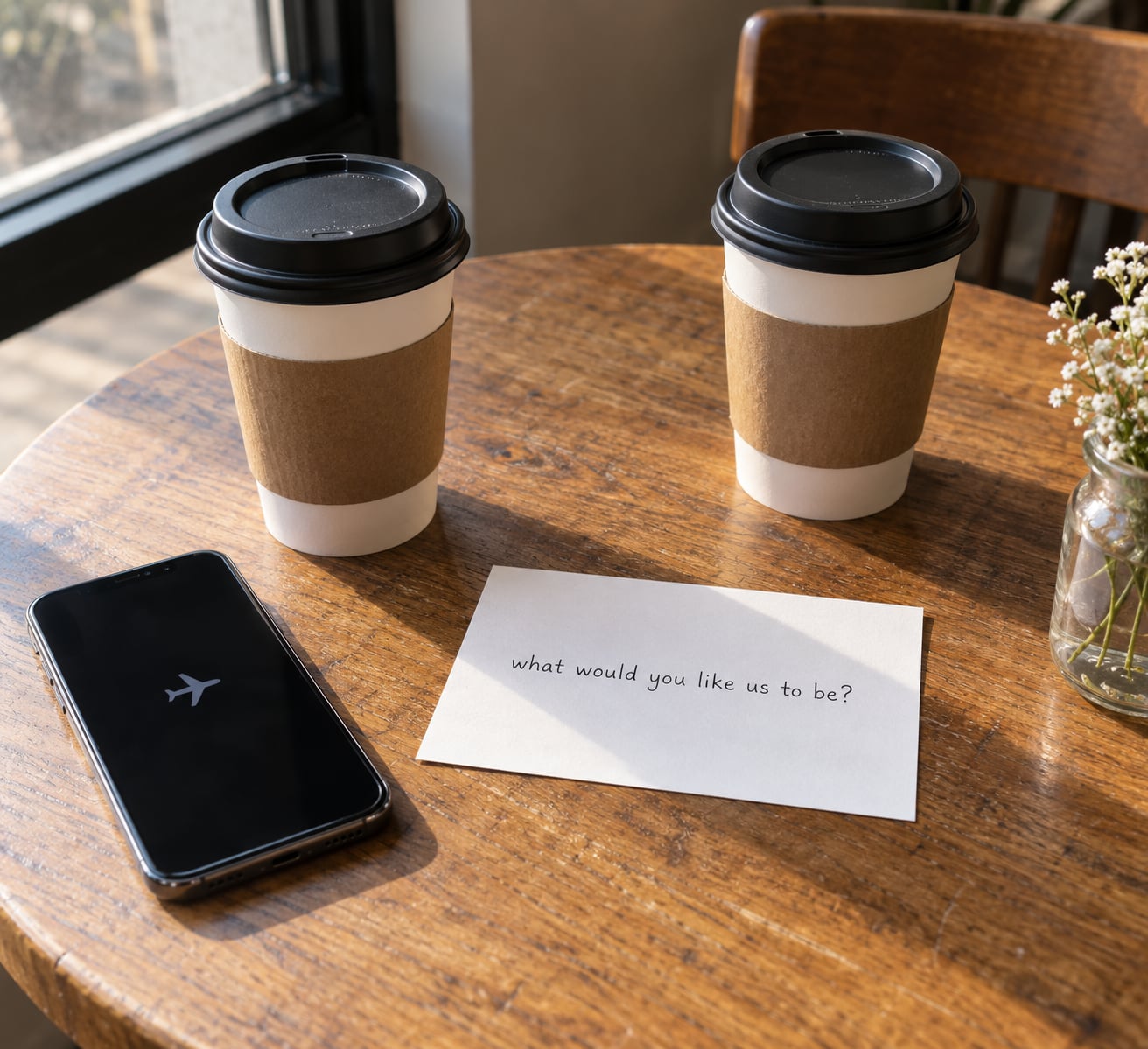
The question itself does most of the work, and it is not “what are we?” That phrasing asks someone to hand you a category, which feels like a quiz with a wrong answer.
Ask instead what they would like the two of you to be. On the GirlsAskGuys thread that ranks for this exact problem, the most-upvoted answer reframes it that way, and it works: it invites a description instead of a verdict.
- “What would you like us to be?”
- “What are you hoping this turns into?”
- “How do you see us in three months?”
- “Is this dating for you, or something else?”
- “Are we seeing anyone else?” — straight, and much less loaded than it sounds.
Then stop talking. The silence after a question feels unbearable to the person who asked it and completely normal to the person answering. Letting them finish is the single thing that makes people give you a real answer instead of a safe one.
Step 5: Share Your Definition and Boundaries
Say what a defined relationship would mean for you, concretely. Vague disclosure produces vague agreement.
Tell them what you are offering and what you are asking for: seeing each other exclusively, weekends together, plans made ahead of time, being each other’s default call when something goes wrong, a conversation in a month to check whether it still fits. Tell them the pace you are comfortable with too, because some people need three months of deliberate progression and some need six, and neither of those is a red flag.
Frame it as information rather than a condition. “Here is what I am looking for, so you know whether it matches what you want” lands completely differently from “This is what you have to do.”
Do not soften it into mush, though. A boundary that is hedged until it is indistinguishable from a preference will be treated as a preference, and then you will be back here in three months.
Step 6: Agree on the Next Step, Not a Forced Label
Very often the honest answer is not yes or no. Here is how to read each response and what to do next.
- “Yes, let’s make it official.” Say what exclusivity means in practice, then let it happen. Do not treat it as a victory lap.
- “I don’t know.” Usually honest rather than evasive. Give a real timeframe: ask them to think for two weeks and tell you on a specific day.
- “I’m not ready for a relationship.” A position, not a diagnosis. Ask whether not ready means not ready for you, or not ready in general. Those are different conversations.
- “Why does anything need to change?” A fair question. Answer it: you want to know you are choosing each other rather than defaulting to each other.
- “Maybe later” / “let’s see how it goes.” Ask for a date, not a mood. “Later” without a shape is a soft no, and you are allowed to treat it as information.
- Refuses to discuss it at all. Say plainly: “I am not able to keep being unclear about this. When you are ready to talk, I am here.” Then decide what you do with your own life in the meantime.
Whichever answer arrives, give yourself 48 hours before you react. Most people spiral immediately after a clarity conversation and send a long message they regret. Let it sit. Write down what actually happened, not what you are afraid it meant.
And follow up once. Readers ask constantly how many times they have to ask, because nobody gives them a number. The honest answer is twice: once to raise it, once after the timeframe you agreed on. After that, you are not being impatient — you are collecting data. A pause both of you agreed on is patience; a pause you imposed on them is pressure, and that is the whole difference between how to define the relationship without pressure and how to force an answer.
Common Mistakes to Avoid
Using the label as a test. “If they really cared, they would say the word.” A person who loves you and cannot yet call it a relationship will pass the test anyway, and the test told you nothing useful.
Sending an ultimatum. Choose me or lose me, decide tonight, pick me or I leave tomorrow. That is not honesty, it is a threat dressed as a boundary, and it reliably produces a defensive answer.
Comparing the situation with a friend’s. Your friend got a title at three weeks because they wanted one at three weeks. Speed is not evidence.
Overexplaining until the message sounds like a defence. Five paragraphs of reassurance usually means you are trying to make the question safe enough to ask. Two sentences is plenty.
Reading uncertainty as rejection. “Not ready” and “not interested in you” are different sentences, and reading one as the other ends things before they had to.
Waiting forever for them to raise it first. Somebody has to go first. The arrangement that suits you least is the one where you keep hoping they will start a conversation you have been ready to have for months.
One more: if the other person says “no pressure” before you have even asked anything, notice it. Sometimes it is a kindness. Sometimes it is a way of pre-empting the question so it never gets asked. You do not need to challenge it — just keep the question in the room.
Frequently Asked Questions
How long should you wait before defining a relationship?
There is no set number of weeks. A reasonable guideline is that the question becomes fair once you are already behaving as a couple and the status has gone unstated for long enough that the ambiguity itself is the problem. Waiting is sensible when you feel unusually anxious, have not seen them handle everyday life, or have barely seen each other outside planned dates. Most people are ready earlier than the date rule they read online suggested.
How do I ask what we are without sounding needy?
Say what you want before you ask what they want. Try: I am really enjoying this, and I want to be clear about where we stand, so I am going to say where I am at. I like us being exclusive, and I would like us to name that. Then ask what they would like us to be. Needing clarity is normal; a deadline attached to someone else’s answer is what turns a question into pressure.
Should I text or call to ask what we are?
In person when you have time and the answer matters, a call when you cannot meet and the conversation is too big for typing, and text when you are long distance, anxious, or the ask is only about exclusivity. Text is not cold. It lets the other person read the question twice and answer without performing composure, which often produces a more honest reply than a face-to-face conversation on a tired evening.
What do you say when they say they are not ready for a relationship?
Accept it as information and then check whether it is about you or about relationships in general. A useful follow-up is: not ready for a relationship with anyone, or not ready for one with me? The answer changes what you decide next. Do not offer to wait indefinitely or ask what would make them ready, which turns your calendar into their project. Take a few days, then decide what pace you can genuinely live with.
How many times should I ask before I know the answer?
Twice. Once to raise it, and once on the date you both agreed to. That second conversation is not pressure, it is a checkpoint you set in advance. If they cannot meet you even then, you have your answer, and it is not about the label — it is about whether this person will engage with something you clearly need.
Is it needy to ask where we stand?
No. Wanting to know where you stand is a normal request in any relationship that matters to you. It becomes uncomfortable to raise only when it arrives with a deadline, a comparison, or a threat attached. Strip those out, say plainly what you want, ask what they want, and you have made a reasonable request that they are free to answer any way they choose.
Conclusion
Write down your own position before you write a single message to them. One sentence, in your own words, saying what you want this to be — that is the whole thing. Then pick one question, ask it in a calm moment, and let the answer land without a deadline attached to it. Learning how to define the relationship without pressure starts with that sentence, not with the conversation.
If they cannot meet you there, that is useful information too. Clarity cuts both ways: sometimes it ends things you were quietly hoping would keep going, and that is a better outcome than another six months of guessing.
This is general relationship guidance, not therapy. If the uncertainty is tangled up with anxiety, a past betrayal, or a pattern you keep repeating, talking to a licensed therapist gives you a place to rehearse the conversation without worrying about the consequences.
Further reading
Elizabeth Brake writes on amatonormativity and why couplehood gets treated as the default. Relationship researchers have studied how uncertainty and perceived commitment affect whether people stay together, and work on the motives behind situationships is worth reading before you assume you are the exception. Try the Gottman Institute’s writing on bid and response for the practical side of requests.
Last updated October 2026.