
Couples argue about the same thing over and over because the visible topic is rarely the real problem. What looks like a fight about the dishwasher, the budget or the bedtime routine is usually a stand-in for something underneath, such as feeling unheard, unappreciated or unsafe. That need never gets named, so the argument resolves nothing and returns in the same shape a few weeks later. Every couple has one of these. Knowing which one you have is the first step toward stopping it.
There is a lot of advice out there about how to argue better. Less about why the argument keeps coming back, which is the harder question and the one most people actually have.
Table of Contents→
- Why Couples Argue About the Same Thing Over and Over
- What Is the Real Issue Beneath the Repeated Argument?
- How the Same Conflict Cycle Develops
- Is the Problem the Topic or the Way You Discuss It?
- How to Stop the Argument From Repeating
- How to Repair After the Argument Gets Out of Hand
- When Recurring Arguments Signal a Deeper Problem
- Frequently Asked Questions
- Is it normal for couples to argue about the same thing?
- What causes the same argument to keep coming back?
- How do you stop fighting about the same thing?
- Why does my partner walk out or go silent when we argue?
- How often is too often to argue with my partner?
- Should one of us apologise first after a recurring fight?
- Conclusion: Start With One Small Change
Why Couples Argue About the Same Thing Over and Over

The short answer is that repeated conflict is a pattern, not a topic. Two things usually happen at once. First, the surface issue carries an emotional payload the couple has never unpacked. Second, both partners respond to that payload with habits learned long before this relationship, and those habits feed each other.
You can spot the pattern by changing the topic and watching the shape stay the same. A couple who fights about money this month, vacation plans next month and where to eat on Saturday is probably not running three separate problems. The argument has the same structure each time: someone raises a concern, the other partner hears a criticism, defensiveness arrives, the temperature rises, and one person walks away.
On Reddit, people in r/Marriage and r/relationship_advice describe exactly this in their own words. One poster put it plainly: recurring fights all have the same shape even when the topic changes. Another described four years of living together with the same unresolved issue resurfacing unchanged, and the exhaustion of feeling that nothing they fix actually sticks.
Repeated conflict almost always comes down to one of four things:
- An unmet need that has never been spoken out loud, so it keeps surfacing through whatever topic is nearest.
- An old wound from earlier relationships, family or childhood that this argument accidentally touches.
- An unspoken expectation, where one partner assumed the other already knew how they should behave.
- A fixed interaction habit, usually pursue and withdraw, that takes over the moment either person gets upset.
Notice that none of those is the chore, the schedule or the money itself. Fixing the surface issue often feels like progress, and sometimes it is a real improvement. But if the need underneath stays unnamed, the argument comes back wearing a different outfit.
What Is the Real Issue Beneath the Repeated Argument?
Separating the visible topic from the concern under it is the hardest skill in this whole process. The table below maps the arguments couples report most often to the needs that often sit underneath them.
| What you argue about | What it can be about underneath |
|---|---|
| Chores and housework | Not being seen as a contributor, or carrying a share that feels unfair |
| Money and spending | Lack of trust about the future, or feeling disrespected when money is questioned |
| Parenting and childcare | Feeling unsupported as a parent, or alone in the day-to-day work |
| Sex and intimacy | Rejection, or a need for reassurance that is not being asked for directly |
| Time, schedules and whose turn it is | Being taken for granted, or having no say over your own week |
| Family and in-laws | Loyalty conflicts, or an old boundary that was never set |
| Decision-making | Not trusting the other person’s judgment or commitment to the relationship |
| Work and career choices | Feeling like your ambitions are treated as an inconvenience |
Read that as a set of possibilities, not verdicts. Plenty of arguments about dishes really are about dishes, and forcing a deep meaning onto a practical problem makes everything harder. The way to tell the difference is simple. If you settle the practical question and the relief lasts for weeks, it was a practical problem. If you settle it and the same tension returns within days, there is something underneath.
Ask one question when the topic flares up: what would this need to look like for me to feel okay? The first answer that arrives is usually still about the topic. Push a little further. What does that ask for from you? Almost always it comes down to a small set of things, such as being listened to, being appreciated, feeling safe to say no, or knowing you are on the same team.
Be careful with one popular line, the idea that the fight is never about the topic. Couples who lean on it too hard start dismissing real problems. A leaking tap is a real problem. Sometimes the honest answer is that a recurring argument has both a practical component and an emotional one, and both need handling.
How the Same Conflict Cycle Develops
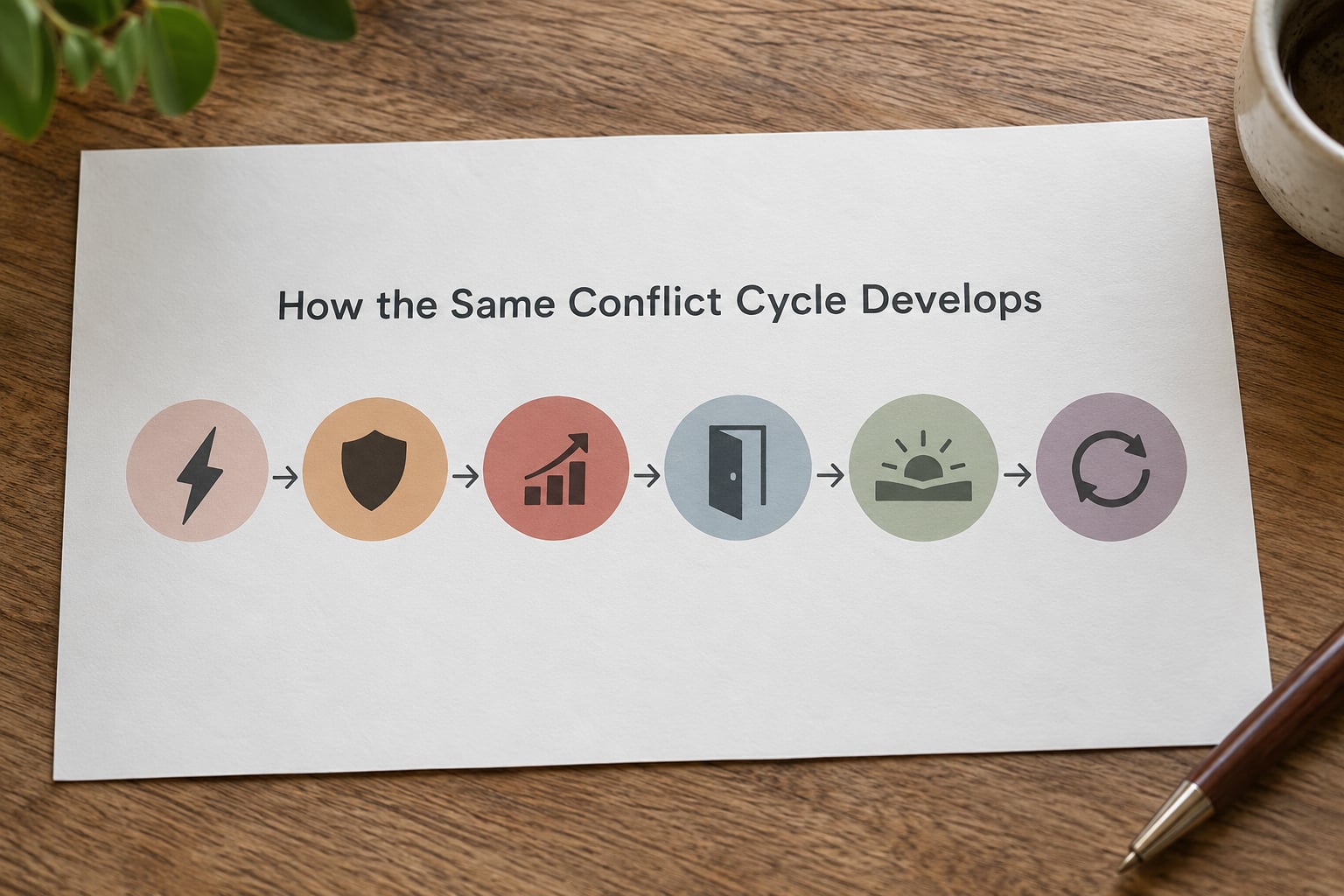
The reason the same fight returns is mechanical. Relationship researchers often call this the negative interaction cycle, and once a couple is inside it, each step pulls the next one into place. Neither partner is choosing it consciously.
- A trigger lands. Someone makes a comment, forgets something, or brings up an old decision. On its own it is small. It lands on an existing sore spot, which is why the reaction is so much bigger than the event deserves.
- The first reaction is defensive. Instead of hearing the concern, the other partner hears an accusation. Counter-attacks, excuses and explanations arrive, often within seconds.
- Escalation adds heat. Tone rises, interruptions multiply and the conversation shifts from the issue to old material. This is the stage where contempt shows up if it is going to, and Gottman’s research treats contempt as a particularly corrosive behaviour because it signals the partner has stopped being seen as someone worth respecting.
- Shutdown or pursuit. One partner pulls away and the other chases, or both withdraw and the argument dies from exhaustion. Whichever happens, nobody has actually heard the original concern.
- The calm arrives. The house goes quiet, the topic gets dropped, and life resumes. Many couples describe this as resolution. It is not. It is a pause.
- The unresolved issue returns. Because the need was never named and no agreement was reached, the next trigger lands on the same open spot. The loop is ready to run again.
That last step is why settling the logistics afterwards often changes nothing. You agreed who takes the bins on Tuesdays. The feeling underneath, whatever it was, was never on the table, so it stays pending.
Common Patterns That Keep Couples Returning to the Argument
Each of these habits quietly reinforces the loop, and each has a workable replacement.
Mind reading. You assume you know what your partner meant and respond to that assumption. Replace it with a check: I may have this wrong, but this is how it landed.
Globalising. You always do this turns one specific incident into a character verdict about the person. It is the fastest route to contempt. Replace it with the specific event and the specific request.
Defensiveness. Hearing a complaint as an accusation, so the only available move is to explain why it is unfair. Counter-arguments feel like counter-attacks from the other side, and the conversation hardens. Try naming the feeling first, before any facts.
Stonewalling. Going silent, leaving the room or answering with monosyllables. Withdrawal under pressure is common, especially if someone grew up in a home where anger was punished. But the person on the receiving end experiences silence as being abandoned, and that reading makes the next pursuit more intense.
Rehashing. Bringing up a grievance from six months ago in the middle of a new fight. It confuses a fresh problem with an old one and guarantees both partners retreat. Handle old business on its own scheduled terms, or let it go.
Assuming the obvious is understood. You care about something, you have shown it, and you cannot understand why it is not showing up. The other partner genuinely does not know. Unspoken expectations are a quiet cause of repeat offences, because the person failing to meet a standard was never told what it was.
Is the Problem the Topic or the Way You Discuss It?
Some arguments end with a decision and stay ended. Others get decided on paper and reappear anyway. This table separates the two, because treating each kind correctly saves a lot of wasted effort.
| A practical disagreement | A pattern problem |
|---|---|
| You can name what each of you wants | You cannot name what anyone wants |
| The conversation ends with an agreement someone might keep | The conversation ends in silence and nothing changes |
| Tone gets uncomfortable but stays respectful | Mocking, eye-rolling, name-calling or intimidation appear |
| One person can say I get your point without collapsing | One person refuses to engage for weeks |
| The topic stays on the topic | Old grievances get pulled in as ammunition |
| Afterwards you feel roughly okay | Afterwards one person feels afraid and the other feels nothing |
| The issue is about logistics or money | The issue is about worth, loyalty or safety |
If the left column fits, a decision may be all you need. Agree on it, write it down if the details are fiddly, and move on.
If the right column fits, no decision will hold, because the argument is doing a job the discussion cannot do. Working through a trust or safety problem takes slower conversations, usually ones that start when nobody is upset. Emotionally Focused Therapy, the approach developed by Sue Johnson, is built around this idea: the fight is a bid for connection, and the way to break the loop is to answer the bid rather than win the point.
One more distinction worth keeping. There is a real difference between a recurring conversation and a circular brawl. A recurring conversation has movement. New information arrives, positions shift, and by the end something is different even if the topic recurs. A circular brawl goes nowhere, and both partners can predict every line of it. Couples often describe the moment they realised the arguments had become scripted. That moment matters.
How to Stop the Argument From Repeating
This process takes a few conversations. It works better cold than it does in the heat, so aim for a calm hour rather than the ten minutes after something goes wrong.
- Pause safely, and agree on when you come back. The biggest problem with a break is not taking one. It is taking one with no return time, so the break quietly becomes the end of the conversation. Say when you will resume: I need twenty minutes and then I want to finish this. On forums like bpdfamily, the do-not-do list for a hot argument has become popular for a reason: do not argue, do not defend, do not justify, do not explain, do not counter-attack. Take care of yourself and take the time out.
- Name the topic narrowly. State the subject in one neutral sentence, without blame. Not you never help with the bins, but bins and the food waste.
- Identify the need. Ask what is at stake for you, and listen for the answer underneath the answer. Usually the first answer is a want and the second is a feeling.
- Make one specific request. Vague requests are what start fights, because nobody knows what would count as doing better. Ask for something observable and small enough to actually happen.
- Listen for meaning, not just facts. When your partner explains, resist building your rebuttal. Look for the fear under the facts. Validation is not agreement; it is telling someone their experience makes sense before you discuss whether you see it the same way.
- Agree one next step, in writing if it helps. Not a complete solution. One change, with a date attached, and a check-in. Small agreements that get kept create the trust that larger conversations need.
- Bring up what is still pending later, on purpose. Some things will not be resolved in one conversation. Put them on a list and revisit them when nobody is activated, instead of dropping them and wondering why they returned.
Language does a lot of the work. Swapping blame for a need statement is the single biggest change most couples can make, and it costs nothing to try.
| Instead of | Try |
|---|---|
| You never listen to me | I need to finish my sentence before you answer, can you do that? |
| You do nothing around here | I feel alone with the house. I need two evenings where I am not the one doing it |
| You are always on your phone | When we are talking, I want your eyes here for ten minutes |
| You shut down every time | When you go quiet I feel shut out. Can you tell me you need a break? |
| Why do you never listen? | When I talked about the holiday I needed you to say yes or no, not stay quiet |
| Fine. Whatever. | I am too wound up to do this well right now, I want to come back to it at eight |
If only one partner is willing to try any of this, the effort still shows, and plenty of couples report that one person’s consistent change eventually shifts the other. r/PMDDpartners threads make the same point from a different angle: a planned break, agreed in advance, does more than an improvised exit every time.
How to Repair After the Argument Gets Out of Hand
Most couples who get stuck already know how to argue well on an ordinary day. What they are missing is the repair, which is a separate skill and one that can be learned.
Repair starts with your own contribution. Saying I am sorry you were shouting at me shifts attention to their behaviour; saying I raised my voice and kept pushing after you asked me to stop puts the responsibility where it belongs. Vulnerable accountability does more in a stalled cycle than any defensive explanation.
Next, clarify the impact without adding blame. I felt alone and unimportant in that conversation is a description. You always make me feel this way is an accusation.
Then apologize specifically. A real apology names the behaviour, acknowledges the effect and asks nothing in return. Skip the word but if you go straight to the other person’s part, it reads as a defence rather than a repair.
Finally, agree on one thing that will be different next time. Not a promise to never get angry. Something concrete: either person can call a ten-minute break, no raised voices after the second one, or no returning to old arguments once a topic is closed.
Timing matters. A repair attempt shouted across the house during the fight rarely lands. Wait until you can both speak without heat, even if that is the next day.
When Recurring Arguments Signal a Deeper Problem
Most repeated conflicts are a communication pattern, and communication patterns respond to work. A few things do not, and treating them as a communication problem wastes time and can cause harm.
- Sustained contempt. Mockery, eye-rolling, name-calling and sneering have a different weight than raised voices. Gottman’s work treats contempt as one of the strongest signals that a relationship is heading the wrong way.
- Intimidation. Threats, blocking a doorway, destroying things, throwing or punching walls, or a fear of what will happen if you push back.
- Coercive control. One partner controlling money, friendships, movement, clothing or contact with family, and treating any objection as part of the argument.
- Repeated dismissal. Every concern is ridiculed, turned into a joke or met with total silence for days, with no willingness to discuss the pattern at any point.
- One-sided responsibility. The same person always apologises, always repairs, always changes the topic, and any request to share the load is treated as an attack.
Some forums carry posts that sound like this one. Someone describing walking on eggshells, crying most days and being insulted over small things is not describing a recurring disagreement. Where there is intimidation or control, the priority is safety, not communication technique. A couple’s exercise will not fix coercion, and asking a person in that situation to soften their communication can make things worse.
Reach out to a domestic violence organisation, a family law or legal aid service, or a professional with experience in coercive control, and get support before you get couples advice. If you are not sure whether what you are living with falls here, trust that feeling and ask someone qualified.
This article is general relationship information, not a diagnosis or a substitute for individual counselling. If either partner has a diagnosed mental health condition, a trauma history, or symptoms that worsen during conflict, a licensed therapist can help you understand what is driving the loop.
For everything short of that, couples therapy is genuinely effective on recurring conflict, and neither partner has to be the one who calls. One person walking in alone is a common starting point.
None of this means repeating fights always mean the end. Plenty of long, happy couples have a topic they still argue about. What matters is whether the arguments move, whether respect holds, and whether both people keep showing up. That is the line this article keeps coming back to.
Frequently Asked Questions
Is it normal for couples to argue about the same thing?
Yes, in moderation. Most couples have one or two recurring topics, usually money, chores, time or parenting, and repeating a topic is far less worrying than repeating the same destructive pattern. Healthy recurring arguments move: something is learned, positions shift, and the next one is shorter or calmer. A problem looks different when the topic is settled on paper and the tension returns within days, when contempt shows up, or when neither person has tried to change how the conversation goes.
What causes the same argument to keep coming back?
Usually four things in combination: an unmet need that has never been named, an older wound the argument keeps touching, an unspoken expectation you assumed the other person knew, and a fixed response loop. One partner pursues, the other withdraws, and both read the other’s reaction as proof they do not care. Because the original concern is never actually heard or resolved, it resurfaces with the next trigger. Settling the practical part alone rarely changes this.
How do you stop fighting about the same thing?
Name the topic in one neutral sentence, then say what you need underneath it, then make one specific, observable request and agree a time to check whether it happened. Take breaks during the argument, but always name when you are coming back so the pause does not become permanent. Hold old grievances for their own conversation instead of using them in the current one. If the same fight returns after several genuine attempts, couples therapy breaks patterns faster than either partner can alone.
Why does my partner walk out or go silent when we argue?
Most often it is overwhelm rather than indifference. When the nervous system floods, talking feels dangerous and going quiet feels like the only way to stop it, especially for people who grew up where anger was punished. The difficulty is that silence gets read by the other person as rejection or abandonment, which makes the next pursuit more intense and the next exit more necessary. Agreeing in advance on a signal and a return time, for example a break with a time to resume, keeps withdrawal from becoming stonewalling.
How often is too often to argue with my partner?
There is no useful number, because severity of the content matters more than frequency. Two respectful disagreements a month about money is a normal relationship. So is one hard conversation a week that ends with a repair. Two arguments a week where people walk away cold, or any pattern involving insults, intimidation or controlling behaviour, is a different category entirely. Judge it by what happens inside the argument and afterwards, not by how many you had this month.
Should one of us apologise first after a recurring fight?
Not automatically. The person who apologises first purely to end the discomfort often ends up apologising for the same thing repeatedly, which builds resentment over years. A repair only works when it names real behaviour and takes real responsibility. If each person owns one piece of what happened, no one has to move first alone. And if one partner never contributes anything to the conflict, that asymmetry is worth naming directly rather than smoothing over every time.
Conclusion: Start With One Small Change
The reason why couples argue about the same thing over and over is that the topic is a carrier, and the payload was never unloaded. You do not fix it by solving the argument better. You fix it by naming what the argument is carrying, and then agreeing on one small change you will both keep.
Pick one: replace a complaint with a need statement, or agree in advance when you will pause and when you will come back. Do that once, properly, and see whether the next round of the same fight feels different. That is where the change starts.
Last reviewed and updated for 2026. This article is general relationship information and is not a diagnosis or a substitute for individual counselling.