
A monthly check-in is a scheduled conversation where two partners take turns answering a short set of prepared questions about how the relationship actually felt over the last 30 days. Asking relationship check in questions to ask monthly works because most couples drift into logistics, and a fixed appointment forces out the conversations small talk never reaches.
Here is the honest version: nobody sits down for fifteen questions. You pick four to six, you time-box it to 30 or 45 minutes, and you close with one small commitment. Couples who run a monthly ritual tend to use past-tense, behavioral prompts, which is why most of the ones below ask what happened rather than what you feel about everything.
Copy this page, mark it up, and run the same four to six relationship check in questions to ask monthly every time so you can actually track the answers.
Table of Contents→
- Relationship Check In Questions to Ask Monthly at a Glance
- 1. How Are We Feeling About Our Relationship Right Now?
- 2. What Has Made You Feel Most Connected to Me Lately?
- 3. Is There Anything You Have Been Holding Back?
- 4. How Satisfied Are We with Our Communication?
- 5. What Do You Need More or Less Of From Me?
- 6. Has Anything Changed in Your Stress or Well-Being?
- 7. Are There Any Small Friction Points We Should Fix?
- 8. What Kind of Quality Time Works Best for Us This Month?
- 9. How Can We Make Our Intimacy Feel Better for Both of Us?
- 10. What Is One Goal You Have for Yourself This Month?
- 11. What Shared Goal Are We Most Excited About Right Now?
- 12. Do Our Plans for the Future Still Feel Aligned?
- 13. What Conflict From This Month Do We Need to Resolve?
- 14. What Do You Appreciate About How We Have Handled Recent Challenges?
- 15. What Is One Small Action We Can Take Together Next Month?
- Frequently Asked Questions
- What are good relationship check in questions to ask monthly?
- How long should a monthly relationship check-in be?
- Should a relationship check-in happen on a specific day?
- What if one partner does not want to do a monthly check-in?
- How do we keep relationship check-in questions from turning into criticism?
- What should we do with the answers after a monthly check-in?
- Conclusion
Relationship Check In Questions to Ask Monthly at a Glance
The full list of monthly check-in questions sits below. This table is the shortcut: it maps all 15 prompts to the area each one covers and the moment in the month when it does the most work, so you can build a shorter set that fits your relationship.
| Prompt | What it covers | Best time to use it |
|---|---|---|
| How are we feeling about our relationship right now? | Overall emotional pulse | Opening question, every month |
| What has made you feel most connected to me lately? | Appreciation and connection | After a distant or difficult month |
| Is there anything you have been holding back? | Unspoken concerns and safety | Mid-month, not first thing |
| How satisfied are we with our communication? | Communication habits | After any argument |
| What do you need more or less of from me? | Support and needs | During a high-stress stretch |
| Has anything changed in your stress or well-being? | Capacity and load | When work or health spikes |
| Are there any small friction points we should fix? | Chores, habits, annoyances | Second half of the month |
| What kind of quality time works best for us this month? | Time, dates, attention | Planning the month ahead |
| How can we make our intimacy feel better for both of us? | Affection and physical intimacy | Mid-month, when nobody is exhausted |
| What is one goal you have for yourself this month? | Individual priorities | Early in the month |
| What shared goal are we most excited about right now? | Joint direction | Early in the month |
| Do our plans for the future still feel aligned? | Big-picture direction | Quarterly, or at life changes |
| What conflict from this month do we need to resolve? | Unresolved threads and repair | Whenever something is stuck |
| What do you appreciate about how we handled a recent challenge? | Strengths and resilience | After a setback or external stress |
| What is one small action we can take together next month? | Commitment and follow-through | Closing question, every month |
Take the first, second, and last rows as a solid default set of three. Everything else waits for the month that needs it.
1. How Are We Feeling About Our Relationship Right Now?

Start every check-in here. This is a broad emotional pulse, not a review, and it works because a rating out of ten forces both partners to commit to a position instead of hiding behind “fine”.
Expect the two answers to diverge. One of you may say 8 while the other says 5, and that gap is the most useful data you will get all month. Ask what sits behind each number rather than arguing about who is more optimistic.
2. What Has Made You Feel Most Connected to Me Lately?
This one is for noticing, not performance. Couples who do well at this name specific behavior, such as a text that checked in during a long shift, a joke nobody else would have gotten, or ten minutes of an unhurried conversation with the phone in another room.
The reason it matters is that connection is built from repeated small acts, not from one big gesture a year. Naming them out loud teaches both of you what actually works, instead of each guessing.
3. Is There Anything You Have Been Holding Back?
Ask this one gently and mid-month, never as the opener. People often carry a small irritation for weeks because there was no moment set aside for it, and by the time it surfaces it has hardened into something bigger.
The listener’s job is to not interrupt and not defend. Repeat the concern back in your own words, ask one clarifying question, and resist the urge to explain your side yet. If the answer surfaces something serious like abuse, coercion, or betrayal, a check-in is the wrong room for it; talk to a qualified professional or a support line instead.
4. How Satisfied Are We with Our Communication?
Ask for a number, then ask what would move it up a point. Most couples who feel unseen are not having a conflict, they are having conversations that skip past the real subject entirely, and neither person names the pattern.
Watch for habits worth adjusting: one partner does all the asking while the other only answers, yes or no answers to open questions, or bringing up something important at 11pm when both people are spent.
5. What Do You Need More or Less Of From Me?
This is the practical version of feeling cared for, and it works better than vague requests for support. “More or less” is the important half, because relationships tend to accumulate excess in one direction without anyone deciding it.
For example, you might need more help planning and more reassurance during a stressful week, while your partner is actually worn out by the reassurance and needs less of it, not more. Both answers can be true.
6. Has Anything Changed in Your Stress or Well-Being?
Ask before you advise. Work, health, family, money, and caring duties all change a person’s capacity for conversation, and a full month is exactly long enough for that shift to go unnoticed on both sides.
Keep it practical rather than diagnostic. You are not diagnosing anything; you are finding out whether this month needs a different pace, fewer commitments, or more alone time.
7. Are There Any Small Friction Points We Should Fix?
Most recurring annoyances are tiny and fixable in under ten minutes, yet they accumulate because nobody raises them while the irritation is still small. Untended chores, late replies, and mismatched planning styles all belong here.
Limit this to three items and give each one a five-minute decision on the spot. If it cannot be solved in five minutes, it is not a friction point, it belongs under question 13 where it gets real attention.
8. What Kind of Quality Time Works Best for Us This Month?
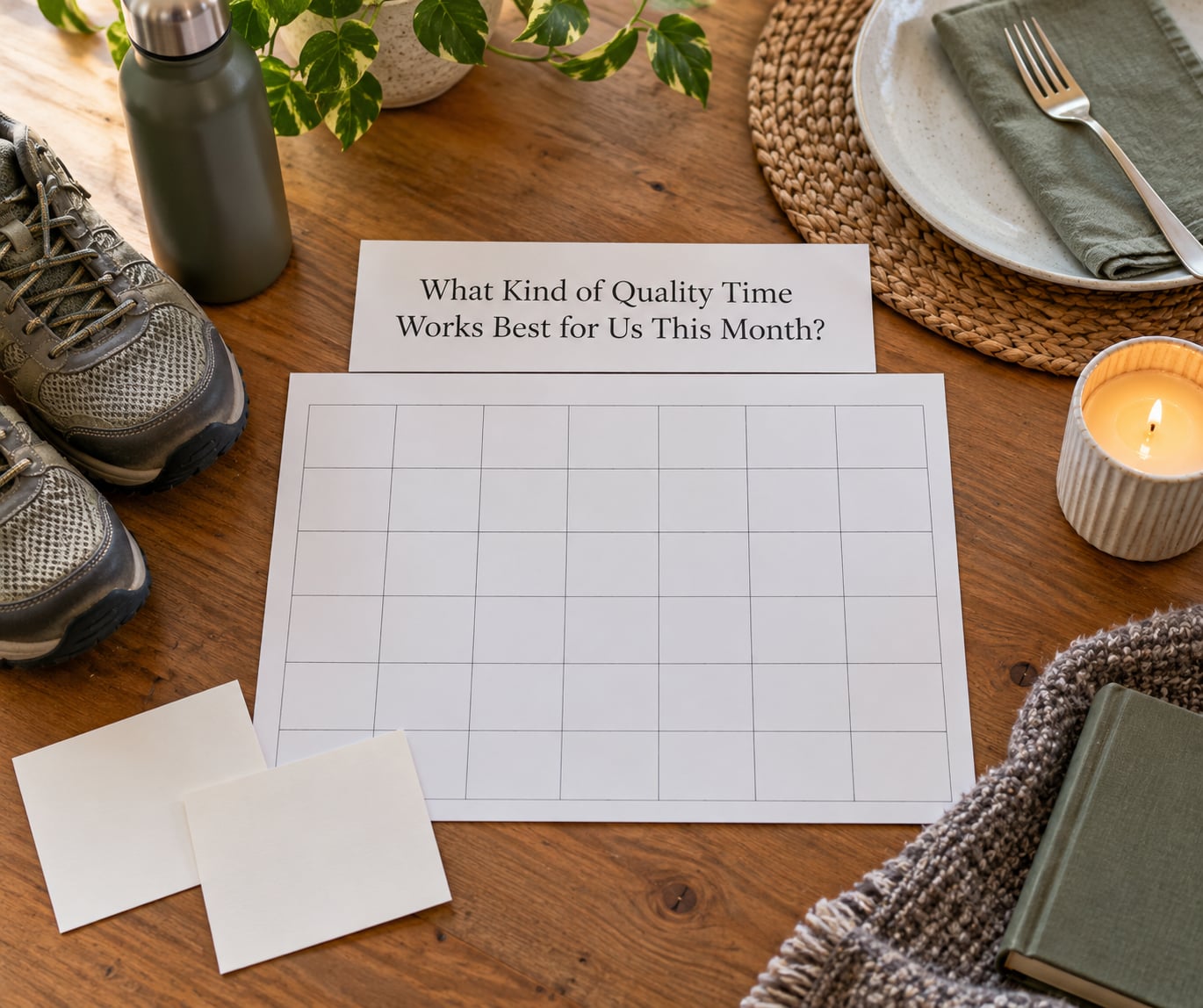
Compare what each of you actually wants rather than defaulting to the same tired routine. One person may want planned dates out, the other quiet time side by side with no talking required, and shared activities somewhere in between.
Then agree on one plan, not a list. A single realistic date scheduled and put on the calendar beats four good intentions, and phone-free attention usually matters more to people than the specific activity does.
9. How Can We Make Our Intimacy Feel Better for Both of Us?
Open this one with consent and curiosity, because the most common failure is assuming you both want the same thing. One partner is craving affection and closeness, the other is craving space, and neither of those is a rejection.
Keep the scope wide enough to include emotional intimacy, physical affection, and time alone, since they are not the same need. When in doubt, ask what would make the other person feel more at ease, then leave room for a no.
10. What Is One Goal You Have for Yourself This Month?
Each partner has a life that is not about the relationship, and this question protects that. A training block, a difficult project, a course, or recontacting an old friend all count.
Your role is to support it, not manage it. Keep the check-in from turning into a performance review by asking only how you can help and by leaving the review of progress for the following month.
11. What Shared Goal Are We Most Excited About Right Now?
Now the joint version: a financial target, a trip, a fitness habit, a project with the house, or something social you both want. Excitement matters more than realism here, because a goal you are both flat about rarely survives contact with a busy month.
Turn it into one action with a date attached. If the goal needs a first step rather than a plan, that first step is the entire commitment for this check-in.
12. Do Our Plans for the Future Still Feel Aligned?
This is a monthly question with a quarterly heart. Location, family, career, lifestyle, and commitment are too big for every month but drift badly when never discussed at all, so give it a real slot after big changes such as a move, a new job, or a pregnancy.
Pick one area to go deeper on and park the rest. The goal is not to solve your five-year plan; it is to notice where the two of you no longer assume the same answer.
13. What Conflict From This Month Do We Need to Resolve?
Choose one unresolved disagreement, not the whole month. The most common failure in monthly check-ins is the same issue resurfacing for the sixth time because it was raised, never resolved, and then dropped.
Separate the people from the problem by stating each perspective out loud, in neutral language, without interruption. Then agree on when you will talk it through properly, and treat that as a commitment with a date rather than an intention to mention it again.
14. What Do You Appreciate About How We Have Handled Recent Challenges?
Rough months tell you more about a relationship than easy ones do, and most couples only count the good stuff. Ask specifically about how a scheduling problem, a misunderstanding, or an external setback was handled.
This question is not filler. Naming a strength you demonstrated, such as your partner keeping a promise after a hard week or the two of you slowing down before a big conversation, builds the confidence you will need when something is actually broken.
15. What Is One Small Action We Can Take Together Next Month?
Close on a commitment, not a summary. One specific action with a day attached is the entire point of the exercise, and anything larger than that has to wait for the next month.
Write it down before you stand up, both names on it if possible. A check-in with no closing agreement is just a conversation that eventually becomes a slightly stale memory.
Frequently Asked Questions
What are good relationship check in questions to ask monthly?
Good monthly prompts are specific, retrospective, and about actions rather than character. Ask what your partner did this month that helped, what you need more or less of, and what conflict is still unresolved. Keep them open-ended so the answer cannot be a yes or no.
How long should a monthly relationship check-in be?
Thirty to forty-five minutes is the useful range. Shorter and the hard question gets skipped, longer and the conversation turns into a complaints list. Time-box it, pick four to six prompts, and stop at the timer even if the conversation is still going somewhere.
Should a relationship check-in happen on a specific day?
Pick a recurring slot and protect it, because the predictability is what turns it into a ritual rather than a confrontation. The last Sunday of the month or the first weekend of the new one both work well. Avoid late nights and never run one during an active argument.
What if one partner does not want to do a monthly check-in?
Do not force it, and do not read the refusal as a verdict on the relationship. Ask what specifically feels wrong, offer a written format or a ten-minute version, and start with one question a month instead of six. If the reluctance stays total, that is worth raising with a couples counselor.
How do we keep relationship check-in questions from turning into criticism?
Frame every prompt as an invitation and let each person pass. Take turns answering, and make listening without interrupting or explaining your own side the rule rather than the exception. Questions about your own observations land far better than questions about what the other person did wrong.
What should we do with the answers after a monthly check-in?
Write down the one action you agreed on and revisit it at the start of the next meeting. A short shared note with the commitment and the date is enough. Unresolved items that keep reappearing are a signal to book a couple of counseling sessions, not more prompting.
Conclusion
The point of relationship check in questions to ask monthly is not to produce a perfect conversation. It is to stop small things from going unsaid for another thirty days and to keep one shared direction in view when the rest of life is loud.
Start with two questions, keep the turns balanced, and agree on the smallest useful next action before you stop. Write it down, then run the same two again next month.