If you want to know how to build self-esteem before dating, the honest answer is that you do not need to finish the work first. Most people who date successfully did not feel fully confident on day one — they dated anyway, in small doses, while they kept working on the beliefs underneath. What actually helps is a plan: find the thoughts that tell you the story, replace them with evidence, practice where the stakes are low, and decide what you will and will not accept. Six steps, roughly a month, most of it done alone in twenty-minute blocks.
This guide is for single adults who feel insecure enough that the idea of opening a dating app feels like handing someone a scorecard. If you are already dating with low self-esteem, that is fine too. Plenty of people start this halfway through.
One thing to say up front, because it is the question underneath almost every other one: nobody is required to love themselves completely before they are allowed to meet someone. That rule mostly keeps people alone. What you want instead is a baseline — enough self-regard that a no stings for an evening instead of reshaping your identity, and enough honesty with yourself that you can tell the difference between a bad match and a verdict on your worth.
What You Need Before You Start
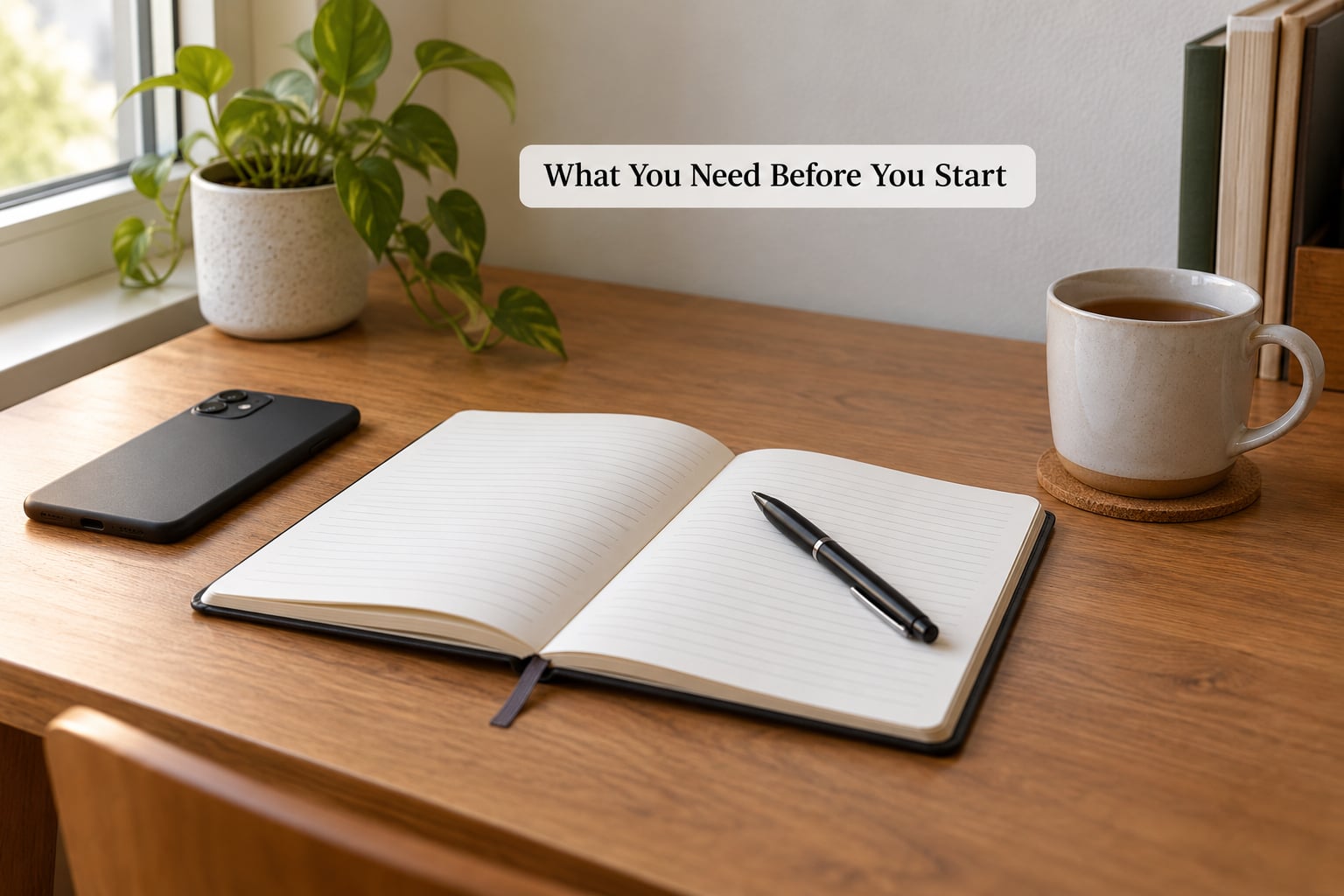
Not much, which is good, because low-energy weeks are exactly when this needs to be possible.
- A notebook or notes app. The work is mostly writing, and you want it somewhere you will not curate. Spelling mistakes and crossed-out lines are fine.
- Twenty uninterrupted minutes. Less than that and you will write what feels comfortable instead of what is true.
- A date-free stretch. Roughly four weeks. Not because you owe anyone a hiatus, but because you cannot hear a new voice while the old one is still shouting.
- An honest baseline. Not a score out of ten. Just a sentence written today: how you feel about your appearance, your social life, your work, and being single. You will compare against this later.
- Privacy. Some of what surfaces is embarrassing. A therapist’s office, a locked drawer, or a journal nobody reads.
That is the whole list. If it feels like too much equipment to become someone worth dating, read that sentence again — it is your critic talking, and step one is aimed at it.
Step-by-Step: How to Build Self-Esteem Before Dating
Step 1: Name the beliefs holding you back
Dating anxiety rarely starts in the dating room. It starts with sentences you have believed so long you stopped noticing them: I’m not interesting enough, people will think I’m boring after ten minutes, I’d be attractive if I were thinner, I’ll be left on read.
Write down every automatic thought that shows up when you imagine a first date. Then split them into two columns. The first column holds things that are genuinely checkable — you do not like your current haircut, you have not dated in four years, you do not know how to make conversation. The second holds the predictions and judgements — people will find me boring, I will embarrass myself, no one will pick me.
Only the first column is worth acting on right now, and even that is usually solved with a haircut, a hobby or a practice run rather than a personality change. The second column is your inner critic, and it is the part this whole guide is about.
Step 2: Build evidence of your strengths
This is the step people skip, and skipping it is why affirmations feel hollow. “I am confident and likeable” bounces off a person who has never once caught themselves being either. Evidence sticks.
Most guides on how to build self-esteem before dating stop at step two and hand you a compliment list. A list is not the same as a case. Open a fresh page and write ten times: I once did a thing where I handled [situation] well. The ten need to be small. Finishing a bike ride in the rain because you said you would. Saying no to a bad invitation. Being the person a friend called first. Cooking for four people without complaining once. Learning a hard skill at work and not quitting in week three.
Then add three specific qualities people have actually said about you — not what you hope they would say. “Funny,” “the reliable one,” “unusually good at explaining hard things.” Ask two friends if you cannot remember. People are almost always kinder in their answer than your critic is in its review.
Confidence built on evidence behaves differently. It is quieter and it holds up mid-date when the flattering version would have folded. Do this page once a month and add to it; it is the most-used artefact in the whole plan.
Step 3: Replace self-criticism with fair self-talk
Empty affirmations — writing “I am gorgeous” twenty times on a sticky note — do very little. What changes how you talk to yourself is arguing back with the critic using what you just wrote down in step two. That is roughly what cognitive behavioural therapists do, and you can do a rough version of it on your own.
Use a three-part sentence. First, name the thought exactly as it appeared: I will bore her. Second, rate how true it feels, out of ten. Third, answer it the way you would answer a friend who said it about themselves: last month I talked for an hour about work and they asked for a second date, so “boring” is more fear than forecast.
Build self-compassion in the same breath. Research on self-compassion, which is treating yourself with the decency you would offer someone else, finds it lowers shame and anxiety more reliably than self-esteem boosting on its own. The line sounds small in writing: that was hard, and I got through it anyway. Repeated on a bad date, it adds up.
The correction is not fake positivity. It is accuracy. Your critic is allowed to be wrong about its predictions.
Step 4: Practice confidence in low-stakes situations
Confidence before dating is mostly a skill with reps, and reps do not come from thinking about them. Forum posters on r/dating and r/confidence describe the same turning point: not affirmations, but small repeated exposures until the situation stopped being frightening.
Build a ladder and climb it weekly. Ask the barista a question about their origin. Say your actual opinion when a friend suggests somewhere. Choose the restaurant for dinner rather than saying “wherever.” Make eye contact and hold it for one second longer than comfortable. Go alone to a film, a class, or a bar where you know nobody.
The point is not to become outgoing. It is to collect evidence that you can tolerate being disliked for a moment and keep going. Every rejection you handle without collapsing is a rep, whether it came from a date or from a stranger at a party.
Track them in a list with the date. Two weeks in, most people find the list is doing more work than the memories are.
Step 5: Define what healthy dating looks like for you
Confidence with no boundaries behind it usually collapses on contact, because it is built on being liked. This step puts a structure under it.
Write your answers to four questions: what a good relationship looks like for you, what you will not negotiate on, how much time you want between dates, and what you are actually looking for right now. Take ten minutes on each. Be concrete — “friends who tell me the truth before I have to ask” is usable, “kind” is not.
Then decide your deal-breakers before you meet anyone, not during. Write three to five, keep them short, and put them somewhere you will see them. Someone who will not be asked for anything unreasonable will leave in an afternoon. Someone you have to earn will take a year.
This is where people-pleasing usually lives. Low self-worth makes asking for something feel dangerous, so you accommodate, and the accommodation becomes the evidence that you are not worth much. A boundary you state calmly and then hold is a better confidence exercise than any party trick, because it is rehearsed in real time.
Step 6: Start dating from a prepared baseline
By now you should have four things in hand: a list of beliefs split into checkable and fictional, a page of ten pieces of evidence, a reworded self-talk routine, and three to five deal-breakers. That is enough. It is not complete, and it does not need to be.
Before you re-open an app or say yes to a set-up, run a short checklist. Am I sleeping and eating like a person? Do I have at least two things in my week that are not about dating? Do I know what I want to ask someone and what I will not do? If the honest answer to those is mostly yes, you are ready enough.
Dating from there means going in with curiosity instead of a job interview. You are checking whether you like them, not waiting to be approved. Bring a question or two rather than a narrative about why you deserve to be there. Bring the evidence page in your pocket for after, when you will want to argue with yourself about whether the evening counted as a success.
People on r/dating_advice keep landing on the same reframe, and I think it is the whole thing in one line: not what do I need to change to be lovable, but who deserves me as I am. The second question has an answer. The first one never does.
Common Mistakes That Keep Self-Esteem Low While Dating
Waiting until you feel perfect
Nobody arrives. The plan above is not a gate you pass before dating is allowed — it is scaffolding you carry in. Perfection as a prerequisite produces people who are single for years and slightly better prepared for a date that never came.
Treating every rejection as a verdict
One person not being interested is information about fit, timing and taste. It is not information about your value. Write the four-line version: who they were, what you noticed, what you would do differently, what you learned. Turning a rejection into a paragraph of data is the fastest way to stop ruminating.
Letting match counts measure anything
This is the app-specific trap and it hits hard. People in the r/dating_advice threads describe the same spiral — watching likes land, treating a quiet week as a personal slump, and swiping longer to get the hit. The fix is boring and effective: set a daily time limit, swipe for a fixed window rather than until you feel better, and judge the app by whether conversations are decent rather than by how many faces appear.
Overworking for someone who has not shown up
Drafting the fourth version of a first message, rehearsing an apology for something you have not done, treating a question about your life as a job interview. It is effort borrowed from the wrong account. Put that energy into the friendships, classes and projects that continue whether or not anyone swipes right.
When self-help is not enough
Everyone here is giving general information, not treatment. If low mood, hopelessness or constant self-criticism have lasted weeks, or if you are using drinking, food, drugs or sex to numb it, talk to a licensed therapist or your doctor. That is a recommendation, not a failure. Forum posters repeatedly name therapy — particularly CBT or attachment-focused work — as the thing that finally moved the needle for them, and a professional can do in an hour what journaling mostly cannot.
Frequently Asked Questions
How long does it take to raise self-esteem?
Honest answer: weeks for the first shift, months for it to feel automatic, and it is not a straight line. People usually notice a difference within four to six weeks of writing things down regularly, because they can see their own evidence instead of only feeling the critic’s version. Expect a dip around month two when the initial momentum wears off. Keep the evidence page going after that, and treat any month that feels worse as noise rather than evidence.
Do I need confidence before I start dating?
No. Plenty of people date with low confidence and build it in motion, because real reps are part of what produces the feeling. What you do want is a baseline: enough sense of yourself that a rejection is disappointing rather than devastating, and enough clarity about your values that you can tell a bad match from a real chance. The four-week plan here builds that baseline, then you keep going.
What should I do after a bad date or a rejection?
Write the four-line version while it is still fresh: who they were, what you noticed, what you would change, and what you now know. Then do one deliberate kind thing for yourself the same day — a meal you wanted, a walk, a call with a friend. Do not re-read their profile or check whether they liked you back. Those steps turn one bad evening into a week of scoring yourself.
Can dating apps make low self-esteem worse?
Yes, for some people, and it is a mechanism rather than a personality flaw. Apps measure you in swipes per hour, which is not a measurement of how you get along in a room. Set a hard daily time limit, swipe for a set window rather than until you feel better, and stop comparing your inbox to someone else’s. If you feel worse every time you open the app, take a month off and rebuild before you go back.
How do I handle low self-esteem on my dating profile?
Pick the two or three things you would actually enjoy talking about for an hour, and write about those. Do not lead with an apology for your age, your body, your experience or your divorce, and do not use a photo you resent. If a profile has been up for two weeks with no conversation, change something specific rather than concluding you are unlikable. People who write about interests get far better conversations than people who write about what they are hoping not to be judged for.
A Calm First Step Toward Dating
Building self-esteem before dating comes down to four moves in order: name the beliefs, collect evidence, argue back with the critic, and practice until the fear shrinks. Then you put your own standards in place, because confidence without boundaries is just a wish for approval.
You can start tonight. Write one honest strength from your evidence page, one dating belief you know is a prediction rather than a fact, and one realistic thing to do this week — a haircut booked, a class signed up for, a message answered. Twenty minutes, then stop.
If you want the short version, it comes down to four artefacts you can finish this week:
- Two columns of dating beliefs — the checkable ones and the predictions.
- Ten pieces of evidence you wrote yourself, plus three things friends have actually said about you.
- One three-part sentence you use to argue back with the critic when a thought shows up.
- Three to five deal-breakers written down before you meet anyone.