
Talking about feeling insecure works best when you name the feeling, describe the one specific moment that set it off, and make a single clear request. Most conversations go wrong not because the feeling is too small, but because it arrives wrapped in ten minutes of evidence and a verdict. Strip it back to three sentences and you usually get a partner who can actually hear you.
The other half is knowing when to have the conversation. Fifteen minutes, somewhere private, and not thirty seconds after an argument you both just had. This guide takes about ten minutes to read and gives you a script you can use tonight.
What You Need to Talk About Feeling Insecure
Before you open your mouth, do three small pieces of prep. None of them takes long, and together they are the difference between a conversation and a monologue you regret in the car afterwards.

Separate the feeling from the behaviour
Insecurity is a feeling inside you. It is real and it is worth saying out loud. But the other person cannot see it, cannot confirm it, and cannot argue with it, which is why you feel ignored often comes out as you’re ignoring me.
Write down two columns. Left side: what you are feeling. Right side: what you actually observed, with dates or details. “Anxious, unwanted” on the left; “replied four hours late on Tuesday, cancelled Friday’s plan, didn’t mention the trip to his sister” on the right. Only the right column belongs in the conversation.
Pick a private, unhurried moment
Not in a restaurant, not in the car, not over text, and never mid-argument. You want somewhere you could sit for twenty minutes without being interrupted, ideally after a normal meal rather than after something has already gone wrong.
Bring one concern and one request
The urge to dump every grievance at once is strong, and it is why these conversations fail. You are not presenting a case, you are asking for something. One trigger, one ask, and save the rest for next time.
Step-by-Step Conversation Plan
Name the Feeling Without Diagnosing Your Partner
Start with an I feel statement and leave their motives out of it. Try: “When plans change at the last minute, I feel left out and a bit on edge.” Not “you only make time for me when it’s convenient.”
The version with an accusation attached gives them something to defend against, and the conversation turns into a debate about whether they are that kind of person. The version without it just describes your weather.
Identify the Specific Trigger
Anchor it to one thing that happened. “On Saturday we said we’d go to the market and then you texted that you were too tired” is workable. “Lately you haven’t been making me a priority” is not, because there is no way to answer it.
People in relationship forums describe this step as the one that changes everything, because once the trigger is on the table most of the drama evaporates. Half the time the explanation turns out to be boring — a bad week at work, a family thing, a forgotten message.
Explain What You Think Is Happening
This is where most people overexplain, so keep it tentative. “I wondered if you’d lost interest” or “I interpreted the quiet as something being wrong with me” gives your partner room to correct you without either of you losing face.
Insecurity runs on assumption. You fill in the gap of what you don’t know with the worst available explanation, then act as though that explanation is a fact. Saying “this is the story I built” out loud does more to defuse the moment than almost anything else you can say.
Make a Clear and Proportionate Request
Turn the feeling into something observable and doable. “If you can’t make it, could you tell me by lunchtime so I’m not waiting around all afternoon?” is a request with a shape to it. “Never cancel on me” is a demand with no shape at all.
A good test: could a reasonable person say yes to this ten times a month without resenting it? If not, it is too big. Ask for one change, not a personality transplant.
Discuss What You Can Each Do
Security is built by follow-through, so agree on one small action from each side. You might stop rereading their texts after they go quiet; they might send a two-line message when plans shift. Then set a date to check in, a week out rather than never.
Also agree on what happens when one of you forgets. Without that, a single missed follow-through turns into evidence for the whole argument again.
Listen for Understanding, Not Just Agreement
You are not asking for a promise or a verdict on whether your feelings are justified. You are looking for signs that they heard you: they ask a question, they reflect something back, they accept the request or offer a different one.
Contempt is the thing to watch for. Eye-rolling, a mocked sigh, or “so what, you want me to text you every hour” tells you the request landed badly and the conversation needs to stop. Pause and say so plainly: “this isn’t landing right now, can we come back to it when we’re both less wound up.”
Common Mistakes That Shut the Conversation Down
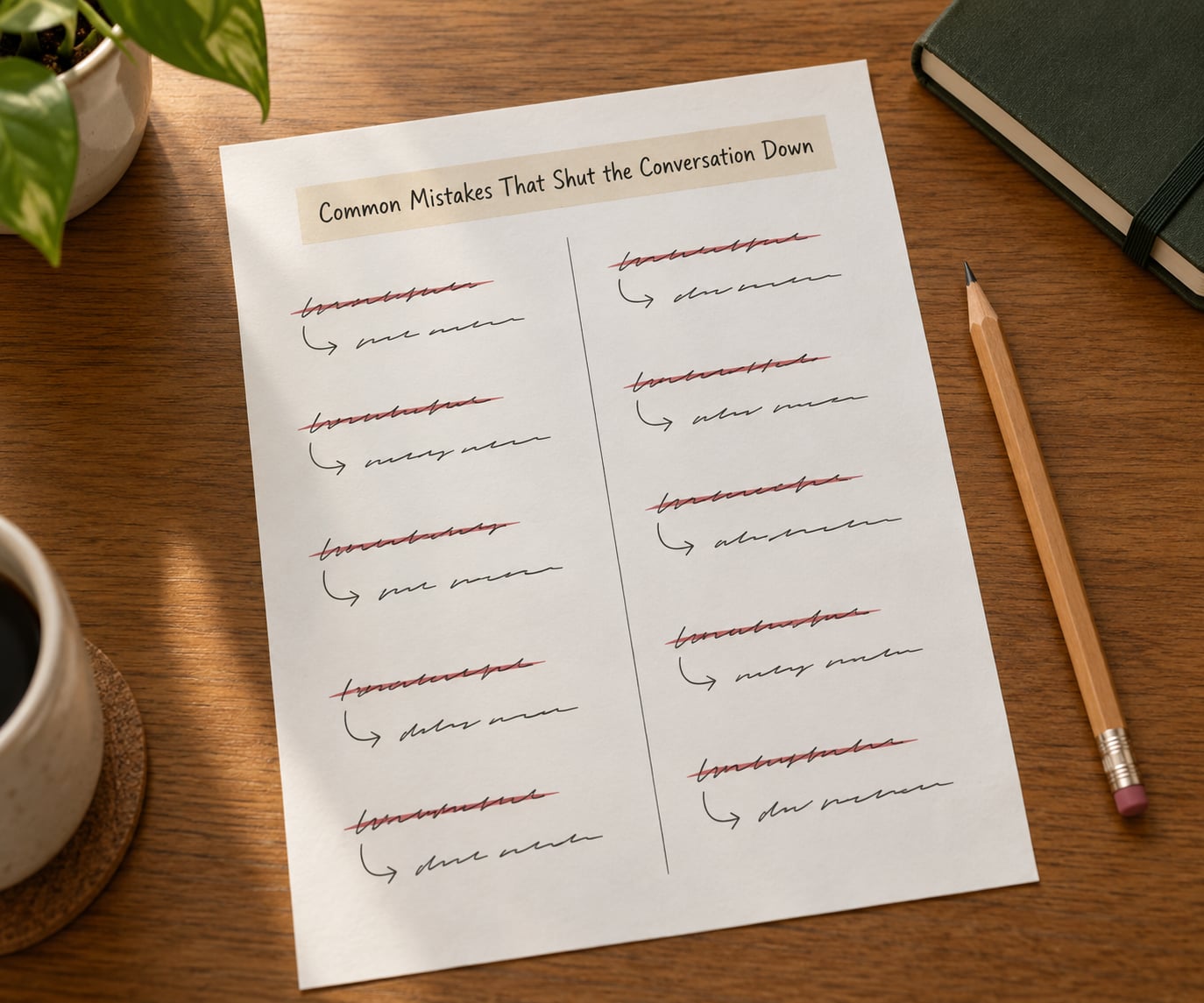
Leading with the label
Never open with “I’ve been feeling really insecure.” Your partner hears a diagnosis of themselves and starts defending. Open with the trigger and the feeling you had; save the word for later, or don’t use it at all.
Mind-reading
“You don’t care” and “you’re just keeping me at arm’s length” are conclusions you drew privately. State them as guesses and you remove about half the fight.
The grievance dump
Five resentments in one conversation means five chances for a rebuttal and zero chances for a resolution. Take the biggest one. Really, just the one.
Threats dressed as honesty
“Maybe I should just leave” said during an uncomfortable moment lands as an ultimatum, even when you don’t mean it. If you want to raise a serious concern, raise it as a concern, not a weapon.
Asking for reassurance with no end point
Repeated checking rarely soothes anything, and it teaches the other person that reassurance is the only available answer. Ask once, take the answer, and let your nervous system do its work.
Having the conversation at the worst time
Dinner with family, the drive to the airport, an hour before their exam. If the setting is rushed, the message is that the feeling was too big to bring up calmly. Pick a better slot.
Frequently Asked Questions
How much reassurance is healthy in a relationship?
Healthy reassurance is specific, occasional and paired with action. Telling your partner you feel anxious and asking them to text when plans change is reasonable. Asking the same question repeatedly, checking their phone, or needing confirmation several times a day is not. A good marker: if the reassurance arrives and the feeling still hasn’t settled, more reassurance usually will not fix it. Ask for one concrete change, then work on the part that is yours.
Is jealousy always the same as feeling insecure?
Not quite. Jealousy is usually about a specific threat to the relationship, real or imagined. Insecurity is broader and often underneath it, tied to self-worth or fear of being left rather than to one person. You can be jealous in one moment and insecure the next, and talking about the jealousy without naming the insecurity underneath tends to leave the actual problem unaddressed.
When should I discuss insecurity on a first date or early relationship?
Early on, keep it light and factual rather than deep. If something genuinely bothered you, a simple in-the-moment note works better than a heavy conversation about patterns you have barely observed. Wait for a real trigger, and keep it about behaviour rather than about where the relationship is going. You are allowed to notice how you feel, but heavy disclosure before you know someone tends to create pressure rather than closeness.
What if I cannot identify the exact reason I feel insecure?
That is more common than you would think, and it does not stop you talking. Use the feeling itself as the subject: tell your partner you have been anxious and you cannot pin it on a specific thing, and ask for a little patience while you work it out. Vague feelings are harder to respond to, so give your partner something small to do while you get clarity, usually more frequent or more explicit communication.
What if my partner says I am being irrational or insecure?
Do not argue about whether the feeling is justified, because that is unwinnable. Say something like: I know it might not look rational from your side, and I am still asking for one specific thing. If your partner dismisses the feeling every time you raise it, that pattern is worth naming as its own issue. Persistent dismissal is not a reason to stop raising it; it is a reason to get support from someone outside the relationship.
Conclusion
Start smaller than feels satisfying. One trigger, one feeling, one request, in three sentences, at a moment when neither of you is tired or angry. If the other person responds well, agree on one action each and a date to check in. If they dismiss it, that tells you something important about the relationship, not about you.
Security after that is built from ordinary follow-through rather than one perfect conversation. Keep doing the small agreed things, and if the feeling keeps circling back with no trigger you can find, that is worth raising with a therapist rather than a partner who has already heard the speech.