
Yes, you can be in a relationship with someone of a different religion. Plenty of couples do it well. What decides whether it works is not whether your doctrines agree, but whether each of you treats the other’s faith with real curiosity and without pressure, and whether you talk about the hard parts before you are attached.
Learning how to date someone with different religious beliefs is mostly about sequencing. You ask small questions early, name the things you will not compromise on before you fall for someone, and watch what they do rather than what they promise. This guide covers that process from the first conversation to the point where you decide whether the relationship is workable.
The odds are not against you. Interfaith marriage went from about 19 percent of US marriages before 1960 to roughly 40 percent since 2010, according to figures widely reported from Pew Research Center data. Different faith is now a normal feature of dating rather than a rare exception, and most of the advice out there still treats it as a crisis to be managed. It is a difference to be discussed, like any other difference in a relationship.
The short version:
- The most useful first question is not about doctrine. It is how important faith is in this person’s daily life.
- Same faith at different observance levels is a different situation from two genuinely different faiths, and it is usually the easier one.
- Name your nonnegotiables before you are emotionally invested, not after.
- Watch the gap between what someone says and what they do. That gap shows up more often than you would expect.
- Attending someone’s service once as a guest is not the same as agreeing to become their religion, and you never owe it.
- Contempt aimed at your faith is a dealbreaker. No tradition has a monopoly on that.
Table of Contents→
- What You Need
- Step-by-Step: How to Date Someone With Different Religious Beliefs
- Common Mistakes
- Frequently Asked Questions
- Can two people with different religious beliefs have a healthy relationship?
- How do I know if religious differences are a dealbreaker?
- How should we handle disagreement about children’s religious upbringing?
- What if one partner’s family pressures them to change their beliefs?
- How do we know when to compromise on religious practices?
- Conclusion: Start With One Honest Conversation
What You Need
You need four things before this gets complicated, and none of them are research materials.
Honest self-awareness about your own position
Most interfaith dating goes badly because someone has not been honest with themselves about what they actually believe. Plenty of people who describe themselves with a label would not describe themselves that way on a Sunday morning. Decide whether you are devout, culturally practicing, or nominal, and be honest about which one, because the gap between those three is often the thing that breaks a relationship later.
Basic working knowledge of what the other person actually practices
You do not need a theology degree. You do need to know that “I am Muslim” and “I am Christian” are answers to different questions about practices, not a single answer with two labels. Ten minutes of asking better questions does more here than a month of reading.
Time to reflect before you commit
The fastest way to make a bad decision is to move fast on purpose. Give yourself enough space to sit with what you learn instead of reacting to it.
A willingness to state your nonnegotiables out loud
Two definitions worth knowing before you start. An interfaith relationship is one where the partners hold different religious beliefs, or where one holds none; it is not the same as two denominations within one faith. Shared values means agreement about how you treat people, handle money, raise children, and keep promises. Shared values sit underneath doctrine and usually matter more to a relationship than shared beliefs do.
Step-by-Step: How to Date Someone With Different Religious Beliefs
Six steps, in order. The order matters, because each one gets easier when you have done the one before it, and much harder when you have skipped it.
1. Identify Your Nonnegotiables
Before you meet someone else, write down the beliefs and practices you could not bend on. Keep the list short. Most people fill a page and then treat it as a contract, which is the fastest route to resenting someone by month three.
Three useful sorting questions:
- What do I actually practice, and how often?
- Which of my beliefs would change how I raise a child?
- What could I compromise on without feeling like I broke a promise to myself?
Then apply the conversion point test, the sharpest idea in this whole conversation. If you would require your partner to convert to your faith as a condition of the relationship, would you be willing to make the same sacrifice? If the answer is no, you are not looking for compatibility, you are looking for a convert, and that is worth knowing in week one rather than year three.
Keep the list where you can revisit it. Your nonnegotiables will not change much as you learn more, and watching them hold steady is itself useful information.
2. Learn About Their Beliefs and Practices
Ask open questions and stay in the asking. Good ones sound like: What does a normal week look like in your house? What part of your faith do you actually enjoy? Which practices would you fight to keep? What did you like about going as a kid that you do not like now?
These questions get you the practice instead of the label. Someone can carry a formal identity and rarely set foot in a place of worship, and someone else can hold a lighter label and structure their whole week around a practice. You are looking for the second person, not the label.
Here is the spectrum to sort with, from one end to the other:
- Nominal. The identity is cultural or inherited. Christmas, a bar mitzvah, Eid, a funeral. Little ongoing practice.
- Culturally practicing. Some regular observance, some holidays, a sense of belonging to a community.
- Devout. Worship, study, or observance structure the week. Beliefs reach into daily decisions, money, food, and relationships.
Also watch for religion operating as culture rather than doctrine. Food, music, language, superstitions, and family rituals carry identity without carrying theology. Couples who treat those as heritage rather than argument have an easier time than couples who argue about salvation in month two.
And include non-religious spirituality in the conversation. Tarot, crystals, witchcraft, astrology, and manifestation are belief differences with real weight for the people who hold them, and a dismissive laugh lands the same way a dismissive comment about church does.
3. Have the First Honest Conversation About Different Religious Beliefs
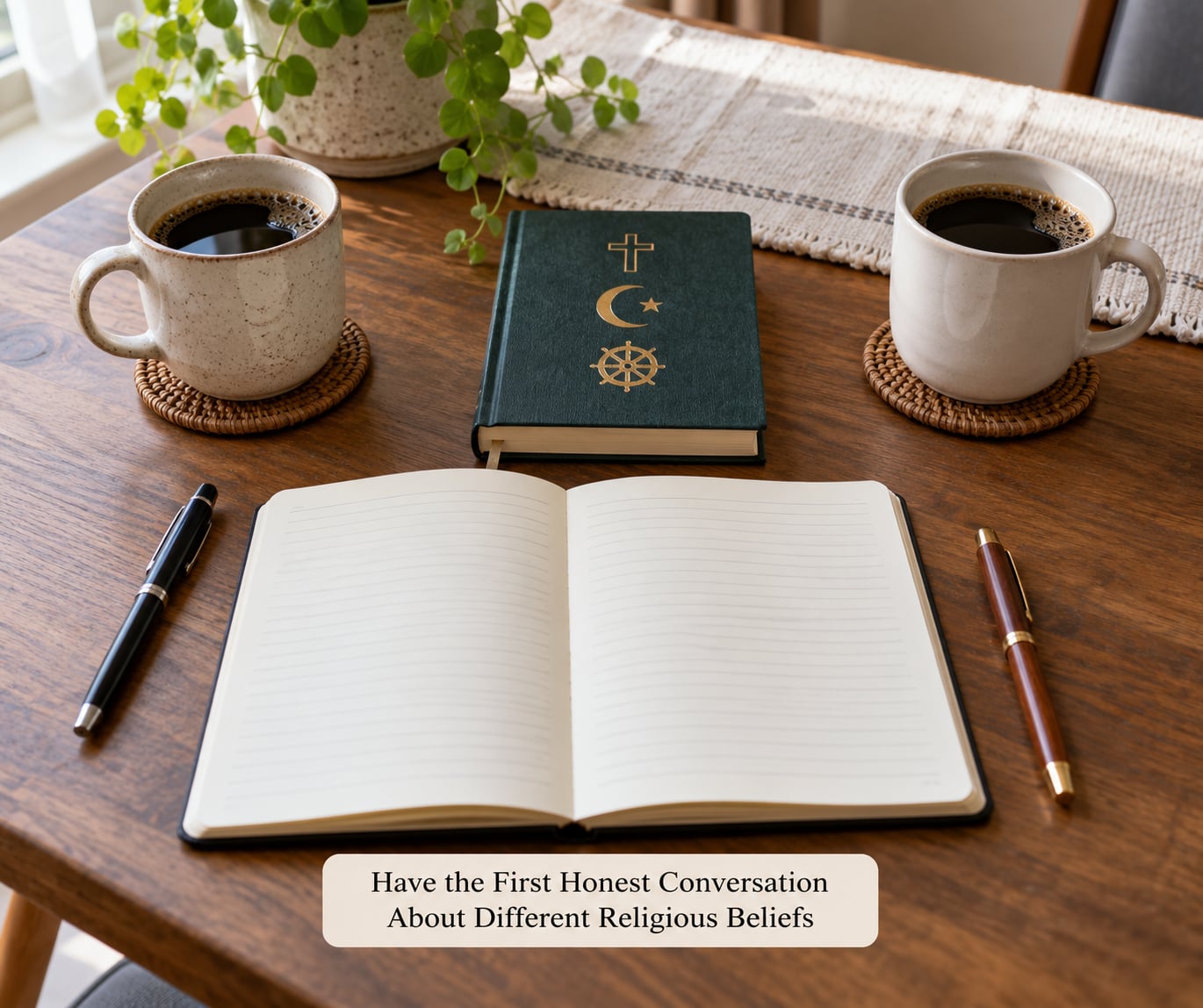
The most asked question in forum threads on this topic is about timing: first date, or month three? Earlier than most people fear, and later than most people think. On a first date, you learn that faith is important to them and roughly how they talk about it. You do not negotiate the details. By the fifth date, you have covered holidays, attendance expectations, and children. Before any engagement, you have covered conversion, families, and money.
How you say it decides how it lands. Two techniques from couples research help more than any script I know. Use a soft start-up, which means opening with your own observation rather than their behaviour: “I noticed you light the candles on Friday, that seems meaningful to you” instead of “Why do you do that?” And use I statements, which keep the conversation about your experience rather than their character.
Share a story before you share a position. Everybody has one: a grandparent who never missed a service, a holiday that felt hollow, a thing you stopped believing and then started again. Stories are hard to argue with, and they hand the other person an easy opening.
Watch for the stated-versus-actual gap. People in mixed-faith relationships describe a pattern where a partner says they are completely comfortable with the other’s belief and then argues with it, corrects it, or rolls their eyes at it. Said once, that is a bad evening. Done repeatedly, it is a statement about whose faith actually counts in the relationship, and it is worth raising directly the first time you notice it.
4. Discuss the Practical Impact on Your Life
Doctrine is abstract. The rest of this is not, and this is where mixed-faith couples actually lose sleep. Go through it item by item.
- Holidays. Two sets of dates, often overlapping. Splitting, rotating, or inventing new traditions all work. Doing nothing about it does not.
- Worship. Weekly attendance, whether you join, and how often. Say the answer plainly and early: attending is optional, presence is not.
- Food. Halal, kosher, vegetarian practice, fasting, and who does the cooking when two rules apply to one meal.
- Prayer. Whether you pray, whether you pray together, and whether either of you minds the other not praying.
- Money and giving. Tithing, charitable giving, and whether decisions are made jointly or by one partner’s tradition.
- Family. How involved the families are, who hosts which holiday, and how much access the non-matching partner gets to the family.
- Community. Whether the social circle is one faith, which can isolate one partner faster than any disagreement.
- Children. The big one, and better discussed before there are children. What will they be told, taught, and exposed to, and who decides when.
Marriage shape is worth naming too. Couples from some faith pairings face real canonical and legal friction around ceremony and registration, and a Catholic partner may need to talk to a parish about permission before a wedding. Know this early enough that it does not ambush you after a proposal.
Some pairings clash more than others, mostly around three pressure points: who leads a naming or circumcision ceremony, what counts as religious education for a child, and how each side describes the other’s path to salvation. Naming the specific clash early is far more productive than a general promise to make it work.
5. Set Boundaries Around Beliefs and Family Pressure
Boundaries written as sentences you can say out loud work better than vague feelings. A few you could adapt:
- “I will come to services sometimes because I like being with you there. I will not pretend to believe something I do not.”
- “You are welcome to explain your belief to me. You are not welcome to explain why my belief is wrong.”
- “If my family asks about your beliefs, I will answer that we are not discussing it. I will not answer for you.”
- “Pressure to change my belief ends the conversation, not just the topic.”
Write your own version of the declining-a-service sentence. Almost everyone needs one, and the difference between a rehearsed boundary and an awkward silence is the whole conversation. A good version names what you will do instead: “I am not going to be able to come to Tuesday, but I want to hear about it after.”
Family pressure is usually worse on the non-matching partner, and it rarely improves with silence. Decide in advance which side handles which family, and make sure the partner who is not of that faith does not become the permanent spokesperson for the other family.
Both directions happen. Expecting conversion dressed as a condition of love deserves one calm answer and then a boundary. Research on relationship satisfaction keeps pointing in the same direction: couples who build shared meaning together hold up better than couples who rely on agreement alone.
Do consider a therapist who works with interfaith couples once conflict becomes a pattern. Not any counselor, and be careful about choosing one inside a single tradition, because the feedback from people in this situation is consistent: a counselor from one faith often puts the non-believing partner straight on the defensive. Ask directly whether they have worked with mixed-faith couples before you book.
And if faith still hurts, that is a separate conversation worth having on its own. Religious trauma shows up in dating as fear of authority, difficulty setting boundaries around belief, or a partner’s family dynamics that feel familiar in a way you do not want. Naming it early, sometimes with a therapist, saves you from treating a pattern as a personality.
6. Take Time to Test Compatibility in Real Life
Beliefs tell you nothing about behaviour. Watch what your partner does under a small amount of difficulty, because that is where the real compatibility shows up. Does a disagreement about faith ever become an insult? Do they keep promises about attendance, about not converting, about speaking well of your family? Does the curiosity stay, or does it turn into a project of persuading you?
Run small trials before big commitments. Go to one service, one iftar, one holiday gathering as a guest. Try a fast together as a reflection rather than an obligation. Watch how you both feel afterward and talk about it. The point is not to be persuaded; it is to find out whether participating is comfortable, and whether they can respect a no.
Know your exit clearly, because almost nobody defines it and everybody needs it. It is time to leave when contempt for your faith becomes a pattern, when pressure to convert recurs after you have drawn a line, when their family sets conditions you are expected to meet, when your nonnegotiables quietly become theirs, or when you catch yourself shrinking your own beliefs to keep the peace.
Leaving well is its own skill. You are allowed to say: “I like you, and I do not think our religious lives fit together well enough for what I want.” That sentence is honest, kind, and final, and it costs you less than a slow exit that takes eight months and says something worse about you both.
Common Mistakes
Mistake 1: Assuming everyone in a faith believes the same thing. This is the most common error and the easiest one to fix. “Muslims believe,” “Christians think,” “Jewish families do” are all statements that will embarrass you. Replace them with what this person does. Say “you” instead of “they.”
Mistake 2: Trying to change the other person. If you enter the relationship planning to argue someone into your beliefs, you are not seeking compatibility, you are seeking a project. Fix: take the conversion point test honestly. If you would not make the same sacrifice yourself, stop expecting them to.
Mistake 3: Avoiding the conversation to keep things easy. Delay feels like kindness and turns out to be a loan at a high rate. Every unspoken assumption about holidays, children, or family becomes an argument later, and by then you have less room to negotiate. Fix: pick a date, one conversation, a list of the topics, and a fixed end time.
Mistake 4: Compromising on the things that matter to you. Flexibility is how mixed-faith relationships work, but flexibility has edges. Fix: rank your nonnegotiables in order before you meet someone, and hold the top two. Everything else is negotiable; those are not.
Mistake 5: Accepting contempt dressed up as conviction. Eye-rolling, mocking, correcting your grammar of belief, and cheerful provocation are not strong faith, whatever anyone claims. Fix: name the behaviour, not the belief. “I will talk about this with you, and I will not be talked down to.”
Mistake 6: Accepting a one-sided emotional load. In a lot of these relationships, one partner explains, defends, and translates their whole worldview while the other never does the same. It wears down over a year, not a week. Fix: notice it, then split the work. Each person explains their own side to their own family.
Two habits help with all of this. Keep one short weekly check-in, twenty minutes, no phones, covering logistics and anything unsaid. And when something goes wrong, repair fast and specifically rather than waiting it out. A short “that landed badly, can we redo it” does more than a week of being careful.
Frequently Asked Questions
Can two people with different religious beliefs have a healthy relationship?
Yes, and plenty do. A mixed-faith relationship runs on how you treat each other’s belief, not on whether your beliefs match. Couples who stay curious, draw clear boundaries around pressure to convert, and agree early on holidays, children, and family expectations do well. Couples who avoid the hard conversation and let resentment build do not. Faith difference is workable. Contempt is not.
How do I know if religious differences are a dealbreaker?
It is a dealbreaker when your nonnegotiables genuinely clash, such as a core belief about how children should be raised, and neither person will move. It is also a dealbreaker when your partner mocks your faith, requires conversion as proof of love, or keeps pressure from family on you. Everything short of that is usually a compromise you can live with.
How should we handle disagreement about children’s religious upbringing?
Talk about it before you have children, because the pressure to decide rises sharply afterward. Agree on the practical shape first: what happens on weekends and holidays, who teaches what, and how children are introduced to the other tradition without being required to choose. Many families land well on children being raised in both traditions and choosing for themselves later, with neither parent treating the child’s eventual choice as a verdict on the parent.
What if one partner’s family pressures them to change their beliefs?
Do not carry that pressure for them. Agree on one line the two of you say together, something simple like: we love you, we are not discussing this, and the subject is closed. Then follow it every time, without variation, because the first wavering invites a repeat. If a family member keeps pushing, your partner answers directly and you step back out of the room.
How do we know when to compromise on religious practices?
Compromise on practices, not on core beliefs. Attending some services, hosting both holiday sets, sharing a fast, or taking turns choosing the week are all real accommodations that cost little. What is harder to give up is who decides a child’s religious education, whether your belief gets dismissed in your own home, and whether either of you gets to hold your faith privately. If a compromise would require you to call something sacred untrue, it is too much.
Conclusion: Start With One Honest Conversation
Knowing how to date someone with different religious beliefs comes down to respect rather than agreement. You do not need matching doctrine, you need curiosity instead of correction, boundaries instead of endurance, and one honest conversation about holidays, children, and families before you are in deep.
Start there. Write down your two nonnegotiables, ask how faith actually shapes their week, and watch what they do next. If the answer is that they keep listening, that is a good sign. If the answer is that they start arguing, you have your answer early, and you saved yourself a year.