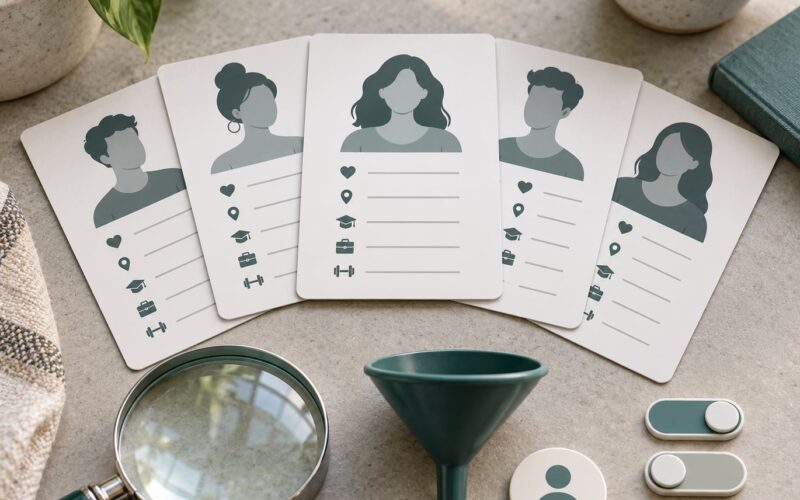
A queer-friendly dating space is any recurring gathering, online or in person, where LGBTQ+ people are expected by design rather than stumbled on by chance — a community center drop-in, a sober social, a climbing club, a campus group. Finding one takes about an hour of research and one honest test visit.
That last part matters more than people expect. Anyone can read a listing and guess whether a space sounds welcoming; the only reliable way to know is to show up once, watch how the room actually behaves, and decide whether you want a second visit.
What counts as a third place: a location that is neither home nor work or school, where you can return repeatedly without having to justify yourself. Those are the spaces worth your time, because repeated contact is what turns a first hello into an actual connection — and most dating starts long before anyone labels it that.
Table of Contents→
- What You Need
- Step-by-Step: How to Find Queer Friendly Dating Spaces That Fit You
- Common Mistakes
- Frequently Asked Questions
- What makes a dating space queer friendly?
- Can queer people use straight dating apps safely?
- Should I use my real name on a queer dating app?
- How can I tell whether identity filters actually work?
- What should I do if someone targets me with a slur or threatens me?
- Is it better to date online or through queer community events?
What You Need
Before you start searching, know what you are screening for. Every space worth your time does four things, whether it is an app, a Discord server, or a Thursday-night drop-in at a community center.
Identity options. Can you say who you are, and can the space hold that accurately? Look for real profile fields and profile prompts, not a single dropdown that lumps every experience into one box. Terms like “queer-friendly” and “LGBTQ+ inclusive” mean nothing on their own if nobody ever built the profile around them.
Matching and conversation tools. A space with 400 members and no way to filter or start a conversation is a directory, not a place to meet people. Filters, prompts, and small-group formats do more work here than raw headcount.
Signals of inclusive practice. Read the code of conduct, the staff or volunteer page, and the recent event descriptions. A space that publishes how it handles harassment is telling you something a rainbow logo cannot.
Privacy and safety controls. Profile visibility options, blocking, reporting, and a support route you can actually reach. If none of those exist, treat every conversation as public regardless of what anyone promises.
For in-person spaces, the same four tests translate differently: how people introduce themselves, whether there is a structured way to meet others in the room, whether queer people are visibly expected, and what happens when something goes wrong.
Step-by-Step: How to Find Queer Friendly Dating Spaces That Fit You
Define What Queer Friendly Means to You
Write your own definition before you read anyone else’s, because the word is stretched to cover very different things. Some people need pronouns honored and misgendering addressed. Others need a space where dating is not the point, and they are tired of being treated as a prospect the moment they walk in.
Then narrow it: which identity-specific spaces might you need (trans, non-binary, asexual, bi, plus-size, faith-based, LGBTQ+ people of color, neurodivergent)? Which relationship intentions are you open to? Does alcohol rule the space out entirely, or is it fine as long as there are real alcohol-free options and a way to leave without making a scene?
That last question is worth sitting with. Plenty of people describe queer spaces as “impossible to find if they are not bars” — a complaint that shows up over and over in queer subreddits, where the recurring detail is unwanted attention and groping, not the presence of alcohol itself. Whatever you land on, write it down. It becomes your filter later.
Check Identity, Filter, and Matching Tools
Open the profile builder before you open the browse screen. You want to know what the space asks about your gender and sexuality, whether it accepts more than one answer, and whether pronouns are a field or an afterthought buried in bio text.
On the browse side, check whether orientation and identity filters exist, and whether preference filters are inclusive rather than just mirroring who is already dominant in the room. Then look at the prompts. Prompt-based matching tends to produce better conversations than photos alone, because it gives people something to say past the opening line.
For offline spaces, the same checks show up in the calendar. A recurring weekly event beats a one-off party every time, because only a repeat schedule lets you build recognition with the same faces. Search Eventbrite and Meetup for identity-specific terms, and check whether your local community or resource center posts a public events calendar — if they do, it is usually the most reliable listing in the city.
Look for Evidence of an Inclusive Community
Branding gets you in the door; behavior tells you whether to come back. Look at three things instead of a logo: what the code of conduct actually prohibits, what moderators are named and empowered to do, and what a recent post that got moderated looks like.
Watch who is visibly present. A space that names itself queer-friendly but is consistently the same cis men and cis women is a space with a crowd code, and queer communities complain about exactly this pattern online. If trans, non-binary, bi, and ace people appear in the photos, the program descriptions, and the volunteer roster, that is a real signal.
Also check whether queer people are expected or merely tolerated. “Pride-friendly pub” and “after-work LGBTQ+ social” are different offers. One schedules you as a guest; the other builds the room around people like you.
Review Privacy, Reporting, and Safety Controls
Open the safety settings and read them properly, not just the toggle names. Check who can see your profile and photos, whether you can limit that by identity or keyword, whether blocking removes someone from search and messages, and what happens to the match record.
Reporting only counts if it leads somewhere. Look for a route that reaches a real person, a stated turnaround expectation, and a stated consequence for repeat offenders. A report button with no published follow-up is decoration.
For anything offline, this becomes a different checklist. For a first meetup, pick a public place, tell a friend the name and rough time, and keep your own transportation. For a group space, find out beforehand whether photography happens and whether you can sit out of an activity without explaining yourself. People who join activity-based queer spaces tend to be fine company, and the normal advice is simply that you can leave whenever you want.
How to Find Queer Friendly Dating Spaces by Testing One
Give one promising space a bounded trial rather than a judgment call. Register, complete your profile honestly, and go to a single event or send a handful of thoughtful messages. Two to four weeks is a fair window: long enough to see how regulars behave, short enough to bail without sunk-cost guilt.
Score it on five things. Do your identity fields render accurately? Do people actually start conversations, or does the room stay silent? Does a message get a reply within a few days? If you reported something minor, did anything come back? And do you feel comfortable there as you are, not just tolerated?
Two honest warnings. Search listings near you are often stale or wrong, which is a complaint that comes up constantly for people outside big cities — if a listing lists an event 40 miles away that you know is local, trust the local knowledge. And online listings for offline spaces routinely overstate the crowd. Confirm the date and time with someone already in the group before you travel.
Compare and Refine Your Shortlist
Score your candidates side by side rather than in isolation: identity fit, filter quality, activity volume in the last 30 days, moderation credibility, alcohol situation, and whether the space is a place you could return to weekly.
Then pick two, not ten. One space you return to weekly will outperform five you sample once. If the trial exposed a gap — no sober option, no trans-specific programming, no activity-based nights — that gap is your next search, and in a small town it may be a space you start yourself.
Common Mistakes
Judging a space by its branding. A rainbow in the logo tells you who the space wants to attract, not who it keeps. Read the conduct policy and look at the actual room.
Choosing by photo volume. A big gallery means a big pool and nothing else. Prompt quality and conversation volume tell you whether you will actually talk to anyone.
Ignoring moderation. An unmoderated space will drift toward whoever is loudest, and that is often the group you least want to be in. No moderation is a reason to pass, not a neutral detail.
Disclosing too much too soon. Your name, workplace, and neighborhood are identifying details. Share them in person, in public, after you have met. Keep early conversations inside the platform where blocking works.
Treating filters as a safety guarantee. A filter narrows who appears in front of you. It does not verify anyone’s identity or intentions. Verification badges and photo checks are useful; they are not a background check.
Using only one space. A single platform makes you entirely dependent on its moderation and its user base. Keeping a second, smaller space open gives you options when the first goes quiet or goes sideways.
Frequently Asked Questions
What makes a dating space queer friendly?
A space is genuinely queer-friendly when queer people are expected by design, not merely accepted. Look for identity fields that hold nuance, filters and prompts that support real matching, a code of conduct with published enforcement, moderators empowered to act, and recurring events where a mix of identities is visibly present. Branding alone is marketing; behavior on a Tuesday night is the evidence.
Can queer people use straight dating apps safely?
They can, and many do, but the burden lands on you instead of the platform. Straight-coded apps rarely offer orientation or identity filters, and you spend more energy screening out mismatches than meeting people. You also get less protection when someone is transphobic or violent, because reporting structures there are built around cis gay men. If you use one, tighten privacy settings and keep your expectations modest.
Should I use my real name on a queer dating app?
Use your first name or a nickname, and keep your full name, workplace, and neighborhood private until you have met in person. Sharing identifying details early is the most common way people get outed or located without consent. If a space pushes for a real name as a trust signal, remember that plenty of people in real life go by something else, and genuine communities rarely require it.
How can I tell whether identity filters actually work?
Test them rather than trusting the label. Set a narrow combination, then check whether the results change and whether they change in the direction you expected. A filter that returns the same visible crowd no matter what you select is decorative. Filter strength is one signal; the people you actually reach when messaging is the better test, which is why a short trial period beats reading about it.
What should I do if someone targets me with a slur or threatens me?
Save evidence first: screenshots, the username, dates, and the original message. Then use the in-app report and blocking tools right away, and check whether you can report separately for harassment, hate speech, and threats, since those may route to different teams. Threatening messages are worth documenting outside the app as well. If there is a real-world threat to your safety, contact local authorities rather than handling it only in the app.
Is it better to date online or through queer community events?
They solve different problems, and the strongest approach usually uses both. Apps give you reach, filters, and control over who you talk to. Community events give you context, reputation, and repeated contact in a room where you are not the only queer person. Many people form the connection at an event and confirm it in an app, or the reverse. If dating offline is your goal, events are the better place to start.
Start where the process starts: write down what you need from a queer-friendly dating space, then check the one candidate that scores best on identity fields, moderation, and schedule. Test it for a few weeks, watch how the room behaves rather than how the page looks, and be willing to drop it without regret. One space you keep returning to beats ten you sample once.