The dating app photos that work best for women are simple: one clear, well-lit, recent close-up where your face is easy to see, followed by a full-body shot and at least one picture that shows a hobby, a pet, or a place you genuinely love. That order matters more than any filter, outfit, or pose trick. When the first photo is dim, cropped at the chin, or three years old, the rest of the profile rarely gets a second look.
Most women are not choosing badly on purpose. The photos that get skipped tend to share the same short list of problems: flat light, a busy background, heavy editing, or a gallery that reads like a brand campaign rather than a person. Clear those out and the response usually shifts within a week of uploading.
Here are ten photo styles that work, what each one signals, and where it belongs in your grid, plus the mistakes worth fixing before you add anything new.
Table of Contents→
- Dating App Photos That Work Best for Women at a Glance
- 1. A Natural Smile in Good Light
- 2. A Clear Head-and-Shoulders Photo
- 3. A Relaxed Full-Body Photo
- 4. A Casual Everyday Snapshot
- 5. A Photo That Shows Your Personality
- 6. A Clean Background Without Location Hints
- 7. A Photo With a Friend in the Background
- 8. A Travel Photo With a Recognisable Place
- 9. A Simple Black-and-White Portrait
- 10. A Low-Effort Photo You Can Take Today
- How to Put Your Best Photos in Profile Order
- Common Photo Mistakes to Avoid
- Frequently Asked Questions
- What is the best photo for a dating profile if I am a woman?
- How many photos should I put on a dating app profile?
- Do dating apps prefer group photos or solo photos?
- Should I wear makeup in my dating profile photo?
- Is it better to smile or look serious in a dating profile photo?
- How recent should my dating profile photos be?
- Conclusion
Dating App Photos That Work Best for Women at a Glance
Every style below earns its place for a different reason. Use this rundown to match a photo you already own to a slot, so you can stop taking new pictures and start rearranging the ones you have.
- Natural smile in window light. Signals warmth, approachability, and that the photo is current. Best in slot 1. Watch for a held photo-smile that looks flat.
- Clear head-and-shoulders close-up. Signals that you are easy to recognise and an honest likeness. Best in slot 1 or 2. Watch for beauty filters and smoothed skin.
- Relaxed full-body photo. Signals confidence, proportion, movement. Best in slot 2. Watch for cropping at the waist or knees.
- Casual everyday snapshot. Signals real life and easy energy. Best in slot 3. Watch for motion blur and accidental clutter.
- Hobby or interest in progress. Signals there is something to talk about. Best in slot 3 or 4. Watch for poses that need a caption to explain them.
- Clean, plain background. Signals that focus stays on you. Best in slots 2 to 4. Watch for house numbers, mail, and street signs.
- Friend in the background. Signals a social life and warmth. Best in slot 4. Watch for the friend becoming the subject.
- Travel with a recognisable place. Signals adventure and ease with plans. Best in slot 4 or 5. Watch for bystanders, geotags, and outgrown outfits.
- Simple black-and-white portrait. Signals understated polish. Best in slot 5. Watch for losing all colour, which can read as severe.
- A low-effort candid you like. Signals authenticity and speed to upload. Best in slots 3 to 5. Watch for blurriness, sunglasses, and dated clothes.
How to choose the right dating app photo style
Start with what you want a match to feel in the first three seconds, because that decides your slot-one photo. If you want conversation rather than compliments, lead with a head-and-shoulders close-up and let a hobby photo take slot three. If you want the opposite effect, lead with a full-body or travel image and keep the close-up second.
Then be honest about how you feel in front of a camera. People who enjoy being photographed do well with posed shots; people who freeze up usually do better with an activity photo or a candid frame, because the posing pressure disappears.
One practical rule: pick one primary photo and two or three supporting images, not six near-identical portraits. A short, varied set reads as a person with a life.
1. A Natural Smile in Good Light
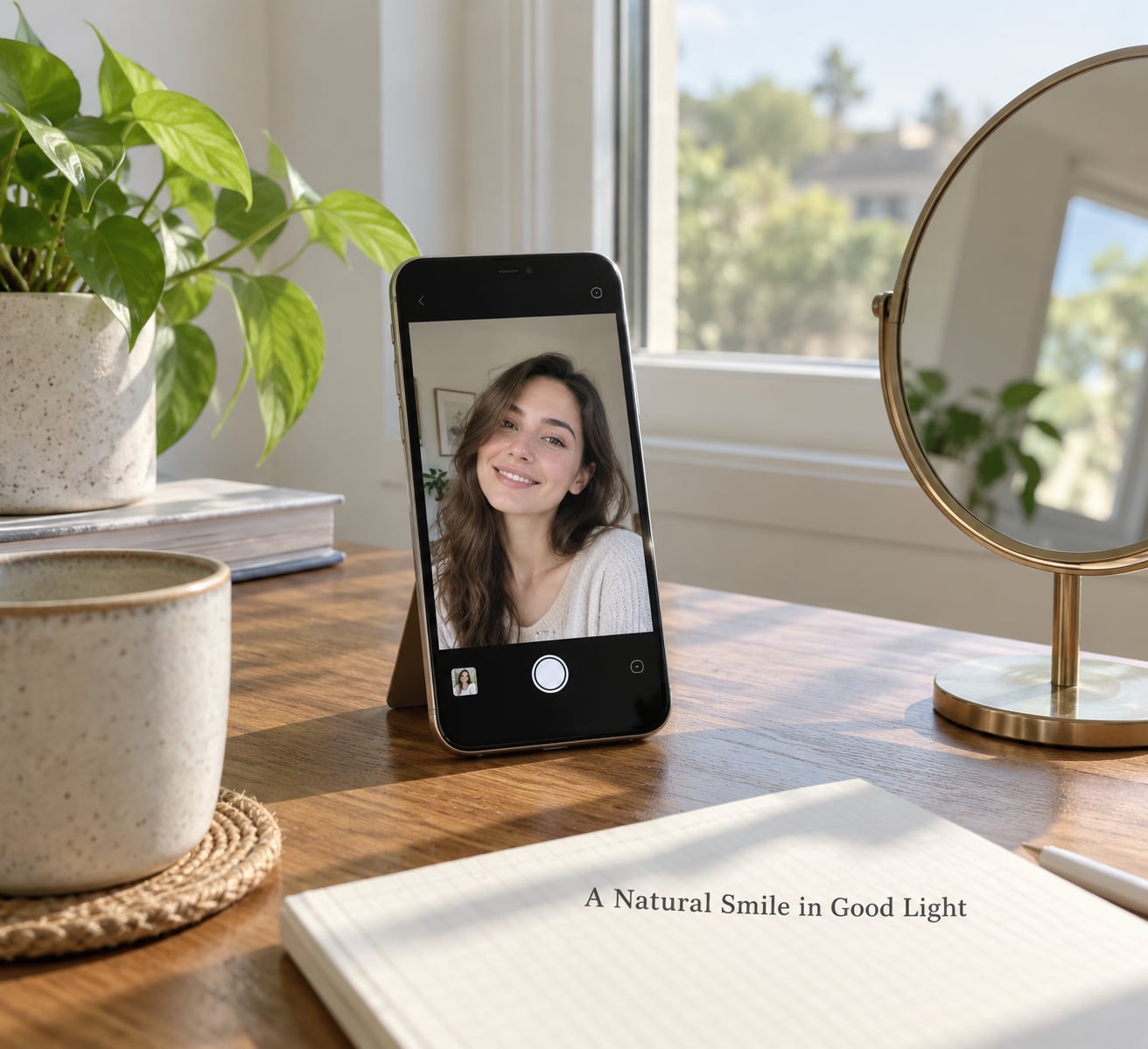
This is the single most requested photo in almost every discussion about what men want to see on a woman’s profile, and the reason is simple: a real expression reads as safe and approachable. Think of the face you make when a friend says something slightly funny, not the one you hold for camera.
To shoot it, stand near a window with the light coming at your face rather than from behind you. Turn your shoulders a few degrees away from the camera so your body is not squared up like a passport photo, and let the camera sit just above eye level. Avoid flash entirely; it flattens skin and turns every photo into a snapshot.
For an example, a friend can take twenty frames in a minute near a kitchen window on a bright afternoon, and you keep the two where your eyes are engaged rather than the two where you looked slightly surprised.
2. A Clear Head-and-Shoulders Photo
A head-and-shoulders close-up is the one image that answers the question every person on a dating app is really asking: does this person look like the person in front of me later? It works because it removes guesswork, and it is the safest option if you are not sure how you come across at a distance.
Frame it from the top of your head to just below your shoulders, with a small gap above your head so the image does not feel cramped. Keep your eyes on the lens, and hold the phone at arm’s length or have someone else shoot from about an arm’s distance rather than using the front camera at full arm’s stretch, which widens the face and softens the background.
Skip anything smoothed, skin-blurred, or eye-enlarged. On a small phone screen, heavy editing reads as a different person, and that mismatch is exactly what a first date is meant to rule out.
3. A Relaxed Full-Body Photo
A full-body photo answers a question a close-up cannot: how you carry yourself. It also gives a match an easy target for conversation, since clothing, shoes, and posture all start a thread.
Wear something you would actually wear on a first date rather than a borrowed outfit that fits oddly. Stand with your weight on one leg, shoulders back, arms relaxed at your sides, and take three steps toward the camera between shots so the images have movement. Keep your feet inside the frame; a photo that stops at the ankle or loses the shoes does not read as a full-body shot.
Ask whoever is shooting to stand about ten feet away and use the phone’s zoom or a 2x lens rather than moving closer, which avoids the wide-angle distortion that makes arms and legs look larger.
4. A Casual Everyday Snapshot
An unstaged frame from an ordinary day does something a portrait cannot: it shows how you look when nobody is asking you to look good. That is where most of the feeling of authenticity in a profile comes from.
Use your rear camera, hold it steady with both hands, and shoot slightly above what you would guess is eye level. Keep a little space in front of your face so the image does not crop your forehead or chin, and check the background for anything that dates the photo or places you somewhere specific.
A good example is a frame of you laughing mid-conversation with a coffee cup out of focus in the foreground. It looks like a person, not a campaign, and it usually produces a far friendlier first message than a studio-style shot.
5. A Photo That Shows Your Personality
Activity photos are the most reliable conversation starter in a profile, because they hand someone an easy opening line. Cooking, hiking, painting, playing music, gardening, pottery, a board game on a table at a friend’s place, even a badly played round of tennis, all give a match something to ask about.
Choose the activity you would actually talk about for ten minutes without getting bored, and photograph it in progress rather than holding a prop up to the lens. Hands in the frame work well, especially mid-task, because they imply movement and a life outside the app.
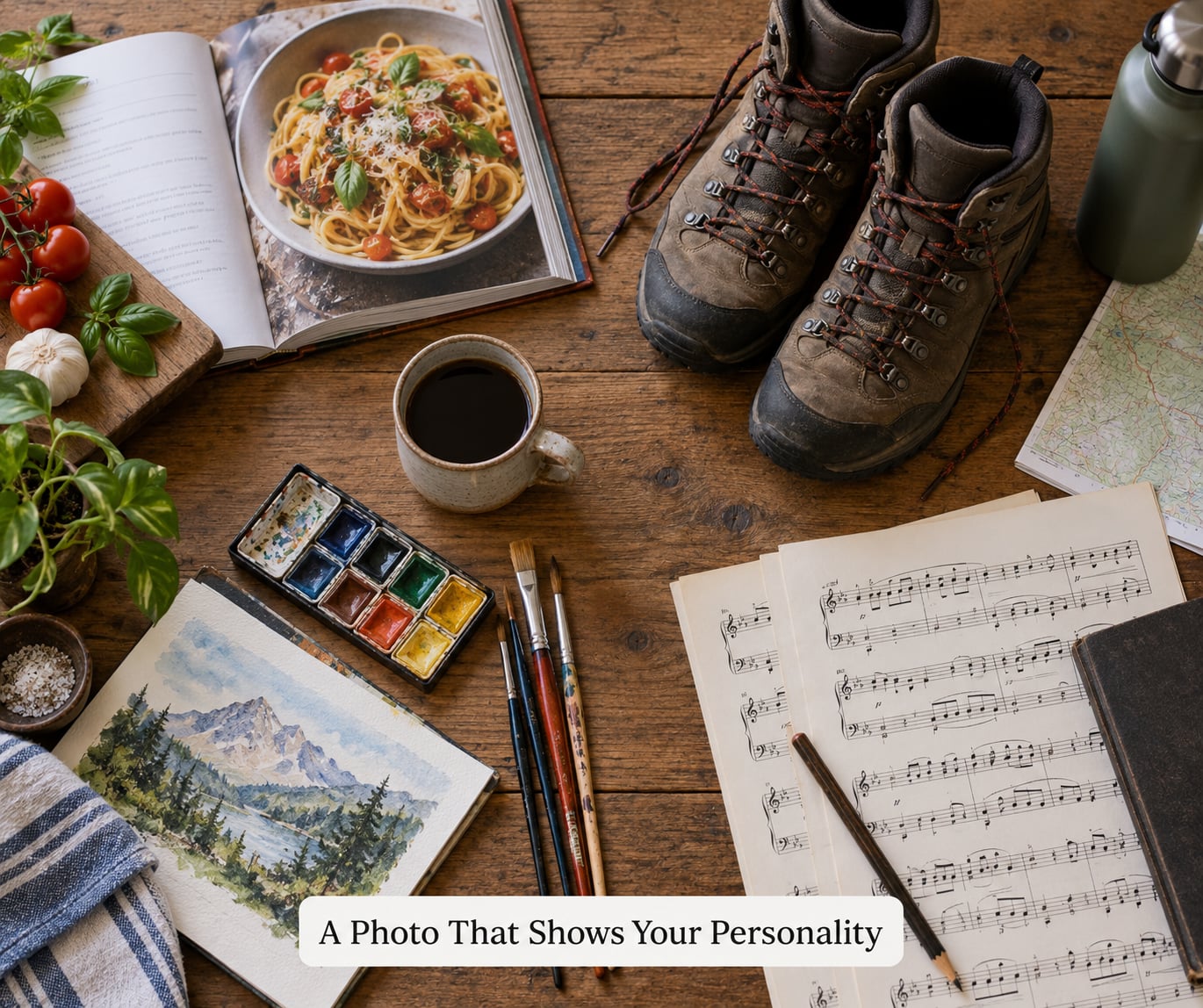
One caution: an activity should be legible at thumbnail size. If the frame is so busy that someone cannot tell what you are doing in a second, it stops being a conversation starter and becomes clutter.
6. A Clean Background Without Location Hints
A plain background keeps attention where you want it, on your face and your expression, and it also reduces the chance of revealing something you would rather not share. A painted wall, a tidy living room, or a blurred outdoor background all work.
Scan the frame for identifying details before you upload. House numbers, street signs, mail with your name on it, a school name on a uniform, a car plate, a gym or workplace logo with a visible location, and a framed diploma or certificate can each be traced with a few seconds of reverse image searching. Move two steps sideways and the problem usually disappears.
If you like a busy background, get closer to the subject so it blurs naturally behind you. The same shot from further away keeps every detail legible, which is the opposite of what you want.
7. A Photo With a Friend in the Background
A friend appearing small and out of focus suggests a social life and makes a profile feel less isolated, which is a real plus when someone is deciding whether they would enjoy meeting you. The trick is making it obvious at a glance that the profile belongs to you.
You should be in the foreground, in focus, taking up most of the frame, with the friend visibly secondary and not touching your face or shoulder. If the friend is the same size as you and standing beside you, most people assume you are half of a couple, and many simply pass.
Sometimes the solution is to add a line to your bio naming who is in the shot. Where an app allows captions, a short one naming your friend works better than any crop, because it removes the guesswork without hiding the social proof.
8. A Travel Photo With a Recognisable Place
Travel images communicate that you are comfortable with plans and that you have a life beyond your job, and a place the other person also recognises doubles as a conversation prompt. “I have been there too” is an effortless opener.
Pick a background that is recognisable but not a stunt. Standing in a spot where every passer-by can see you is where the excitement stops being worth it, and a photo full of bystanders, or one that includes strangers whose faces you did not ask for, is worth thinking twice about before it goes up.
Also keep an eye on what the background reveals. A hotel balcony, a workplace window, a colleague’s name on a conference lanyard, or a geotag that has not been stripped can all be more revealing than the photo is worth.
9. A Simple Black-and-White Portrait
Monochrome portraits can look polished and considered because the removal of colour takes attention off your clothes, your background, and your makeup, and puts it on shape and expression. They suit people who normally dress in loud colours or who work in busy environments where colour competes with the subject.
Keep it simple: plain background, one clear pose, natural light, and no filter bundle. A black-and-white conversion of a good colour photo works better than a heavy preset, which tends to crush shadows and turn skin grey.
It is not the right choice for everyone. If your personality shows through colour, or if a full-body travel shot loses its impact in monochrome, keep this as a later slot rather than leading with it. Test how it looks beside your other photos before you commit.
10. A Low-Effort Photo You Can Take Today
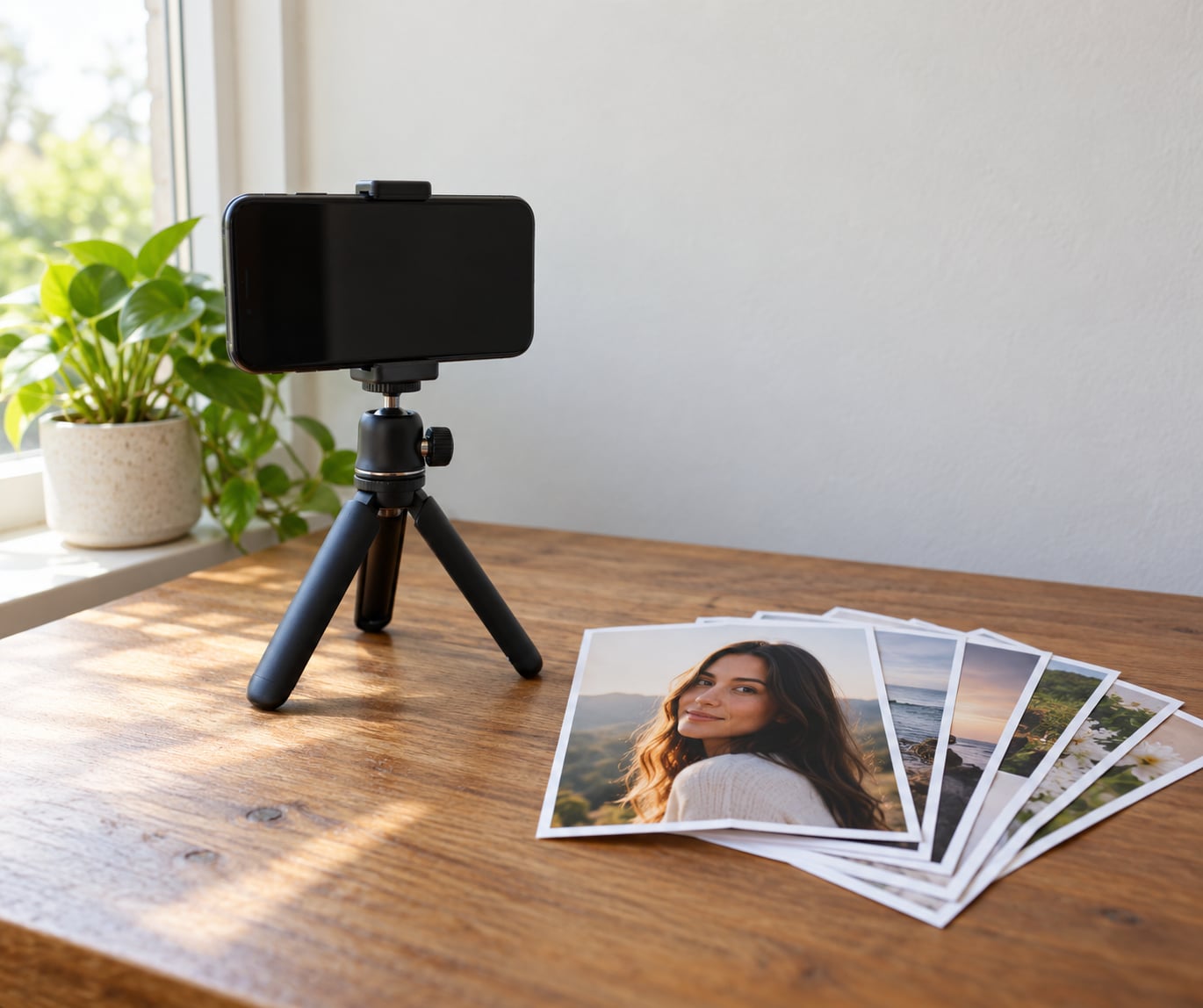
If you dislike being photographed, the workable answer is to stop treating it as a performance. Use a phone on a small tripod or a stack of books by a window, set a timer or use the ten-second remote on your earbuds or watch, and take a burst of frames while you stand at the mark of a piece of tape on the floor.
Then choose from the batch rather than reacting to the first one. Most people have a usable frame in twenty shots, and the gap between what they saw in the viewfinder and what actually looks fine is usually where self-criticism lives.
If a friend is available, ask them to shoot ten frames at a time in good light, near a window, while you talk rather than stand silent. Talking produces a natural expression, which is the whole point of this style anyway.
How to Put Your Best Photos in Profile Order
Order matters because most people decide before they look at everything. Slot one should be the photo that makes you recognisable and easy to read; slot two should add a different kind of information, usually a full-body or activity image; slot three onwards should build a small picture of your life rather than repeat the first photo from a different angle.
A workable order is a clear close-up in slot one, a relaxed full-body shot in slot two, then an activity photo, a photo with a friend or a pet, and a travel or black-and-white image at the end. Four to six photos is plenty; a small varied set beats a long gallery of near-identical portraits.
Leave out anything that needs an explanation you are not writing, including screenshots, images with other people’s faces cropped awkwardly, and photos where you cannot tell whether the person is you. Then show the set to one friend who is honest and ask them, without leading, who they think each person is. If they hesitate on slot one, you have found your problem in about a second.
Common Photo Mistakes to Avoid
Most weak profiles are not short of photos; they are carrying the wrong ones in the wrong order. Here are the mistakes that come up again and again, with the fix for each.
- Group photos as the lead image. Fix: move it to a later slot, stand clearly in front, and caption it if the app allows.
- Heavy filters and beauty smoothing. Fix: shoot clean and adjust brightness and warmth slightly instead.
- Bathroom or rear-view mirror selfies. Fix: replace with a clear close-up taken by someone else or on a timer.
- Photos that are several years old. Fix: anything from more than two or three years ago is worth re-taking, especially if the hairstyle or body shape has changed noticeably.
- Sunglasses, hats, or hands covering the face. Fix: keep at most one such photo in a later slot, never in slot one.
- Low-resolution or blurry images. Fix: check the photo at full size on your phone before uploading, and avoid digital zoom.
- Misleading crops. Fix: look at the crop inside the app, because most apps cut photos differently from your camera roll.
- Six near-identical selfies. Fix: keep one or two, and give the other slots to full-body, activity, and travel images.
Frequently Asked Questions
What is the best photo for a dating profile if I am a woman?
A clear, well-lit, recent head-and-shoulders photo where you are easy to recognise, with a natural expression and no heavy filtering. It should be recent enough that it looks like you now, and shot in light that falls on your face rather than from behind. Most people scroll past the first image quickly, so that one photo does most of the work of getting read.
How many photos should I put on a dating app profile?
Four to six works well, and more is rarely better. A small set gives you room to show a clear close-up, a full-body shot, and a couple of images that say something about your life. Six near-identical selfies add nothing, because a person who wants one picture of you does not need six. If you only have two good photos, two clear ones beat six weak ones.
Do dating apps prefer group photos or solo photos?
Solo photos, almost every time, especially in the first slot. A group image is fine later in the set, because it suggests a social life, but it has to be obvious that the profile belongs to you. In a group shot the people blur together and many people assume the profile is a couple, so they pass. If a friend appears, put yourself in front and keep them smaller and behind you.
Should I wear makeup in my dating profile photo?
Wear whatever you would normally wear out. The useful test is whether the photo looks like you on a good day, not like a different person. Heavy coverage, smoothing, and enlarged eyes read as edited on a phone screen and can create an unpleasant surprise later. Light makeup, or none, usually photographs more naturally in daylight than a full face under a bathroom mirror.
Is it better to smile or look serious in a dating profile photo?
A genuine half-smile is the safe middle ground, and a real smile often works even better. What tends to fall flat is a held, posed smile with no movement in the eyes. A serious expression is not a mistake if that is genuinely you, but if it is the only mood in your profile it can read as unapproachable. Try one smiling frame and one relaxed frame, and keep the one that looks most like your face.
How recent should my dating profile photos be?
Recent enough that someone would not be surprised to meet you. As a rough guide, anything more than two or three years old is worth replacing, especially if your hair, weight, or style has changed. People notice, and a mismatch between photos and reality is one of the most common reasons a good match turns into an awkward first meeting. If you are unsure, ask a friend to look at your oldest photo and tell you honestly.
Conclusion
Do one thing first: choose a single recent photo where your face is clearly visible, the light is soft, and your expression is the one you actually make around people. Put it in slot one, follow it with a full-body shot and one activity image, then clear out the filters, group photos, and pictures older than a few years.
Before you upload the full set, show it to one friend who will be straight with you and ask them which photo is you and what your profile is about. If they hesitate anywhere, that is the slot to fix before 2026 turns into another season of the same results.