Dating apps and gender options explained in one line: nearly every major app gives you two separate controls, the gender identity shown on your profile and the set of genders you want to be shown, and changing one usually does not change the other. That gap between the two is where most of the confusion lives, and it is also the setting that decides whether the right people ever see you.
Last updated: October 2026. We are not affiliated with any app named here, and menu labels change often, so treat exact button names as a starting point rather than gospel.
Table of Contents→
- Dating Apps and Gender Options Explained
- What Is the Difference Between Gender, Pronouns, and Sexual Orientation?
- Which Gender Options May You See on a Dating App?
- How Do You Set Gender and Pronoun Options in Your Profile?
- How Do Dating Apps Use Gender Settings for Matches?
- What If Your Identity or Gender Is Not Listed?
- Should You Choose a Gender Option Just to Get More Matches?
- Gender Options, Privacy, and Dating Safety
- Frequently Asked Questions
- Conclusion
Dating Apps and Gender Options Explained
Gender options on dating apps are the labels a platform offers for who you are and who you want to meet. Most apps now go past a man or woman choice, adding non-binary, transgender, genderfluid and custom-typed entries alongside a pronoun field. The catch is that no single list is standard, so the same words can sit in different menus with different effects on your match pool.
Think of the settings as three separate questions rather than one. What is my gender identity? Which pronouns should other people use for me? Whom do I want to see in my feed? Apps mix these together differently, which is why a straightforward setting change can quietly reshape who appears on your screen.
| Common label | What it may mean | Limitation to expect |
|---|---|---|
| Woman / Man | A binary identity, usually also used as a filter signal | Often the only options on older apps or in some countries |
| Non-binary | An identity that is not exclusively a man or a woman | Frequently treated as a filter bucket rather than a lived identity |
| Transgender | Someone whose gender identity differs from the sex assigned at birth | Sometimes bundled with orientation instead of kept separate |
| Genderqueer or genderfluid | Identity that bends past, or shifts between, binary labels | Missing from many fixed dropdowns |
| Two spirit, agender, intersex | Specific cultural, identity or biological descriptors | Rarely offered except on the most detailed apps |
| Custom text entry | Anything the app lets you type yourself | Not every app allows free text, and filters may not index it |
| Prefer not to say | A deliberate choice to keep the field empty | Some apps treat an empty field as matching nobody |
How dating apps and gender options explained terms appear across major apps
The labels above are the vocabulary. How an app actually implements them is where the differences show. Tinder has let users type a custom identity since a 2016 expansion that added a long list of options in partnership with GLAAD, and that free-text approach is still its distinguishing feature. Bumble and Hinge sit in the middle: a fixed set of choices plus a way to add a label the list missed.
OkCupid is the app review sites keep coming back to, because it has published the longest visible label list for both gender identity and sexual orientation, commonly cited at roughly 22 gender and 12 orientation choices. HER is reported by reviewers as carrying more than 20 sexuality options and more than 21 gender identity entries, plus pronouns and pride pins. Grindr, Feeld, Taimi and Lex sit closer to the identity-first end, where gender and sexuality are separate choices and community features matter more than match volume.
None of that is fixed. Lists get added, renamed and pulled, and rollout differs by country and by app version, so treat any count as a snapshot rather than a specification.
What Is the Difference Between Gender, Pronouns, and Sexual Orientation?
Gender identity is who you are. Pronouns are the words other people should use when they refer to you, and they do not have to match your identity label exactly. Sexual orientation is who you are attracted to. Dating preference is who you want to be introduced to, which is a choice rather than a description of yourself.
Apps often run these together in a single onboarding question, which is why a match filter can look like a statement about your identity when it is really a statement about your search. Setting an identity and choosing who appears in your feed are separate fields, and the second one never defines the first.
Sex assigned at birth comes up in some bios and forms. Disclosing it is optional and personal, and no app needs it to match you with anyone.
Which Gender Options May You See on a Dating App?
At the basic end, you get woman and man, which is what many older apps and some regional versions still offer. One step up, apps add non-binary alongside the binary choices. Further along come transgender, genderqueer, genderfluid, two spirit and agender entries, sometimes only inside an expanded More Genders or identity menu rather than in the main list.
The most flexible apps go past lists entirely and let you type your own words, or let you select more than one identity at once. That flexibility is genuinely useful, but it has a catch: a custom label may be displayed on your profile while remaining invisible to other people’s search filters.
Pick the option that reflects your identity rather than the one that produces the biggest match count. A setting that misrepresents you tends to attract people who matched the label, not you.
How Do You Set Gender and Pronoun Options in Your Profile?
The path is almost always the same shape, even when the words differ. Open the app and go to your profile or account settings. Look for a section covering identity, gender, pronouns or discovery, which is often nested under Edit profile rather than sitting at the top level. Review the choices offered in the version you have installed, add your pronouns, and save.
Then go back to your profile view and confirm the change actually rendered on your public card. Some apps apply identity changes immediately and hold pronoun changes until the profile is re-saved, and a few keep a separate Show me setting that resets when you edit anything else in the same session.
Exact menu paths differ between apps, between mobile and desktop, and between app versions, so if a label is not where this description puts it, search the settings for the word identity or pronouns rather than hunting for an old screenshot.
How Do Dating Apps Use Gender Settings for Matches?
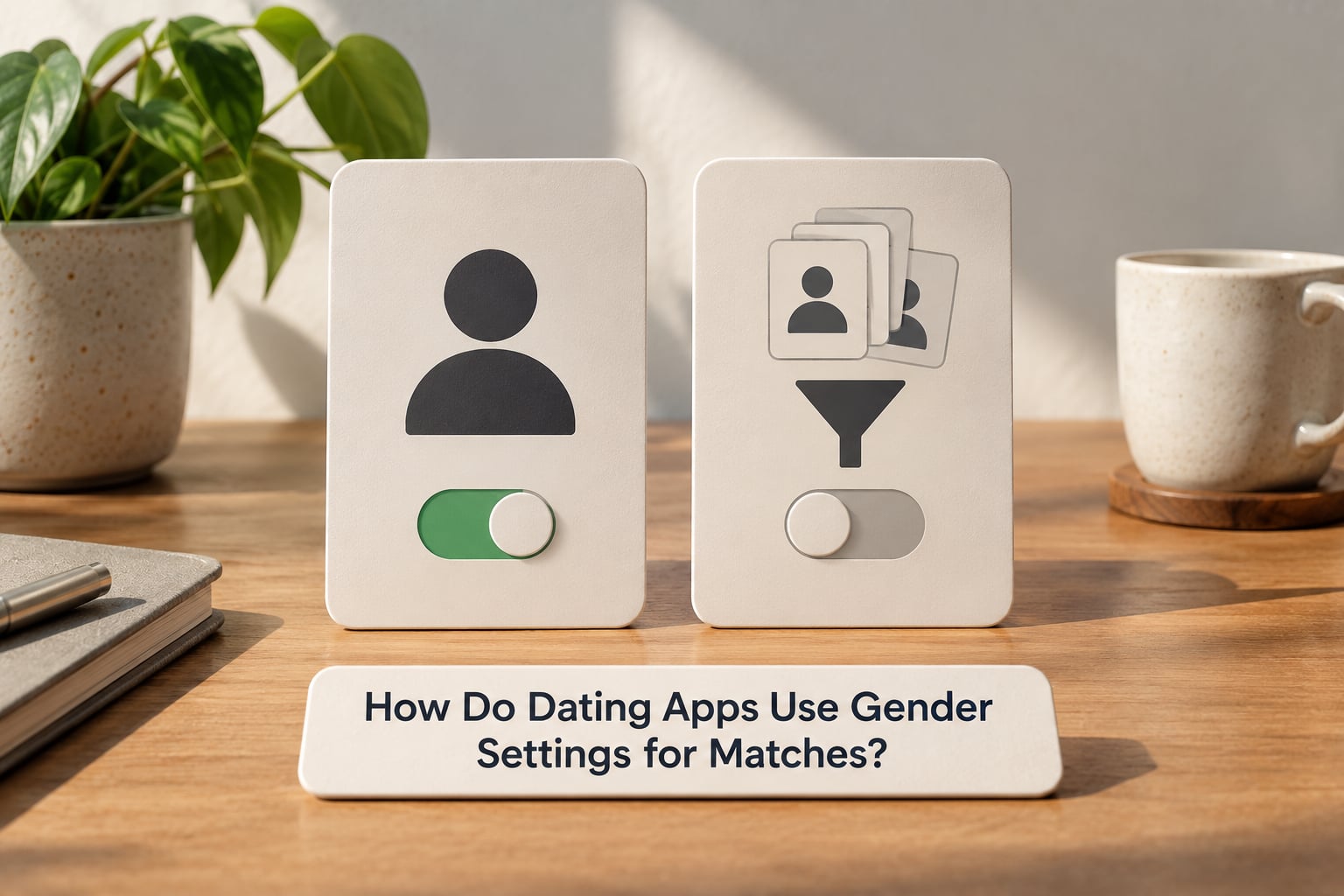
Here is the part most guides skip. The gender shown on your profile is one control; the gender filter applied to your discovery feed is a second control. They can disagree, and that is normal. Some apps even show a Show gender on profile toggle, which changes what others read without changing who you see at all.
A quick example. You list yourself as a man and set your discovery filter to show women. Change the display to non-binary and your feed does not move. Now change the discovery filter to show non-binary people and you leave the previous feed entirely. The app is following the filter, not your identity field.
| What you set | Likely effect |
|---|---|
| Display gender changed | How you appear on your card and in others’ inboxes |
| Show me filter changed | Which genders appear in your own feed |
| Both changed together | Both sides of the conversation shift at once |
| Field left empty or set to prefer not to say | Some apps index you under nothing and drop you from filtered searches |
What If Your Identity or Gender Is Not Listed?
You usually have more moves than the dropdown suggests. Type a custom entry if the app allows free text, or pick the nearest broader identity and make it precise in your bio. Pride flags, a photo, or a line in your prompt such as she and they, or trans, enby, bi do a lot of the work that a missing label cannot.
If a custom entry is impossible, contact the app’s support team and describe the gap. Support tickets are how labels get added, and a clear description of what you needed is useful to them.
A missing option is a limitation, not a verdict on your safety there. Judge the whole picture: whether pronouns are supported, whether profile controls let you manage visibility, whether moderation appeals work at all, and whether real users in that community keep using it. The last one is the honest test.
Should You Choose a Gender Option Just to Get More Matches?
It is tempting, and some people do it openly. In threads on r/FTMOver30, users have said they display non-binary on the app because it widens their matches even when it is not how they identify. That tells you something useful about how these filters behave, but it is a short-term trade.
More matches of the wrong kind mean more replies from people who matched a label, more first messages that misgender you, and more explaining. Accurate settings usually produce a smaller pool that is far easier to talk to. If a choice misrepresents you, the conversations it generates are not the ones you wanted.
Gender Options, Privacy, and Dating Safety
Listing a gender identity is disclosure, and disclosure has consequences. The most common one is a linked account: several apps, HER among them, require or strongly encourage signing up through Facebook or Instagram, which lets people who know you offline connect the profile to your name and photos before you have said a word.
Review what is visible and what is connected before you publish. Check whether your profile appears in search, whether location precision can be reduced, and whether any photo verification step ties your identity documents to the account. None of this means avoid the app; it means make the choice with your eyes open.
Unwanted messages follow identity settings more often than people expect, because a label is a targeting signal. Report harassment or clear threats through the app’s own reporting and blocking tools rather than replying, and take screenshots first, because in-app reports and external evidence are handled differently.
Frequently Asked Questions
Can I change my gender option after creating a dating profile?
Usually yes. Nearly every major app lets you edit your identity after signup, through a profile or account settings area covering identity, gender or pronouns. The one thing to watch is whether your discovery filter resets at the same time, which happens on some apps when you save an unrelated profile edit. Change the identity, save, then reopen the filter settings and confirm it still matches what you want.
Why do different dating apps use different gender labels?
Because there is no shared standard. Each app designs its own list based on its user base, its moderation history and the pressure it has faced to expand. One app may offer a fixed set of twenty-plus labels, another may let you type anything. Rollouts also differ by country and app version, so the same account can show different options to two people on the same day.
Can I choose both gender identities on a dating app?
Some apps allow multiple identity selections, others allow one with a separate custom text entry, and some allow neither. Where multiple selection exists it usually covers identity display, not the discovery filter, so you may see both labels on your profile while only one gender reaches your feed. Check the identity field and the show-me filter separately, because they are stored apart.
Does listing a gender option limit who can message me?
It can. Your identity label sits in the search index other people filter against, so a narrow or missing label may remove you from certain inboxes even if your profile is public. That is also why some users change what they display in order to be found. The practical fix is to make sure your identity is actually saved on the public card, not only in your settings screen.
What should I do if my identity is not available on an app?
Type it yourself if the app permits custom text, otherwise pick the closest broader identity and name the exact one in your bio or prompt. A pronoun line and a pride flag cover most of the gap for anyone scanning quickly. If the app restricts both, send a support ticket describing what was missing, and decide whether staying is worth it based on moderation and privacy controls rather than that one field.
Conclusion
Gender labels on dating apps are design choices, not shared definitions, and the identity field and the discovery filter are two different settings that happen to sit near each other. That is the short version of dating apps and gender options explained here. Before you use an app again, check three things: the identity shown on your public card, the pronouns attached to it, and the gender filter driving your feed. Update all three, then see whether the conversations improve. That is usually where the fix was hiding.