
Dating with intention after a long single stretch is simpler than it sounds: decide what kind of relationship you want right now, say it early, pace your dating so it does not swallow your week, and judge people on consistency and character rather than on the first spark. The hard part is not the strategy. It is being honest with yourself about what you lost, what you built, and what you are actually willing to share.
Most advice for long-term singles falls into one of two camps. Some say take a break, heal, and the right person will appear. Others say get out there immediately and stop overthinking. Both skip the middle, which is where most people actually live: a full calendar, a settled routine, a little rusty, and still open to something.
This guide takes about twenty minutes to read and gives you a seven-step process you can work through at your own speed.
Table of Contents→
- What You Need
- How to Date With Intention After a Long Single Stretch: Step by Step
- Step 1: Learn How to Date With Intention After a Long Single Stretch
- Step 2: Reflect on Your Long Single Period Without Turning It into a Penalty
- Step 3: Define What You Want From Dating Right Now
- Step 4: Rebuild Readiness Before Increasing Your Dating Activity
- Step 5: Choose Dating Channels That Match Your Actual Goal
- Step 6: Set a Pace That Protects Your Energy
- Step 7: Communicate Your Intentions and Notice Mutual Fit
- Common Mistakes
- Frequently Asked Questions
- Conclusion: Start With One Clear Dating Goal
What You Need
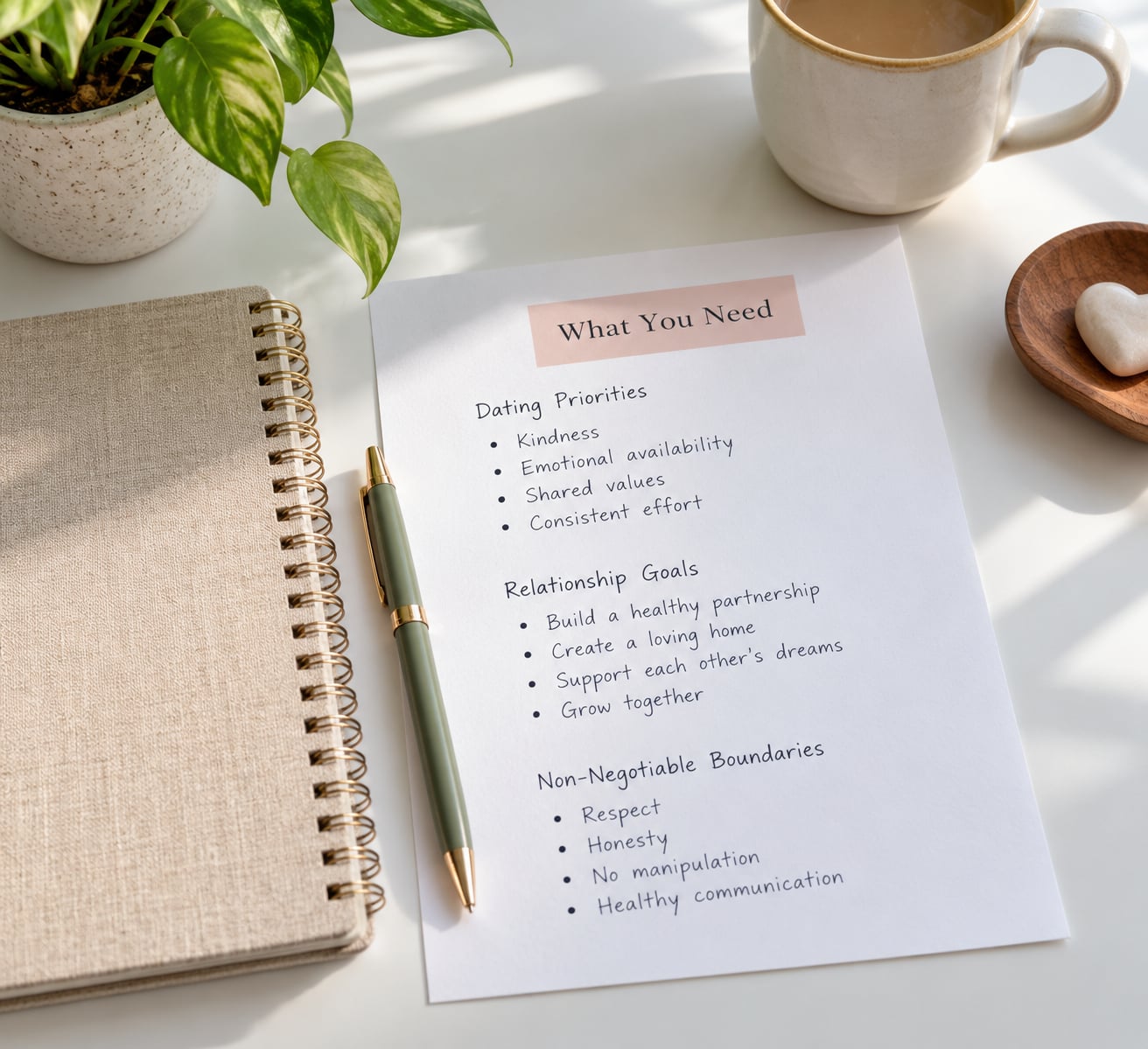
Before you touch an app or accept an invitation, five things help. Most people have at least three of them already, which is good news.
- An honest read on your single stretch. Not a cheerful retelling. Where did you go, who did you lean on, and what did you stop wanting?
- One current goal. Not a life plan. One sentence describing what you are dating for now: a long relationship, new friends, or genuine open-mindedness.
- Real availability. One or two evenings a week you could give to dating without it wrecking sleep, work, or friendships.
- Basic safety habits. A separate phone number people do not have, a friend who knows where you are on a first date, and a ride you arranged yourself.
- A short list of non-negotiables. Three or four things, not twenty.
Worth saying plainly: Pew Research Center has found that roughly one in three US adults has never been in a romantic relationship. A long single stretch is common, not a personal defect, and you do not owe anyone an explanation for it.
How to Date With Intention After a Long Single Stretch: Step by Step
Step 1: Learn How to Date With Intention After a Long Single Stretch
Dating with intention means you choose dates and relationships based on self-awareness, compatible goals, healthy communication, and genuine mutual interest, rather than on whichever person fills the loneliest evening of your week.
That definition sounds obvious until you watch the alternative. Dating from loneliness tends to look like this: saying yes to a second date you do not want, accepting plans you would never have suggested, treating attention as proof of attraction, and quietly rearranging your week around someone you barely know.
Intentional dating looks different. You decline the second date and feel fine about it. You ask what someone is looking for before investing an evening. You notice whether their actions match their words across several weeks.
How do you know you are ready to start? Three markers: you can hold a normal evening without dating on the agenda, you are not actively grieving, and you would be willing to tell someone your actual goal out loud. If you cannot do the third one yet, nothing bad happens. You keep working on the first two.
Step 2: Reflect on Your Long Single Period Without Turning It into a Penalty
Years of being single will change you, and the change is not automatically damage. You have built a life that works, a routine that suits you, and a sense of which relationships actually served you and which were decoration.
Here is a short exercise. Take twenty minutes and write down four things: what your single stretch taught you, what pattern from past relationships you now see clearly, what you want more of, and what you want less of. Then change each line from a lesson into a decision.
For example, “I learned that I over-gave” is a lesson. “I now notice within the first three weeks when I am doing too much, and I say something at week two instead of week six” is a decision you can actually act on.
A second useful distinction: single by choice or single by circumstance. People who wanted long stretches of solitude tend to value independence more sharply and need slower merging. People who lost a partner through death or divorce often carry an unfinished story, and rushing past that creates its own problems. Both can date well, but they need different pacing.
Step 3: Define What You Want From Dating Right Now
Write one sentence about what you want. “I am open to something serious and will take the time it takes” and “I want to meet people and see what happens” are both legitimate, but they lead to very different conversations.
Then sort your criteria into two columns. Must-haves are the handful of things that genuinely make a relationship viable, such as wanting a committed relationship or not wanting to be around smoking. Preferences are everything else, including things like a particular job or a certain city.
Here is why the second column matters more than people expect. After a decade alone, deal-breakers are often written from a place of fear rather than from knowing what you want, and a rigid list is a fast way to meet nobody. A flexible deal-breaker gets a specific date. A rigid one gets you a filter you forgot you set.
A useful test for each item: if you never meet this person again, would you still be glad you held out for it? If the answer is yes, it stays. If you are unsure, move it down the list for now.
Step 4: Rebuild Readiness Before Increasing Your Dating Activity
Feeling rusty and feeling ready are different things. Rusty means you have not practised. Ready means there is capacity in your week, emotional bandwidth on a Tuesday evening, and a willingness to be disappointed.
Run through this checklist and count your yeses. Four or more, start at a normal pace. Two or three, start small. Zero or one, and the honest move is to keep building your social life first, because dating is much harder from a depleted base.
- I have a calendar with regular plans that are not dating.
- I can sit through a three-hour dinner without needing it to go somewhere.
- I have someone who knows I am dating and will ask me how it went.
- I can handle someone not texting back without spiralling.
- I am not using dating to prove I am fine.
- I would be willing to introduce someone to my friends if it went well.
Before you start meeting people one to one, warm up socially. Go to the thing you already half enjoy, talk to strangers in the queue, host dinner for four. Re-entering the dating pool while rusty socially is like trying to serve a meal you never learned to cook.
Step 5: Choose Dating Channels That Match Your Actual Goal
Where you meet people should follow from the kind of relationship you want, not from whatever is easiest to download.
Dating apps are fast and wide, which suits people who want volume and specific filtering. They are poor at depth, and after years away the sheer volume of profiles can feel clinical. If you go this route, be honest in your profile about what you are looking for, and expect a lot of messages from people who did not read a word of it.
Friends and their networks suit people who want a relationship with a built-in layer of trust. The trade-off is context: mutual friends will tell you things, and you will have to see your date in a room with people they know.
Interest-based groups suit people who want something specific to talk about. A climbing gym, a choir, a football league, a community garden. Shared activity lowers the pressure of conversation, which is exactly what a rusty dater needs.
One more channel people forget: volunteering. Regular hours, the same small group, and a reason to keep showing up. It is slow and it works.
If you want a long relationship, spend most of your energy on the two slowest channels and use apps as a supplement. If you genuinely do not know what you want, apps are a reasonable place to browse without commitment.
Step 6: Set a Pace That Protects Your Energy
The most common way people burn out is treating dating like a second job. They answer every message quickly, book three dates in a week, and disappear into a swipe-match-meet-evaluate-reject loop that starts to resemble unpaid admin.
A workable pace for most long-term singles is one or two dates a week, one evening protected completely, and a simple rule: no new dating activity scheduled during a week when work or family is already heavy.
The same eight moments usually tell you which mode you are in. Dating with intention looks like this; dating from loneliness looks like that.
- Saying yes. Intentional: because the person genuinely interests you. Lonely: because the evening is empty.
- The second date. Intentional: based on how the first actually went. Lonely: taken by default.
- Attention. Intentional: enjoyed, not relied on. Lonely: treated as proof of worth.
- No reply for two days. Intentional: noticed once, not twice. Lonely: replayed constantly.
- A disagreement. Intentional: brought up early. Lonely: absorbed to keep things easy.
- Your schedule. Intentional: some of it kept. Lonely: fully overwritten.
- Rejection. Intentional: information, not a verdict. Lonely: proof you are unlovable.
- Your goal. Intentional: stated plainly, early. Lonely: hidden so nobody is disappointed.
Slowing down is not a failure state. Waiting four weeks to meet someone is better than spending four months on someone you never wanted. Plenty of people who date deliberately use a three-date minimum before deciding against someone, simply because early dates are not very accurate.
Step 7: Communicate Your Intentions and Notice Mutual Fit
The single most useful thing you can do after a long single stretch is say what you are looking for, out loud, before you are emotionally invested. It saves everyone time, including you.
It can sound like this. “I am dating with the intention of finding something committed, and I am taking things slowly, so nothing to read into this dinner.” Or, later: “What are you hoping this turns into?” Or, still later: “I like you and I want to keep seeing you. Are you looking for something serious?”
None of that is demanding. Demanding is an ultimatum attached to the question.
Then watch how the other person responds. Someone who is also dating intentionally will answer, sometimes awkwardly, and will not punish you for asking. Look for consistency between what they say, how they treat their ex, how much notice they give you, and whether their actions from six weeks ago match their words tonight.
Mutual fit is quiet and specific. Two people who both want something committed, who both move at a pace they can sustain, and who both find the other easy to talk to on an unremarkable Tuesday. That is worth more than chemistry you cannot explain to anyone.
Common Mistakes
Rushing into exclusivity. Excitement arrives before judgement does. A fix: set a personal rule that you do not discuss living together, shared finances, or labelling the relationship until you have seen someone behave consistently for at least six to eight weeks.
Becoming overavailable after long loneliness. The opposite of loneliness is not dependence, and filling every gap is its own kind of avoidance. A fix: keep two fixed weekly commitments that have nothing to do with dating, and do not move them.
Mistaking attention for compatibility. Fast replies and big effort feel like chemistry, and effort is not character. A fix: ask about something uncomfortable from their past and listen to the answer rather than to how charming they are.
Ignoring deal-breakers. Hoping a mismatch will soften on its own rarely works. A fix: name it plainly early, before either of you is invested, and accept that being turned down by a bad match is a lucky outcome.
Carrying assumptions from the past. The person who was unfaithful is not the person in front of you. A fix: write down the assumption, then write the most likely alternative explanation. Judge the person in front of you.
Treating it as a rigid checklist. If a wrong song, a cancelled plan, or a slow reply ends things, the list is doing the deciding for you. A fix: keep your non-negotiables short and let curiosity do the rest.
Reading bad moods as your own failure. A short reply is usually a short day. A fix: assume the ordinary explanation until you have real evidence otherwise.
A few final tips. Tell a friend the details so you are not the only record. Book something active for early dates, a walk or a class, so conversation is not the whole test. And decide in advance how many dates you will go on before you evaluate anyone, because choosing in advance is the only way to keep your judgement honest.
Frequently Asked Questions
Am I ready to start dating again after a long single stretch?
You are closer than you think. Readiness is less about the length of your single stretch and more about capacity: you have a life with plans in it, you can handle mild disappointment, and you are willing to say what you want. If a normal evening still feels empty without someone in it, take a few more months. If you can genuinely enjoy a solo Friday, you are probably ready now, even if you feel out of practice.
How long should I wait before dating again?
There is no correct number of months or years. After a long relationship, most people need enough time to have built a routine they actually chose, rather than one left behind. Signs you are moving too fast include still comparing every date to your ex, flinching at the idea of merging schedules, and dating mainly to prove something. Signs you are ready include a full calendar and genuine curiosity about strangers.
Does being intentional mean settling for less?
No, if you do it properly. Intentional dating is about being clear about what you want early, not about lowering the bar. A short list of real non-negotiables followed by genuine curiosity produces better matches than a twenty-point checklist, because the list stops excluding people for reasons you would not have admitted. You are choosing more deliberately, not accepting less.
How long should I talk to someone before meeting in person?
Enough to establish that both of you want the same thing, and no longer. A few weeks of regular conversation is usually plenty for anyone serious. Beyond that, endless texting often means one of you is hoping to avoid a no. If someone will not meet you within a month or so of regular chat, that itself is useful information about their pace and their confidence.
How do I communicate that I want a serious relationship?
Say it plainly and early, in your profile and then out loud. Something as simple as I am dating to find something committed, and I move slowly, sets the frame without pressure. Then ask the same question back, because a shared goal matters more than a stated one. If someone hears it, disagrees, and keeps dating you anyway, you have your answer quickly.
Conclusion: Start With One Clear Dating Goal
Do not try to overhaul your whole approach this month. Four things, in order.
Write down the relationship you are seeking in one sentence. Pick two lessons from your single stretch and turn each into a behaviour, not a feeling. Choose one way of meeting people that suits your goal rather than your convenience. Take one low-pressure step this week, such as joining the thing you already half enjoy or telling one person where your dating life stands.
That is the whole method. One goal, two behaviours, one channel, one small action. Repeat until being single stops being the story you tell about yourself and becomes a chapter that already closed.