
A deal breaker is something you will not accept in a partner no matter how much you like them. A preference is something you would like but can trade, adjust or grow into. Getting the deal breakers vs preferences in dating distinction right is the difference between filtering honestly and quietly building a list that leaves you nobody to meet.
Most people carry one undifferentiated list in their head and call all of it non-negotiable. That list then does two jobs badly. It filters out people who would have been good, and it fails to flag the ones who were never going to work.
The short version:
- Deal breaker: a boundary tied to safety, wellbeing or a value you cannot compromise on. Binary. Present means the relationship ends.
- Preference: a desirable you can live without, negotiate on, or decide later. Negotiable between two people who both want the relationship to work.
- Red flag: a warning about how someone treats people, observed in behavior rather than declared in a list. It predicts future, it does not label a category.
Coming back to dating after a long relationship, or after a long stretch of being single, often reshuffles what belongs in which bucket. That is normal. What is not useful is deciding the whole question from memory instead of from a short, written test.
Table of Contents→
- Deal Breakers vs Preferences in Dating at a Glance
- What Is a Deal Breaker?
- What Is a Preference?
- What Counts as Deal Breakers vs Preferences in Dating?
- Common Deal Breakers to Identify Early
- Common Preferences You May Be Able to Negotiate
- How to Test Whether a Boundary Is Truly Non-Negotiable
- How to Discuss Your Deal Breakers and Preferences
- When Flexibility Is Healthy and When It Is Not
- How Many Deal Breakers Should You Have?
- Which Should You Choose?
- Frequently Asked Questions
- Should I list my deal breakers on a dating profile?
- Can a deal breaker become a preference later?
- How many deal breakers are too many to have?
- What if my partner and I disagree about children or marriage?
- Is it okay to change my preferences after dating someone?
- How do I bring up deal breakers without sounding judgmental?
- Conclusion
Deal Breakers vs Preferences in Dating at a Glance
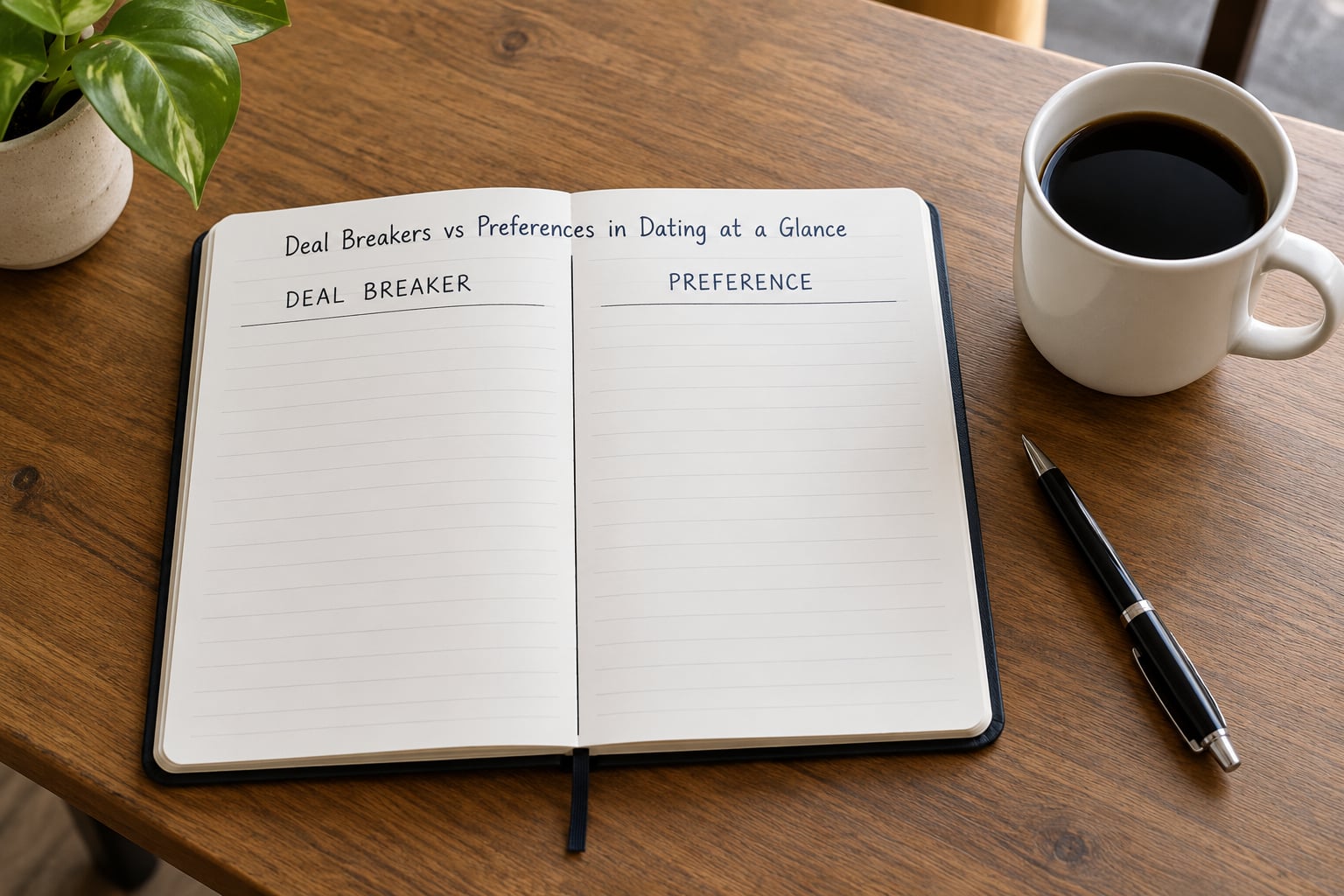
Here is the whole difference on one page. If you read nothing else, this table is the answer.
| Category | Deal breaker | Preference |
|---|---|---|
| Definition | A standard tied to your safety, your wellbeing or a value you hold. Crossing it would make the relationship unsafe, unhealthy or fundamentally wrong for you. | Something you find appealing or convenient. Wanting it makes your life easier, not your safety better. |
| Flexibility | None. If the trait is there and the boundary is real, the relationship ends before it starts. | High. Two people can each give a little and both end up satisfied. |
| Typical example | Wanting children when your partner does not, or any pattern of deception or control. | Preferring a partner who does not smoke, or who shares your taste in live music. |
| How to evaluate it | Ask whether the concern is about how you are treated, and whether you would hold it for the person you actually like. | Ask whether you could describe this person’s life to a friend and feel fine about it. |
| When to revisit | Only when new information shows a one-off was actually a pattern, or when your values genuinely change. | Regularly. Preferences get cheaper as you learn what actually matters to you day to day. |
| What to communicate | State it plainly as a boundary, with a reason, and accept the other person’s answer as final. | Share it as something you’d enjoy, not as a condition of interest. |
What Is a Deal Breaker?
A deal breaker is a line you draw before you fall in love, on purpose, because falling in love first makes the line impossible to hold.
The useful test is impact. If the trait present would make you feel unsafe, disrespected or steadily worse off, it belongs here. Examples include any pattern of lying, physical or verbal aggression, controlling behavior like monitoring your phone or isolating you from friends, substance misuse that continues after you raise it, a firm refusal of monogamy when you have asked for it, or a genuine conflict on having children, marriage or religion that neither of you is willing to bend.
Ignoring a real one does not just waste time. It usually produces the two situations people describe on r/datingoverthirty and r/datingoverforty threads: years spent on a relationship you were always going to leave, or settling because leaving felt worse.
Research on self-reported deal breakers points the same way. In one study, participants were asked whether they would still accept a date with a person who held three of their own stated deal breakers, and a large share said yes. When the same offer was made with the person actually waiting in the room rather than hypothetically, that share rose sharply.
Their explanation is that people overestimate how willing they are to reject, because they underestimate how much they will care about hurting the other person’s feelings. In other words, you already suspect your list is softer than it looks. Writing it down in two columns is a small correction.
What Is a Preference?
A preference is something you want, and would be a little disappointed to do without, but that would not damage the relationship if you never got it.
The test here is whether you can describe the gap honestly without it sounding like a loss. You might prefer a partner who keeps a tidy kitchen, reads fiction, lives within thirty minutes of you, or is not heavily into social media. None of those is a moral position. They are preferences, and they are worth having out loud because a partner who enjoys them is a nicer person to spend a Saturday with.
Preferences are also the currency of compromise. If you want a non-smoker and your partner wants someone who will not mind their cigar on the porch, you have traded, and everybody gained something. That trade is impossible when one side has packaged its preference as a non-negotiable.
One thing worth naming: a preference is not a small deal breaker. People often blur them because both start as a wish. The difference is what happens when it doesn’t come true. Missing a preference leaves an empty space. Missing a deal breaker leaves an exit.
What Counts as Deal Breakers vs Preferences in Dating?
Sorting deal breakers vs preferences in dating works best when you go category by category instead of arguing about one trait at a time.
Values, children and life plans
Wanting or not wanting children is usually a genuine deal breaker, and the reason is not that children are the point. It is that there is no halfway version. You either build a family or you build a life without one, and both people usually know which one they want before they meet.
Marriage, religion and how money is handled sit in the same bucket for many people. They are structural. You cannot split them down the middle later the way you can split chores.
Behavior, treatment and safety
This category is almost always deal breaker territory, and it is the one place where being strict costs nothing. Deception, cruelty, controlling behavior, aggression, contempt, an unwillingness to be accountable and substance misuse that turns on you when you raise it. These are about character, not taste.
Red flags, deal breakers and preferences together
People mix these three up constantly, and the mix-up turns a decision into a complaint. A red flag is something you observed. A deal breaker is a standard you hold. A preference is a wish. One bad date at a restaurant is a red flag; a repeated pattern of dismissing you in front of strangers is the evidence that turns it into a deal breaker.
Sorting them keeps you honest. Judging one cocktail, one text or one opinion is how people end up alone at fifty with a very specific list of grievances.
Lifestyle and daily compatibility
Smoking, drinking, hobbies, clothing, sleep schedules, pets, how much time you want alone, whether you want a big wedding or a small one. Most of this is preference. Some people have zero flexibility on substances, and that is their call.
Physical attraction and appearance
Height, weight, hair, build and who you picture when you picture your partner. This one needs honesty rather than a rule, because attraction is real and nobody has to apologize for it. Whether a specific physical trait is a deal breaker or a preference is entirely personal, and it is much less common than people assume.
Forum threads on this get tangled fast, often because a genuine personal boundary gets treated as a moral failing. It is not. What matters is whether you can hold the boundary without turning it into a general judgment about the people who do not meet it.
Beliefs, politics and family expectations
Usually preferences for most people, deal breakers for a few. If politics or faith is central to your identity, it may be a non-negotiable. If it is not, it is a preference about dinner conversation and weekend plans.
Family expectations are worth separating out, because you are often choosing a partner to a family you already have. Think about what you can actually negotiate with a parent-in-law you did not pick, and how much of that you are handing to your partner to handle.
Common Deal Breakers to Identify Early
These are the ones most people end up listing, and most of them earn their place.
- Disrespect. Dismissal, eye-rolling at your boundaries, or treating your opinions as a joke to be endured.
- Dishonesty. Lying about where you have been or who you have seen. One small lie about a rental apartment is a pattern, not a clerical slip.
- Any form of abuse. Physical, verbal, sexual, or emotional. Non-negotiable by default.
- Substance misuse. Especially the part where it becomes your problem to manage and your concerns become the complaint.
- Controlling behavior. Monitoring your phone, tracking your movements, dictating who you see, or manufacturing guilt.
- Unwillingness toward monogamy. If you want an exclusive relationship and they will not give you one, that is the end of it.
- Fundamental conflicts over children, religion or marriage. Real structural conflicts, not mild discomfort.
The line to watch is between a concern and a stigma. A deal breaker protects you. Stigma targets a category of people. You can require that someone never insult you and still date a smoker, an atheist, or someone a good deal shorter than you.
Common Preferences You May Be Able to Negotiate
These are where most people over-filter, because a preference feels as urgent in the moment as a deal breaker does.
- Location. City or neighborhood preferences usually bend when two people genuinely want to be together.
- Smoking. Many people hold a hard no here, and many others have a hard yes. Both are fine. What matters is that you know which one you are.
- Hobbies and interests. Wanting someone to share your thing is a preference. Not sharing it is normal and survivable.
- Clothing and grooming. You are going to be in public together. Preferences here are common and rarely worth ending anything over.
- Communication style. Some people text constantly and some need a few hours. Almost everyone has preferences here that are not deal breakers.
- Household routines. Cleaning schedules, quiet hours, how the bathroom is left. Trivially negotiable, endlessly arguable.
- Fitness. Attraction still counts, and attraction is not negotiable against your own feelings.
- Physical attraction generally. This is the most commonly mislabeled category of all. It belongs wherever your honest answer puts it.
Flexibility only works when it is mutual. Compromising on something you actually want, with someone indifferent to what you gave up, is not compromise. It is a slow withdrawal of interest, and it usually ends the same way.
How to Test Whether a Boundary Is Truly Non-Negotiable
You can sort almost any item with five questions, written down, in about ten minutes.
A five-question test for deal breakers vs preferences in dating
- Is this about how I am treated, or about who I am? Treatment concerns point toward deal breaker. Identity and taste point toward preference.
- Would I still feel this about the person I actually like? Many deal breakers dissolve the moment someone specific shows up. Check whether your standard is about them or about a stranger.
- What happens if this never changes? Picture five years of Tuesday evenings with this trait in place. Discomfort is normal. Dread is information.
- Am I willing to end the relationship over it, with the person in front of me? If you cannot imagine saying the sentence out loud, it is not a deal breaker.
- Am I reacting to fear or to fact? Fear of being single, fear of loneliness, or fear of repeating a mistake is a feeling. A pattern of behavior you have now seen more than once is a fact.
Three deal breakers is a working number for most people, not a rule. What the exercise gives you is a list short enough to remember and honest enough to act on.
How to Discuss Your Deal Breakers and Preferences
Say deal breakers plainly and early, and say preferences later and lightly. The language difference matters more than the timing.
Try describing yourself and your standard rather than issuing an instruction. “I want a partner who wants children, and that’s the one thing I can’t be flexible about” lands differently from “If you don’t want kids, don’t apply.” Both communicate the same boundary. Only one of them treats the other person as someone who has to be screened out rather than talked to.
Ask before you state. A question gets you information and leaves room for the answer to surprise you. A demand gets you compliance, which is not the same thing as agreement.
On dating profiles: put the handful of structural things in the profile if you want, but not the full inventory. The recurring argument in r/NoStupidQuestions threads is that a long public list reads as hostile and filters out decent people along with the rest. Most people end up somewhere in between, listing maybe children, distance and monogamy, and raising everything else in conversation.
One more thing worth doing: tell people you are dating before you get deep. Disclosing something early, calmly and without demanding a reaction, is much kinder than a disclosure that lands like an ambush in month seven.
When Flexibility Is Healthy and When It Is Not
Flexibility is healthy when both people are giving something and both people notice. It is what lets two strangers with different bedtimes and different tastes build a shared life.
It stops being healthy in a few recognizable shapes. One-sided compromise, where your side keeps shrinking and theirs never moves. Boundary testing, where a deal breaker gets softened once, then twice, because the first time did not produce the expected consequence. And bargaining, where an actual deal breaker gets traded like furniture because the alternative was being alone.
There is a fourth pattern that is harder to name: erosion. Nobody breaks a boundary. They just gradually arrange the relationship so the boundary never comes up. That is why it helps to state the important ones once, out loud, early, and then let ordinary flexibility handle everything else.
How Many Deal Breakers Should You Have?
There is no required number. Three is common. Zero is fine for some people in some seasons. A person who has just left a ten-year marriage often has a longer list than they did at twenty-five, and that is a reasonable response to new information rather than a character flaw.
What matters is the function of the list. A short list you will actually enforce does real work: it keeps you out of relationships that were never going to last. A long list that filters everyone becomes a screening process, and screening processes produce two bad outcomes. You turn down people who were good, and you end up accepting the first person who clears the bar, which is often the definition of settling.
If you have not gone on a date in a long time, the list may have grown from anxiety rather than experience. That is a signal to shrink it back to your real non-negotiables and go meet some people.
Which Should You Choose?
Choose the deal breaker when the issue affects safety, your wellbeing, a value you actually hold, or a structural goal like children, marriage or relocation that cannot be split in two. Choose the preference when the issue affects attraction, convenience or daily lifestyle, and when two people could each give a little and both be glad they did.
One practical frame. If finding out you were wrong would make you less safe or less well, it is a deal breaker. If finding out you were wrong would make your Tuesday evenings slightly less pleasant, it is a preference.
And if a category will not resolve on paper, treat it as a preference until behavior proves otherwise. Behavior is where the real information lives, and it takes a few months to see it clearly.
Frequently Asked Questions
Should I list my deal breakers on a dating profile?
List the structural ones only. Things like whether you want children, how far you will commute, or wanting an exclusive relationship are reasonable to state plainly. Leave the full inventory for conversation, because a long public list tends to filter out decent people along with the rest and reads as hostile to the people reading it. If a partner has to clear your whole inventory before you spend an hour together, the filter is doing more damage than it saves.
Can a deal breaker become a preference later?
Yes, but rarely on purpose. Most shifts happen when a real person shows up and turns out to be worth more than the rule you wrote. That is healthy, and it is not hypocrisy. A slower kind of shift happens after a divorce or a long single period, when experience has genuinely changed what you need. The shift to watch for is the one driven by fear, where a boundary gets softened because you are tired of being alone rather than because you changed your mind.
How many deal breakers are too many to have?
There is no number, but there is a test. If your list is long enough that almost nobody clears it, it has stopped being a set of boundaries and started being a screening process. The result is a smaller pool, more time spent saying no, and a higher chance of settling for whoever comes through first. Write down everything, then keep only what you would actually be willing to end a relationship over. That trimmed list is your real answer.
What if my partner and I disagree about children or marriage?
Treat it as a real conflict rather than a communication problem, because it usually is one. You get one conversation where each of you says plainly what you want and why, without arguing the other side. If you end up wanting genuinely different lives, that is an irreconcilable difference and it is kinder to find out in month two than in year three. Neither of you is wrong. You are simply building different relationships, and no amount of compromise fixes that.
Is it okay to change my preferences after dating someone?
Of course. Preferences are allowed to be wrong, and finding out what you actually want usually takes real people rather than theory. What matters is saying it out loud early instead of letting it quietly reshape your behavior. Nobody expects you to have a complete self-knowledge at thirty. They do expect you to be honest about what has changed instead of quietly hoping the other person will not notice.
How do I bring up deal breakers without sounding judgmental?
Describe the standard as yours rather than as a verdict on them. Saying that you need an exclusive relationship communicates a boundary; saying that anyone who dates around is not serious makes it a moral judgment and invites a fight. Ask a question before you make a statement, give the reason once, and then stop negotiating. The tone that works most often is calm and slightly curious, not firm and raised.
Conclusion
Deal breakers protect you. Preferences make a good life pleasant. The confusion between them costs you in both directions: too many deal breakers and you never meet anyone, too few and you stay in something you described as unacceptable before you started.
So do one thing tonight. Write down three things you would actually end a relationship over, and three things you would simply enjoy having. Then say them out loud to someone you are dating, using the calm version rather than the firm one.
That short, honest list is worth more than the longest one you have ever built.